
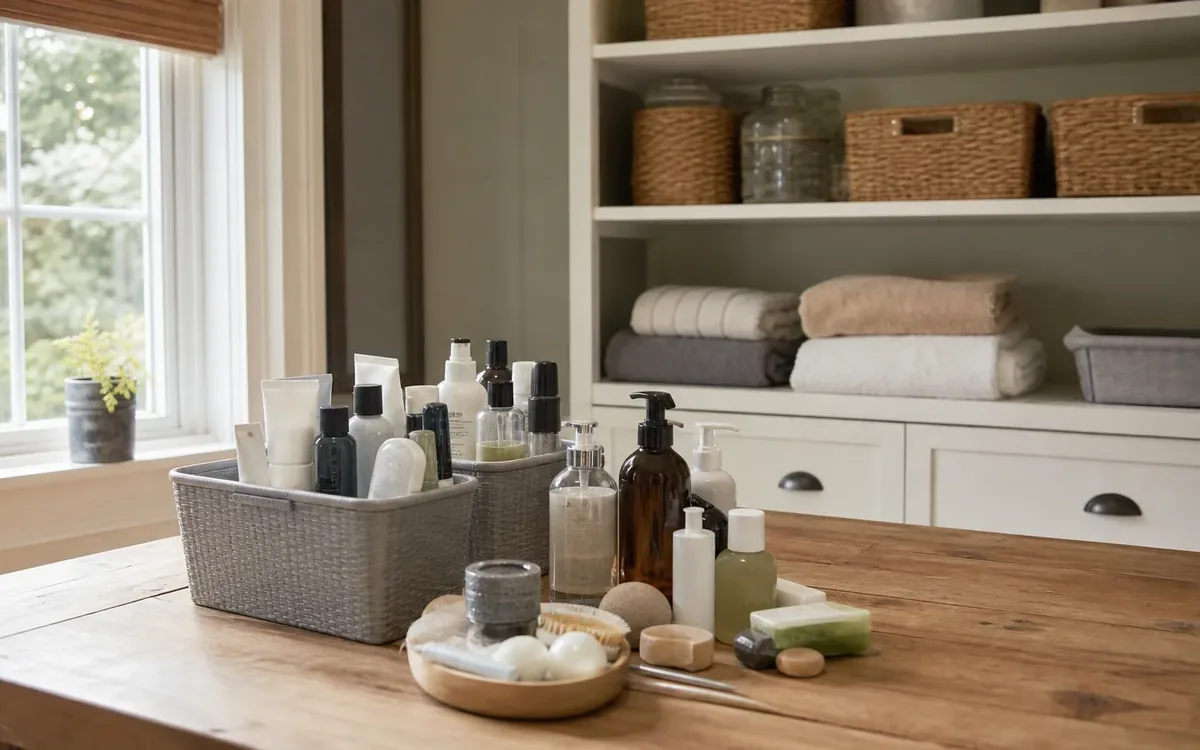
Downsize toiletries in small steps. Sort opened products, sealed duplicates, and daily key items. Keep only what your household can safely use and store. Build your supply around the routine you follow, not every product you might try. In South Carolina, a hot garage is a poor overflow choice. Check the label first. Some products need cool storage.
Quick answer: Keep daily products easy to reach. Put safe unopened backups in one set area. Remove products that are unsafe, unwanted, or wrong for your needs. Check labels before deciding what to keep, give away, or discard. Let the space on hand in your bathroom set the storage limit, then restock from a simple shopping list instead of buying duplicates by default.
What toiletries should you keep when downsizing?
Start with what you use rather than what you own. A crowded cabinet can make six products seem worth keeping. Yet only one may belong in your routine. Use room-by-room downsizing help to set the wider plan, and move management support to link the sort to your move date.
Identify key items by use: washing, dental care, shaving, hair care, skin care, menstrual care, and any other personal needs. Different household members may need different products. Downsizing should not remove needed support or force everyone to share something unsuitable.
Sort each type into these groups:
- Routine key items: Products now used and suitable for the person using them.
- Opened extras: Partly used products, unused trials, and similar options.
- Unopened backstock: Sealed replacements or duplicates waiting for use.
- Decision items: Products with unclear condition, owner, storage history, or use.
A practical limit is the amount that fits in safe storage without hiding current key items. There is no one-size-fits-all replacement count. A shared shampoo may be used each day. A styling product may be used less often. They should not have the same backup rules.
For help making those household decisions during a move, explore downsizing and organizing services. The useful goal is a routine you can use with ease.
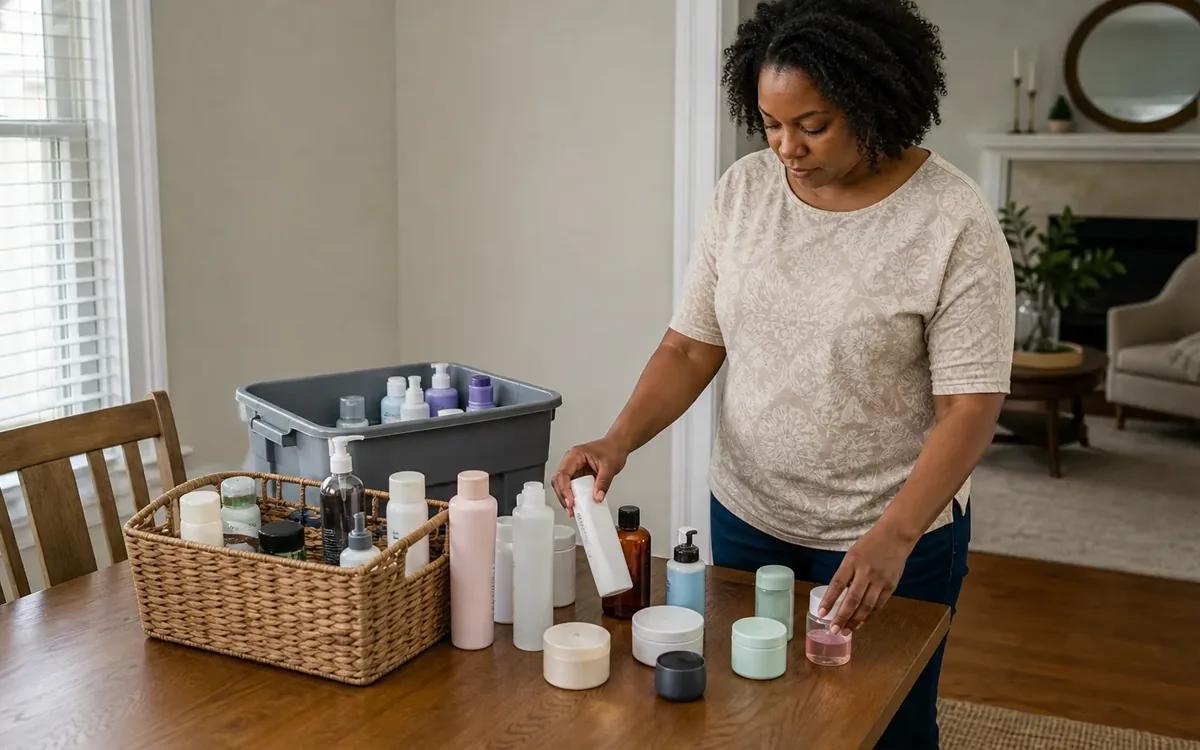
Sort opened products before touching the unopened supply
Opened products deserve the first review because they are easy to overlook while shopping. Gather them from shower ledges, bathroom drawers, travel bags, bedside tables, and other places where personal care items build up. Keep each person’s items easy to identify. For a bathroom that is also being prepared for sale, see bathroom decluttering before listing and home sale preparation support.
Do not assume an opened product is usable just because some remains. Look for maker instructions, expiration details where provided, and any symbol indicating use after opening. If the opening date is unknown, do not make one up to justify keeping it.
Look for leaks or a damaged container. Note a changed smell or texture. Watch for changes in how the product blends that its label does not describe. Appearance alone does not show safety. When directions are unclear, the maker or a healthcare professional can help resolve the question.
Choose one safe product you use for each task when possible. Keep an extra opened option only for a real reason. It might meet different hair needs or suit a travel routine. Another person may need their own product.
Do not combine partly used bottles to save space. Mixing what is inside can hide labels, expiration details, and ingredients. Keep products in the containers they came in when you can, in particular when directions or warnings matter.
Turn unopened duplicates into a realistic replacement queue
Unopened does not by default mean worth keeping. A sealed product can still be expired, poorly stored, unwanted, or unlikely to be used before its condition becomes unclear. Tie the backup queue to downsizing and organizing; for a relative’s home, use the estate cleanout guide to keep ownership decisions clear.
Group duplicates by use, then compare them with the active routine. A backup is useful when it replaces something you already use. It is less useful if you no longer use it. The same is true if you bought it only because it was on sale.
For each duplicate, ask:
- Does someone in this household in fact want this product?
- Is the packaging intact, with readable directions?
- Does the label indicate it is still appropriate to use?
- Has it been stored under suitable conditions?
- Can it fit in the set backstock area without crowding key items?
Arrange kept products so the ones that should be used first are easy to see. Think about expiration details, purchase history, and product condition. Do not rely only on where a bottle happens to sit.
If these supplies came from a relative’s home, keep the difference between household sorting and estate decisions. The guide What Is the Best Way to Clean Out an Estate? gives a wider plan for handling belongings. Authority to distribute estate property remains with the person in charge, not whoever is organizing the bathroom.
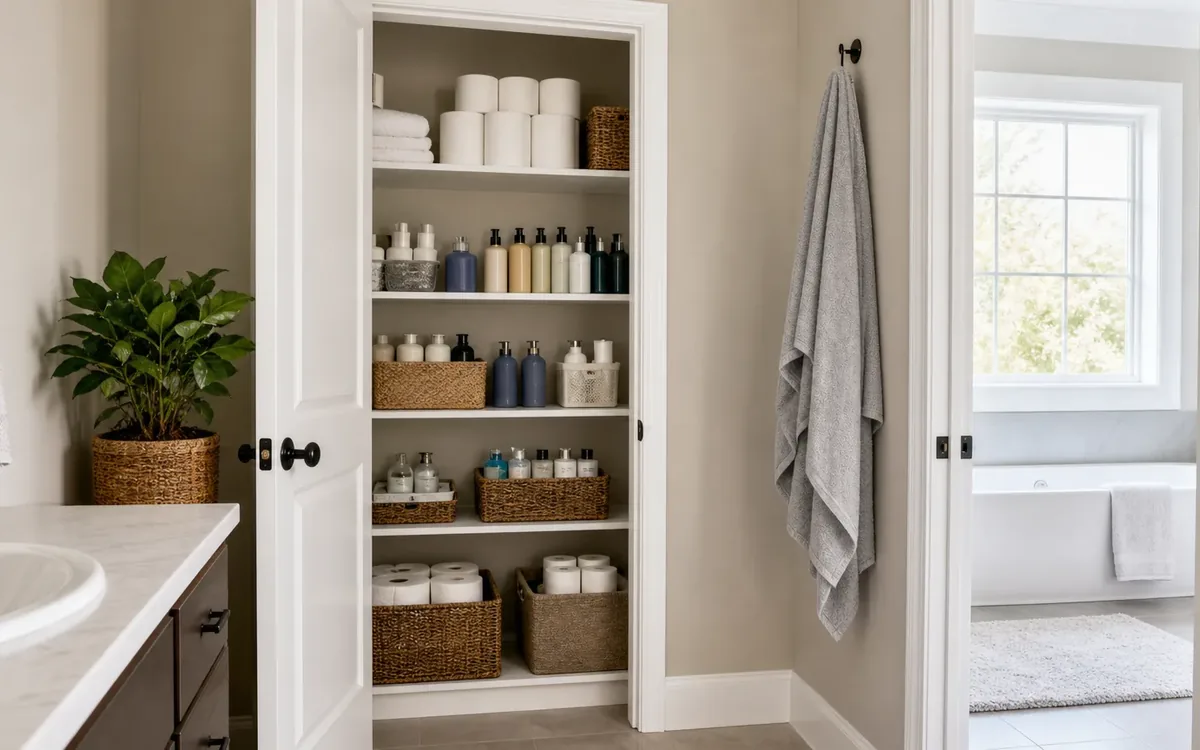
How much backstock will fit your next bathroom?
Measure the usable storage before deciding what to carry into a smaller home. Bathroom floor space does not tell you how much fits in a cabinet. Pipes can block a large part of the space under a sink. Build this space check into move management planning, and use the guide to storage bins and clutter before buying more tubs.
Think about shelves, drawer depth, door clearance, and whether containers can stand upright. Reserve easy locations for daily items. Backstock should not displace towels, accessibility supplies, or other essentials.
A workable layout might include:
- A reachable drawer or tray for current daily products.
- A shelf or bin for unopened replacements.
- A separate place for rarely used personal care items.
- A secure place for products that must stay away from children or pets.
Let the shelf space set the limit. If replacements spill into other closets, shopping habits or product choices may need a change.
Avoid buying organizers before finishing the sort. A divider can make useful supplies easier to see. It cannot make a large stock worth keeping. Check that any container is easy to clean and does not hide product labels or leaks.
Why is a hot South Carolina garage a poor backstock solution?
Moving bathroom overflow into a garage may create more space indoors while making storage conditions worse. In South Carolina, think about heat when choosing storage. Garages, sheds, and cars may get too hot. Check the product label before using these spaces. If garage overflow is part of a larger sort, downsizing support can help frame the room plan; the guide to starting when clutter feels too much breaks the task into smaller steps.
Follow the storage directions for each product. Heat, dampness, and direct sunlight can be at odds with those directions. Aerosols and certain other products have clear warnings that should guide where they are stored.
Do not assume a sealed tote protects its contents from unsuitable heat levels. A container keeps items together. It does not keep them cool.
If products have already been stored in a hot garage, separate them for review. Ask the maker about past storage conditions you are unsure about when needed. For medicated products, ask a pharmacist or healthcare professional. Ask them about storage that may affect treatment. Do not guess from how the product looks.
Indoor storage also deserves review. A damp cabinet, leaking pipe, or shelf beside a heat source may be unsuitable. Repairs and building-condition checks belong with the right contractor or inspection professional. Downsizing can reveal a problem, but it does not fix the cause.
Build a restocking system that prevents duplicate purchases
Once the keepers fit, make the system clear without a complex list. The key facts are what is open, what replacement is on hand, and what needs buying. The guide to choosing a first decluttering task can help you begin, while downsizing and organizing support puts the new routine in the wider home plan.
Use a small household list with three headings:
- In use: The active product for each routine need.
- Replacement on hand: A suitable unopened product already at home.
- Buy next: Something needed when there is no usable replacement.
Add an item to the shopping list only after checking the replacement area. When you open a backup, update its status so another household member does not assume it is still waiting.
Set special cases with care. You may need more spare stock of a product that is hard to replace. Keep less of something you can get easily. The household chooses the amount. Label rules and storage space still set the limits.
For shared bathrooms, choose who checks and updates the list. Separate personal products from shared supplies. This keeps someone else’s product out of the shared supply.
Review trial sizes and travel products within the same system. Keep them for a clear use, not as a separate stock free from storage limits. A travel pouch should match real travel needs, not hold every small bottle that enters the house.
Handle unwanted products without passing along a problem
Separate the decision to remove a product from the decision about where it goes. Donation, personal gifting, and disposal each have different rules. For an inherited home, connect this step with estate cleanout planning and the estate cleanout guide.
Before offering unopened items to a group, ask what it accepts. Packaging condition, product type, expiration details, and other limits may matter. Do not assume every shelter or local group accepts toiletries, and do not drop off unapproved items.
Opened personal care products are not by default suitable for sharing. Think about the risk of germs. Brushes and tips may not be safe to share. The person receiving it must be able to check the product. Avoid pushing someone to take something just because discarding it feels wasteful.
For disposal:
- Read the product label for useful directions.
- Check local waste-provider or collection-program guidance for unclear items.
- Keep aerosols and products with special warnings separate until their handling is clear.
- Do not pour unwanted contents down a drain merely to empty a container.
- Follow current recycling rules rather than assuming all bathroom packaging is recyclable.
Medicines require a separate review. If prescription items or other medicines appear during sorting, keep them apart from other toiletry donations and ask a pharmacist or approved collection program about handling. Disposal providers and local authorities decide how to handle them. An organizing team should not guess.
What can a downsizing or move team help you discuss?
Clutter Cleaner of South Carolina is based in Mount Pleasant and serves households across South Carolina, including the Charleston market. Its downsizing and organizing and move management services offer a setting for discussing how personal care supplies fit into a household move. Explore downsizing and organizing services and move management services when talking about the scope of a home move.
A talk may cover who owns each product and what they want to keep. It can also cover storage space. Decide how to tell daily supplies apart from backups. For a move, discuss keeping key personal items easy to identify and following product-specific handling directions.
The household remains responsible for choices and consent to release belongings. Product safety questions stay with makers or appropriate healthcare professionals. Estate authority and disputed ownership stay with the person in charge and legal adviser when needed.
Storage providers, donation groups, and disposal providers make their own acceptance rules. Contractor work is separate from organizing. The right professional or authority handles appraisals, home sales, inspections, and compliance. Sorting toiletries does not decide those matters.
Short FAQ
Keep the daily routine easy to use, with backups that fit safe storage. Add that routine to downsizing plans and move management notes so essential products stay close during the move.
Should I finish every opened product before buying anything else?
No. Use only products that remain suitable for you and meet their directions. Finishing an unwanted or doubtful product is not a needed part of downsizing.
Can I keep bulk purchases if they save shopping trips?
Yes, if the products suit your routine and fit safe storage. Ease should be weighed against crowding, label rules, and the risk of forgotten duplicates.
What if my household disagrees about backups?
Give each person a set space and agree on shared-supply rules. Keep real personal needs while making the storage limit easy to see.
What is the simplest way to keep the result?
Check the backstock area before shopping and update the list when opening a replacement. That small habit connects buying to what your household uses.



