
Choose your first decluttering task by comparing small, clearly bounded jobs for daily usefulness and decision difficulty. Favor a spot you use often, can reach safely, and have authority to organize. A crowded breakfast surface or one everyday drawer may be a better starting point than family photographs, shared paperwork, or an entire spare room.
For South Carolina households staying in their current home, the aim is to make living there easier. You do not need a moving date or a plan to reduce everything you own. Start with a specific inconvenience you can resolve without opening several other projects.
Quick answer
Choose a contained task that offers a noticeable daily benefit and involves relatively straightforward decisions.
- Name the function you want back, such as a place to prepare lunch.
- Compare a few bounded candidates, such as one shelf, drawer, or section of a surface.
- Favor the candidate with clear ownership, accessible contents, and few outside dependencies.
- Define what finished means before moving anything.
If the job requires family agreement, heavy lifting, specialist advice, or somewhere else to put everything, narrow it or choose another starting point.

What would make daily life easier in your home?
Look for a repeated inconvenience rather than the largest pile. Where do you regularly move objects before using the space? What useful item is difficult to reach? Which surface has gradually lost its purpose?
A first task should answer a concrete need. “Organize the kitchen” leaves too many choices open. “Make the breakfast end of the kitchen table usable” identifies both a boundary and a benefit.
Possible starting jobs include:
- Making one drawer useful for the utensils you regularly reach for.
- Restoring the chair you prefer for reading.
- Arranging one accessible shelf for everyday towels.
- Giving keys and a bag a defined place near the entrance.
Choose a benefit that matters to the people who live there. A cleared display shelf may look satisfying but do little for a household struggling to find cooking tools.
For help discussing these household goals, explore Clutter Cleaner of South Carolina’s downsizing and organizing service. Explain that you are staying in your home and describe the function you want to restore, so any proposed scope reflects that goal.
Compare daily benefit with decision difficulty
Think of each candidate in terms of two questions: How much would finishing this improve an ordinary day? How complicated are the decisions inside this boundary?
Decision difficulty includes more than sentimental attachment. A task may involve uncertain ownership, unfamiliar paperwork, several household members, or objects whose purpose you cannot identify.
Consider this hypothetical comparison:
| Candidate task | Daily benefit | Decision difficulty | Starting choice |
|---|---|---|---|
| One drawer of everyday kitchen tools you own | Easier meal preparation | Lower if uses and storage places are clear | Strong candidate |
| A box of inherited letters | Little change to daily access | Higher because of family meaning and ownership questions | Reserve for a separate project |
| A whole spare room | Potentially useful space | Higher because contents and destinations vary | Choose a smaller boundary |
| One shelf of frequently used towels | Easier access after bathing | Lower when household preferences are agreed | Strong candidate |
These are examples, not fixed rankings. Your kitchen drawer could contain someone else’s collection. Your towel shelf could be too high to reach safely. The strongest candidate depends on what is actually there.
If two jobs offer similar benefits, favor the one with clearer decisions. If both are complicated, reduce the boundary until the useful result becomes manageable.

Which tasks should wait for agreement or specialist advice?
Some small spaces contain decisions that make them poor starting choices. A folder of property documents fits in a drawer, but its size says little about the care it needs.
Pause a candidate when its contents include:
- Belongings whose owner has not agreed to changes.
- Records with uncertain retention requirements.
- Objects that may require an appraisal before a sale decision.
- Materials requiring special handling or disposal guidance.
- Items too heavy, unstable, or difficult to reach safely.
A household can choose a different task while these questions are resolved. Label the issue specifically, such as “ask owner about these supplies,” instead of making the entire room off limits indefinitely.
Inherited belongings deserve their own scope when authority or estate responsibilities are involved. The existing guide How do estate cleanouts work? is relevant when your project involves an estate rather than ordinary household organizing.
For your first current-home task, prefer a space where ownership and permission are already clear. That lets you focus on restoring its use.
Turn a promising area into one contained job
Once you choose an area, write a boundary that someone else could recognize. “The pantry” is broad. “The shelf holding our everyday breakfast supplies” is much clearer.
Give the job a finish condition based on use. For example: “The breakfast supplies are visible and reachable, and nothing from this shelf is left on the counter.”
A useful task statement names:
- The boundary: One drawer, shelf, chair, or defined surface section.
- The purpose: What the household needs to do there.
- The exclusions: Nearby cupboards, other people’s belongings, or unrelated collections.
- The finish condition: How you will know the space works again.
Avoid a finish condition that requires another unfinished project. “Clear this chair after reorganizing the garage” hides a much larger job inside a small one.
If choosing among tasks is itself difficult, How do you start decluttering when you feel overwhelmed? addresses that separate starting barrier. Here, the decision is narrower: which contained job offers the best useful result with the fewest complications?
Check whether the job can finish where it starts
A candidate may look simple until you consider where its contents would go. Clearing a table by covering the sofa removes one inconvenience and creates another.
Before selecting the job, check whether items that belong elsewhere have accessible destinations. You do not need to settle every future disposal or storage choice. You do need a way to keep the household’s essential spaces usable.
Ask:
- Can belongings return to an existing place without reorganizing that place?
- Is there a contained spot for an unresolved item that will not block daily use?
- Can the chosen area remain usable if one decision stays open?
- Would finishing require buying containers or arranging another provider?
A task with obvious destinations is usually easier to contain than one that depends on new storage. Buying a cabinet or renting storage is a separate household choice, not a requirement for starting.
For methods that keep the work within its boundary, read How do you declutter without making a bigger mess?. Use that guidance after choosing the task, rather than expanding your first job into a whole-room reset.
Adjust the choice to the people doing the work
The best candidate must fit the household’s access, energy, and ability to make decisions. A low drawer may be difficult for someone who cannot bend comfortably. A reachable table section may offer a better first result.
Shared use matters too. If several people use the same entrance surface, agree on what it must hold before changing it. Otherwise, a visually clear surface may fail because someone’s everyday needs were overlooked.
A practical cleanout or move team may discuss the boundary, access, lifting needs, household permissions, and what completion should look like. Ask what work is included in the proposed arrangement and which decisions need your approval.
Useful details to provide include:
- The exact area you want help with.
- The daily function you want to restore.
- Items or spaces that must remain untouched.
- Who can approve changes to shared belongings.
- Any access or handling concern you already know about.
These details support a focused discussion. They do not commit you to a whole-home cleanout, move, or sale.
Keep household choices and professional decisions separate
Household members can set priorities, agree on permitted changes, and choose how they want an everyday space to function. A practical team can discuss how to carry out an agreed task within its proposed scope.
Other decisions remain with the responsible person or provider:
- Legal authority and records: The authorized decision-maker and appropriate legal professional resolve ownership, estate authority, and legal retention questions.
- Appraisals: An appropriate appraiser assesses value when that information is needed.
- Real estate: A real-estate professional advises on sale strategy and property marketing if a sale becomes relevant.
- Inspection and compliance: Inspectors, qualified contractors, and the responsible authority address conditions, repairs, and compliance decisions.
- Storage and disposal: The household chooses separate providers or destinations and confirms applicable acceptance and handling requirements.
Organizing a shelf does not establish whether a repair meets code. Moving paperwork does not settle who has authority over it.
If a candidate depends on one of these decisions, choose a different starting job or limit the task to an agreed action that preserves the unresolved items.
What if the first task turns out to be harder than expected?
New information can change a sensible choice. A drawer may contain another person’s documents. A shelf may reveal items needing specialist handling. Treat that discovery as a reason to revise the scope.
Stop expanding the job. Keep unresolved belongings secure and preserve their context where relevant. Then identify what can still be completed safely within the original boundary.
Sometimes the useful finish is smaller than planned. You might restore the front section of a shelf while leaving a clearly identified group untouched. If that partial result does not help daily use, choose another candidate.
Do not let one uncertain object change the task into a lengthy debate about every possession. How do you decide whether to keep something you might need? addresses that individual decision. Keep it separate from selecting the best starting job.
Short FAQ
Should I start with the messiest room?
Only if you can identify a contained task there with a useful finish. The room’s appearance does not tell you how difficult its decisions will be.
Do I have to discard things to complete my first task?
No. A useful result may come from arranging belongings you use and restoring access. Disposal is a separate decision, not the measure of success.
How do I choose between two equally useful tasks?
Favor the one with clearer ownership, easier access, and fewer dependencies. If neither has a realistic finish condition, make the boundary smaller.
Can I ask for organizing help while staying in my home?
Yes. Clutter Cleaner of South Carolina offers downsizing and organizing across South Carolina. Its physical business location is Mount Pleasant, SC, and Charleston is its primary market. Call (843) 972-7020 to discuss a contained task and ask about the proposed scope.
Photo credits
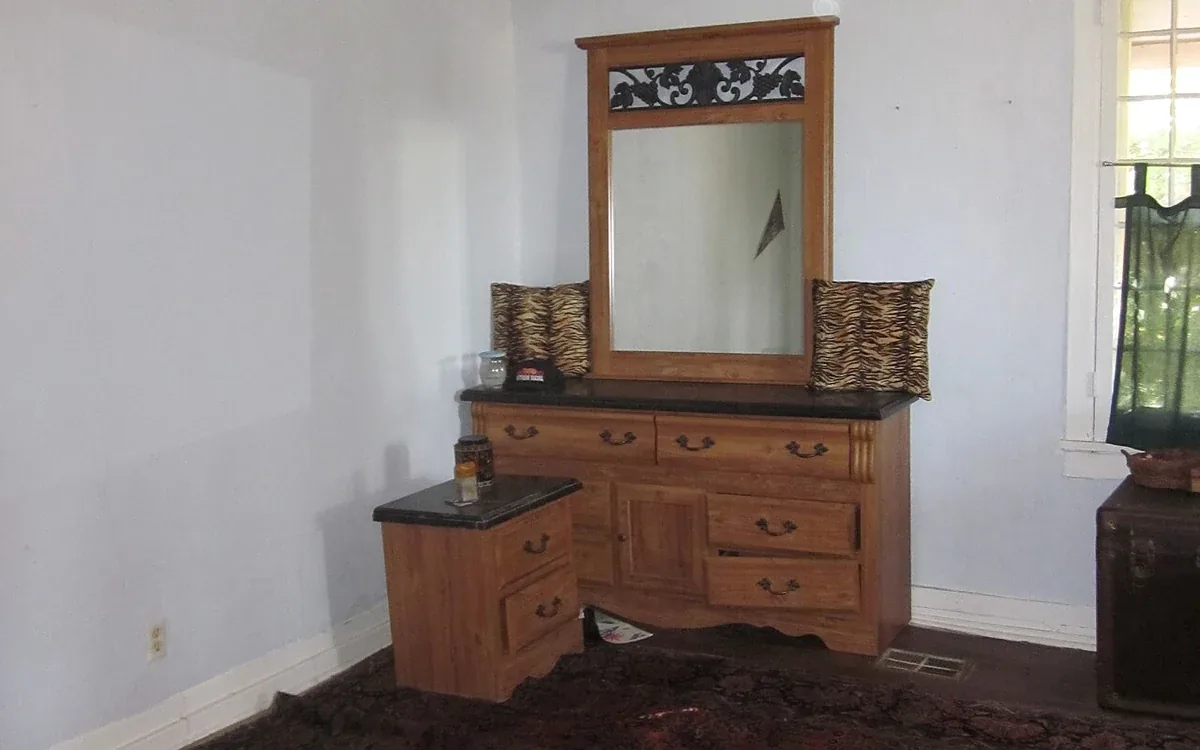
- Wooden dresser in a mostly empty room: Infrogmation of New Orleans. Original photograph, CC BY-SA 3.0. Cropped and resized.
- Keyboard and mouse on a clear desk: Michał Kubalczyk rev3n. Original photograph, CC0. Cropped and resized.
- Flower vase on a pale drawer unit: Julia Janeta juliajanetawilling. Original photograph, CC0. Cropped and resized.






