

The items not to bring to assisted living are those the community prohibits, the apartment cannot safely hold, or the resident is unlikely to use. That often includes oversized furniture, duplicate household goods, loose rugs, ladders, expired medications, hazardous products, and appliances that conflict with community rules. Before packing, compare every questionable item with the signed residency documents, the room measurements, and the resident’s daily needs.
Quick answer: Do not move an item until it passes three tests: the community permits it, it fits without blocking safe movement, and it supports the resident’s current life. Ask the assisted living community about restrictions in writing. Let the household choose sentimental priorities, while qualified professionals handle legal, medical, appraisal, inspection, and compliance decisions.
Why should the community’s rules come before packing?
Assisted living communities set their own policies for resident rooms, appliances, medications, mobility routes, wall attachments, pets, and other belongings. A neighboring community may follow different procedures, so a general online list cannot replace the rules for the selected residence.
Request the current resident handbook, move-in instructions, floor plan, and any prohibited-items list. If possible, clarify ambiguous language with the community’s designated staff member before arranging transportation.
Questions worth asking include:
- Are cooking appliances permitted in the room?
- Are candles, incense, space heaters, or heating pads restricted?
- May residents keep over-the-counter or prescription medicine in their rooms?
- Are extension cords or power strips allowed, and are particular types required?
- Can furniture be attached to a wall?
- Are rugs permitted when a resident uses a cane, walker, or wheelchair?
- Is there a limit on furniture size, quantity, or placement?
- What are the rules for firearms, ammunition, tools, chemicals, and alcohol?
- Does the community inspect belongings before or during move-in?
Community staff interpret and enforce their policies. Fire officials, building officials, health professionals, or other responsible authorities determine matters within their jurisdictions. A household or move team can flag a question, but should not declare that an item complies.
Families coordinating sorting, packing, and placement can review the scope of move management services. This practical support is separate from the community’s authority to approve belongings.

What furniture should stay out of the new room?
Large furniture is often the first category to reconsider. A piece may technically fit through the door yet make the room difficult to navigate. Measure the room itself, doorway widths, halls, elevators, alcoves, and the clear route around the bed and bathroom.
Furniture that may be unsuitable includes:
- Oversized sofas or sectionals
- Large dining tables and extra dining chairs
- Deep armoires or wide entertainment centers
- Unstable bookshelves
- Glass-topped tables with sharp edges
- Low tables that are difficult to see or walk around
- Rockers or recliners that obstruct a mobility path
- Extra dressers when built-in storage is available
- Furniture with damaged legs, loose joints, or protruding hardware
Do not assume that a familiar chair is automatically the right chair. Seat height, stability, controls, and ease of standing matter. An occupational therapist, physical therapist, medical professional, or community representative should address individual mobility and safety needs.
Create a scaled floor plan before assigning furniture to the move. Mark the bed, bathroom, closet, windows, doors, outlets, and any community-provided furnishings. Include the turning space needed for the resident’s mobility equipment rather than placing pieces edge to edge.
The household can choose which meaningful furnishings deserve priority. A practical cleanout or move team may discuss measurements, room layout, packing sequence, and disposition options. The team should not make clinical accessibility judgments or override the facility’s placement requirements.
Which appliances and household products are commonly restricted?
Rules differ, but appliances that generate heat or create an open flame deserve early review. Do not pack them based on assumptions from a previous home.
Items that may be prohibited or limited include:
- Toasters and toaster ovens
- Hot plates, portable burners, and electric skillets
- Coffee makers and electric kettles
- Space heaters
- Irons and clothes steamers
- Electric blankets and heating pads
- Candles, oil lamps, incense, and wax warmers
- Extension cords and noncompliant power strips
- Large refrigerators, freezers, or microwaves
- Power tools and soldering equipment
The same caution applies to household and garage products. Paint, fuel, propane cylinders, pesticides, solvents, strong cleaning chemicals, and compressed-gas containers should not enter the packing stream without explicit approval. Batteries also need appropriate handling, especially if damaged or associated with mobility or medical equipment.
A mover can identify and set aside questionable goods. The assisted living community, carrier, waste facility, fire authority, or another responsible party determines whether the item is accepted, transportable, or disposable. Never place hazardous materials in ordinary trash unless the appropriate disposal authority says that method is allowed.
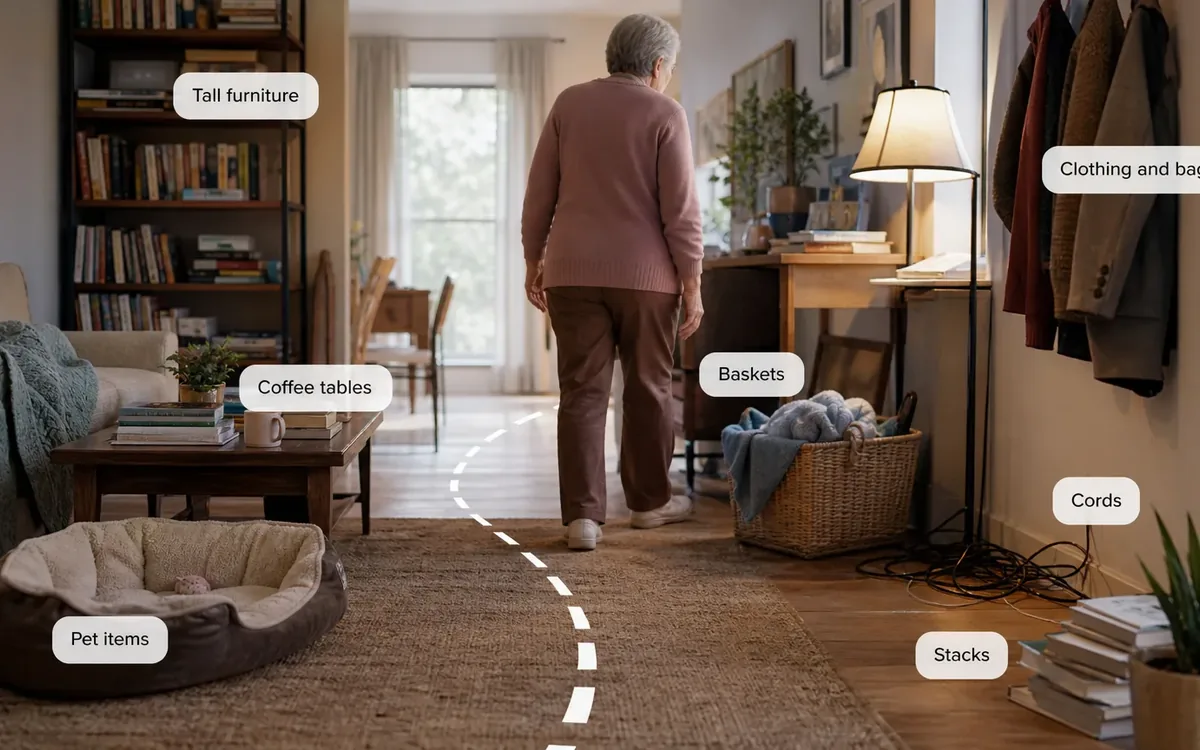
What creates unnecessary trip or access hazards?
A comfortable room can still be unsafe if objects narrow walkways or shift underfoot. Review belongings from the resident’s current eye level and movement pattern, particularly when mobility or vision has changed.
Common concerns include:
- Loose area rugs and runners
- Floor lamps with cords crossing a path
- Decorative baskets placed beside chairs or beds
- Freestanding magazine racks
- Stacks of books, papers, or unopened boxes
- Footstools and low storage cubes
- Furniture that blocks closet or bathroom access
- Over-the-door organizers that interfere with closure
- Heavy objects stored on high shelves
- Decorations with sharp, fragile, or projecting parts
This does not mean every rug or lamp must go. It means each item requires review against community rules, available floor space, and the resident’s needs. Tape, adhesive cord covers, furniture anchors, and wall fasteners may also require permission.
Keep mobility devices out of the decluttering pile, even if they look unused. The resident’s medical or rehabilitation professional should decide whether a cane, walker, wheelchair, transfer aid, or other device remains necessary. The community can explain storage and charging rules for approved equipment.
Which personal items should receive extra scrutiny?
Some belongings involve privacy, health, security, or legal responsibility. They should be separated before general sorting begins.
Medications and medical supplies
Do not pack expired medications, unidentified pills, or loose prescriptions with ordinary bathroom items. Ask the community how medicines must arrive and who may store or administer them. A pharmacist, prescribing clinician, or approved collection program should advise on medication disposal.
Check medical supplies for expiration dates, damaged packaging, and current relevance. Clinical professionals should decide whether supplies or equipment are still appropriate. A sorting team may organize items for review, but it should not make a medical determination.
Firearms and other weapons
Do not place firearms, ammunition, knives intended as weapons, or similar items into an ordinary moving carton. Ask the community about its policy and obtain appropriate legal guidance on possession, transfer, transportation, storage, or disposition. Those decisions belong to the owner, authorized representative, attorney, law enforcement agency, licensed dealer, or other responsible authority as applicable.
Documents and valuables
Avoid moving entire filing cabinets without examining their contents. Separate identification, financial papers, insurance records, estate documents, deeds, titles, tax materials, military records, and medical information. An attorney, accountant, fiduciary, or records professional can advise what must be retained.
Jewelry, cash, collectibles, and small valuables should not disappear into mixed boxes. Make an inventory and establish who is responsible for transport and receipt. If value affects a sale, division, donation, or insurance decision, consult a qualified appraiser or appropriate specialist.
Why should duplicates and bulk supplies remain behind?
An assisted living room generally serves a different purpose than a full household. Moving every towel, pan, vase, tool, and spare sheet can consume limited storage before the resident has settled in.
Review likely duplicates such as:
- Multiple dish sets and cookware collections
- Extra linens beyond available storage
- Bulk paper goods and cleaning products
- Duplicate lamps, clocks, radios, or televisions
- Seasonal decorations with no planned display space
- Hobby supplies that no longer match current activities
- Pantry goods the community cannot store or use
- Extra luggage and empty storage containers
- Large collections of books, magazines, or media
Start with the space, not the quantity owned. Determine the number of shelves, drawers, cabinets, and closets available. Then select the items that fit those locations without creating unstable stacks.
Bulk supplies can feel economical, but they may become clutter when meals, housekeeping, laundry, or maintenance are provided differently in the new setting. Ask what the community supplies and what residents are expected to furnish.
How can sentimental belongings be reduced without making the room impersonal?
Sentimental decisions should focus on representation rather than total volume. The goal is not to erase a household. It is to identify which objects best carry its stories into a smaller setting.
Use four questions for each collection:
- Which pieces does the resident recognize and enjoy most?
- Which items can be displayed or stored without crowding the room?
- Which pieces have financial, historical, or family significance requiring review?
- Who should receive, store, sell, donate, or document the remainder?
A rotating display may work better than moving an entire collection. Photographs can be consolidated into labeled albums if the resident prefers that format. Family members may choose particular heirlooms, but ownership and authority should be confirmed before anything is distributed.
Do not treat apparent resale value as established value. An auction professional or estate-sale provider may discuss marketability, while a qualified appraiser provides an appraisal when one is needed. Those are separate services and decisions. The household or legally authorized person decides whether to pursue a sale, donation, storage, or transfer.
When downsizing overlaps with settling a home or estate, the guide on what to get rid of first when downsizing explains how authority, sorting, and removal can be organized without mixing important property into disposal.
Build a “do not load yet” zone
A holding area prevents uncertain objects from entering the moving truck simply because someone packed them. Mark it clearly and keep it apart from confirmed move items, donations, sale candidates, and waste.
Place an item in this zone when it requires:
- Written approval from the community
- A measurement or layout check
- A medical or mobility decision
- Ownership confirmation
- Review by an attorney, fiduciary, or authorized representative
- An appraisal or specialist opinion
- Hazardous-material handling instructions
- A decision among family members
Use an inventory that records the item, the unresolved question, the person responsible for answering it, and the final destination. Photos can help decision-makers who are not present, but protect private documents and identifying information.
Only the authorized household decision-maker should release property. When authority is uncertain because of a power of attorney, guardianship, probate matter, trust, divorce, or ownership dispute, pause and seek guidance from the appropriate attorney, court, fiduciary, or other responsible authority.
Decide where excluded possessions will go
“Not going to assisted living” is not a complete disposition decision. Assign each excluded item to a specific next step rather than creating an indefinite pile at the former home.
Possible paths include:
- Keeping it with a family member, with ownership confirmed
- Renting storage under a household-selected agreement
- Requesting an appraisal before deciding
- Discussing sale potential with an auction or estate-sale provider
- Donating to an organization that confirms acceptance
- Using an appropriate recycling or disposal facility
- Hiring a qualified contractor for attached fixtures or repair work
- Retaining the item until legal authority is established
Storage is a household choice involving access, cost, insurance, climate needs, and responsibility for future review. Contractor work is separate from sorting and moving. Appraisal is separate from resale. Disposal requirements come from the receiving facility or relevant authority.
A practical cleanout or move team may discuss sorting categories, loading boundaries, room measurements, and handoffs to household-selected providers. It should not guarantee acceptance by a buyer, charity, storage facility, disposal site, contractor, or assisted living community.
South Carolina planning considerations
Clutter Cleaner of South Carolina is physically located in Mount Pleasant and serves households across South Carolina, with Charleston as its primary market. Regardless of location, the selected assisted living community’s written policies and the destination room’s actual dimensions should guide the packing plan.
Statewide moves can involve different municipalities, waste providers, building procedures, and receiving-community requirements. Confirm rules with the responsible organization rather than assuming that guidance from one South Carolina location applies in another.
The household controls personal preferences, authorized distributions, and choices among storage, sale, donation, or disposal. Community administrators interpret residence policies. Attorneys and courts address legal authority. Appraisers address value. Real-estate professionals advise on listing and marketing decisions. Inspectors, contractors, code officials, and other authorities address property condition and compliance within their roles.
Short FAQ
Can family members decide what furniture is safe?
They can choose preferred furniture and compare measurements, but individual mobility concerns may require input from a medical or rehabilitation professional. The assisted living community determines what its room and policy allow.
Should every family heirloom be moved first and sorted later?
Usually, no. Confirm ownership, significance, value concerns, and available space before transport. Move only selected pieces that have a planned location.
Can unwanted possessions remain in the former home?
They can remain only if the authorized household decision-maker accepts the consequences for security, property access, a pending sale, lease obligations, or compliance. Real-estate, legal, inspection, and code questions should go to the relevant professional or authority.
Who decides whether an item is trash, a donation, or saleable?
The owner or authorized representative makes the disposition decision. Receiving organizations decide what they accept. Appraisers and sale professionals may provide specialized input, but that input does not replace legal authority or household approval.
What should be reviewed on moving day?
Check that only approved and measured items are loaded, sensitive papers and valuables have a designated custodian, medication follows community instructions, and all unresolved belongings remain in the clearly marked holding zone.



