
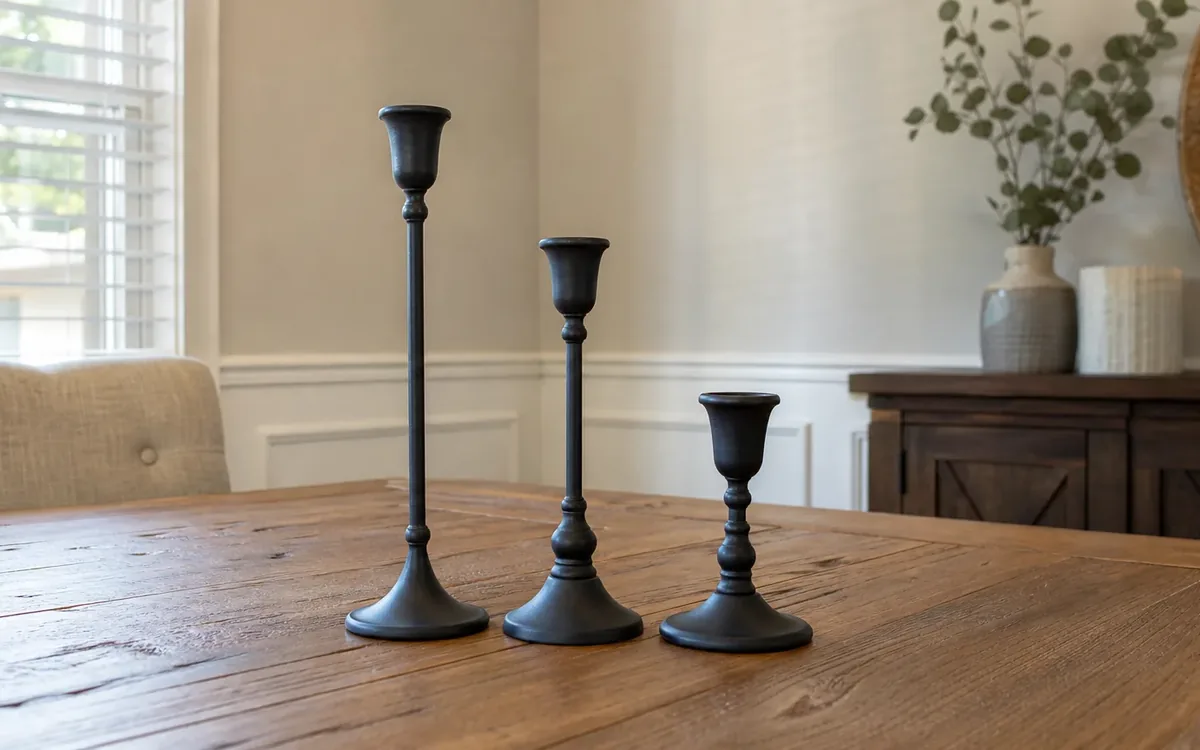
Sort candleholders before a household move by separating empty, unlit holders into clear groups. Start with candle fit, then check pairs, loose parts, and the space each group needs. Keep the pieces you can identify and place with purpose. Record uncertain items before choosing what will move with you.
The EPA’s home reuse and recycling tips explain ways to reduce household waste. Keep useful items that are in good shape. Before discarding items, check where they can be reused.
How should you start sorting candleholders?
Begin with one small group of empty, unlit candleholders and keep each holder beside its known accessories. The guide to keeping household accessories with their items explains that connection. Use downsizing and organizing support when the main decision is which complete groups belong in your next home.
Choose a clear surface where you can see bases, openings, and loose pieces. Leave unrelated decor out of this pass. A tray of mixed objects can hide the fact that one holder has a separate insert or that two bases form a pair.
Keep the first sort simple. You need enough detail to tell groups apart, without making a full inventory of every household item.
- Each holder stays beside any removable piece already known to belong to it.
- Each known pair stays together, even when the two holders have different heights.
- Each uncertain holder gets a brief note that states what you still need to identify.
- Each group gets a destination, such as a specific shelf or storage space in the next home.
Use plain names such as “two short glass holders” or “tall brass pair with inserts.” Avoid labels like “miscellaneous decor.” That label gives the next person little help.
If holders are spread across several rooms, finish one room before adding another. This keeps a missing piece from being confused with one that was simply left elsewhere. Bring only clearly related items into the same group.

How do you group holders by candle fit?
Group holders by the candle type they are known to accept, using existing labels or reliable product information. Planning a household move can include keeping these groups clear. Help with sorting household belongings is useful when similar holders have different uses or uncertain matches that still need a decision.
A narrow opening, shallow cup, and broad plate are useful visual clues. They do not prove that a particular candle belongs there. Record what you know, and keep an uncertain fit separate from a confirmed match.
Use familiar group names only when they are supported. “Known taper holders” is clearer than “probably tapers.” If a label or product record identifies the intended candle type, include that detail in the group note.
Do not make a match just because a loose candle happens to be nearby. It may have been placed in the same drawer for storage. Keep that distinction in your notes so the moving process does not turn a guess into an apparent fact.
For holders with more than one known setup, record the insert that goes with each setup. A base and its insert should remain linked even if you pack them in separate bundles.
The aim is a useful sort, not a test session. Keep the holders empty and unlit throughout this work. If you cannot establish the intended fit, describe the opening and mark the fit as unknown. You can still decide whether the holder earns space in the move without resolving every product detail.
Which pairs and sets should stay together?
Keep known pairs and sets together through sorting, labeling, and packing decisions. Organizing before downsizing helps you choose complete groups with a clear place to go. The household accessory matching guide also supports keeping the identity of a set clear when its parts must be packed separately.
Start with what makes the group a set. Matching finish, base shape, and details may support the connection. A household record or a known history of using them together can add context. Similar color alone is a weak reason to call two holders a pair.
Different heights do not rule out a set. Describe the group as it exists, such as “one tall and one short holder with matching bases.” That note is more useful than forcing both into a category based on height.
- A confirmed pair receives one shared label that also identifies both holders.
- A larger set records the number of holders and the loose pieces assigned to them.
- A partial set records what is present, without describing an absent piece as lost.
A partial set can still have a place in the next home. Decide based on the pieces you actually have. Avoid reserving space for a missing holder unless you have a clear reason to expect it will join the group.
If you keep only one member of a pair, make that choice explicit. Update the note before packing. Otherwise, someone may keep searching for the second holder or assume it belongs in another box.

What should you do with removable pieces?
Identify removable pieces before making final keep decisions, and record which holder each piece belongs to. Move management support can help keep those relationships clear during a transition. For a household being cleared, estate cleanout planning can help organize decisions about holders whose parts are scattered among other belongings.
Look for pieces already stored separately, such as a known insert, sleeve, or removable cup. Do not assume that every loose ring or small plate is part of a candleholder. Compare existing notes, labels, and clear matching features before assigning it.
Keep the sort focused on parts that are already separate or are known to be removable. A stuck or uncertain fitting calls for advice from the maker or a suitable specialist. This guide does not call for taking holders apart or repairing them.
Give a confirmed loose piece the same group name as its holder. If the holder is “white ceramic pair A,” use that exact name on the related piece. A vague note such as “small insert” can become useless once several groups are packed.
When a piece has no confirmed match, keep it in a clearly marked unresolved group. State what is uncertain. “May belong to the tall silver holder” preserves the question; “silver holder insert” hides it.
Review incomplete holders before assigning packing space. Some may still have a clear purpose as they are. Others may depend on a part you cannot identify. Choose based on the actual object, and leave questions about intended use with the responsible specialist.
How does packing footprint affect the choice?
Compare the space each complete group needs, including its base, height, and known loose pieces. Preparing for move management helps connect those details to the move plan. Downsizing household accessories helps when two similar groups serve the same purpose but take up different amounts of space.
A holder’s height tells only part of the story. A broad base may need more room than a taller narrow holder. A pair also needs space for both objects, even when you usually see only one on display.
Record simple dimensions when they help distinguish choices. Note the widest part of the base and the full height. Include any projecting details that affect how the object occupies space. These notes support a packing discussion; they are not packing specifications.
| Choice | Main reason to consider it | What to record |
|---|---|---|
| Keep a complete pair. | Both holders have a named place together. | Record both sizes and the shared destination. |
| Keep one holder. | One complete holder meets the planned use. | Identify which holder remains in the move. |
| Keep a smaller group. | Similar groups compete for limited space. | Record the chosen group and its loose parts. |
| Hold the decision. | Fit, parts, or destination remain unclear. | State the exact question to resolve. |
Do not assume that holders will nest simply because their shapes look compatible. Base your space estimate on the group you have, without forcing pieces together.
A named destination makes this comparison easier. “Upper cupboard, left shelf” gives you a real space to assess. “Somewhere in the new house” leaves the decision unfinished.
How do you choose what follows you to the next home?
Choose candleholders that have a clear purpose, a known identity, and a realistic place in the next home. Support with downsizing decisions can help narrow overlapping groups. If you are sorting a full household, estate cleanout support can help place these decisions within the wider transition without losing their details.
Start with the intended place. A shelf, cabinet, or storage area has limits you can discuss. Consider the full group, including accessories, rather than judging only the most visible holder.
Then compare repeated uses. Three confirmed pairs may all serve the same planned purpose. You do not need to rank them by a guessed value. Compare which pair is complete, which you prefer, and which fits its assigned space.
Keep personal meaning separate from product identity. A holder can matter to you even when its maker or intended candle fit is unknown. Record that uncertainty honestly, then decide whether its personal importance justifies the space it needs.
If a question of value affects the decision, take it to a qualified appraiser. Do not treat weight, finish, or an old appearance as proof of worth. Auctions and estate sales are known service options, but a sorting note cannot establish value or predict a sale result.
Give unresolved choices a specific question. “Keep if the matching cup is found” is actionable. “Decide later” is not. Before ending the session, check whether the question changes the move decision or simply adds background you would like to know.
What should the handoff note include?
A useful handoff note identifies the holders, confirms their groups, and states where each group is going. Coordinating the household move can build on that record. The guide to moving accessories with their items explains why the same names should follow related pieces through each stage of the transition.
Use this sequence once the main choices are settled:
- Name each retained group with a short description that distinguishes it from the others.
- Record the number of holders and identify any confirmed loose pieces that belong with them.
- State the intended destination and any fit or identity question that remains open.
- Give separately packed parts the same group name and note where they are recorded.
- Check the final record against the items selected to move before closing the sorting session.
The record can be a simple sheet. It does not need a complex numbering system. Use enough detail that another person can tell the tall dark pair from the short dark pair without asking you to reopen every decision.
For a household move in Charleston, SC, keep the destination note as specific as you would for a move elsewhere in the state. The business is physically based in Mount Pleasant, SC, and its service territory covers all South Carolina. Those facts do not replace the details of your own move.
If you request help, explain whether you need sorting decisions or coordination for the move. Bring the holder list, known part matches, and open questions into that discussion. This gives the service conversation a clear starting point.
What else should you know about sorting candleholders?
Most remaining questions concern uncertain matches, incomplete sets, and limited space in the next home. Help with household organizing can support those decisions. Move management planning can then use the settled groups and clear notes to keep each holder connected with its intended destination and known parts during the transition.
Should holders with different heights count as a pair?
Different heights can belong to one pair or set when their relationship is known. Keep that group together and describe both heights in the note. If the connection is uncertain, call them two similar holders rather than a confirmed pair. The label should reflect what you know, not what their appearance suggests.
What if I cannot identify the intended candle fit?
Mark the candle fit as unknown and describe the holder clearly. Use an existing label or reliable product information if available. Do not assign a candle type based only on a nearby candle or a rough visual match. You can still assess its complete footprint and intended destination while the fit question remains open.
Can I keep one holder from a matching set?
You can choose one holder when it meets your planned use and has its own complete parts. Update the set note so it names the selected holder and no longer implies that both will move. Check whether any shared accessory affects that choice. Keep the decision tied to the actual pieces you retain.
How should I record a loose piece with no clear match?
Describe the loose piece and mark its match as unresolved. Include any useful clue, such as where it was found, without presenting that clue as proof. Keep it separate from confirmed accessories in the record. If its identity changes a keep decision, seek reliable product information or advice from a suitable specialist.
Which holder should I choose when shelf space is limited?
Choose the complete holder or group that fits a named space and serves your planned purpose. Compare the full base width, height, and related pieces. Personal meaning can also guide the choice. Avoid treating compact size as the only measure; a small holder with no intended place can still leave the decision unresolved.



