
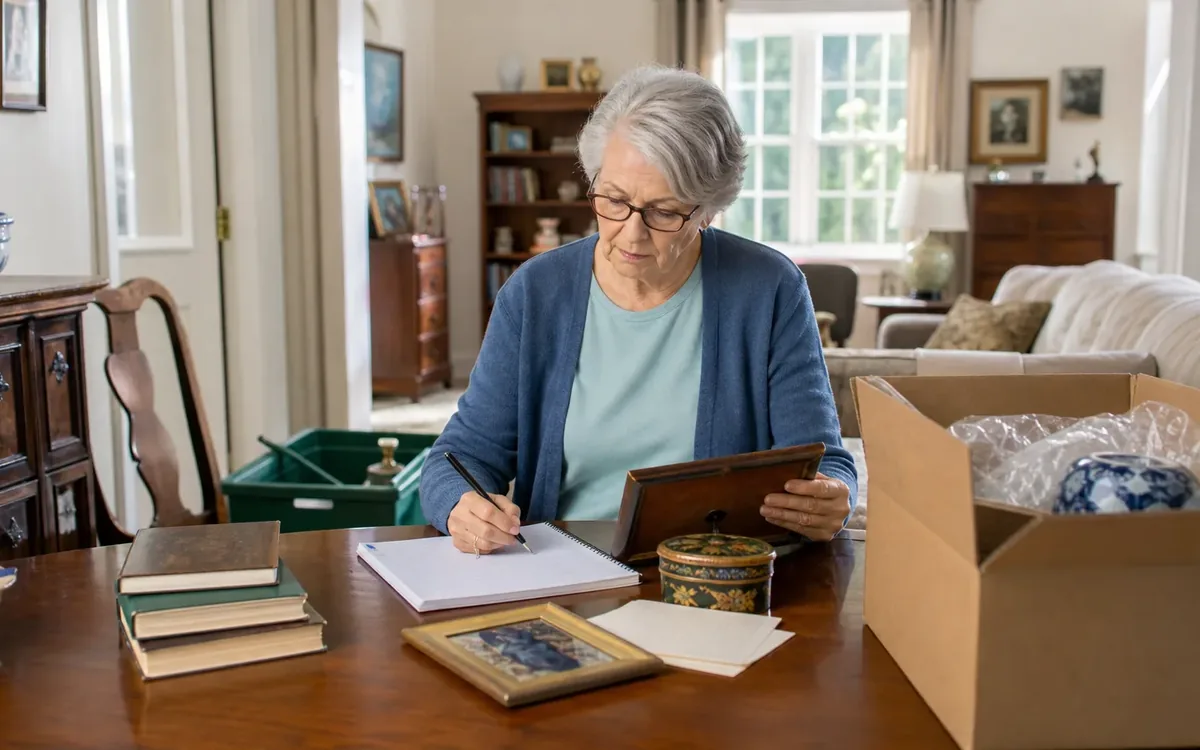
A useful furniture inventory for a senior living move lists each item, records its dimensions and condition, and assigns a clear outcome: move, sell, donate, give to family, store, recycle, or discard. Build it from the destination floor plan rather than the current home. This prevents the inventory from becoming a record of possessions that does not answer the central question: what will safely and comfortably fit in the new residence?
Quick answer: Obtain the senior living community’s floor plan and written move requirements. Measure the destination, photograph and measure each possible furniture item, assign every item a unique number, and mark its destination and backup plan. Confirm placement with a scaled layout before movers or other providers receive the final list.
A household can prepare this inventory independently or use professional assistance. A practical move management service may discuss sorting, measurements, room planning, packing coordination, and removal options. The senior living community, mover, appraiser, attorney, real-estate professional, inspector, contractor, or local authority remains responsible for decisions within its own role.
Why should the destination come before the inventory?
Beginning with every chair, table, and cabinet in the current home creates unnecessary work. A destination-first process establishes limits before emotional decisions begin.
Request the most current floor plan from the senior living community. Ask whether its dimensions are approximate or verified. If permitted, measure the residence in person and note features that affect usable space:
- Interior wall lengths
- Door and hallway widths
- Closet dimensions
- Window locations and sill heights
- Heating or cooling units
- Outlets and switches
- Built-in shelves or cabinets
- Radiators, columns, and other projections
- Bathroom and kitchen clearances
- Existing community-provided furniture
Do not assume a familiar item will fit because the room appears large enough. A dresser may fit along a wall but block an outlet, door swing, or walking route. A dining table may fit physically while leaving too little room to pull out chairs.
The household may decide what comfort and familiarity mean to the resident. The senior living community determines its property rules and can explain restrictions involving furniture, appliances, wall attachments, deliveries, elevators, or move access. Questions involving accessibility or care needs should go to the community and the resident’s appropriate health or accessibility professional.

What information belongs in a furniture inventory?
Use a spreadsheet, shared document, or paper worksheet that family members can understand. One row should represent one item or one inseparable set. Avoid entries such as “bedroom furniture,” which conceal important differences in size and destination.
Include these fields:
- Item number: A short, unique code such as LR-01 or BR-04.
- Item name: A specific description, such as “six-drawer walnut dresser.”
- Current room: Where the item is located now.
- Width, depth, and height: Record dimensions in the same order throughout.
- Extended dimensions: Include opened recliners, table leaves, pullout beds, and cabinet doors.
- Condition: Note stains, loose joints, odors, tears, scratches, or missing parts without minimizing them.
- Photograph reference: Match each row to one or more labeled photographs.
- Ownership status: Identify the resident, joint owner, trust, estate, or another person when relevant.
- Proposed outcome: Move, family, sell, donate, store, recycle, or discard.
- Destination room: Name the exact room or area in the new residence.
- Priority: Essential, preferred, optional, or not moving.
- Backup outcome: Record what happens if the item does not fit or is not accepted.
- Notes: Include disassembly needs, fragile surfaces, matching parts, or unresolved questions.
Ownership deserves careful attention. Family members can flag uncertainty, but disputed ownership, estate authority, trust interpretation, and distribution rights are legal matters. The authorized decision-maker should consult the relevant attorney or fiduciary before an item is promised, sold, donated, or removed.
If the move is part of a larger household transition, the guide on how to arrange furniture in a small home explains how sorting and disposition can relate to a broader property cleanout without treating every senior move as an estate matter.
How do you measure furniture correctly?
Measure the item at its widest, deepest, and highest points rather than relying on the manufacturer’s description. Decorative trim, handles, feet, cushions, and overhanging tops can change whether a piece clears a doorway or fits against a wall.
Follow these five steps:
- Assign the item number first. Put a removable label on the piece and use the same number in the inventory and photographs.
- Measure the main body. Record width, depth, and height consistently.
- Measure moving parts. Open drawers and doors, extend a recliner, and record a table with and without leaves.
- Note detachable components. Identify legs, shelves, glass tops, mirrors, finials, and hardware that must stay together.
- Check the travel path. Compare the item with doorways, turns, corridors, elevators, stairways, and the destination entrance.
Do not force a conclusion from dimensions alone. Movers determine their handling methods and whether they will accept or disassemble a particular piece. The senior living community controls access requirements at its property. Contractors decide whether physical alterations are feasible and authorized. Any proposed removal of doors, railings, trim, or built-ins should be discussed with the property owner, community, and qualified contractor before work is scheduled.
Photograph the front and one side of each item so its scale and condition are visible. Add close-ups of damage, maker labels, distinctive hardware, and detachable parts. Images help family members make decisions remotely, but they are not professional appraisals or formal condition reports.
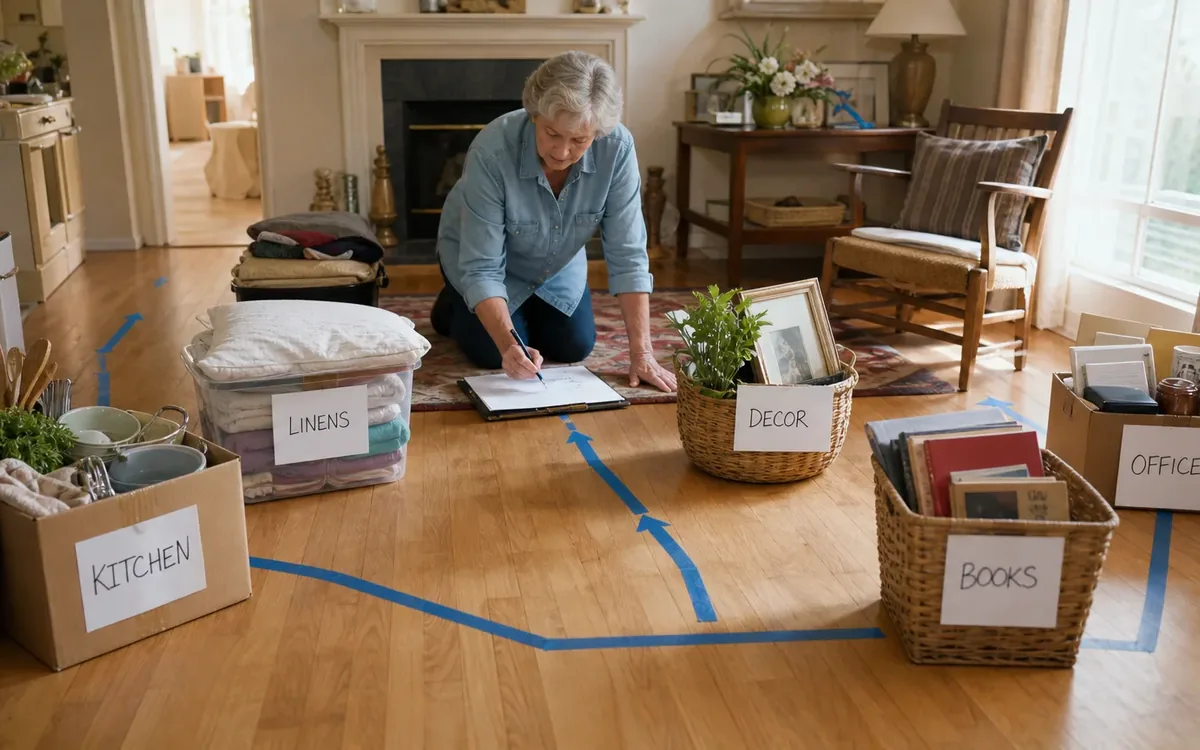
Build the move list around daily life
A senior living move is not a contest to fit the maximum amount of furniture into a smaller residence. The inventory should support how the resident expects to sleep, dress, eat, relax, welcome visitors, and reach frequently used belongings.
Start with essential functions:
- A suitable bed and accessible bedside surface
- Comfortable seating that the resident can enter and leave safely
- Clothing storage appropriate to the available closets
- A practical surface for meals, reading, or hobbies
- Lighting where permitted and needed
- Storage for regularly used personal items
- Space for mobility aids or other necessary equipment
Next, identify emotionally important pieces. A favorite chair, small heirloom table, or familiar chest may matter more than a complete matching set. Record that priority instead of allowing size or resale assumptions to make the decision automatically.
Keep traffic paths visible on the floor plan. Furniture should not conceal switches, restrict doors, or crowd routine routes. The household can identify preferences, while questions about accessibility, fall risk, medical equipment, emergency access, or care delivery should be reviewed with the senior living community and the relevant qualified professional.
Create a scaled furniture plan
A furniture inventory becomes more useful when connected to a layout. Use graph paper, a floor-planning tool, or scaled paper rectangles representing each proposed item.
Place essential furniture first. Then add preferred pieces only where they preserve useful circulation and access. Mark the inventory number on each furniture shape so the layout corresponds directly to the list.
Test common activities rather than only checking whether outlines overlap:
- Can drawers and cabinet doors open?
- Is there room to make the bed?
- Can a chair pull away from a table?
- Does a recliner extend without blocking a route?
- Are frequently used items reachable?
- Can windows, closets, and room doors function?
- Is there an uncluttered path through the residence?
Treat the plan as a decision tool, not a guarantee. Floor plans may omit trim, projections, or slight variations. The community can confirm property information and rules, while a mover can assess handling and access. An accessibility specialist or other qualified professional should address needs beyond basic room planning.
What should happen to furniture that is not moving?
Give every nonmoving item a specific route. A vague “deal with later” category shifts pressure to the end of the project and can lead to accidental disposal or unwanted storage.
Use separate outcomes for:
- Family transfer: Name the recipient and require confirmation before reserving the item.
- Potential sale: Keep the item available for an appraiser, auction professional, estate-sale provider, or resale business to evaluate.
- Donation: Ask the chosen organization directly about condition standards, accepted categories, and pickup or drop-off policies.
- Storage: Select a storage provider separately and understand access, insurance, climate conditions, contract terms, and ongoing responsibility.
- Recycling or disposal: Confirm acceptance requirements with the appropriate facility or provider.
- Unresolved: Isolate items affected by ownership, legal, appraisal, or family questions.
Do not assign value based on age, original purchase price, family tradition, or an online listing alone. The household decides whether it wants a professional valuation. A qualified appraiser determines appraisal conclusions, and auction or sale providers establish their own acceptance and sale terms.
A cleanout or move team may discuss practical sorting and routing options. It should not decide who legally owns an item, provide an appraisal unless separately qualified to do so, or override a donation organization’s or disposal facility’s requirements.
Keep family decisions controlled and traceable
Shared decision-making works best when relatives respond to the same information. Send the numbered inventory and photographs rather than separate text-message descriptions. Set one authorized contact to collect answers and update the master file.
Use clear status labels such as:
- Proposed for move
- Confirmed for move
- Claimed by family
- Awaiting valuation
- Donation pending acceptance
- Disposal pending approval
- Ownership question
- Final decision required
Do not remove an item from the list after its route is chosen. Change its status and record the recipient or provider. This preserves a simple decision history and reduces confusion when a room begins to empty.
If disagreement arises, separate emotional preference from decision authority. Relatives may express requests, but the resident or legally authorized person makes decisions within their authority. Attorneys, personal representatives, trustees, guardians, or other responsible professionals should address disputed rights and legal obligations.
Prepare a final handoff for the move
Once decisions are approved, create a filtered version showing only items confirmed for the new residence. Give each moved item a destination room that matches labels used on boxes and the floor plan.
The handoff packet can contain:
- Final furniture inventory
- Destination floor plan
- Numbered placement layout
- Furniture photographs
- Access information supplied by the community
- List of detachable parts
- Items requiring special discussion with the mover
- Contact details for the authorized household decision-maker
- A backup plan for any piece rejected or unable to fit
Confirm move requirements directly with the community and moving provider. Discuss loading access, delivery procedures, building protection, elevator use, insurance documentation, assembly boundaries, and prohibited items. Each provider sets its own scope and terms.
If repairs or modifications appear necessary, keep that work separate from the inventory. The household may request estimates, but a qualified contractor determines methods and feasibility. The property owner or senior living community must authorize work affecting the premises, and applicable permit or compliance decisions belong to the responsible authority.
Clutter Cleaner of South Carolina is physically located in Mount Pleasant and serves a statewide South Carolina territory, with Charleston as its primary market. A conversation about move management can focus on practical sorting, organization, and coordination. Availability, exact scope, and involvement of separate providers should be confirmed for the individual project.
Common inventory mistakes to avoid
The most disruptive mistakes occur when an inventory looks complete but lacks decision-ready information. Watch for these problems:
- Measuring rooms but not doorways or furniture projections
- Listing sets instead of individual pieces
- Photographing items without visible identification numbers
- Assuming community approval without asking
- Treating a floor-plan image as a verified field measurement
- Promising items before confirming ownership or authority
- Sending furniture to storage without naming the long-term decision
- Assuming donation, sale, or disposal acceptance
- Mixing sentimental importance with estimated market value
- Failing to create a backup outcome for oversized pieces
A final review should leave no unlabeled furniture and no unexplained status. If an answer depends on another professional, write down the question, the responsible person, and the confirmation still needed.
Short FAQ
Should every piece of furniture be inventoried?
Inventory every item that might move, be transferred, sold, donated, stored, recycled, or discarded. Fixed cabinetry and built-ins can be noted separately so no one mistakes them for removable property.
Can photographs replace measurements?
No. Photographs show appearance and condition, but they do not establish whether an item fits the destination or travel path. Use both photographs and measurements.
Who decides whether furniture is valuable?
The household can decide whether to seek a valuation and whether sentimental value affects its plans. A qualified appraiser provides an appraisal. Auction, estate-sale, consignment, and resale providers make their own acceptance and pricing decisions.
What if a family member wants an item?
Record the person’s name, require confirmation, and set a clear transfer plan. Do not release property when ownership or authority is disputed. Direct legal questions to the appropriate attorney or authorized fiduciary.
Should storage be the default for uncertain items?
Not automatically. Storage is a separate household choice involving a provider, contract, access arrangements, insurance considerations, and continuing responsibility. Use it intentionally, with a documented review plan, rather than as an unexamined fallback.
When is the inventory finished?
It is ready for move coordination when each item has measurements, a photograph reference, a confirmed status, a destination or disposition route, and a backup plan. Community rules, mover requirements, legal questions, appraisals, and contractor work must still be confirmed by the parties responsible for them.



