

Organize medications and care records as a protected project separate from packing the rest of the home. Keep current medicines accessible, create one verified medication list, gather essential records, assign a responsible person, and hand-carry the active-care materials. A household or move team can organize and label these items, but pharmacists, prescribers, insurers, and care providers must resolve clinical questions.
Quick answer: Make an “active care” kit containing current medications, the verified medication list, identification, insurance information, essential care contacts, and necessary medical supplies. Do not place this kit on a moving truck or mix it with items being donated, stored, sold, or discarded. Ask the appropriate pharmacist or prescriber about refills, storage conditions, transfers, duplicates, and discontinued medicines.
Why should medications be handled separately from ordinary packing?
Medications and care records are not ordinary household contents. Losing access to a lamp or mixing bowl is inconvenient. Losing a prescription, dosage instruction, insurance card, or clinician’s contact information can interrupt care.
Separation also reduces the chance that important items will be packed into long-term storage, included in an estate sale, or discarded during a cleanout. Start by designating a clean work surface and several clearly marked containers. Keep this area away from donation and disposal zones.
Useful categories include:
- Current prescription medications
- Current nonprescription medicines and supplements
- Refrigerated or otherwise specially stored medications
- Daily medical supplies and equipment accessories
- Identification and insurance materials
- Current care instructions and contact details
- Older records that may need archiving
- Medications requiring pharmacist guidance for disposal
This sorting step is about visibility, not medical judgment. Family members and organizers should not decide that a medicine is unnecessary based only on its age, appearance, or location.
If the medication project is part of a larger transition, review the household’s options for downsizing and organizing support. The medication area should still remain a controlled, separately managed part of that work.

Who should be responsible for the medication plan?
Choose one responsible household member or legally authorized representative to oversee the process. Too many people independently moving bottles, calling providers, or changing lists can create conflicting information.
The responsible person can coordinate four tasks:
- Control access to medications and private records.
- Maintain the working medication list.
- Direct questions to pharmacists, prescribers, insurers, or care providers.
- Confirm that the active-care kit travels with the correct person.
A practical cleanout or move team may discuss packing order, document sorting, room labels, privacy bins, and which boxes must remain accessible. It can also help identify medication containers found in cabinets, drawers, purses, bedside tables, refrigerators, and mobility equipment storage.
The household retains decisions about who may view private information, who receives records, and where sensitive materials go. Questions about legal authority, health care proxies, guardianship, powers of attorney, or access to another person’s medical information belong with the relevant attorney, provider, institution, or other responsible authority.
During an estate transition, the risk of mixing medication and records with general contents can be especially high. The guide on how do you keep important documents safe and organized explains the broader sorting process, while this guide focuses specifically on protecting health-related items.
How do you build an accurate medication list?
Begin with every location where medications might be kept. Check kitchen cabinets, bathroom storage, bedside drawers, travel bags, coat pockets, refrigerators, lockboxes, and recently used vehicles. Do not combine loose pills or pour different prescriptions into one container.
Create a draft list with fields such as:
- Person’s full name
- Medication name as printed on the label
- Strength shown on the label
- Directions shown on the current label
- Prescriber listed on the container
- Dispensing pharmacy and phone number
- Prescription number, if appropriate to record securely
- Storage instructions printed on the label
- Supply concerns or questions requiring professional review
Record nonprescription medicines, vitamins, supplements, creams, drops, injections, inhalers, and as-needed products separately. These may still be relevant to a pharmacist or clinician reviewing the full list.
A household member can transcribe labels and note visible discrepancies. A move organizer can provide a worksheet or help arrange bottles so the responsible person can review them. Neither should reconcile conflicting directions, determine whether two products interact, or decide what should be stopped.
Ask a pharmacist, prescriber, or other qualified care professional to resolve issues such as:
- Two containers with different instructions
- Duplicate or unfamiliar prescriptions
- Missing or damaged labels
- Expired medication
- Pills outside their original container
- Uncertainty about continued use
- Questions about interactions or side effects
- Changes needed because of travel or the new residence
After professional questions have been resolved, mark the list with the date it was checked and keep copies only where they can be stored securely.
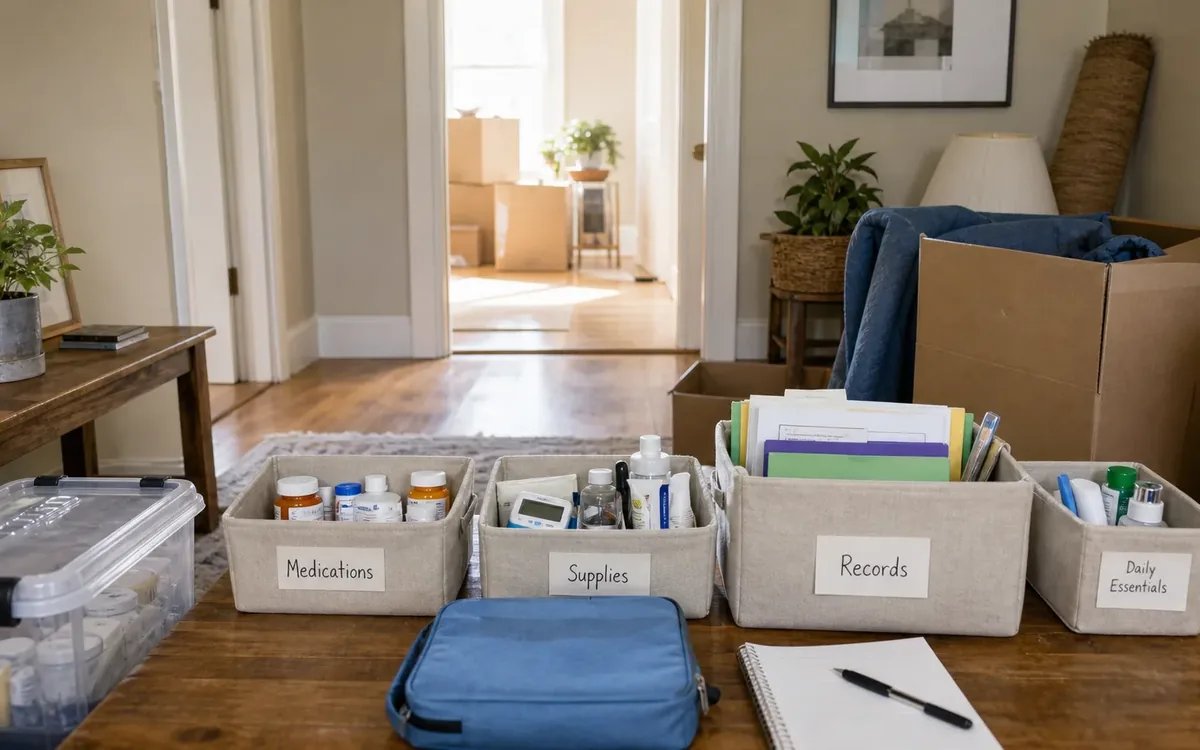
What belongs in the active-care kit?
The active-care kit contains items that must remain under the responsible person’s control throughout the move. Use a sturdy, clearly identifiable bag or container that will not be mistaken for ordinary luggage, donations, or mover-packed contents.
Consider including:
- Current medications in labeled containers
- The verified medication list
- Essential identification and insurance cards
- Pharmacy, prescriber, and care-provider contacts
- Relevant current instructions provided by care professionals
- Necessary testing or administration supplies
- Mobility or medical device chargers and compatible accessories
- A small written note identifying storage requirements
- Any emergency information supplied or approved by the person’s clinician
Keep private documents inside a closed folder rather than attaching them to the outside of the bag. An exterior label can say “Hand Carry” or “Do Not Pack” without displaying diagnoses, medication names, or insurance numbers.
Special storage conditions require professional confirmation. Follow the medication label and instructions from the dispensing pharmacy or manufacturer. Ask a pharmacist how to manage temperature-sensitive products during travel and what to do if a product is exposed to questionable conditions. A household organizer or moving team should not improvise refrigeration, insulated packaging, or product viability decisions.
How should paper and digital care records be sorted?
Care records are easier to use when divided by purpose instead of placed in one large chronological pile. The goal is to distinguish active information from archival material without making unauthorized retention or destruction decisions.
Create these practical groups:
- Immediate access: Current medication list, care contacts, insurance details, recent instructions, and information needed during the transition
- Current care: Recent visit summaries, active treatment documents, equipment instructions, and relevant test information
- Administrative: Billing, benefit, authorization, and insurance correspondence
- Historical: Older records that are not needed during the move but may require retention
- Review required: Duplicates, unclear documents, outdated instructions, or papers belonging to another person
Use broad folder labels that make retrieval easy but protect privacy. Avoid writing a diagnosis on the outside of a moving carton. Boxes containing confidential records should be closed, kept out of public sorting areas, and transferred only as directed by the responsible person.
Digital records need similar care. The household can identify portals, download records it is authorized to access, update contact details, and store files in a secure location. Password sharing, record disclosure, and access on behalf of someone else should follow the provider’s rules and applicable legal authority.
Ask the medical provider, insurer, attorney, records custodian, or other responsible professional about retention and destruction requirements. A cleanout team may help stage boxes for “keep,” “professional review,” or approved shredding, but it should not determine whether health records may legally be destroyed.
How can the household prevent medication from entering donation or disposal piles?
Use physical separation and simple visual controls. Medication sorting should happen before closets, cabinets, bedside tables, and bathroom contents are cleared for donation, sale, storage, or disposal.
Set up four zones:
- Active-care kit
- Pharmacist or prescriber review
- Approved record storage
- Household contents unrelated to care
Do not create an unverified “trash medication” box. Unused, expired, discontinued, or unidentified medicines may require different handling. Ask a pharmacist or appropriate disposal authority which options apply to each item. Follow product instructions and official requirements rather than placing medicines in household trash, sinks, or toilets without confirmed guidance.
Sharps, injectable supplies, controlled substances, medical devices, and products containing personal information may each have separate requirements. The responsible professional or authority should explain those requirements. A practical cleanout team can isolate and label the materials for review, but disposal and compliance decisions remain with the household and the appropriate expert or authority.
What should be confirmed before changing residences?
The household should verify where care-related items will be kept in the new residence and who will have authorized access. Avoid choosing a location solely because it is convenient for unpacking.
Confirm these details with the relevant parties:
- Whether prescriptions need to be transferred to another pharmacy
- Whether an insurer or provider needs updated contact information
- Whether the new residence has suitable storage for current products
- Whether medication access must be restricted from children, visitors, or other residents
- Whether a care facility has its own intake and medication-management procedures
- Whether equipment requires compatible power, space, or environmental conditions
- Whether records must be sent directly between providers
Pharmacists and prescribers handle prescription, refill, interaction, and clinical questions. Insurers explain coverage and network rules. A receiving community or care provider determines its intake requirements. An attorney or authorized institution addresses questions about decision-making authority and records access.
If the move is connected to selling a home, real-estate agents, inspectors, appraisers, contractors, and compliance authorities keep their separate roles. An organizer may help clear access to rooms or gather documents, but it does not set property value, interpret an inspection, approve repairs, perform contractor work, or make legal and compliance determinations.
A focused move-day handoff
Before general loading begins, the responsible person should take control of the active-care kit. It should not sit beside boxes that movers or helpers are expected to load.
Use this five-point handoff:
- Compare the kit against the verified medication list.
- Confirm that specially stored medication is being handled according to professional instructions.
- Place records and insurance materials in a secure inner folder.
- Confirm who will physically carry the kit and where it will be kept.
- Check the former residence’s medication storage locations after other contents have been removed.
At the new residence, unpack the kit before nonessential household goods. Place medications only in a location consistent with label instructions, professional guidance, privacy needs, and household safety. Keep the verified list accessible to the person managing care, but do not display it publicly.
Any damage, missing dose, temperature concern, label discrepancy, or uncertainty should be directed promptly to the relevant pharmacist, prescriber, or care provider. Do not guess whether a questionable medication remains usable.
What can a move or organizing team discuss?
A practical team may discuss workflow rather than health care. Appropriate topics include:
- Establishing a private sorting area
- Finding medication and record storage locations
- Creating clearly separated packing zones
- Labeling containers without exposing medical details
- Keeping essential items out of storage, sale, donation, and disposal streams
- Coordinating the order in which rooms are sorted
- Setting aside unclear items for household or professional review
- Packing approved archival records as directed
The household decides who participates, what may be packed, what remains accessible, and what information may be shared. If third-party storage is considered, the household chooses the provider and evaluates privacy, access, environmental conditions, and contract terms.
Clutter Cleaner of South Carolina provides verified services that include downsizing and organizing, move management, estate cleanouts, auctions and estate sales, home sale preparation, and code compliance support across South Carolina. That scope does not replace pharmacists, clinicians, attorneys, appraisers, real-estate professionals, inspectors, contractors, records custodians, or government authorities.
Short FAQ
Should medications go in a moving truck?
Current medications should remain accessible and under the responsible person’s control. Ask a pharmacist about any product with temperature, security, or transport concerns.
Can family members discard old prescriptions?
They should first obtain disposal guidance from a pharmacist or appropriate authority. Do not assume every medication, sharp, or medical product follows the same disposal method.
Should all medical records travel with the person?
Carry the records needed for immediate care and transition tasks. Securely pack or store other records only after the household and appropriate records, legal, or care professional determine what must be retained and who may access it.
Can an organizer update the medication list?
An organizer may help transcribe label information or format a list at the household’s direction. A pharmacist, prescriber, or qualified care professional should resolve clinical discrepancies and confirm medication-related guidance.
What if medication is found after the move?
Secure it away from unauthorized access, preserve its label, and contact the appropriate pharmacist, prescriber, or authority for next steps. Do not add it to an active regimen without professional confirmation.
Where can South Carolina households start?
Begin with one responsible person, one active-care kit, and one verified list. For practical downsizing or move-management discussions within the verified statewide scope, contact Clutter Cleaner of South Carolina at (843) 972-7020. The physical business location is in Mount Pleasant, and Charleston is the primary market.



