

A showing day reset checklist should return an occupied home to a consistent, buyer-ready condition without requiring a full cleaning or redesign before every visit. Build it around a fixed room order, visible priorities, assigned household roles, and one final exit check. The goal is not perfection. It is a repeatable reset that controls clutter, odors, lighting, privacy, access, and signs of daily life.
Quick answer: Divide the checklist into five passes: personal items, surfaces, sensory details, access, and departure. Assign each task to a person, decide where displaced belongings will go, and confirm showing instructions with the real-estate professional responsible for the listing. Keep repairs, inspection issues, disclosure questions, and legal decisions off the household reset list and with the appropriate professional.
Why should an occupied home use a reset instead of a general cleaning list?
A general cleaning list tends to expand. Once it includes every baseboard, closet, cabinet, and unfinished repair, it becomes difficult to complete consistently. A showing day reset has a narrower purpose: restoring the presentation already established for the home.
That distinction matters when people, pets, meals, work, and school continue inside the property. The checklist should address what changed since the previous reset, not restart the entire home-sale preparation process.
The household can decide how beds are made, where countertop items are stored, which rooms receive priority, and who handles each task. The listing agent or other responsible real-estate professional should advise on showing access, buyer expectations, listing presentation, open-house procedures, and any property-specific concerns.
If the home needs a larger initial reduction before a reset can work, review Clutter Cleaner of South Carolina’s home sale preparation service. For inherited property or belongings connected to an estate, the guide to how clean should a house be for showings explains why authority, distribution, valuation, and removal should be separated.

What should go on the showing day reset checklist?
Use five passes in the same order each time. A predictable sequence makes omissions easier to spot and reduces duplicated work.
-
Secure personal and sensitive items. Put away medications, financial papers, mail, calendars, school information, spare keys, portable electronics, jewelry, and documents that reveal personal schedules. Choose secure storage appropriate to the item rather than placing valuables in an unlocked drawer or decorative basket.
-
Clear visual clutter. Reset kitchen and bathroom counters, nightstands, desks, entry surfaces, floors, and seating. Return everyday possessions to designated homes instead of moving them randomly from one room to another.
-
Correct sensory distractions. Empty odor-producing trash, wash or contain dishes, manage laundry, ventilate as appropriate, and address pet-related smells. Avoid using heavy fragrance to conceal an unresolved source.
-
Restore visibility and access. Follow the listing professional’s guidance for lights, shades, doors, gates, parking, keys, and any spaces buyers are expected to view. Remove ordinary obstacles from walking paths.
-
Complete the departure check. Confirm that people and pets are accounted for, personal devices are removed or secured, requested access is available, and the home is left according to the agreed showing instructions.
Write tasks as observable results. “Kitchen counters clear except approved display items” is more useful than “tidy kitchen.” “Used towels removed and fresh towels straight” is clearer than “fix bathroom.”
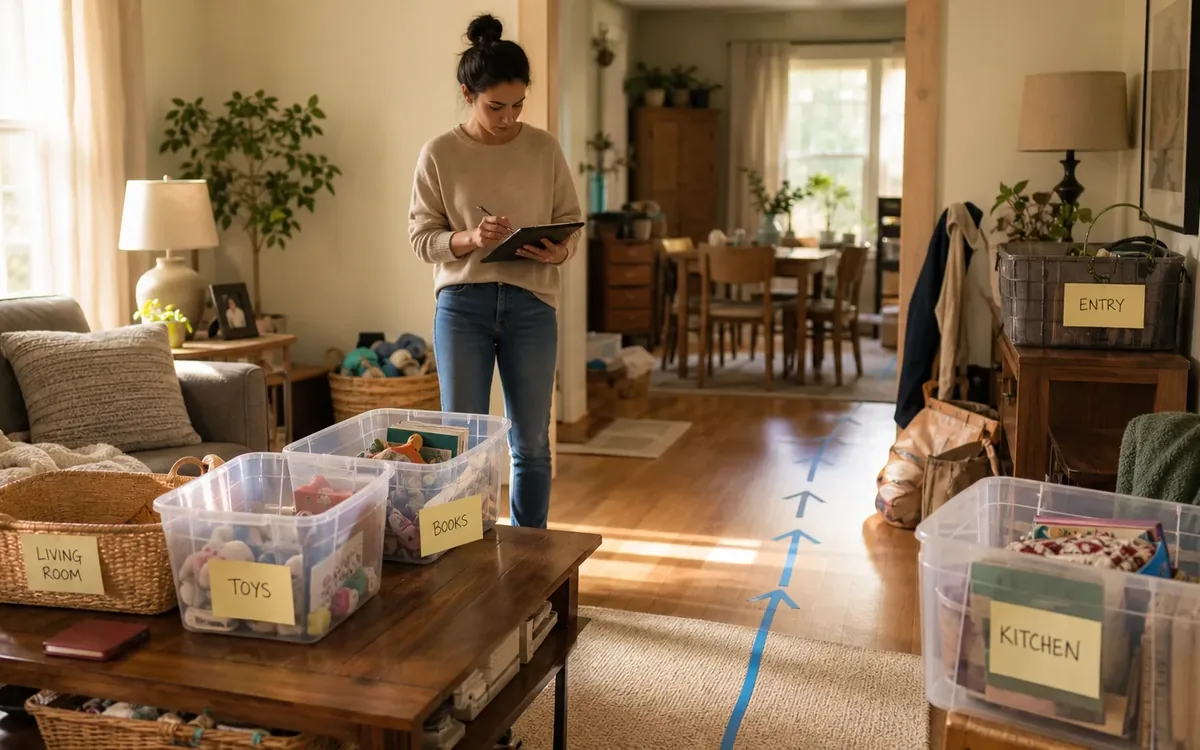
Build the checklist around permanent landing zones
A reset fails when there is nowhere for daily belongings to go. Before writing tasks, establish landing zones for the items that repeatedly appear during normal routines.
Useful zones may include:
- A closed container for incoming mail that does not hold sensitive documents
- A drawer or cabinet for chargers and small electronics
- A hamper with a lid for worn clothing and towels
- A shelf for school bags and work bags
- A cabinet for countertop appliances used regularly
- A secure location for medication, jewelry, keys, and confidential records
- A defined place for pet supplies, carriers, bowls, and cleaning tools
A landing zone is not permission to overfill a closet buyers may open. It should be a sustainable storage choice that preserves reasonable access and presentation. If cabinets, garages, or closets are part of the showing, ask the real-estate professional how they should be presented.
Off-site storage is a household decision involving access, cost, insurance, security, and transport. A cleanout or move team may discuss sorting, packing, organizing, or moving logistics within an agreed scope. It should not select a storage contract, determine insurance coverage, or promise that stored property will be suitable for a future sale.
How do you assign tasks without disrupting daily life?
Assign ownership by routine rather than asking everyone to “help.” Each recurring task needs a named person and a backup when practical. Children can be responsible for age-appropriate belongings, but an adult should verify security, pet arrangements, access, and final departure.
A simple responsibility plan can use four roles:
- Room reset: Each person returns belongings in assigned bedrooms or living areas to their landing zones.
- Kitchen and bath reset: One person handles dishes, food, trash, towels, toiletries, and visible moisture.
- Access and pet check: One adult confirms pet plans, doors, gates, keys, parking, and any agent instructions.
- Final walkthrough: One adult moves through the home in the established order and checks the written list without starting unrelated projects.
Avoid assigning vague duties such as “make it look good.” Instead, define the finish line for each task. This is especially useful in shared homes where people have different ideas about what counts as clean or uncluttered.
A practical cleanout or move team may discuss division of labor, sorting categories, packing destinations, donation or disposal options, and how to stage work so occupied rooms remain usable. The household retains decisions about what to keep, give away, sell, store, or discard unless another person has documented authority to decide.
Create room standards that can be checked quickly
The checklist should describe the intended reset condition in each high-impact room. Keep these standards narrow and repeatable.
Entry and living areas
- Shoes, bags, mail, and keys are in their designated places.
- Seating is clear and cushions are straight.
- Remote controls, cords, and personal devices are contained.
- Walkways and the immediate entrance are unobstructed.
- Highly personal schedules, photographs, or notices selected for removal are put away.
Kitchen
- Dishes are washed or placed inside the dishwasher.
- Sink and counters are clear of food debris and unnecessary items.
- Food, pet supplies, and cleaning products are stored.
- Trash that may create odor is removed.
- Refrigerator notes and personal information are handled according to the household’s presentation plan.
Bathrooms
- Toiletries and medications are secured.
- Used towels and laundry are contained.
- Sink, mirror, counter, and toilet are visibly reset.
- Trash and odor sources are addressed.
- Shower curtains or doors follow the chosen presentation standard.
Bedrooms and work areas
- Beds follow one consistent made-bed standard.
- Clothing is hung, folded, or placed in a hamper.
- Desks are cleared of confidential or identifying material.
- Cords, exercise equipment, and personal care items are contained.
- Floors and walking paths are clear.
Utility, garage, and outdoor areas
- Tools, chemicals, and sharp objects are secured appropriately.
- Laundry is contained and appliance areas are accessible.
- Household waste follows the property’s disposal arrangement.
- Gates, paths, and expected entrances are handled according to showing instructions.
- Seasonal or weather-related items are placed where they do not block access.
South Carolina weather can affect what enters the home, but the checklist does not need speculative seasonal rules. Add a simple condition-based line such as “check the entry for tracked moisture, sand, leaves, or debris” whenever conditions warrant it.
What belongs outside the showing reset?
A reset checklist should not become a substitute for repairs, inspections, appraisals, disclosures, or legal guidance. Keeping those matters separate helps the household avoid treating a cosmetic action as a professional conclusion.
Use a separate issue log for observations such as leaks, damaged surfaces, electrical concerns, pests, moisture, odors that return, unsafe walking areas, or systems that appear not to function correctly. The log can note where the issue was observed and which responsible professional should receive it.
The boundaries are straightforward:
- Household: Decides what personal property to keep, pack, store, donate, sell, or discard, subject to ownership and legal authority.
- Cleanout or move team: May discuss practical sorting, removal, packing, organizing, and move sequencing within the agreed scope.
- Contractor or qualified trade: Evaluates and performs repair work within that provider’s qualifications and agreement.
- Inspector: Reports observations and findings under the inspection engagement.
- Appraiser: Develops the appraisal opinion. Removing clutter does not establish value.
- Real-estate professional: Advises on marketing, showing presentation, access, offers, and transaction strategy within the professional’s role.
- Attorney, court, personal representative, or other authority: Resolves ownership, estate authority, disputes, required approvals, and legal obligations.
- Government or compliance authority: Determines official code requirements, permits, violations, deadlines, and whether compliance has been achieved.
Clutter Cleaner of South Carolina lists code compliance support among its services, but support with clearing or organizing does not replace an authority’s determination or a qualified contractor’s work.
Use a final walkthrough that does not create new work
The final walkthrough should verify the checklist, not trigger deep cleaning. Start at the showing entrance and move in the order a visitor is likely to encounter the home, including any expected secondary spaces.
Carry only the written list and a small container for last-minute misplaced items. If a newly noticed task is not essential to privacy, safety, access, odor control, or the established room standard, place it on a later-work list.
During the walkthrough, check:
- Personal and confidential items are secured
- Obvious dishes, laundry, waste, and pet evidence are handled
- Counters, seating, and primary floors meet the reset standard
- Expected doors, gates, lights, and shades match professional instructions
- No ordinary household item blocks a walking path
- Pets and household members have a confirmed plan
- The exit procedure follows the agreed access instructions
Do not conceal a known material condition merely to improve appearance. Questions about disclosure should go to the appropriate real-estate professional or attorney. Questions about safety, repairs, or code status should go to the responsible inspector, contractor, authority, or other qualified professional.
Keep a reset kit separate from stored belongings
A small, accessible reset kit prevents cleaning products from being packed away or scattered throughout the house. Its contents should match the home’s surfaces, occupants, pets, and product instructions.
Possible contents include:
- Microfiber cloths
- Surface-appropriate cleaning products
- Paper towels or reusable cleaning cloths
- Trash bags
- A lint roller
- A small hand vacuum or other suitable floor tool
- Disposable gloves where appropriate
- A neutral container for last-minute nonvaluable items
- A printed copy of the checklist
Keep chemicals in their original labeled containers and store them safely. Do not mix cleaning products. Product selection, ventilation, child safety, pet safety, and surface compatibility remain household responsibilities unless a qualified provider has accepted a specific task.
The last-minute container is a transfer tool, not permanent storage. Empty it after the showing by returning each item to its landing zone. Otherwise, it becomes another clutter source or a place where important possessions disappear.
Review the checklist when the home changes
Update the list when occupants’ routines change, a room is packed, furniture is moved, a pet plan changes, or showing instructions are revised. Remove tasks that no longer apply. A short, accurate checklist is better than a long document that everyone stops reading.
Also revise the list after identifying repeated friction. If shoes are always near the entrance, the solution may be a better landing zone rather than another reminder. If confidential papers repeatedly remain on a desk, create secure storage near the workspace. If trash produces recurring odor, adjust the household’s disposal routine while following applicable property and local requirements.
For wider sorting or transition needs, the guide to preparing a home for listing photos covers estate cleanouts and related household decisions. Service availability and scope should be confirmed directly for the South Carolina property involved. The company’s physical business location is Mount Pleasant, and Charleston is its primary market.
Short FAQ
Should every cabinet and closet be empty?
No. An occupied home needs functional storage. Aim for orderly, accessible spaces rather than hiding loose belongings in areas buyers may view. Ask the listing professional which storage areas should receive special attention.
Can the checklist include repairs?
Keep repair observations on a separate issue log. A contractor or qualified trade should evaluate repair needs, while inspection, disclosure, code, and legal questions belong with the responsible professionals or authorities.
Where should valuables go during a showing?
Use secure storage appropriate to the item, or remove it from the property if that is the household’s chosen plan. Do not rely on decorative boxes, unlocked drawers, or the reset basket for valuables, medication, keys, or confidential records.
What if the home contains estate property?
Confirm who has authority before selling, donating, discarding, or moving property. Family preference does not necessarily establish legal authority. Appraisal decisions belong to a qualified appraiser, sale strategy to the appropriate estate-sale or auction provider, and legal questions to the responsible attorney, court, or representative.
Who should approve the final showing setup?
The household can maintain the agreed room standards, but the listing’s real-estate professional should address marketing presentation, showing access, and transaction-related instructions. Any safety, compliance, appraisal, inspection, or legal conclusion remains with the relevant professional or authority.



