
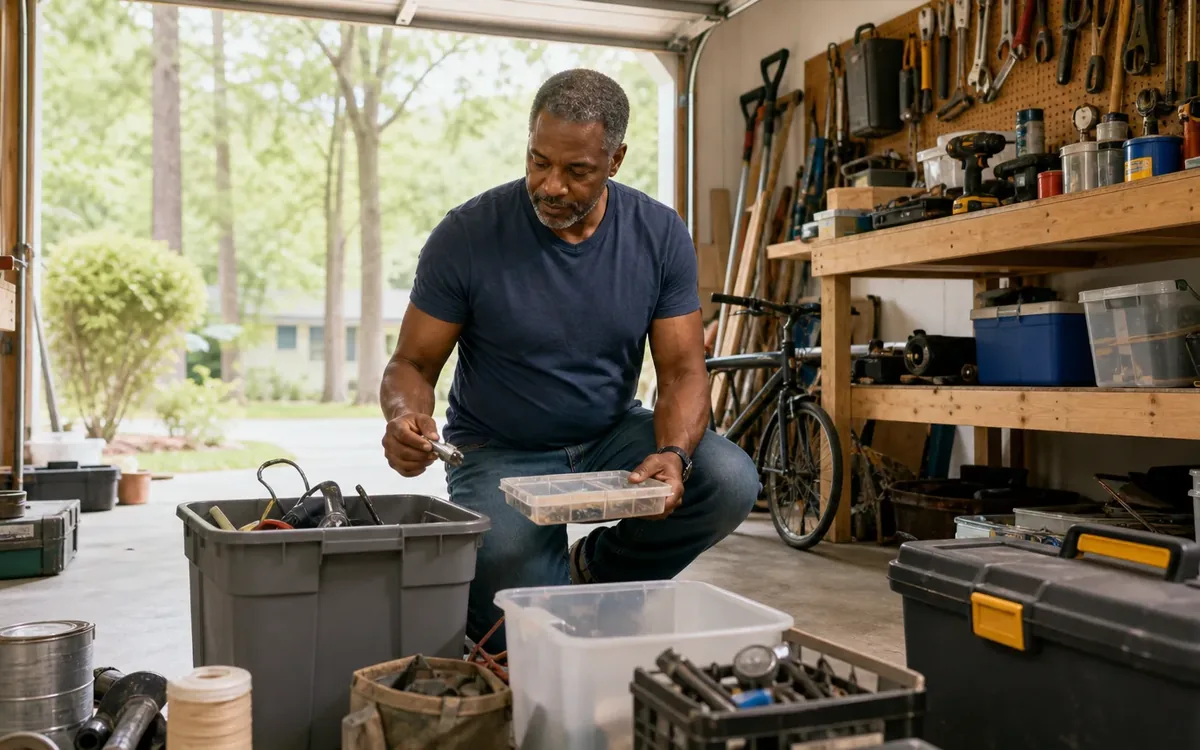
The best way to downsize tools and workshop supplies is to sort by function, condition, duplication, and realistic future use before deciding where anything goes. Start with hazardous materials and high-value tools, then build a smaller working set around the projects, space, and physical abilities that will matter in the next home. Keep disposal, appraisal, legal, and moving decisions separate so useful equipment is not lost and restricted material is not handled incorrectly.
Quick answer: First make the workshop safe. Next identify valuable, borrowed, hazardous, and essential items. Then choose what fits the future workspace. Sell or transfer usable surplus, route chemicals and regulated materials through an appropriate program, and confirm that movers or storage providers will accept what remains.
What should you decide before sorting the workshop?
Decide what the smaller workshop is meant to support. A person moving from a detached garage to a condominium may need a basic repair kit rather than a full woodworking setup. Someone staying in the same house but reducing clutter may keep a compact bench and a few frequently used power tools.
Answer these questions before opening drawers:
- Which projects will realistically continue?
- How much secured, dry storage will be available?
- Is there room for a bench, cabinet, or freestanding machine?
- Are noise, dust, ventilation, or electrical capacity concerns?
- Can the owner safely lift and operate each tool?
- Does another household member want part of the collection?
- Are any tools borrowed, jointly owned, or tied to a business?
Measure the future storage area rather than estimating it. Record shelf width, cabinet depth, door clearance, ceiling height, and usable wall space. If the destination is governed by a landlord, condominium association, homeowners association, insurer, or local authority, the responsible party should verify applicable restrictions. A cleanout or move team cannot interpret those rules as legal authority.
Households that need help reducing belongings can review the statewide downsizing and organizing service. For a workshop connected to a larger inherited property, the guide to what to get rid of first when downsizing explains the broader sequence without replacing advice from an attorney, appraiser, or other responsible professional.
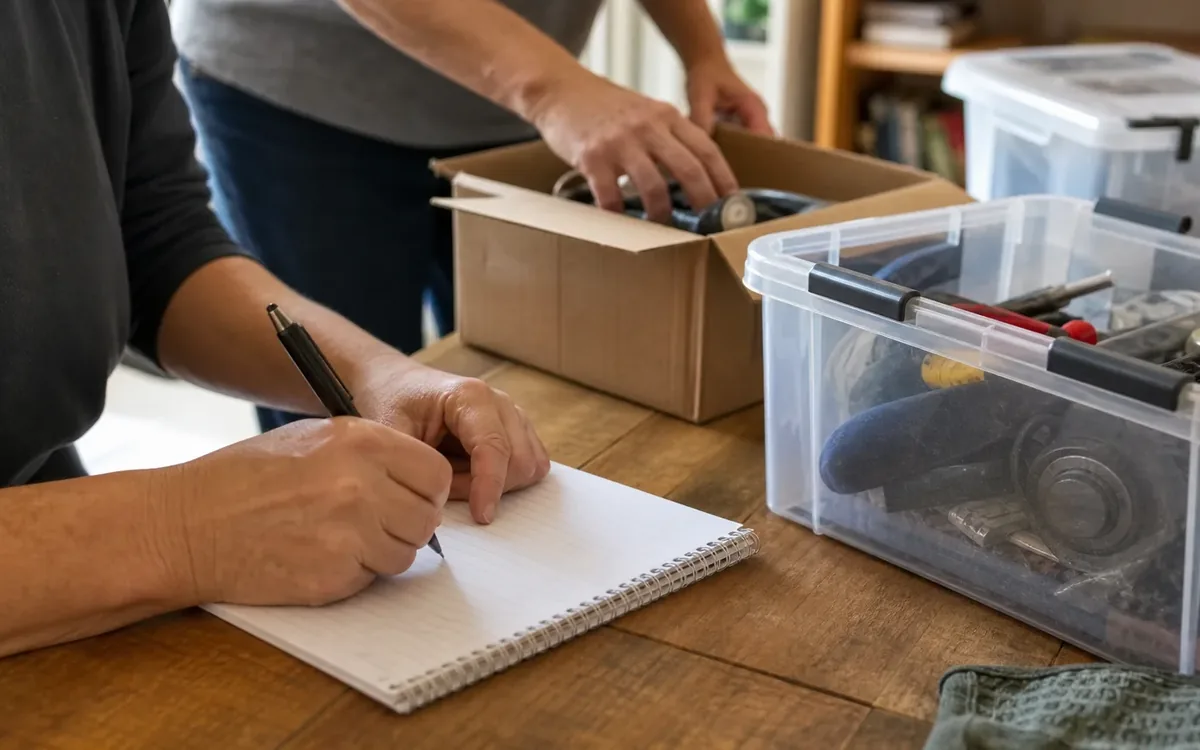
How do you make a crowded workshop safe to sort?
Do not begin by emptying every cabinet onto the floor. That creates trip hazards and makes it harder to identify chemicals, sharp objects, and unstable equipment.
Use this order:
- Clear an exit path. Remove loose cords, scrap, and boxes from doors and walkways without handling questionable containers unnecessarily.
- Disconnect power where appropriate. Unplug portable tools before inspecting them. Electrical or hardwired equipment concerns belong with a qualified electrician or contractor.
- Stabilize heavy items. Do not move a leaning cabinet, top-heavy machine, compressed-gas cylinder, or loaded rack without suitable help and equipment.
- Separate immediate hazards. Isolate leaking containers, oily rags, fuel, ammunition, damaged batteries, broken blades, and unidentified chemicals from the ordinary sorting area.
- Improve visibility. Use adequate lighting and inspect shelves before reaching into dark bins or drawers.
- Use appropriate protection. Gloves, eye protection, sturdy footwear, and dust protection may be suitable depending on the material and task.
Never mix chemicals or pour unknown liquids together to save containers. Keep products in labeled original packaging when possible. South Carolina households should check instructions from the relevant county, municipality, waste provider, fire authority, or facility before transporting hazardous material. Acceptance rules can differ by location and material.
Suspected asbestos, lead contamination, mold, pest waste, unstable structures, or significant chemical spills should be assessed by the appropriate qualified professional. These are not ordinary organizing decisions.
Build a smaller tool set around actual work
The goal is not to keep the most tools. It is to keep a coherent set that supports expected tasks without exceeding the available space.
Create project groups such as:
- Household repair and picture hanging
- Yard and garden maintenance
- Automotive or bicycle work
- Woodworking
- Metalworking or welding
- Painting and finishing
- Electrical or plumbing tasks
- Crafts, carving, or model building
Within each group, identify the minimum useful set. A household repair kit might include a hammer, screwdrivers, pliers, adjustable wrench, tape measure, level, utility knife, drill, bits, and basic fasteners. The exact set depends on the owner’s skills and plans.
Use a simple decision test for each tool:
- Purpose: What specific future task will it serve?
- Frequency: Has it been used, and is that use likely to continue?
- Condition: Is it safe and functional?
- Fit: Does it fit the future storage plan?
- Replacement: Would renting or borrowing be more sensible for rare work?
- Overlap: Does another tool perform the same function?
- Support: Are compatible batteries, blades, bits, manuals, and guards present?
Do not keep a broken tool solely because it was expensive. Set a repair deadline based on the move or property plan, obtain an assessment from a suitable repair provider if warranted, and release the item if repair no longer makes sense to the owner.
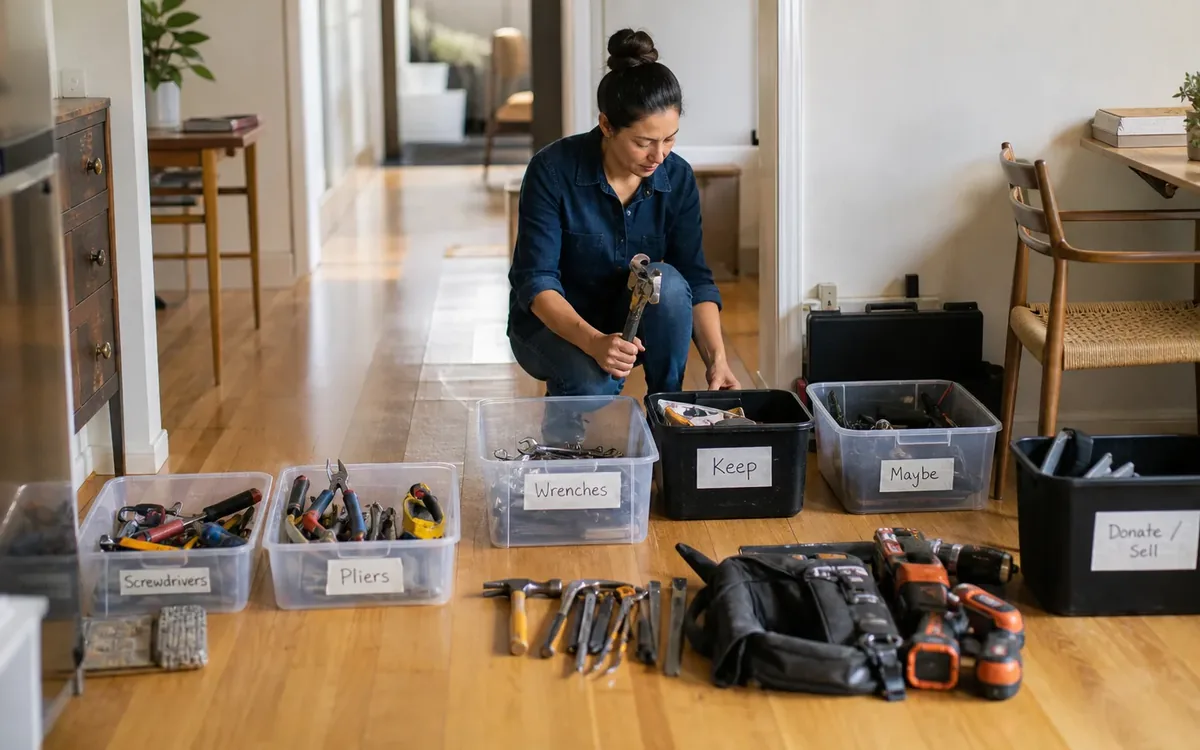
Which duplicate tools are worth keeping?
Duplicates are common because workshops grow one project at a time. Some duplicates are useful, but each one should have a reason.
Keep a duplicate when it serves a clear role, such as a second measuring tape for a portable kit, a backup battery for a regularly used platform, or two clamps needed at the same time. Consider releasing duplicates that are lower quality, uncomfortable to use, incompatible with the main system, or never selected.
Power-tool platforms deserve special attention. Group each tool with its compatible batteries, charger, case, accessories, and manual. Compare complete systems rather than individual drills or saws. Keeping one reliable platform may reduce charger and battery clutter, but the household should weigh condition, ergonomics, project needs, and replacement cost.
For hand tools, choose the best example rather than automatically keeping the newest one. Check for:
- Cracked or loose handles
- Excessive corrosion
- Chipped striking faces
- Damaged insulation
- Bent shafts or jaws
- Missing guards or safety parts
- Worn adjustment mechanisms
- Owner-applied modifications that may affect safety
A qualified repair professional or manufacturer guidance should resolve uncertain safety questions. An organizer can help compare and group items but should not certify that a tool is safe.
Separate value decisions from cleanout decisions
A fast cleanout can erase value when collectible, specialized, or professional-grade tools are mixed with ordinary hardware. Before sending items to donation or disposal, create a review zone for anything that may warrant research.
Potential review items include:
- Complete machinist or measuring sets
- Specialized trade tools
- Older branded hand tools
- Large stationary equipment
- Unusual planes, saws, vises, or anvils
- Complete battery systems in good condition
- Unopened consumables with transferable value
- Tools with documented ownership or provenance
The household may decide what it is willing to keep or release. A practical cleanout or move team may discuss sorting order, access, lifting concerns, staging space, and possible disposition categories. An appraiser determines value when a formal or specialist opinion is needed. An auctioneer, estate-sale provider, or resale platform decides what it will accept and under what terms.
Do not treat online asking prices as completed-sale values. Condition, completeness, local demand, shipping difficulty, and selling costs all matter. Obtain suitable professional input before distributing an estate, dividing jointly owned assets, or disposing of items that may have substantial value.
If ownership is uncertain, pause. An executor, personal representative, attorney, court, co-owner, or other responsible party may need to authorize the decision. A cleanout company does not decide title, inheritance rights, or legal distribution.
How should workshop supplies be reduced?
Supplies need a different process from durable tools. Sort them by condition, compatibility, storage risk, and whether another person or organization can lawfully accept them.
Fasteners and small hardware
Keep fasteners that are identifiable, useful, and stored in manageable quantities. Label bins by type and size. Mixed jars of rusty or unknown hardware usually consume more time than they save, but the final choice belongs to the household.
Lumber and sheet goods
Measure usable pieces and match them to real projects. Check for rot, infestation, embedded fasteners, severe warping, or water damage. A contractor or pest professional should evaluate concerns outside ordinary sorting.
Paints, finishes, adhesives, and solvents
Read labels and preserve them. Do not assume an opened container is safe, usable, or accepted by a disposal facility. Hardened, leaking, unlabeled, reactive, or flammable products require material-specific guidance from the relevant authority or facility.
Blades, bits, and abrasives
Pair accessories with the tools being kept. Protect sharp edges and discard damaged items through an appropriate method. Do not place exposed blades or sharp metal loosely into a bag.
Batteries and fuel
Separate rechargeable tool batteries, household batteries, lead-acid batteries, fuel, and fuel-powered equipment. Damaged or swollen batteries need careful handling under current official guidance. Movers, storage facilities, donation recipients, and disposal sites may each have different restrictions.
Where can unwanted tools and supplies go?
Choose a destination only after confirming ownership, condition, and acceptance rules. Useful routes may include:
- Transfer to relatives, neighbors, or friends
- Sale through an auction, estate sale, dealer, or marketplace
- Donation to an organization that has confirmed acceptance
- Return of rented or borrowed equipment
- Manufacturer or retailer take-back programs where offered
- Scrap recycling accepted by an appropriate facility
- Household hazardous-waste or other approved disposal channels
- Ordinary waste only when permitted and properly prepared
Call or check official instructions before loading a vehicle. Donation organizations may decline fuel-powered equipment, opened chemicals, incomplete tools, recalled products, or damaged electrical items. Disposal facilities may limit container types, quantities, residency, or materials.
Remove personal information from smart equipment, labels, cases, and service records. Keep serial numbers and receipts for retained high-value tools. For sold or transferred equipment, document the household’s decision as appropriate, particularly during an estate administration.
Firearms, ammunition, controlled items, and certain pressurized cylinders require separate handling. The responsible owner, attorney, law-enforcement authority, licensed dealer, fire authority, or other applicable professional should provide current direction. Do not place them in an ordinary donation, sale, or cleanout pile.
Plan the retained workshop before packing it
A scaled-down workshop works best when every retained item has a destination. Draw the future layout and assign zones for hand tools, portable power tools, hardware, protective equipment, and active project supplies.
Prioritize accessible storage. Frequently used items should not require lifting heavy bins or climbing. Store sharp tools securely, keep chemicals away from heat and ignition sources according to their instructions, and avoid overloading shelves.
Before a move, ask the selected mover or move manager about:
- Prohibited or restricted materials
- Fuel and battery preparation
- Weight or access concerns for machinery
- Required disassembly
- Protection for blades and sharp edges
- Conditions for transporting tool chests
- Documentation for unusually valuable equipment
A move team may discuss packing sequence, access, staging, and transport requirements within its scope. A qualified contractor should handle electrical disconnection, structural attachment, gas lines, ventilation, or complex machinery installation. A storage provider sets its own rules for chemicals, fuel, batteries, equipment, and insurance. None of those decisions should be assumed to be included in organizing or cleanout work.
For a home being prepared for sale, the owner and real-estate professional decide presentation goals. Licensed inspectors, contractors, and relevant authorities address defects, repairs, permits, and compliance. Clearing a workshop can improve access, but it does not establish that the space or its systems comply with applicable requirements.
A focused sequence for the final decisions
Use these seven passes to finish without repeatedly reconsidering the same objects:
- Ownership pass: Remove borrowed, disputed, business-owned, or estate-controlled property from ordinary sorting.
- Hazard pass: Isolate chemicals, fuel, batteries, sharp items, cylinders, and questionable materials.
- Value pass: Hold specialized or potentially collectible tools for informed review.
- Function pass: Choose the core set that supports planned projects.
- Duplicate pass: Retain only duplicates with a defined purpose.
- Destination pass: Confirm sale, donation, recycling, return, or disposal acceptance.
- Packing pass: Label retained tools by function and future storage location.
Photograph the retained layout before packing if someone else will unpack it. Label cords, accessories, keys, guards, and manuals so they stay with the correct equipment. Keep essential household tools accessible rather than burying them in general moving boxes.
FAQ
Should every old tool be appraised?
No. Start by separating specialized, collectible, professional-grade, or unusually complete items. A qualified appraiser or relevant specialist can advise when a formal valuation is appropriate. Organizers and cleanout teams should not present sorting opinions as appraisals.
Can partially used paint or chemicals be donated?
Possibly, but only if a recipient explicitly accepts the material and it is lawful and safe to transfer. Confirm container condition, labeling, and current acceptance rules. Otherwise, consult the appropriate local waste or environmental authority.
What if family members disagree about the tools?
Pause disposition and create a written inventory with photographs. The owner or legally authorized decision-maker should resolve distribution. Estates, disputed ownership, and jointly owned property may require an attorney or other responsible authority.
Can heavy workshop machines go into storage?
That depends on the facility’s rules, access, floor capacity, equipment condition, and insurance terms. The storage provider decides acceptance. Qualified movers or riggers should evaluate safe handling, while contractors or electricians address disconnection and installation.
How can Clutter Cleaner of South Carolina fit into the process?
Clutter Cleaner of South Carolina, physically based in Mount Pleasant and serving households statewide, may discuss applicable downsizing and organizing, estate cleanout, auction or estate-sale, move-management, home-sale preparation, and code-compliance support needs. The household retains control of ordinary keep-or-release choices unless a legally authorized representative is responsible. Appraisals, legal determinations, real-estate advice, inspections, contractor work, facility acceptance, and official compliance decisions remain with the relevant professionals or authorities. Call (843) 972-7020 to discuss the property and requested scope.



