
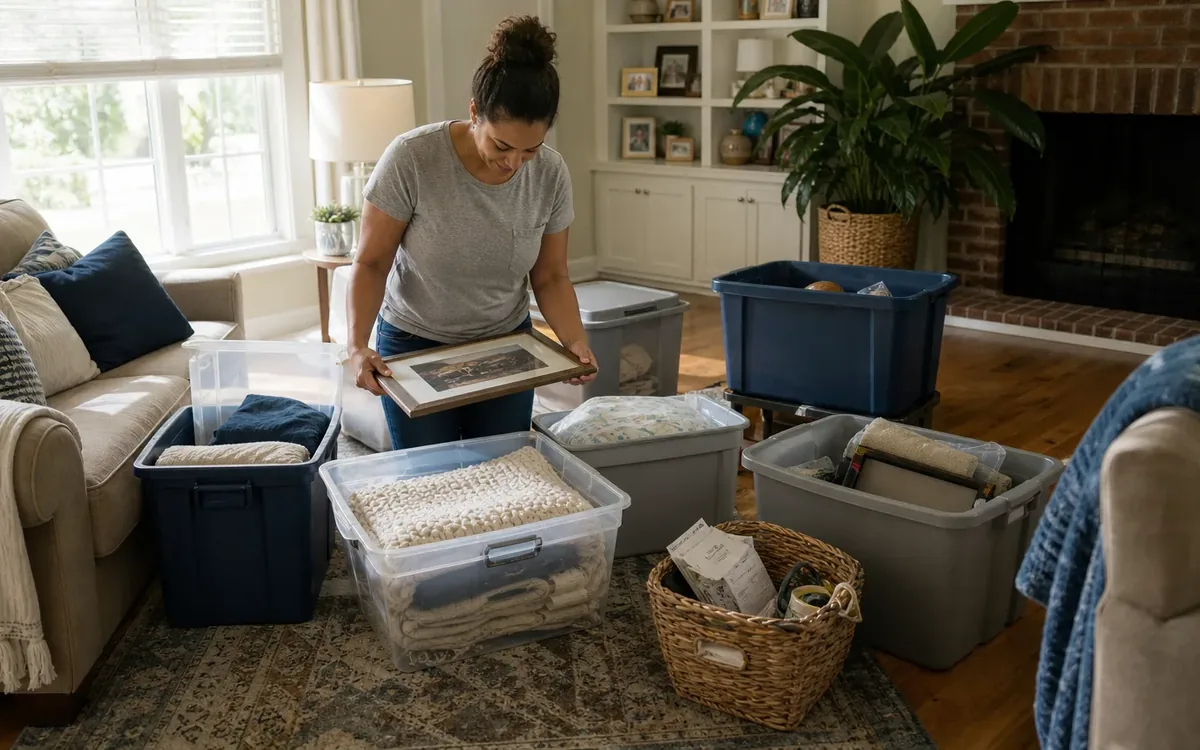
If storage bins have remained unopened for years, do not begin by emptying all of them at once. Start with one low-risk bin, identify why its contents were kept, and sort each item by its next destination. The goal is not simply to own less. It is to make deliberate decisions while protecting records, valuables, family items, and anything that needs professional review.
Quick answer: Label every bin before opening it, create a small sorting area, and work through one container at a time. Separate items into keep, relocate, give to a named person, sell or appraise, donate, recycle, dispose, and professional-review groups. Do not discard unidentified documents, valuables, hazardous materials, or property whose ownership is unclear.
Why are unopened bins difficult to downsize?
An unopened bin is often more complicated than a box of ordinary clutter. Its contents may represent an interrupted move, an inherited household, a former hobby, children’s belongings, financial records, or objects saved during a stressful transition.
Years without use provide useful evidence, but they do not automatically make everything disposable. You may not use a birth certificate, property record, or heirloom regularly, yet it can still be important. Conversely, an object may carry a strong memory without needing permanent storage.
Unopened bins also conceal the amount of work involved. Opening every container at once creates mixed piles and removes the boundaries that made the project manageable. A controlled sequence helps you preserve context and prevents undecided objects from spreading through the house.
For households that want structured sorting assistance, the statewide downsizing and organizing service explains the relevant service category. The household still controls decisions about personal property unless an authorized representative has legal decision-making responsibility.

Prepare a sorting area without unpacking everything
Choose a dry, well-lit space where you can examine objects safely. Use a table rather than the floor when possible, particularly for documents, glass, photographs, and small valuables. Keep pets, food, and drinks away from the work surface.
Before opening a bin, record what can be observed from outside:
- Existing labels, names, dates, or room descriptions
- The person who packed or owned the contents, if known
- Signs of moisture, pests, mold, rust, or damage
- Whether the lid is cracked or the container is unstable
- Any reason the bin may contain records, valuables, chemicals, or sharp objects
Create clearly marked destinations nearby. Avoid using a single vague category such as “deal with later.” Better labels include keep in home, transfer to family, possible sale, possible donation, recycling, disposal, and specialist review.
Have replacement folders or small boxes available, but do not buy a large storage system yet. Containers should support decisions already made. They should not become a new way to postpone those decisions.
If the bins are part of an inherited property, the process may involve authority, ownership, and estate questions beyond ordinary decluttering. The guide to what to get rid of first when downsizing provides useful context without treating every household bin as estate property.
Which storage bin should you open first?
Begin with a bin that is unlikely to contain emotionally intense, legally significant, hazardous, or highly valuable items. A container labeled for ordinary linens, seasonal decorations, or a discontinued hobby may be easier than one marked “family papers” or bearing a deceased relative’s name.
Use this four-step opening sequence:
- Photograph or copy the label. Preserve information about where the bin came from and who may have packed it.
- Open it carefully. Stop if you notice odors, active pests, leaking containers, visible mold, broken glass, or unstable contents.
- Identify the general category. Decide whether the bin contains household goods, records, memorabilia, collections, equipment, clothing, or mixed items.
- Finish that bin’s decisions before opening another. Place each item in a defined destination and record any unresolved question.
A practical cleanout or move team may discuss workflow, lifting concerns, sorting stations, packing, destination labels, and coordination needs. The team should not decide who legally owns property, authenticate collectibles, determine market value, interpret an estate document, or declare a material safe.

Use evidence instead of guilt to make decisions
The phrase “I might need it someday” does not distinguish a practical backup from an object that has merely remained out of sight. Ask questions tied to the item’s function and future location.
Consider:
- Did anyone remember or look for this item before the bin was opened?
- Is there a realistic use for it in the current or next home?
- Is a working duplicate already available?
- Would keeping it require paid storage or space needed for something more useful?
- Does it fit the household’s current health, mobility, hobbies, or family structure?
- Can the memory be retained through a photograph, written note, or smaller representative object?
- Is there a specific person who has agreed to receive it?
Avoid making a “keep” decision without assigning a location. If an object belongs in the home, identify the cabinet, closet, shelf, or room where it will live. If no suitable location exists, the household must weigh the object against the space it would occupy.
For sentimental groups, choose the best examples rather than retaining every similar object. One labeled folder of meaningful school papers may preserve the story better than several unsorted bins. A small set of representative decorations may carry the same tradition as damaged duplicates.
Guilt is not proof of usefulness, value, or obligation. It is a signal to pause and clarify why the item feels difficult.
What deserves professional review before leaving the home?
Some objects should be isolated rather than placed immediately into donation or disposal. A review pile should remain small and should name the needed decision. “Ask appraiser” is more useful than “maybe valuable.”
Set aside the following when relevant:
- Wills, trusts, deeds, titles, tax materials, military records, certificates, and identifying documents
- Jewelry, coins, signed works, collections, antiques, and objects with unclear value
- Firearms, ammunition, medicines, chemicals, fuel, paint, compressed cylinders, and unidentified liquids
- Electronics or media that may hold personal, financial, medical, or business data
- Items that may belong to an estate, business, former spouse, adult child, tenant, or another third party
- Materials showing mold, pests, contamination, or structural damage
- Objects restricted by a building, community, carrier, recycling program, or disposal facility
The appropriate professional depends on the question. An attorney or authorized estate representative addresses ownership, authority, and document interpretation. A qualified appraiser evaluates value for the stated purpose. A real-estate professional advises on market presentation. An inspector or relevant contractor evaluates property condition and repair needs. Local authorities, facilities, associations, or compliance professionals determine applicable handling and disposal requirements.
These roles should remain separate. A cleanout or organizing discussion can help identify which questions are unresolved, but it does not replace legal advice, an appraisal, an inspection, or an official disposal determination.
Give every item a specific next destination
A category is not complete until it leads somewhere. “Donate” is only a tentative decision until a recipient accepts the type and condition of item. “Give to family” remains storage unless the person wants it and a transfer plan exists.
Use destination-based decisions:
- Keep in the home: Assign a precise storage location and label it clearly.
- Transfer to a person: Confirm that the recipient wants it, then agree on pickup, delivery, or shipping separately.
- Consider for sale: Separate it for an auction, estate-sale, resale, or consignment discussion without assuming acceptance or proceeds.
- Seek an appraisal: Protect the item and provide any known history to an appropriate appraiser.
- Donate: Check the receiving organization’s current policies, condition standards, and acceptance limits.
- Recycle: Confirm requirements with the relevant program or facility before transport.
- Dispose: Verify restrictions for the material and location rather than placing every unwanted item in household trash.
- Store elsewhere: Compare the reason for storage with its ongoing space, access, security, and cost implications.
Clutter Cleaner of South Carolina lists auctions and estate sales among its services, but acceptance, valuation, sale method, and suitability are separate discussions. No household should assume that every old item has a resale market.
If off-site storage remains a choice, make it intentional. List what is being stored, why it must remain, who can access it, and what event will trigger another review. Storage providers set their own terms, access rules, security arrangements, and charges.
Prevent the “maybe” category from becoming another bin
Uncertainty is normal, especially when contents belong to several people or relate to a major transition. The problem begins when every uncomfortable decision is repacked without a reason.
Use five narrowly defined holds:
- Ownership hold: The person entitled to decide has not been identified or consulted.
- Legal hold: A responsible legal professional or authorized representative must address the item or record.
- Value hold: An appropriate appraiser, auction professional, or other market specialist needs to assess it.
- Safety hold: A facility, contractor, inspector, or authority must advise on handling.
- Recipient hold: A named person must accept or decline the item.
Write the reason and responsible contact on each hold container. Do not mix ordinary indecision with documents, suspected valuables, or unsafe materials.
When several family members are involved, use a written decision log. Record the object, its current location, the question, who may decide, and its eventual destination. This reduces repeated conversations and accidental removal.
How can you reduce the remaining bins without losing order?
Once decisions are complete, consolidate only items that share a purpose and destination. Do not combine unrelated leftovers merely to reduce the visible number of containers.
Keep household records in an appropriate record system, not mixed with keepsakes or decorations. Group photographs in archival materials chosen by the household. Place frequently needed objects where they can be reached without moving several bins.
Label retained containers with specific contents. “Holiday lights and tree stand” is better than “miscellaneous.” Include the owner or household member when that distinction matters.
Also note what should not return to long-term storage:
- Items awaiting an outside recipient
- Materials needing professional review
- Broken objects pending a repair decision
- Unidentified cords and parts with no matching device
- Donations that have not been checked against recipient policies
- Trash, recycling, food, leaking products, or damp textiles
If shelves, electrical work, repairs, pest treatment, mold evaluation, or other contractor work appears necessary, the household should select the appropriate provider and define that project separately. Organizing a bin does not establish whether building work is required or compliant.
Plan next steps for a move or home sale
A bin project often reveals decisions that affect a larger transition. Retained objects may need packing for a move. Unwanted furniture may need a separate removal plan. Repairs may need evaluation. Important records may need secure transport.
The household can decide what it wants to keep, who may receive personal items, and which goals matter most. An authorized representative may make those choices when the household cannot or when estate authority applies.
A practical move or cleanout team may discuss sequencing, sorting support, packing, removal categories, access, and coordination with other providers. A real-estate professional determines listing strategy and presentation recommendations. Inspectors and contractors assess condition and work. Authorities and associations decide applicable compliance matters. Appraisers address value, while attorneys address legal rights and obligations.
Keeping these responsibilities clear protects the project from rushed assumptions. It also lets each retained bin enter the next home for a known reason rather than by default.
Short FAQ
Should I discard a bin because nobody opened it for years?
No. Long disuse is evidence that ordinary contents may not be needed, but inspect the bin for records, valuables, ownership concerns, sentimental items, and restricted materials before deciding.
What if relatives disagree about the contents?
Pause removal of disputed items. Identify who has authority to decide and document each person’s request. Estate documents and ownership disputes should be addressed by the authorized representative or an appropriate legal professional.
Should I get old collectibles appraised?
Seek an appropriate appraisal when potential value could materially affect the decision or when value is needed for an estate, insurance, tax, donation, or sale purpose. The responsible professional can explain the appraisal type and scope.
Can all unwanted items go to a donation center?
No. Acceptance policies vary by organization, item type, and condition. Confirm current rules before loading or transporting anything.
Where does Clutter Cleaner of South Carolina fit?
Clutter Cleaner of South Carolina is physically located in Mount Pleasant, with Charleston as its primary market and service territory across South Carolina. Its listed services include downsizing and organizing, estate cleanouts, move management, auctions and estate sales, home sale preparation, and code compliance support. Specific scope should be discussed directly at (843) 972-7020, while legal, appraisal, real-estate, inspection, contractor, and official compliance decisions remain with the appropriate professional or authority.



