

The best way to downsize outdoor furniture is to plan around the next outdoor space, not the amount of furniture you currently own. Identify the activities the new area must support, confirm its usable dimensions and restrictions, then keep only pieces that fit those needs without blocking doors, walkways, railings, or maintenance access.
Quick answer: Sketch the new outdoor area, mark fixed obstacles, and assign each remaining zone a purpose. Keep the smallest useful combination of furniture that fits those zones. Sell, donate, gift, recycle, or dispose of everything else according to its condition and local requirements.
This focused approach is more reliable than trying to shrink an entire patio set by instinct. A smaller outdoor area may have enough square footage for several chairs, yet still feel crowded once door swings, planters, grills, stairs, and circulation paths are considered.
If the outdoor decisions are part of a broader household transition, review Clutter Cleaner of South Carolina’s downsizing and organizing service. For a move involving an inherited property, the guide to how to arrange furniture in a small home explains the larger process without treating every possession as an ordinary discard.
What Will You Actually Do in the New Outdoor Space?
Start with activities rather than objects. A large dining table may be attractive, but it should not consume most of a small patio if outdoor dining will be rare. Conversely, someone who eats outside regularly may prefer a compact dining setup over a lounge chair and several decorative pieces.
Choose the primary use of the space. Possibilities include:
- Drinking coffee or reading
- Eating meals outdoors
- Entertaining a few guests
- Gardening in containers
- Grilling or outdoor cooking
- Providing a secure place for a pet
- Relaxing with a view
- Creating shade near the home
Then choose one secondary use, if room permits. Trying to preserve every former activity usually produces a cramped arrangement. A compact space often works better when it serves one purpose well and accommodates another through folding, stacking, or movable furniture.
Consider who will use it. Seat height, chair arms, stability, weight, and ease of movement may matter more than how many seats technically fit. A low lounge chair may be difficult for one household member to use. A lightweight chair may be convenient to move but unsuitable for an exposed area unless it can be secured or stored appropriately.
The household decides which activities and comfort needs matter most. A practical downsizing or move team may help sort pieces, label decisions, and coordinate an agreed plan. Medical accessibility needs should be discussed with the appropriate healthcare or accessibility professional rather than assumed by a cleanout team.

How Do You Test Whether Furniture Fits the Next Space?
You do not need to measure every item you own. First measure the destination, then measure only the pieces that remain plausible candidates.
Record the usable length and width of the patio, balcony, porch, deck, or yard section. Add fixed features that reduce usable space:
- Doors and their swing paths
- Steps and changes in elevation
- Railings, columns, and posts
- Utility equipment and access panels
- Hose connections and drains
- Built-in grills, counters, or benches
- Planters that will make the move
- Roof supports, low overhangs, or sloped ceilings
- Gates and access routes
Make a simple scaled sketch or mark dimensions on graph paper. Paper cutouts representing the candidate furniture can be moved around before anything is transported. Painter’s tape can also show furniture footprints in an empty space, provided its use is suitable for the surface.
Do not plan wall-to-wall coverage. Chairs need room to pull back, people need room to pass, and doors must operate freely. Maintenance and emergency access cannot be sacrificed to fit another table or storage box.
For a condominium, apartment, rental, or community with an owners association, check the governing documents or written property rules. These may address balcony loads, grills, rail attachments, exterior appearance, storage, or items in shared passages. Property management, the association, the landlord, a qualified inspector, or another responsible authority interprets and enforces those requirements. A moving or cleanout provider should not decide that a placement is compliant.
Which Outdoor Pieces Earn a Place in the New Home?
Evaluate each candidate using function, fit, condition, and effort. Sentiment can also matter, but it should be an explicit reason rather than a reason to avoid deciding.
A piece is a strong candidate to keep when it:
- Supports the primary planned activity
- Fits the mapped zone with adequate clearance
- Is comfortable for its intended users
- Is structurally sound
- Can tolerate the degree of exposure at the new property
- Is manageable to clean, move, or store
- Works with other pieces being retained
Multifunctional furniture can help, but only when each function is genuinely useful. A storage bench is not an advantage if its lid cannot open in the selected location. An extension table is not useful if expanding it blocks the only walkway. Folding chairs save space only if there is an appropriate place to keep them when folded.
Condition deserves a close look. Check frames, welds, fasteners, joints, slats, woven surfaces, glass, cushions, umbrellas, canopies, and moving mechanisms. Look for instability, sharp edges, corrosion, rot, cracking, mold, staining, or missing hardware.
The household can decide whether cosmetic wear is acceptable. A qualified repair contractor or furniture specialist should assess structural repair questions when safety or durability is uncertain. Do not assume a damaged piece is safe because it still stands upright.
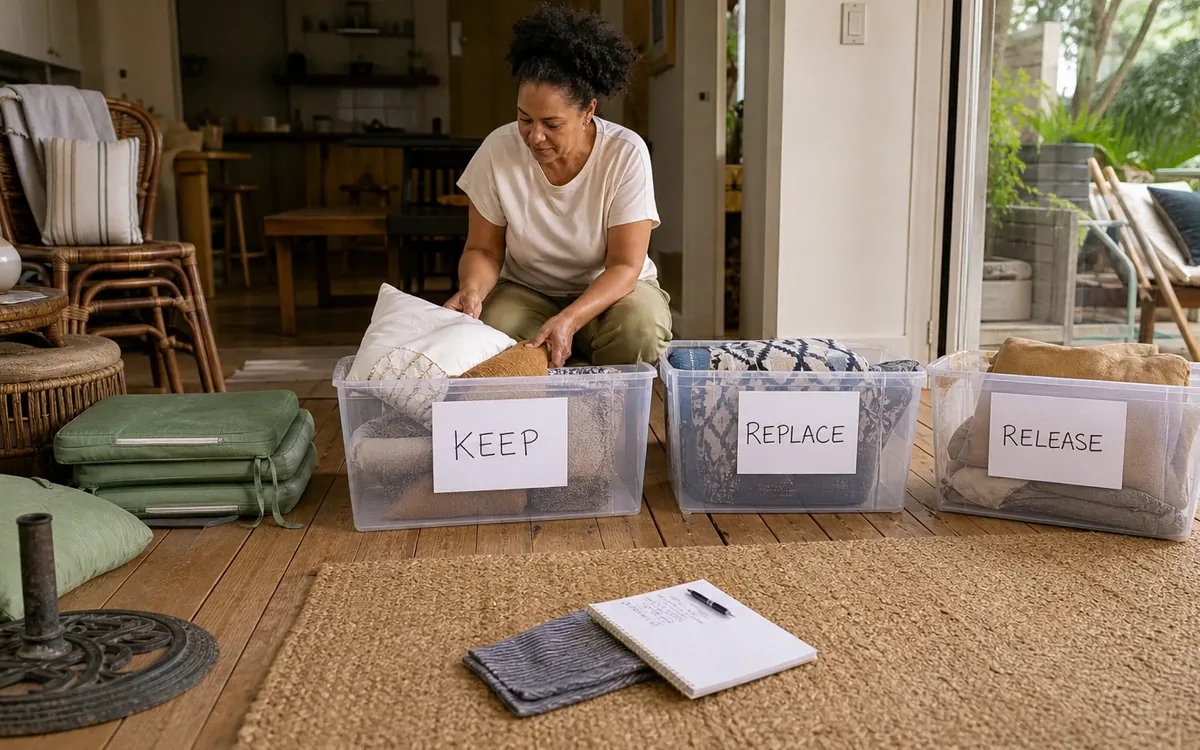
Use a Keep, Replace, or Release Decision
A three-way decision is more useful than a simple keep-or-discard choice. It recognizes that an item may serve a valid purpose but still be wrong for the new setting.
Keep
Keep an item when it fits, supports a priority activity, and is in suitable condition. Record its destination, such as “covered porch reading corner,” so it does not become an unassigned object at the new home.
Replace
Replace an item when its function is needed but its size, shape, condition, or storage demands do not suit the destination. Examples include replacing a long rectangular table with a smaller round table or exchanging a deep sectional for upright chairs.
Replacement does not have to happen before the move. Living with an open space can reveal what is actually missing and prevent an unnecessary purchase. Purchasing decisions belong to the household, including budget, materials, warranty, and delivery arrangements.
Release
Release an item when it has no planned role, cannot fit safely, duplicates something better, or requires more care than the household wants to provide. Assign a disposition method instead of leaving the piece in an undecided pile.
Use labels or an inventory note to prevent confusion, especially when relatives, movers, or multiple providers are involved. Separate “keep” from “replace later.” Otherwise, an unsuitable piece may be moved simply because it was not marked for disposal.
How Should You Handle Sets and Sentimental Pieces?
Outdoor furniture does not have to remain as a complete set. Keeping two chairs from a six-chair dining group may be sensible if they fit the next porch and work with a smaller table. A side table can move without its matching loungers. Cushions and covers should stay only when they match retained items.
Before splitting a set, consider whether selling or consigning it intact could be more practical. An auctioneer, estate-sale company, consignment business, or resale professional can advise on marketability and presentation. If value is significant or uncertain, use a qualified appraiser. A cleanout or move team may discuss logistics, but it does not determine formal value unless separately qualified to do so.
Sentimental pieces need a defined test. Ask what carries the meaning: the furniture itself, the memories associated with the former home, or a particular detail. Options might include:
- Keeping one representative chair
- Retaining a small side table instead of a full group
- Photographing the original arrangement
- Giving pieces to relatives who want and can use them
- Reusing a removable plaque or decorative element, when appropriate
Do not dismantle a valuable, historic, or structurally complex piece without suitable advice. Alterations can affect integrity and value. The owner, authorized decision-maker, appraiser, conservator, or relevant specialist should direct those choices.
Account for South Carolina Outdoor Conditions
The furniture’s exposure at the destination matters more than a broad label such as “outdoor rated.” A screened porch, uncovered balcony, shaded courtyard, and open yard create different maintenance and storage demands.
South Carolina households may need to consider strong sun, rain, humidity, pollen, salt exposure in coastal settings, and severe weather planning. Conditions vary across the state and by property. Inspect the actual location rather than assuming an inland yard and a coastal balcony need the same materials or storage plan.
Ask practical questions:
- Will cushions stay covered or need indoor storage?
- Can lightweight pieces be secured or moved when necessary?
- Is there a dry place for furniture covers?
- Will water collect beneath a rug, planter, or storage box?
- Can the furniture be moved for cleaning and property maintenance?
- Does the material require upkeep the household intends to perform?
A contractor may address repairs, anchoring, built-ins, deck work, or construction. A qualified inspector may evaluate relevant property conditions. Building officials, fire authorities, property managers, landlords, or associations decide applicable compliance questions. The household should obtain required approvals rather than relying on furniture placement advice from a move or cleanout team.
Decide Where Released Furniture Will Go
Disposition should reflect condition, ownership, value, and local acceptance rules. Avoid assuming that every charity accepts large outdoor pieces or that municipal collection will take them.
Common routes include:
- Giving usable pieces to family, friends, or neighbors
- Selling them directly
- Working with an auction, estate-sale, or consignment provider
- Donating them to an organization that confirms acceptance
- Recycling eligible metal or other materials at an appropriate facility
- Using an authorized disposal option for unusable items
Confirm ownership before anything leaves the property. This is especially important during an estate, divorce, trust administration, or shared household move. The executor, personal representative, trustee, owner, attorney, court, or other authorized party should settle legal authority and disputed property questions.
Remove personal contents from storage benches, cabinets, and cushion boxes. Check under cushions and inside zipped covers. Keep hardware with disassembled furniture and clearly identify which piece it belongs to.
A practical cleanout or move team may discuss sorting categories, removal access, sequencing, and the household’s selected destination for items. Donation acceptance, recycling eligibility, disposal rules, sale method, and valuation remain separate decisions governed by the receiving organization, facility, sales professional, appraiser, owner, or responsible authority.
Plan the Move Without Moving Too Much
Finalize outdoor furniture decisions before general loading whenever possible. Large pieces can occupy substantial vehicle and staging space, and a vague “take it for now” choice transfers the problem to the smaller home.
Use this four-step sequence:
- Confirm the destination. Verify the usable layout, access route, property rules, and intended activities.
- Select the pieces. Mark each item as keep, replace, or release, and record its assigned location or disposition.
- Prepare retained furniture. Clean it, remove loose components, contain hardware, and note any assembly needs.
- Complete release arrangements. Confirm recipients, appointments, provider terms, facility rules, and authorization before move day.
Storage should be a deliberate household choice, not the automatic destination for unresolved furniture. Compare the reason for storage with the cost, access needs, protection offered, and a plan for later review. Storage facilities determine their own terms and prohibited items.
For items that need disassembly, refinishing, structural repair, electrical work, gas-line work, anchoring, or construction, consult the appropriate contractor or specialist. A move team may coordinate access or sequencing when agreed, but contractor scope, permits, workmanship, and code compliance remain with the contractor and applicable authorities.
Short FAQ
Should I keep extra outdoor chairs for visitors?
Keep extras only if they have a realistic storage place and can be brought out without disrupting the home. Folding or stacking chairs may work, but borrowing or renting for unusual gatherings can avoid permanent crowding.
Is a storage bench always useful in a small space?
No. Measure the bench with its lid or doors fully open, and confirm that stored contents tolerate the location. A bench that blocks circulation or traps moisture is not an efficient use of space.
Can I donate weathered patio furniture?
Possibly, but the receiving organization decides what it accepts. Describe the condition accurately and confirm its policy before arranging transport. Broken or unsafe furniture may need recycling or authorized disposal instead.
Who decides whether furniture is allowed on a balcony?
The applicable property rules and responsible authorities control that decision. Consult the landlord, property manager, association, inspector, building official, or fire authority as relevant. Do not rely on a mover or cleanout provider for a compliance determination.
When should I request an appraisal?
Consider a qualified appraiser when an item may have meaningful financial, historic, or collectible value, or when an estate or legal process requires formal valuation. Resale estimates and formal appraisals are not interchangeable.
The goal is not to recreate a large patio in a smaller footprint. It is to preserve the outdoor activities that matter with fewer, better-suited pieces. Once each retained item has a purpose and a safe destination, the rest of the move becomes easier to organize without carrying an old space plan into a new home.



