
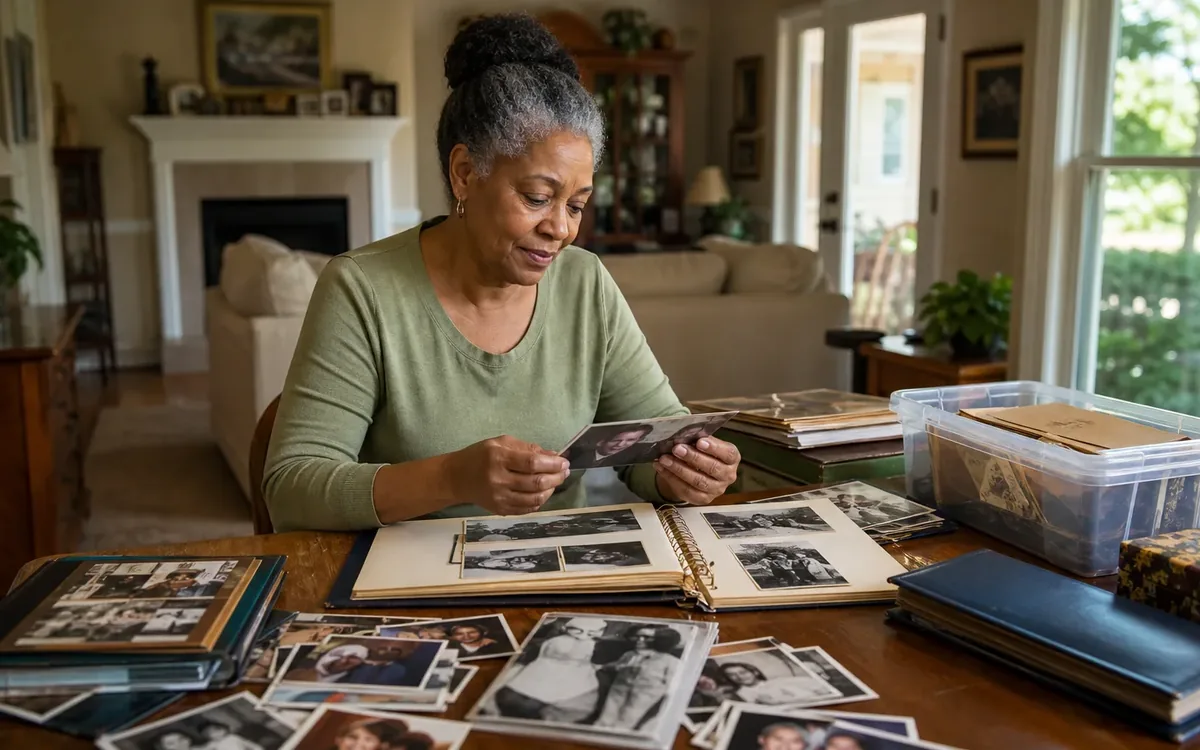
The best way to decide which family photos to keep when downsizing is to preserve the images with the strongest meaning, clearest identities, best quality, and least duplication. Start by gathering photos into broad groups, remove obvious discards, choose representative images from repeated events, ask relatives what matters to them, and scan selected originals. You do not need to preserve every print to protect your family story.
Quick answer: Keep photos that identify people, document important relationships or events, trigger a specific memory, or are difficult to replace. Share duplicates, scan bulky collections, and let go of blurred, damaged, unidentified, or repetitive images unless they carry unusual family significance.
The hard part is rarely finding boxes or albums. It is deciding what deserves limited space without feeling that discarding a photograph means discarding a person. A structured process separates emotional decisions from routine sorting and makes the collection more useful to whoever receives it.
Why Is Choosing Family Photos So Difficult?
Photos combine memory, identity, and responsibility. A faded snapshot may look unimportant to one person but be the only image another relative has of a grandparent, childhood home, military uniform, family business, or community gathering.
Downsizing adds pressure because the new home may have less storage. The collection may also belong to several generations, leaving one person to interpret what the whole family might value. Unlabeled photos create another problem: their importance may disappear when the last person who recognizes the subjects can no longer identify them.
It helps to separate three questions:
- Is this image meaningful? Consider the person, relationship, story, place, or event it represents.
- Does this physical copy need to survive? A digital version or another relative’s copy may preserve its useful content.
- Who should make the final choice? Some images should be offered to relatives rather than discarded by one decision-maker.
A household can decide which memories matter, who should receive originals, and how much physical storage to reserve. A practical downsizing and organizing service may discuss sorting zones, packing methods, room sequencing, and how photo decisions fit into the larger move. The household, however, remains responsible for sentimental choices unless an authorized representative has been appointed to decide.
What Should You Do Before Sorting Individual Photos?
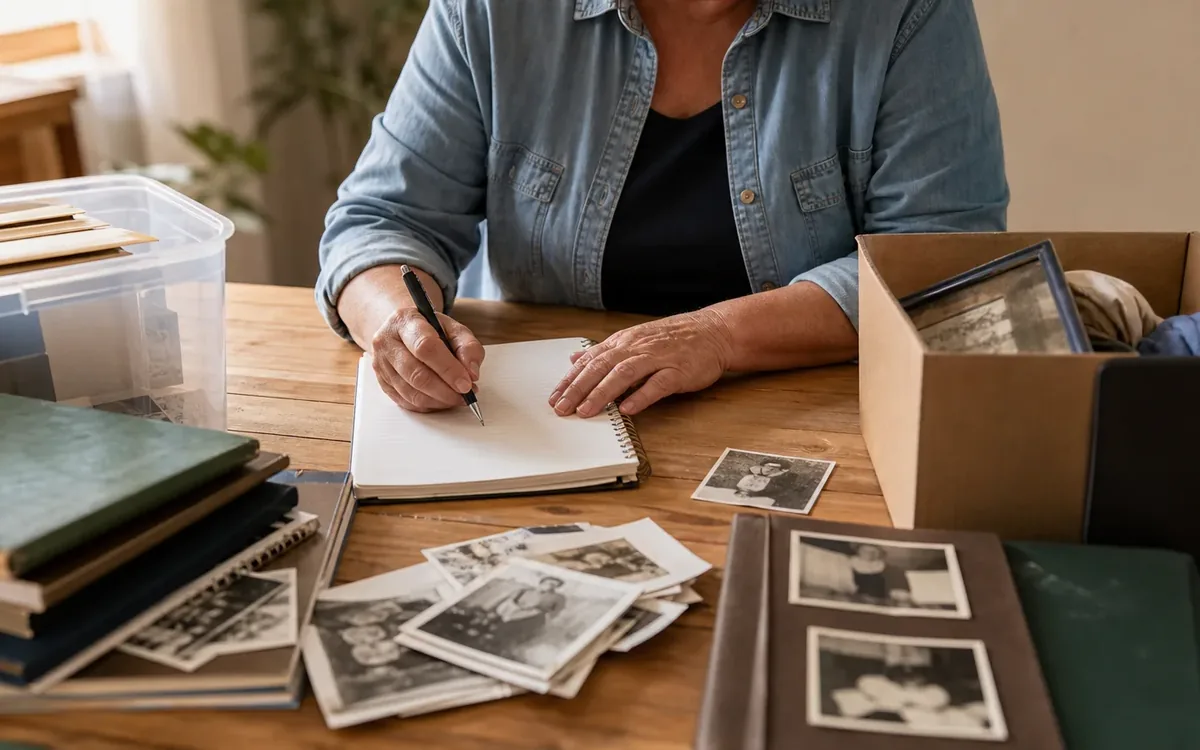
Do not begin by examining every image in detail. First, build a simple structure around the collection. This prevents one emotionally charged album from consuming all the available attention while other boxes remain untouched.
Use these five preparation steps:
- Gather accessible photo materials. Include loose prints, framed pictures, albums, slides, negatives, labeled envelopes, and removable digital media. Do not dismantle fragile albums merely to consolidate them.
- Choose a safe sorting area. Use a clean, dry surface away from food, direct sunlight, pets, and open drinks.
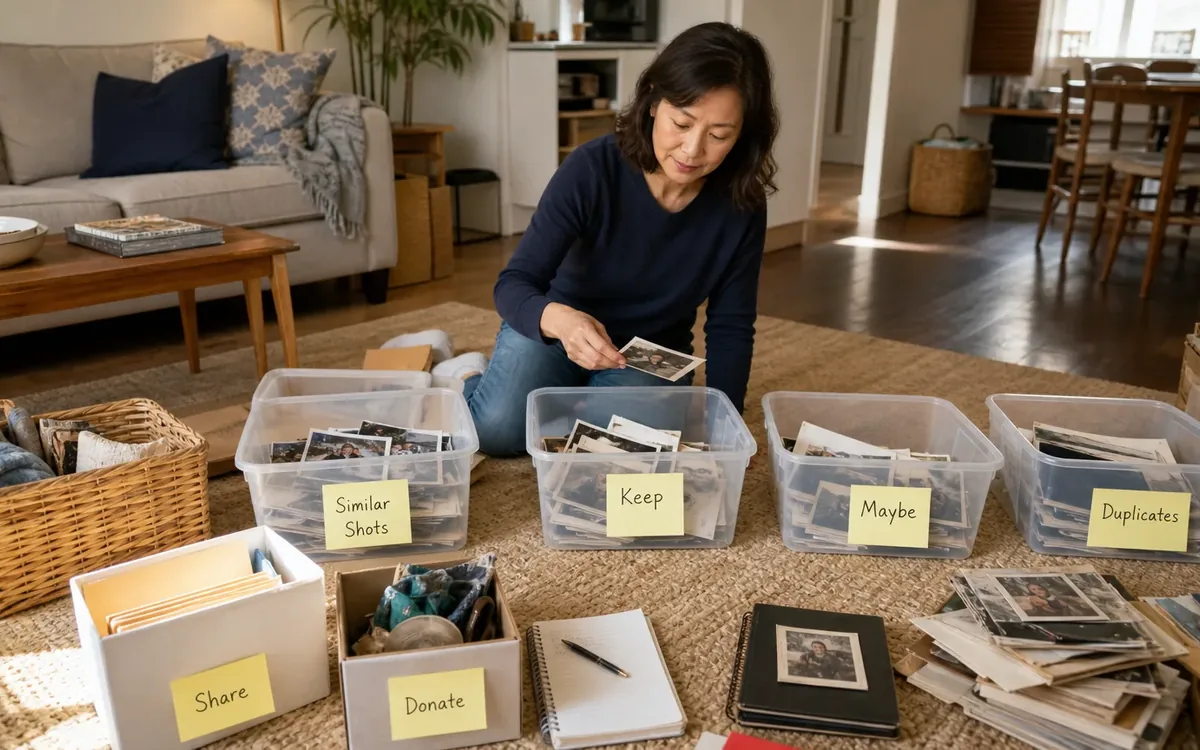
- Create broad destination groups. Useful labels include keep as original, scan then decide, share with family, research identity, and discard.
- Set a physical limit. Decide how many archival boxes, albums, or shelves can reasonably fit in the next home.
- Identify family contacts. List relatives who may recognize unknown people or want particular branches of the collection.
Keep labels and handwritten notes with their corresponding photos. The writing on an envelope or album page may hold more identifying information than the image itself. Photograph labels before separating anything.
If the photos are part of a larger inherited household, read the guide to how to declutter when everything is sentimental before removing items. It explains why authority, records, valuables, and family communication should be addressed before broad disposal begins.
Which Family Photos Are Worth Keeping?
A photo is a strong candidate for retention when it does at least one job well. It might identify a person, preserve a relationship, document a meaningful place, or tell a family story that cannot easily be reconstructed.
Prioritize images with these characteristics:
- The people are known or can probably be identified.
- The image is the best or only record of a person or relationship.
- It captures a milestone, tradition, reunion, ordinary family routine, or important location.
- Someone has written names, dates, places, or context on it.
- It shows details that descendants may value, such as clothing, homes, workplaces, vehicles, crafts, or family possessions.
- It has strong emotional meaning to a current family member.
- It is an original with no known duplicate.
- The photograph itself may have historical, artistic, or financial significance.
Ordinary scenes can be more informative than formal portraits. A kitchen table, backyard, porch, workshop, or holiday meal may reveal how family members actually lived and related to one another. Do not keep only posed pictures.
At the same time, avoid treating age as the only measure of value. An old unidentified landscape may contribute less to the family record than a recent image of several generations together. Use context, uniqueness, and meaning as the main standards.
When a photo, album, negative, or related document may be valuable, consult a qualified appraiser or appropriate specialist before selling, donating, altering, or discarding it. A cleanout or move team may isolate the item and follow the household’s handling instructions, but appraisal and authentication decisions belong to the selected professional.
How Can You Reduce Duplicates Without Losing the Story?
Repeated images often create most of the volume. Families may have multiple prints from the same negative, near-identical shots from an event, or several envelopes containing different exposures of one pose.
Compare duplicates as a group rather than one at a time. Keep the copy with the best focus, composition, condition, and useful writing. If two versions reveal different people or background details, retain both when those differences add meaning.
For a long sequence from one occasion, choose a small set that covers distinct parts of the story. For example, an event group might include:
- One image that establishes the place
- One clear group portrait
- One candid interaction
- One image featuring an important person not shown elsewhere
- One detail that explains the tradition or occasion
That is not a rigid quota. A major event may justify more, while an ordinary roll of near-identical pictures may justify fewer. The goal is representative coverage, not arbitrary reduction.
Duplicates can also become a sharing opportunity. Offer clearly labeled copies to the relatives pictured in them. Ask family members to select what they genuinely want rather than distributing equal stacks that may become unwanted clutter in several homes.
How Should Unidentified and Sensitive Photos Be Handled?
Unknown photos deserve a research stage, but not necessarily permanent storage. Group them by visual clues such as album source, location, clothing, handwriting, processing style, or recurring faces. Keep them connected to the box or album where they were found because proximity can provide context.
Send clear digital copies to selected relatives with focused questions. Asking, “Is this person connected to the Wilson side of the family?” is easier to answer than sending a large folder with no direction. Record both confirmed identifications and uncertainty. Do not turn guesses into facts.
After reasonable family review, retain unidentified images when they have distinctive locations, inscriptions, or apparent connections to known people. A large volume of anonymous, repetitive, or poor-quality images may not warrant space simply because it is old.
Sensitive photos require separate judgment. They may reveal adoption, prior relationships, medical circumstances, conflict, or other private matters. Consider who owns the materials, who appears in them, and who is authorized to make decisions. Avoid casually sharing private images in group messages or public online spaces.
If ownership is disputed, an estate is unsettled, or instructions in legal documents may control the collection, pause distribution and disposal. The personal representative, attorney, court, or other responsible authority should resolve legal authority. A practical cleanout team can work from authorized instructions but should not determine ownership or interpret estate documents.
Should You Scan Photos or Keep the Originals?
Scanning is useful for access, sharing, and reducing the need to handle fragile prints. It does not automatically make the physical original unnecessary. Keep originals when they are unique, annotated, historically meaningful, visually superior to the scan, or personally valued as objects.
A sensible preservation approach has four parts:
- Select before scanning. Digitizing every blurry duplicate transfers clutter into a harder-to-manage digital form.
- Use consistent file names. Include known surnames, approximate dates, events, or places without claiming uncertain details as facts.
- Add context. Store names and stories in file metadata, a companion document, or a clearly indexed folder system.
- Maintain separate copies. Do not rely on one phone, computer, drive, or account as the only location.
Scanning can be completed by the household or a separate digitization provider. Ask any provider about handling methods, image resolution, color correction, file formats, privacy, return shipping if applicable, and what happens to temporary copies of the files. Those choices are separate from physical downsizing assistance.
Storage also requires its own decision. The household may keep photos at home, ask a relative to hold them, or hire a storage provider. Review access, climate conditions, insurance, and contract terms directly with that provider. No cleanout decision can guarantee long-term preservation in a separate facility.
Build a Photo Collection That People Can Understand
Keeping fewer images works best when the remaining collection is organized and labeled. A compact, understandable archive is more likely to be opened, shared, and passed on than several mystery boxes.
Choose one primary system that suits how your family remembers. Options include:
- Family branch
- Household or generation
- Decade
- Major life stage
- Place
- Event type
Avoid overly detailed categories that require constant interpretation. A basic structure with accurate labels is better than an elaborate unfinished system.
Write identifying information with care. For physical photos, use materials appropriate for photo labeling and avoid pressing hard enough to mark the image. Preserve original handwriting even when adding a clearer transcription. For digital files, distinguish exact dates from estimates, such as “circa 1970s” rather than inventing a year.
Include a short collection note explaining who organized the photos, what family lines are represented, what remains uncertain, and where digital copies are stored. This provides context future relatives would otherwise have to reconstruct.
Fit Photo Decisions Into the Wider Downsizing Plan
Family photos should have their own decision lane within the move. Mixing them into general household piles increases the risk of accidental disposal and stalls progress on furniture, clothing, kitchenware, and paperwork.
A practical sequence is to stabilize and label the photo collection, move it to a protected review area, and continue downsizing the rest of the home. Return to detailed photo decisions in focused sessions rather than trying to complete them during general packing.
The household can decide:
- How much space the final collection may occupy
- Which relatives should be consulted
- Which originals remain with the household
- What may be scanned, shared, donated, sold, or discarded
- Who receives access to digital files
A downsizing, cleanout, or move-management team may discuss protected staging areas, packing categories, transport instructions, and how retained boxes fit into the move plan. It may also follow authorized directions for items designated for removal. Specific availability and scope should be confirmed directly before relying on any service.
Other decisions remain separate. Appraisers determine value within their professional scope. Real-estate professionals advise on listing and sale strategy. Inspectors assess property conditions. Contractors decide how to perform agreed repair or installation work. Disposal facilities and local authorities determine acceptance and compliance requirements. Attorneys, courts, or authorized estate representatives address ownership and legal authority.
A Final Decision Test for Difficult Photos
When one image is hard to release, ask these six questions:
- Do I know who, where, or what this shows?
- Does it tell a story not preserved elsewhere?
- Is it the best version among similar images?
- Would a specific person genuinely value the original?
- Would a scan preserve what matters about it?
- Does keeping it fit the space assigned to the collection?
No single answer controls the result. A photograph may deserve retention because it is emotionally irreplaceable even if it is damaged. Another may be visually perfect but offer no recognizable connection to the family.
Use a temporary research group for unresolved items, but define what still needs to happen, such as contacting a relative or comparing another album. An undecided box without a next action is merely postponed clutter.
FAQ
Is it wrong to discard old family photos?
No. Age alone does not create an obligation to keep every print. Preserve meaningful, identifiable, unique, or historically relevant images, then make deliberate decisions about duplicates and photos with no usable context.
Should every relative receive an equal share?
Not necessarily. A better goal is a fair opportunity to express interest. Some relatives may prefer digital copies, while others may value originals connected to their branch of the family.
Can damaged photos be thrown away?
First determine whether the image is unique and whether a restoration or scanning specialist could recover useful detail. The household can then weigh its meaning against condition, cost, storage, and replacement options.
What if family members disagree?
Pause irreversible steps. Share scans for discussion, document requests, and confirm who has authority to decide. Ownership or estate disputes should go to the responsible attorney, representative, court, or other appropriate authority.
Where should downsizing help begin?
Begin by clarifying the new home’s space, the household’s priorities, and who can authorize decisions. Clutter Cleaner of South Carolina is based in Mount Pleasant, serves households statewide, and can be reached at (843) 972-7020 to discuss whether its downsizing and organizing scope fits the situation.



