

A decision log gives family members one shared record of what should happen to belongings, who agreed, and what remains unresolved. Create a simple table, assign each item a unique number, record each person’s request, and confirm the final decision before anything is moved, donated, sold, stored, or discarded.
Quick answer: Photograph each significant item, give it an item number, list the available choices, set a response date chosen by the family, document every person’s preference, and name the person authorized to confirm the outcome. Keep disputed items physically separate until the appropriate family member, estate representative, attorney, appraiser, or other responsible professional resolves the issue.
A log is useful during downsizing, an estate cleanout, a household move, or preparation for a home sale. Its main purpose is not to decide who is legally entitled to an item. It is to prevent memory gaps, duplicate promises, accidental disposal, and confusion about what has already been decided.
What should a shared-belongings decision log contain?
The log should contain enough information to identify an item and reconstruct the decision without relying on anyone’s memory. A spreadsheet works well for a large household, while a notebook or shared document may be sufficient for a smaller project.
Use these fields:
- Item number: A unique code such as K-014 for a kitchen item or BR2-006 for an item in the second bedroom.
- Brief description: Include distinguishing features, not just “table” or “jewelry.”
- Current location: Record the room, closet, cabinet, box, or storage area.
- Photo reference: Link the entry to one or more clear photographs.
- Known ownership: State only what is supported by a will, trust, title, receipt, written gift record, or other reliable information.
- Family requests: Record each interested person’s preference separately.
- Proposed outcome: Keep, distribute, sell, donate, store, recycle, discard, or hold for review.
- Decision authority: Identify who is permitted to approve the outcome.
- Status: Mark the item as unreviewed, requested, disputed, approved, or completed.
- Completion details: Note who received it, the date it left the property, and any receipt or transaction reference.
Do not place sensitive account numbers, full financial details, combinations, or unnecessary personal information in a broadly shared file. Restrict access when the log covers valuables, documents, firearms, medication, or private records.
Families that need help sorting possessions into workable categories can review downsizing and organizing services. The household still determines sentimental priorities and personal preferences, while any ownership or fiduciary question belongs with the person or professional who has authority to decide it.

How do you build the log without creating more conflict?
A neutral process is more useful than a perfect spreadsheet. Build the log before relatives begin removing items, and apply the same recording rules to everyone.
Follow this six-step sequence:
- Define the purpose. State whether the household is downsizing, settling an estate, moving, or preparing a property for sale. This keeps unrelated issues out of the item discussion.
- Confirm who participates. List the people allowed to request belongings and identify the person who can approve final outcomes.
- Inventory before distributing. Photograph and label items where they are found. Avoid moving them into unlabeled piles.
- Collect preferences separately. Let each participant submit choices without editing another person’s request.
- Resolve overlaps under an agreed rule. Use the family’s selected process only after ownership and authority are clear.
- Record completion. Update the log when an item is picked up, shipped, sold, donated, stored, or discarded.
Before starting, agree on vocabulary. “Claimed” might mean someone expressed interest, while “assigned” means the authorized decision-maker approved that person as the recipient. If those terms are used interchangeably, a preliminary request can be mistaken for a final decision.
For an estate-specific sequence, see how to declutter when everything is sentimental. That guide provides broader cleanout context, while the decision log here focuses specifically on tracking shared belongings.
Which belongings deserve individual entries?
Not every object needs its own row. The family can group ordinary, low-concern items, but anything valuable, sentimental, disputed, legally regulated, or difficult to replace should have an individual entry.
Create separate records for:
- Jewelry, watches, coins, and collections
- Artwork, antiques, and signed objects
- Family photographs, albums, letters, and genealogical records
- Titled property and ownership documents
- Items specifically mentioned in estate-planning documents
- Objects promised to more than one person
- Firearms, ammunition, medication, and regulated materials
- Digital devices that may contain personal information
- Keys, safe-deposit information, and access devices
- Anything a participant identifies as emotionally significant
Household staples can often be entered by group, such as “pantry cookware” or “garage hand tools,” if nobody disputes them and the authorized person approves that approach. Do not group items merely to make a disagreement less visible.
Use photographs that show the entire item and any maker’s marks, signatures, labels, serial numbers, condition concerns, or contents. Photos document identity, but they do not establish ownership, authenticity, condition, or value.
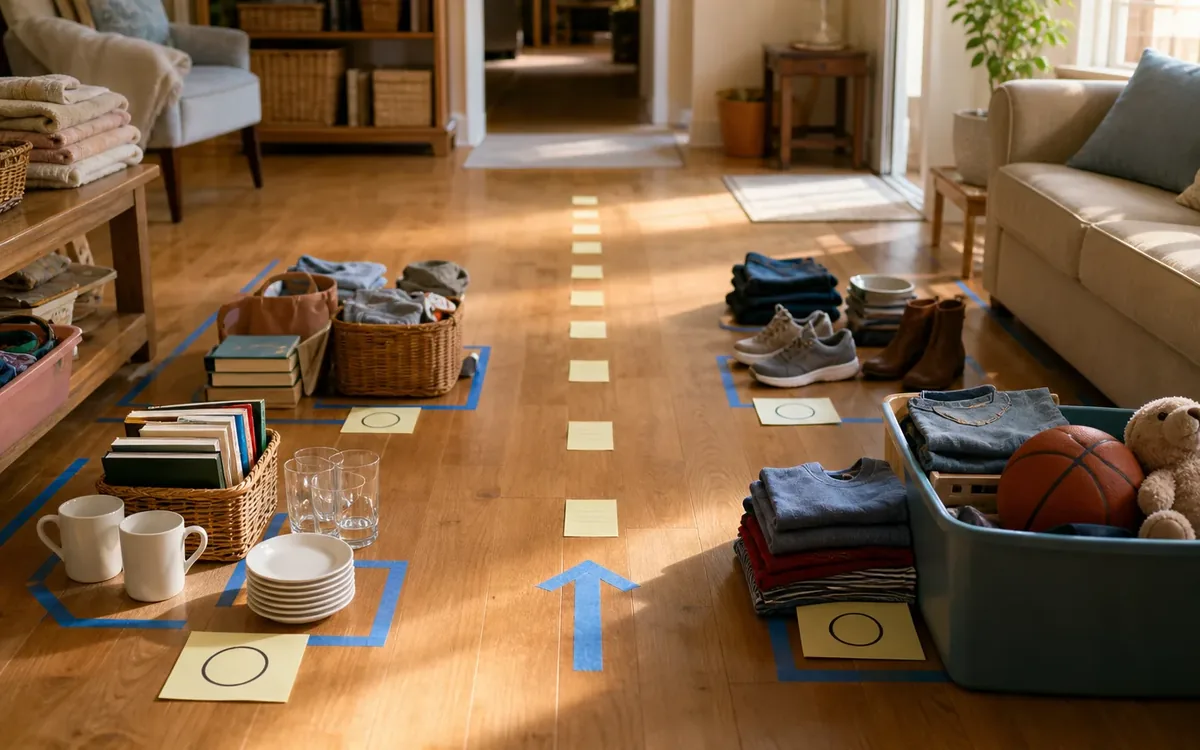
How should multiple requests for the same item be handled?
Record every request first. Do not decide the winner while inventorying the room, and do not remove an item simply because one person spoke first.
The household may choose a conflict rule, provided the rule is consistent with controlling documents and the authorized decision-maker accepts it. Options might include:
- A voluntary conversation among the interested family members
- Taking turns selecting from a defined group of available items
- Drawing lots when participants agree that chance is acceptable
- Trading assignments by mutual written agreement
- Selling an item under an approved plan rather than assigning it to one person
- Holding the item until legal or professional guidance is obtained
Add a dispute note to the item’s row. It should identify each request, the chosen resolution process, the person responsible for the next step, and whether the item must remain in place.
Fair does not always mean equal item counts. One object may carry substantial market value, family history, or personal meaning. The log should preserve the facts and the agreed outcome rather than declaring that a division is equitable.
If a will, trust, court order, title, marital-property issue, creditor concern, or fiduciary duty may affect an item, pause the family process. An estate’s personal representative, trustee, attorney, probate court, or other appropriate authority may need to determine what can be distributed and by whom. A cleanout or move team should not interpret legal documents or decide legal ownership.
Separate preference, authority, and value
Many disagreements begin because three different questions are treated as one:
- Preference: Who wants the item?
- Authority: Who is permitted to decide what happens to it?
- Value: What might the item be worth in a relevant market?
A family member can answer the first question for themselves. The appropriate representative, owner, or legal authority addresses the second. A qualified appraiser or suitable market professional may be needed for the third.
Do not write an informal family estimate in a column labeled “appraised value.” Instead, use separate fields such as “family estimate,” “sale result,” and “formal appraisal reference.” Note who provided the information and why it was obtained.
An appraisal is a separate professional choice. A practical cleanout or move team may flag categories that the household could consider reviewing before disposal, but it should not guarantee value, authenticate property, or replace a qualified appraisal. Likewise, auction and estate-sale decisions depend on the chosen provider’s evaluation, terms, and acceptance criteria.
Build a status system that prevents premature removal
A visible status system lets relatives and workers understand what may move without reading every note. Use words rather than color alone so printed copies and users with color-vision differences remain clear.
A practical status set is:
- Unreviewed: No one has evaluated the item.
- Open for requests: Participants may state preferences.
- Requested: At least one person is interested.
- Disputed: More than one request or an ownership concern exists.
- Professional review: Legal, appraisal, inspection, or another specialist’s input is pending.
- Approved: The authorized person has confirmed the outcome.
- Completed: The approved action occurred and was documented.
Match physical labels to the log. For example, an item listed as “Disputed” should also carry a tag with its item number and a clear “Do not remove” instruction. Avoid labels that damage furniture, artwork, paper, or delicate finishes.
Keep a protected holding area for unresolved objects if moving them is authorized and safe. Record every transfer into that area. Storage is a separate household and provider decision, including who selects the facility, signs the agreement, pays charges, controls access, and insures the contents.
What can a cleanout or move team discuss?
A practical team may discuss workflow and physical handling once the responsible person has clarified authority. The conversation can cover:
- How items will be labeled and matched to the log
- Which rooms or categories should be processed first
- Where approved keep, sale, donation, recycling, and disposal groups will be staged
- How fragile, bulky, or access-sensitive items affect handling
- What must remain untouched pending a family or professional decision
- How completed removals will be recorded
- Whether sale preparation or move coordination requires separate planning
The household decides personal priorities, recipients, keepsakes, and whether it wants to explore storage, donation, sale, or disposal options. A team can follow documented instructions and identify practical conflicts, such as an item marked both “keep” and “donate.”
Certain decisions remain outside that practical role:
- Legal decisions: Ownership, estate authority, document interpretation, creditor issues, and distribution rights belong with the appropriate attorney, court, fiduciary, or authority.
- Appraisal decisions: Authentication and formal value opinions belong with qualified appraisers or relevant specialists.
- Real-estate decisions: Listing strategy, disclosure, pricing, and contract matters belong with the owner and appropriate real-estate or legal professionals.
- Inspection decisions: Structural, environmental, electrical, plumbing, or other property conditions belong with qualified inspectors or contractors.
- Compliance decisions: Government agencies and authorized professionals determine whether legal or regulatory requirements are satisfied. Physical support does not amount to official approval.
- Disposal decisions: The household selects approved outcomes, while facilities, carriers, donation organizations, and authorities determine what they accept and under what rules.
Contractor repairs and alterations should also be tracked separately from belongings. The owner or authorized representative chooses the contractor and scope, while the relevant professional handles permits, technical methods, and code-related determinations.
Keep an audit trail without making the log cumbersome
Preserve prior entries instead of silently replacing them. If a recipient changes, add the new decision date, the approving person, and a short reason. In a spreadsheet, restrict editing where practical and keep periodic copies. In a paper system, cross out errors with a single line so the original remains readable.
For each completed item, retain only the records relevant to the household’s needs, such as:
- A signed pickup acknowledgment
- Shipping or delivery details
- A donation receipt supplied by the receiving organization
- A sale statement or transaction record
- A storage intake document
- A disposal or recycling receipt when available
- Written approval from the authorized decision-maker
Tax treatment and record-retention requirements should be discussed with a qualified tax or legal professional. A donation receipt does not by itself determine deductibility or value.
Close the log only after reconciling physical items with approved outcomes. Investigate missing entries, duplicate item numbers, and objects that left without completion details. Save the final version where the appropriate family members or estate representative can access it.
Short FAQ
Should every family member be able to edit the log?
Usually, one coordinator or a small authorized group should control edits. Other participants can submit requests or comments through an agreed channel. The family decides access, subject to any legal duties governing the property or estate.
Can text messages serve as the decision record?
They can support a record, but scattered messages are hard to reconcile. Transfer each confirmed decision into the central log and retain the relevant message if needed.
What if an item has already been removed?
Add an entry rather than hiding the gap. Record who took it, when, its current location if known, and whether the removal was approved. Refer ownership or authority disputes to the responsible representative or appropriate legal professional.
When should the family seek an appraisal?
Consider professional advice when value could affect distribution, sale, insurance, tax, or estate decisions, or when authenticity and condition require expertise. The responsible person chooses whether to obtain an appraisal and selects the appraiser.
Can the log include donated and discarded items?
Yes. Record the approved destination and completion details. Acceptance rules vary by organization, facility, material, and jurisdiction, so confirm them with the receiving provider or relevant authority.
Turn the record into clear next steps
Once the log distinguishes approved items from unresolved ones, the physical project becomes easier to control. Create separate work groups for family pickup, moving, sale evaluation, donation, storage, recycling, and disposal. Keep disputed and professional-review items out of every removal group.
Clutter Cleaner of South Carolina has a physical business location in Mount Pleasant, serves Charleston as its primary market, and has a statewide South Carolina service territory. A household considering practical downsizing, organizing, estate cleanout, move management, auction or estate-sale coordination, home-sale preparation, or code-compliance support can call (843) 972-7020 to discuss scope. Availability, item acceptance, outside-provider requirements, and project details should be confirmed directly.
The most useful decision log is not the most elaborate. It is the one that clearly identifies the item, preserves each request, names the decision authority, separates professional questions from household preferences, and documents what actually happened.



