

A household records binder should give you one reliable place to find the information needed to sort belongings, prepare for a move, manage the current home, and hand responsibilities to someone else. Build it before heavy sorting begins: choose a secure format, gather records by category, create a one-page index, separate originals from working copies, and assign clear next actions. The goal is not to preserve every piece of paper. It is to make important household decisions easier and safer during downsizing.
Quick answer: Start with a physical binder or secure digital folder divided into property, finances, insurance, utilities, possessions, move planning, and professional contacts. Keep irreplaceable originals in a more secure location, place only necessary copies in the working binder, and record where every original can be found. Review the binder with the household decision-maker before discarding documents or sharing information.
Why build the binder before sorting the house?
Downsizing creates hundreds of small decisions. A records binder prevents those decisions from being delayed because a deed, policy number, receipt, account contact, or measurement cannot be found.
It also helps separate paperwork from possessions. Without a system, important records may remain inside desks, file cabinets, kitchen drawers, boxes, safes, and furniture scheduled for removal. Gathering records early reduces the chance that something essential leaves with a donated, sold, recycled, or discarded item.
The binder can support several overlapping projects:
- Deciding which furniture fits the next home
- Identifying items that may need appraisal
- Tracking donations, sales, transfers, and disposal
- Preparing questions for an attorney, accountant, insurer, or real-estate professional
- Transferring utilities and household services
- Recording repairs or property-preparation tasks
- Giving an authorized family member a clear overview
- Keeping move dates, contacts, and access instructions together
If physical sorting is part of the project, a downsizing and organizing service may help the household establish categories, sequence rooms, and coordinate practical tasks. The household still controls what information is shared and what happens to each record.

Should the binder be physical, digital, or both?
For many households, a hybrid system is the most useful. A physical binder is easy to consult during appointments and sorting sessions. A digital folder provides searchable copies and a backup if paper records are misplaced.
A physical binder works well for:
- A printed master index
- Current checklists and calendars
- Copies needed during the move
- Property measurements and floor plans
- Contact lists
- Receipts generated during the project
- Notes and questions for professionals
Use a sturdy binder, labeled dividers, and zippered document sleeves for small receipts or keys. Avoid labeling the outside with terms such as “financial accounts,” “estate documents,” or “passwords.” A neutral title such as “Household File” reveals less.
A digital system works well for:
- Scanned records
- Photographs of valuables and serial numbers
- Searchable inventories
- Spreadsheets for disposition decisions
- Copies shared with an authorized person
- Records that must be accessed away from the house
Create clearly named folders rather than saving every file in one location. Use specific filenames, such as Homeowners-Policy-2026.pdf, instead of scan0047.pdf.
Protect digital files with strong passwords and appropriate device security. Do not keep passwords, alarm codes, bank access details, and identity documents in an unprotected shared folder.
What belongs somewhere more secure?
A working binder should generally contain copies or location notes rather than irreplaceable originals. Consider more secure storage for:
- Original wills and trust documents
- Birth, adoption, marriage, and death certificates
- Passports and Social Security cards
- Original deeds, titles, and court documents
- Negotiable instruments
- Sensitive medical or financial records
Storage requirements and access rules vary. An attorney, financial institution, insurer, records custodian, or issuing authority should answer questions about the proper location and legal effect of an original document.
What sections should a downsizing records binder contain?
Start with eight practical sections. Add or remove categories according to the household, property, and next residence.
1. Master index and authority
The first page should explain what is in the binder and where originals are stored. Include:
- Binder owner’s name
- Date last reviewed
- Names and contact details for authorized participants
- Location of original documents
- A list of unresolved questions
- Immediate deadlines
Do not assume that being a relative permits someone to access accounts, sign documents, or direct property transfers. Questions about powers of attorney, probate authority, trusts, guardianship, or ownership belong with the relevant attorney, court, institution, or authority.
2. Current and future housing
Place working information about both homes here:
- Room measurements
- Doorway, elevator, stairway, and hall measurements
- Floor plans, if available
- Community or building move procedures
- Move-in and move-out dates
- Parking or access instructions
- Furniture placement sketches
- Rules supplied by the property manager or association
The household can compare measurements and decide what is likely to fit. A mover can discuss handling and access. A property manager, association, building official, inspector, or other responsible authority determines applicable rules, restrictions, and compliance requirements.
3. Property and maintenance
Gather copies or location notes for:
- Deed and mortgage information
- Property tax records
- Surveys and plats
- Homeowners association documents
- Warranties and manuals
- Repair and improvement records
- Permits and inspection reports already in the household’s possession
- Pest, roof, HVAC, plumbing, and electrical service records
These records can help the household explain the home’s maintenance history. They do not replace inspections, title work, disclosure advice, or professional opinions.
4. Insurance, utilities, and recurring services
Create a page listing provider, account number or safe reference, contact method, billing cycle, and planned transfer or cancellation date for each account.
Include utilities, internet, security monitoring, insurance, lawn care, pest service, cleaning arrangements, and other recurring household services. Avoid placing complete payment card numbers or login credentials in the binder.
5. Possessions and disposition tracking
Use one sheet or spreadsheet to record significant items and decisions. Helpful columns include:
- Item description
- Current room
- Intended destination
- Keep, gift, sell, donate, recycle, or discard
- Person responsible
- Deadline
- Receipt or confirmation received
- Notes about appraisal or special handling
If the project also involves an estate, the guide on how do you keep important documents safe and organized explains the practical sequence and where household authority matters.
6. Financial and tax records
Include a concise account inventory and the location of supporting records. Do not overfill the working binder with years of statements.
A tax professional, attorney, financial institution, plan administrator, or government authority should advise how long records must be retained and who may access them. A cleanout or move team should not decide whether tax, investment, debt, or estate-administration documents can be destroyed.
7. Move and home-sale planning
Keep estimates, appointment notes, task lists, access details, and vendor contacts in this section. You can also track:
- Packing milestones
- Donation and pickup appointments
- Repair scheduling
- Cleaning sequence
- Key and remote inventory
- Final meter readings
- Address-change status
- Closing or occupancy dates provided by the responsible parties
A practical move or cleanout team may discuss sequencing, labor needs, packing categories, removal access, and what should remain in the home. A real-estate professional handles market and transaction guidance. Inspectors evaluate conditions within their scope. Attorneys, closing professionals, associations, municipalities, and other authorities address legal or compliance requirements.
8. Professional contacts and questions
List each professional’s role rather than expecting one person to answer every question. Possible contacts include:
- Attorney
- Accountant or tax preparer
- Financial adviser
- Insurance representative
- Real-estate professional
- Appraiser
- Home inspector
- Moving company
- Property manager or association contact
- Local or state authority, when applicable
- Downsizing, organizing, or cleanout contact
Add a “question owner” beside each unresolved issue. This prevents legal questions from being directed to a mover or valuation questions from being left to a cleanout crew.
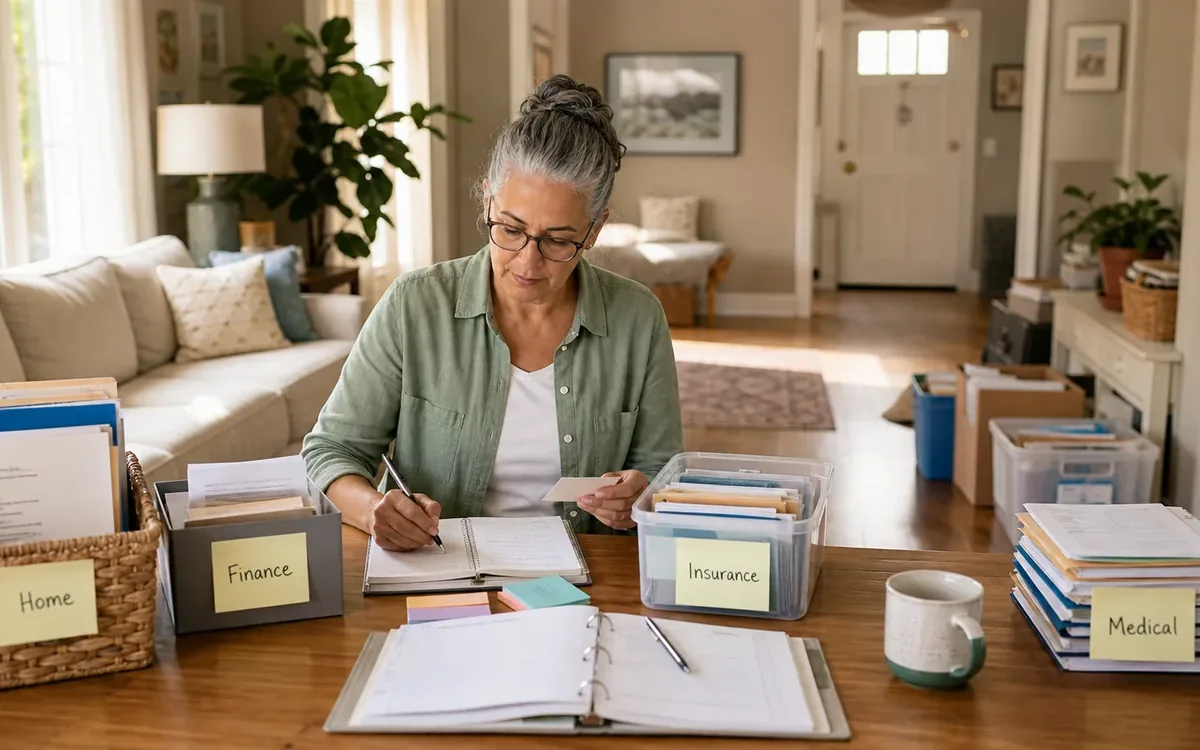
How do you gather records without stalling the downsizing project?
Do not begin by reading every page. Use a fast collection pass, followed by a focused review.
Step 1: Establish a paper checkpoint
Choose one table or portable file box as the only destination for newly found records. Tell everyone involved not to throw away paper from drawers, folders, books, safes, luggage, or locked furniture until it has passed through this checkpoint.
Step 2: Search likely locations
Check:
- Desks and filing cabinets
- Bedside tables
- Kitchen and utility drawers
- Closets and luggage
- Books and photo albums
- Lockboxes and safes, when access is authorized
- Vehicle compartments
- Boxes labeled office, taxes, personal, or miscellaneous
Respect privacy and authority. If ownership or permission is uncertain, secure the material and ask the responsible person before reviewing it.
Step 3: Sort by category, not by final retention
Create temporary folders labeled property, financial, insurance, identity, medical, possessions, utilities, move, and review. The “review” folder is important because it keeps uncertain pages from stopping progress.
Step 4: Remove obvious nonrecords
Duplicates, blank forms, envelopes, and generic advertisements can often be separated quickly. However, do not discard documents merely because they are old. Age alone does not determine legal, tax, ownership, historical, or financial significance.
Step 5: Escalate uncertain records
Mark each uncertain document with a removable note naming the person who should answer the question. For example:
- “Ask tax preparer about retention”
- “Confirm ownership with attorney”
- “Ask insurer whether this inventory is current”
- “Ask appraiser whether supporting provenance is useful”
This method allows physical sorting to continue while the proper professional reviews the issue.
Who decides what can be discarded or shared?
The household decision-maker can choose the binder format, organize ordinary household information, set access preferences, and decide which authorized relatives or helpers receive working copies. An owner can also make disposition decisions about belongings they are legally entitled to control.
A practical downsizing, organizing, cleanout, or move team may discuss:
- A workable room-by-room sequence
- How to label and track items
- Which records should be set aside for household review
- Packing and access logistics
- Coordination with authorized participants
- Practical preparation for donation, sale, moving, or removal
The team should not determine legal ownership, interpret estate documents, give tax advice, authenticate valuables, set formal appraised values, perform a home inspection, provide title opinions, or decide whether a property satisfies a legal or regulatory requirement.
Those decisions remain with the responsible attorney, accountant, appraiser, real-estate professional, inspector, institution, government office, association, court, or other authority. When authority is unclear, pause the affected task rather than guessing.
How should valuables and sentimental items be documented?
Documentation should support decisions without implying a value that has not been professionally established. Photograph an item, note where it was found, record any visible maker’s marks or serial numbers, and place related receipts or history in the same binder section.
For each potentially significant item, record:
- Plain-language description
- Dimensions
- Current condition without speculation
- Visible signature, label, hallmark, or serial number
- Related receipt, certificate, correspondence, or photograph
- Current custodian and storage location
- Planned next step
The household may decide that an item is personally meaningful and should stay with the family. If fair market value, insurance value, authenticity, equitable distribution, tax treatment, or sale strategy matters, consult the appropriate appraiser, insurer, tax professional, attorney, or sales professional.
Avoid attaching unverified prices from online listings. Asking prices do not necessarily establish value, and an incomplete description can mislead later decision-makers.
Keep the binder useful through moving day
A binder becomes outdated quickly unless one person maintains it. Assign a records coordinator, even if several people participate in the move.
Use a simple weekly routine:
- File new records.
- Update deadlines and completed tasks.
- Scan essential new pages.
- Move resolved questions out of the active section.
- Confirm that originals remain secure.
- Review who currently has access.
On moving day, the binder should travel with the responsible person, not in a packed box or removal vehicle. Keep it with identification, medications, keys, phones, chargers, and other essentials.
After the transition, archive the project material. Shred sensitive duplicates using a suitable method, but only after the household or appropriate professional confirms they are no longer needed. Update the index so the binder reflects the new residence rather than the completed move.
A focused binder setup sequence
A practical setup does not need to consume the entire downsizing schedule. Use this order:
- Session one: Choose the binder and digital structure, print an index, and establish the paper checkpoint.
- Session two: Gather records from the most likely locations without reading everything.
- Session three: Sort into the eight sections and flag uncertain material.
- Session four: Build the possessions tracker and record deadlines.
- Session five: Ask the appropriate professionals the flagged questions.
- Session six: Scan key working records, confirm secure storage, and remove unnecessary duplicates.
This sequence keeps the records project tied to the downsizing decision. It is not an attempt to reorganize every historical family paper before the move.
Short FAQ
Should passwords be kept in the household binder?
Usually not in plain text. Use a secure password-management method appropriate for the household, and leave instructions for authorized access where suitable. Ask the relevant institution or professional about account-access procedures after incapacity or death.
Do original documents need to travel to the new home?
Some may, while others may belong in secure storage or with an authorized custodian. Record each original’s location. Ask the issuing authority, institution, or attorney when legal significance or custody requirements are unclear.
How long should household records be kept?
There is no single retention period for every category. Tax, property, insurance, medical, employment, estate, and warranty records can have different requirements. Obtain retention guidance from the responsible professional, institution, or authority before destruction.
Can a downsizing team identify papers that look important?
A practical team may set aside documents for household review and help organize approved categories. It should not make legal, tax, appraisal, title, inspection, or compliance determinations.
What should happen if records reveal conflicting ownership claims?
Pause the sale, gift, donation, or removal of the affected property. Preserve the records and refer the issue to the person or authority responsible for determining ownership.
What is the best first step if the paperwork feels overwhelming?
Create the paper checkpoint and gather without evaluating. Separating collection from decision-making usually makes the job manageable while protecting records that need expert review.
A well-built household records binder is a control center, not an archive of every page the household has accumulated. Keep it concise, secure, current, and connected to specific downsizing decisions. That gives the household and its authorized helpers a dependable way to move forward without asking a practical cleanout or move team to make decisions that belong to qualified professionals or responsible authorities.



