

Pack for assisted living by starting with the residence’s measurements and move-in instructions, then choosing daily essentials, comfortable clothing, approved furniture, important documents, health-related items, and a small number of meaningful belongings. The goal is not to recreate an entire house. It is to create a safe, familiar living space where necessary items are easy to reach and everything fits.
Quick answer: Pack what the resident uses regularly and what fits the assigned room or apartment. Prioritize identification, paperwork, clothing, toiletries, mobility aids, approved medications, bedding, a few kitchen items if applicable, familiar decor, and correctly sized furniture. Confirm requirements with the assisted living community before packing medical equipment, electronics, furnishings, or anything governed by its policies.
For South Carolina households, climate also matters. Breathable warm-weather clothing and a lighter layer for strong indoor air conditioning can both be useful. A family coordinating many parts of the transition may also review professional move management support for organizing, packing coordination, placement planning, and other agreed move tasks.
What should you pack first for assisted living?
Pack the items that affect identity, health, comfort, and the first days in the new residence before dealing with decorations or sentimental collections. Keep these essentials together rather than mixing them into boxes that may not be opened immediately.
Start with:
- Government-issued identification and insurance cards
- Admission or move-in documents requested by the community
- Current contact information for relatives, physicians, and other responsible parties
- Clothing, sleepwear, underwear, socks, and supportive shoes
- Toiletries, hearing aids, glasses, and dental items
- Mobility aids and other approved assistive equipment
- Bedding and towels if the residence asks the resident to provide them
- A phone, charger, clock, and simple contact list
- A few comforting objects, such as photographs or a favorite blanket
Keep original documents, medications, jewelry, keys, financial papers, and irreplaceable objects out of the general moving load. A responsible family member should carry or closely supervise them.
The assisted living community should explain its admission paperwork, medication procedures, labeling requirements, room access, delivery rules, and equipment restrictions. A moving or cleanout team may discuss packing order and handling logistics, but it does not replace the community’s instructions or a clinician’s medical judgment.

Measure the new space before choosing belongings
The most useful packing decision often happens before a box is opened: determine what can physically fit. Ask the community for a floor plan or arrange to measure the room. Record wall lengths, closets, door openings, windows, outlets, and the clearance needed around any mobility equipment.
Create a simple floor plan showing:
- The bed and required access around it
- A chair suitable for the resident’s comfort and mobility
- Bedside storage
- Dresser or closet capacity
- Routes to the bathroom and exit
- Space needed for a walker, wheelchair, or other device
- Locations of outlets and community-provided fixtures
Confirm which furnishings the community already supplies. Bringing a duplicate dresser, nightstand, or chair wastes limited space and creates another decision on move-in day.
Paper templates can help with placement. Cut scaled outlines for the bed, dresser, chair, and small table, then test arrangements on the floor plan. Keep walking routes open and avoid relying on narrow gaps that look workable only on paper.
The household can select belongings based on fit and preference. A practical move team may help inventory furniture, review measurements, label pieces, and plan placement. Questions about accessibility standards, emergency clearance, electrical safety, or required room configuration belong to the residence, an appropriate inspector, contractor, clinician, or other responsible professional.
How much clothing belongs in an assisted living room?
Choose enough clothing to support the resident’s routine without filling every drawer and closet. The right amount depends on laundry arrangements, storage capacity, activities, personal habits, and whether family members can rotate seasonal clothes.
Prioritize clothing that is:
- Comfortable while sitting and moving
- Easy for the resident or caregiver to fasten
- Suitable for meals and community activities
- Compatible with mobility or medical equipment
- Machine washable when possible
- Clearly labeled if the community requests labels
- Appropriate for warm South Carolina weather and cool indoor spaces
A useful wardrobe may include casual outfits, sleepwear, undergarments, a robe, nonslip or supportive footwear, a light sweater, rain protection, and one or two dressier options. Include hobby or activity clothing only when it reflects the resident’s actual routine.
Avoid treating the closet as long-term storage. If winter coats, formalwear, or keepsake garments are rarely used, the family can store them elsewhere, pass them to relatives, donate them, or make another deliberate choice. Storage is a separate household decision and should be arranged with a storage provider if needed. It is not automatically part of a move or cleanout service.
For a broader view of sorting a home while preparing for a transition, see the guide to what are the easiest packing methods for seniors. Its decision framework can help when packing reveals larger groups of belongings that will not move with the resident.
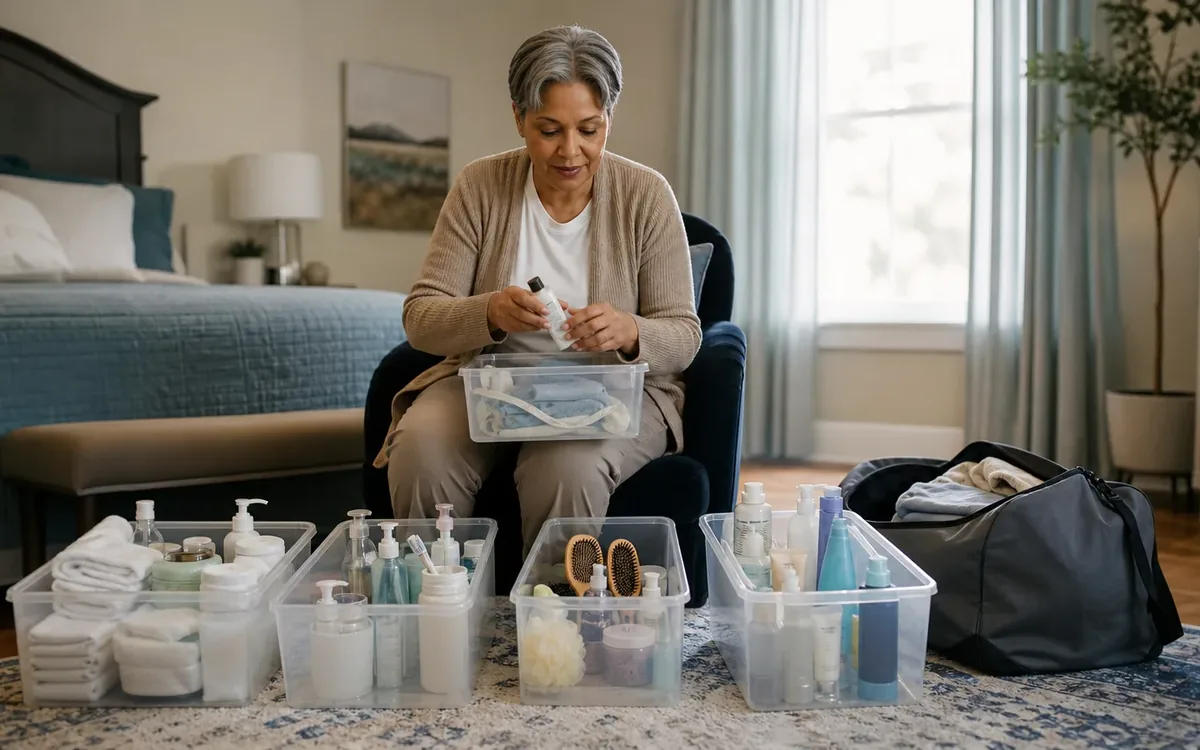
Pack personal-care and health items carefully
Personal-care supplies should be familiar, easy to identify, and consistent with the community’s storage rules. Pack everyday toiletries in a small caddy or clearly marked container. Include items such as a toothbrush, denture supplies, hairbrush, preferred soap, shaving supplies, tissues, and skin-care products the resident routinely uses.
Health-related packing requires added coordination. Prepare an inventory of:
- Glasses and cases
- Hearing aids, batteries, and chargers
- Dentures and labeled storage containers
- Mobility aids
- Compression garments or braces used under professional guidance
- Approved medical equipment and its instructions
- Current medication information requested by the residence
Do not put medication decisions in the hands of a mover, organizer, or cleanout crew. The resident, authorized representative, prescribing clinician, pharmacy, and assisted living community should determine how prescriptions and over-the-counter products are reviewed, transported, stored, and administered.
Likewise, ask the community before moving oxygen equipment, powered mobility devices, refrigerators used for health-related storage, or equipment that affects electrical use and room layout. The residence and qualified professionals decide what can be accommodated safely and in compliance with applicable requirements.
Which furniture and household items should make the move?
Select furniture for function, comfort, fit, and safe access. A familiar chair or bedside table can make the new room feel recognizable, but only if it fits without obstructing movement.
Consider these categories:
- Sleep: A bed, mattress, pillows, and linens if they are not provided
- Seating: A stable chair that supports safe sitting and standing
- Storage: One appropriately sized dresser or cabinet if permitted
- Bedside needs: A small table, lamp if approved, clock, and charging access
- Entertainment: A television, radio, tablet, books, or hobby materials that will be used
- Kitchen items: A mug, dishes, utensils, or small appliances only when the room type and community rules allow them
Check furniture condition before moving it. Unstable legs, difficult drawers, frayed electrical cords, sharp edges, or upholstery that cannot be cleaned may make an item unsuitable. A qualified repair provider, electrician, furniture specialist, or other contractor should evaluate or perform work outside ordinary packing and placement.
Do not assume that every familiar item belongs in the new space. A large cabinet may hold memories, but framed photographs or a small object from that cabinet can preserve the connection without consuming valuable floor area.
How can meaningful belongings fit without creating clutter?
Use a space limit for sentimental belongings rather than trying to rank every memory against every other memory. For example, designate one shelf, one photo area, and one keepsake box. The physical boundary makes selection more manageable.
Choose items that support recognition or regular enjoyment:
- Photographs with names written on the back or in an accompanying list
- A favorite quilt or throw
- A small piece of art
- A familiar clock
- A few letters or cards
- Religious or cultural objects
- Supplies for a current hobby
- One or two objects connected to important family stories
Photographing bulky objects is another option. A resident may value the memory associated with a dining set, collection, or workshop more than having the entire object in the room. A printed album can preserve those visual prompts.
Let the resident make as many choices as practical. Instead of asking, “What do you want to get rid of?” ask, “Which three photographs would you like beside your chair?” Specific questions focus attention on the new home rather than only on loss.
For items not moving, the household decides whether to give them to family, sell them, donate them, recycle them, dispose of them, or place them in separately arranged storage. An auction professional, estate-sale provider, donation recipient, recycler, or disposal facility may set its own acceptance terms. Appraisers determine value when a formal or specialized valuation is needed.
Organize documents and valuables separately
Documents should not be scattered among household boxes. Use one portable file that remains with the resident or authorized family member. Divide it into clearly labeled sections so the right person can find information without searching the entire room.
Possible sections include:
- Personal identification
- Insurance information
- Medical contacts and information requested by the community
- Residence agreements and contact details
- Emergency contacts
- Legal and financial professional contacts
- Household account information needed during the transition
- Inventory notes for valuables or items stored elsewhere
Only keep copies in the room when originals should remain in a secure location. The resident or legally authorized person should decide who may access private records.
Questions about powers of attorney, guardianship, contracts, benefits, taxes, asset ownership, estate administration, or required notices belong to an attorney, financial professional, government agency, or other appropriate authority. A move team can pack and label documents under the household’s direction, but it should not interpret them or make legal decisions.
Jewelry, cash, small heirlooms, deeds, titles, and similar valuables need a separate plan. The household may choose secure off-site storage, a financial institution’s available options, direct family custody, or another suitable arrangement. If value affects insurance, sale, division, or estate decisions, consult an insurer or qualified appraiser rather than guessing.
Pack by destination, not just by room
A home-to-assisted-living transition usually creates several destinations. Labeling everything “bedroom” or “kitchen” is not enough because only some of those contents are moving to the new residence.
Use destination labels such as:
- Assisted living room: Approved items included on the floor plan
- Family: Objects already assigned to a specific person
- Professional valuation: Items requiring appraisal or specialist review
- Sale consideration: Items to discuss with an auction or estate-sale provider
- Donation or recycling: Items subject to recipient acceptance
- Storage: Items covered by a separate storage decision
- Disposal: Items the household has authorized for lawful disposal
- Undecided: A small, controlled group requiring a named decision-maker
This system prevents unwanted items from arriving at the residence and reduces the risk that valuables are discarded accidentally. Use large labels on more than one side of each box, and maintain a basic inventory for important contents.
A cleanout or move team may discuss sorting zones, packing materials, access, item handling, donation or disposal preferences, and furniture placement within the agreed scope. The household remains responsible for authorizing destinations. The assisted living residence controls its property and move-in policies, while disposal facilities and other recipients control what they accept.
Prepare a move-in box that stays accessible
Create one clearly marked box or bag for immediate use. It should travel with the resident or responsible family member rather than becoming buried in the moving load.
Include:
- A change of clothes and sleepwear
- Essential toiletries
- Phone and device chargers
- Glasses and hearing-aid supplies
- Residence paperwork and contact numbers
- A favorite snack if allowed
- Basic bedding or towels if required
- A framed photograph or another comforting item
- Necessary health items handled according to the community’s instructions
Keep tools, hardware, remote controls, and furniture instructions together in another labeled container. Photograph cable connections before disconnecting electronics. Do not rely on loose bags for important pieces because small components are easy to misplace.
Before leaving the former home, compare loaded items with the destination inventory. At the residence, place essential items first, establish clear walking paths, and avoid stacking unopened boxes around the bed or bathroom route.
What should happen to everything that does not fit?
Treat the remaining household contents as a separate project, not as overflow for the assisted living room. Start by identifying property the resident wants to retain and confirming who has authority to make decisions about everything else.
Then sort by outcome:
- Give specifically chosen items to relatives or friends
- Seek qualified appraisal where value is uncertain or consequential
- Discuss suitable property with an auction or estate-sale professional
- Confirm donations directly with the intended organization
- Arrange recycling or lawful disposal based on local acceptance rules
- Contract separately for storage when retaining items off-site
- Engage appropriate contractors for repairs, hauling, specialty handling, or property work as needed
If the former home will be sold, a real-estate professional should advise on market strategy and listing preparation. Inspectors assess property conditions within their professional scope. Contractors estimate and perform repair work. Local authorities or relevant professionals determine code and compliance requirements. A cleanout provider may assist with authorized contents removal or agreed home preparation, but it does not make those professional decisions.
Short FAQ
Should every box be unpacked on move-in day?
No. Unpack immediate-use items and establish a functional, clear room first. Keep any remaining boxes consolidated and out of walking paths, then review them deliberately.
Can family members pack medication with ordinary toiletries?
Medication should be handled according to instructions from the assisted living community, prescribing professionals, pharmacy, and authorized decision-maker. Do not bury it in a general moving box.
Is a storage unit the best answer for extra belongings?
It can be one option, but the household should weigh access, ongoing responsibility, security, insurance, and whether the contents are likely to be used. Storage arrangements are separate from move and cleanout decisions.
Who decides whether furniture is safe for the new room?
The household can assess comfort and condition, while the residence determines what its policies permit. Accessibility, repair, electrical, inspection, or compliance questions should go to the appropriate qualified professional or authority.
Can Clutter Cleaner of South Carolina help with the transition?
Clutter Cleaner of South Carolina provides move management, downsizing and organizing, estate cleanouts, auctions and estate sales, home sale preparation, and code compliance support across South Carolina. The physical business location is Mount Pleasant, with Charleston as the primary market. Households can call (843) 972-7020 to discuss the situation and clarify an appropriate scope.



