

Before signing an estate sale agreement, ask exactly what happens to every item that does not sell, who makes each decision, who pays related expenses, and when the property must be cleared. The written agreement should distinguish between items the company may retain for another sale, items returned to the household, and property designated for donation, storage, recycling, or disposal.
Quick answer: Do not rely on a general promise that unsold contents will be “handled.” Ask for written terms covering ownership, decision authority, removal, donation documentation, disposal, storage, added charges, sale extensions, and the condition in which the home will be left. Make sure those terms fit the executor’s authority, the property closing plan, and any probate or family restrictions.
This issue matters throughout South Carolina because an estate sale and a cleared house are not the same result. A sale operator may focus on marketing and selling personal property, while the household still has to resolve leftovers. If the property will be listed, transferred, inspected, or occupied, those remaining contents can affect the next step.
Why do unsold items need their own written terms?
Even a well-attended sale may leave furniture, household goods, clothing, books, garage contents, or items with limited resale demand. “Unsold” can also mean several different things:
- The item was displayed but did not receive an acceptable offer.
- The item was held back because a reserve was not met.
- The item was not offered because ownership was disputed.
- The operator decided it did not suit the sale.
- The item was overlooked or found after staging began.
- The item was removed from the sale at the household’s request.
Those categories should not automatically receive the same treatment. A family heirloom held out of the sale should not be swept into a disposal clause. Likewise, an ordinary household item that attracted no buyer should not remain indefinitely without a plan.
Review the proposed agreement alongside the provider’s explanation of its auctions and estate sales service. Marketing language describes a service generally, but the signed contract controls the particular engagement. If the wording conflicts with a verbal explanation, request clarification before signing.

Who owns and controls property that does not sell?
The agreement should state whether unsold property remains with the estate or owner unless a separate transfer is approved. Pay particular attention to clauses using terms such as “abandoned,” “forfeited,” “removed,” “disposed of,” or “company property.” Ask what each term means in practice.
The household can usually decide its preferences for items it has authority to control. For example, it can identify keepsakes, propose donation recipients, choose whether storage is worth considering, and set priorities for clearing the home. That does not establish legal authority by itself.
An executor, personal representative, trustee, court-appointed fiduciary, or other responsible party may need to approve a sale or disposition. Questions about title, probate powers, creditor rights, beneficiary consent, or disputed ownership belong with a South Carolina attorney or the appropriate court, not a cleanout or sale team.
Before signing, identify:
- The person authorized to approve prices and post-sale disposition
- Items owned by someone other than the estate
- Property promised to a beneficiary or named in estate documents
- Items subject to liens, leases, or other ownership questions
- Documents, photographs, jewelry, firearms, medication, and personal data requiring special handling
- Anything that must not be sold, donated, or discarded
If authority is uncertain, separate and secure the item until the responsible professional resolves it. Convenience should not substitute for a documented ownership decision.
What exact questions should you ask about leftovers?
Use the following seven questions to turn a vague cleanup promise into a workable plan:
- What counts as unsold? Ask whether this includes unlisted, rejected, withdrawn, overlooked, or reserve-price items.
- Who decides the next destination? Confirm whether the household, fiduciary, sale operator, or another provider selects donation, storage, resale, recycling, or disposal.
- Is any ownership transferred? Ask whether the agreement gives the operator rights to keep, buy, consign, or dispose of leftovers.
- Are there separate expenses? Request written identification of removal, hauling, labor, storage, donation, recycling, disposal, or transportation charges.
- May items be sold later? Clarify whether leftovers can move to another sale, an online platform, a consignment provider, or another location, and who approves that step.
- What condition will the property be left in? Define whether the scope ends after sale operations, basic removal, a broader cleanout, or another specifically described condition.
- What records will be provided? Ask about inventories, settlement statements, donation acknowledgments, disposal receipts, and documentation of items transferred elsewhere.
Write the answers into the agreement or an attached scope. Notes from a conversation can help the household compare options, but they are not a substitute for contract language accepted by both parties.
If the sale is one part of a larger property project, the guide on how estate cleanouts work explains how sorting, removal, and final property goals can be coordinated without treating them as one indistinct task.
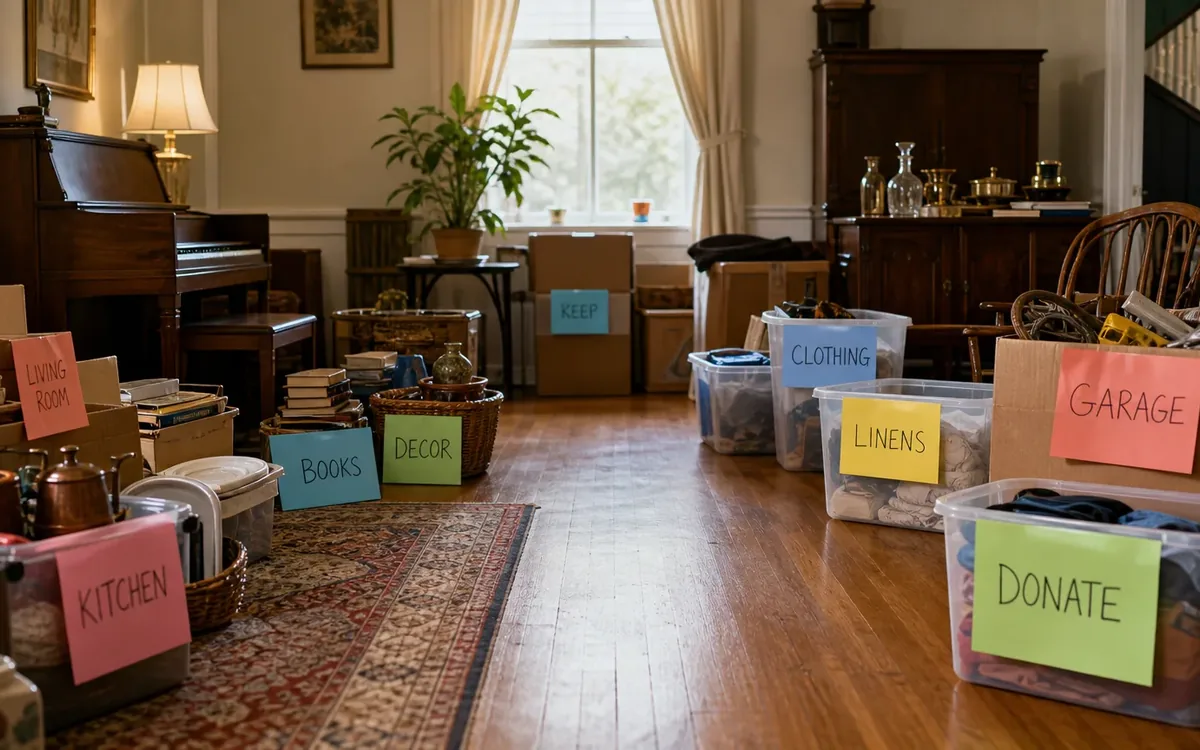
Will the estate sale company clear the whole property?
Not necessarily. Running a sale, removing unsold contents, cleaning rooms, completing repairs, and preparing a property for listing are different scopes. One provider may discuss more than one scope, but the agreement should not blur them together.
Ask whether “cleanout” includes only merchandise selected for the sale or all remaining contents in areas such as:
- Closets and cabinets
- Attics and crawl spaces
- Garages, sheds, and workshops
- Refrigerators, freezers, and pantries
- Patios and outdoor storage
- Papers and personal records
- Household trash and damaged goods
- Paint, chemicals, fuel, medication, or other restricted materials
A practical sale or cleanout team may discuss sorting, packing, labor, access, removal destinations, donation preferences, and the desired empty condition. It may also flag items that require a specialist or cannot enter an ordinary disposal stream.
The household decides what it wants kept, subject to the authority of the person responsible for the estate. A qualified appraiser determines appraisal conclusions. Contractors address repairs or alterations. Real-estate professionals advise on listing strategy. Inspectors report property conditions within their field. Government agencies, facility operators, and regulated disposal providers determine applicable acceptance and compliance requirements.
Do not assume “broom clean,” “empty,” “market ready,” or “all contents removed” has a universal meaning. Define the rooms, structures, surfaces, fixtures, appliances, and excluded materials covered by the phrase.
How should donation, storage, and disposal choices be separated?
These destinations involve different decisions and providers. Combining them under a single phrase such as “remove all leftovers” hides important details.
Donation
Ask who chooses the recipient and whether acceptance is confirmed before items leave. Donation organizations set their own standards and may reject stained furniture, outdated equipment, damaged goods, or other categories. No sale or cleanout agreement should imply that every leftover item is donatable.
Clarify who receives any acknowledgment and who decides how it is used. Questions about tax deductions, valuation, or estate reporting should go to a qualified tax or legal professional. A removal provider should not assign a charitable value unless separately qualified to do so.
Storage
Storage can preserve property while a family or fiduciary makes decisions, but it should be an intentional choice. Identify who signs the storage agreement, pays transportation and ongoing fees, controls access, and decides when storage ends.
Record which items enter storage. Do not let a temporary destination become an undocumented transfer of responsibility. The storage provider’s contract governs its access, payment, insurance, and default terms.
Disposal and recycling
Ask how trash, ordinary household goods, electronics, chemicals, medication, fuel, paint, and other restricted materials will be separated. Acceptance rules depend on the material and the receiving facility or program.
The household may approve disposal within its authority, and a cleanout team may explain practical routing options. The appropriate facility, regulator, or specialist decides what it can legally and safely accept. Put excluded materials and unresolved items in writing rather than assuming they will disappear with the general load.
How do you protect items that need appraisal or family review?
Create a protected category before staging begins. Label and physically separate anything awaiting appraisal, beneficiary review, ownership confirmation, or legal guidance. If possible, move it to a secure area excluded from sale access.
Items that may warrant separate attention include:
- Collections with uncertain value
- Fine art, jewelry, coins, or specialty objects
- Signed documents and historical materials
- Family photographs and correspondence
- Titled property or ownership records
- Firearms and ammunition
- Digital devices and storage media
- Safe contents, keys, and financial papers
An estate sale operator may suggest that an item appears notable or may benefit from specialist review. That observation is not a formal appraisal. Ask who will appraise it, what kind of value is being determined, and whether the appraiser has any financial interest in acquiring or selling it.
The household can decide whether to seek an appraisal. The executor or other authorized party decides whether an item may be sold. The appraiser develops the valuation opinion. An attorney addresses disputes or fiduciary duties. Keep those roles distinct in the agreement and decision log.
What contract language deserves closer attention?
Read the entire agreement, including exhibits and incorporated policies. Do not evaluate only the commission or sale dates. Terms about unsold items may appear under cleanup, abandonment, removal, cancellation, settlement, or company discretion.
Look closely for:
- Automatic transfer of leftovers to the operator
- Broad permission to discard property without further approval
- Undefined removal or disposal charges
- Authority to reduce prices without stated limits
- Rights to combine property with another sale
- Permission to move items off-site
- Deadlines tied to forfeiture or abandonment
- Limits on retrieving withdrawn or excluded items
- Responsibility for damage during post-sale removal
- Treatment of items discovered after settlement
- Requirements when the agreement ends early
Ask for ambiguous language to be revised rather than relying on “that is not how we use the clause.” The agreement should reflect the intended practice.
Also verify how sale proceeds and expenses will be documented. The settlement statement should be understandable enough for the responsible party to distinguish sold property, authorized deductions, and any separate handling of leftovers.
Contract interpretation and enforceability are legal questions. If the value, family conflict, fiduciary exposure, or wording creates concern, a South Carolina attorney should review the agreement before it is signed.
Coordinate leftovers with the property’s next step
An unsold-item plan should work backward from the intended condition of the home. A property remaining in the family may need a different approach from one being listed, transferred to a buyer, or returned to a landlord.
Discuss access and sequencing with the appropriate participants:
- The sale operator handles the agreed sale scope.
- A cleanout or move team may discuss sorting, packing, removal, and destination logistics.
- A storage provider controls storage terms and access.
- Contractors address repairs, hauling within their scope, or physical alterations.
- A real-estate professional advises on presentation and listing strategy.
- An inspector evaluates property conditions within the inspection scope.
- Attorneys, courts, or fiduciaries resolve authority and estate issues.
- Disposal sites and public authorities establish material acceptance and compliance rules.
Clutter Cleaner of South Carolina is based in Mount Pleasant, with Charleston as its primary market and statewide service territory. A household may contact the company at (843) 972-7020 to discuss estate cleanouts, downsizing and organizing, auctions and estate sales, move management, home sale preparation, or code compliance support. Any proposed scope should still be confirmed in writing for the particular property.
A final pre-signing review
Before committing, confirm four points:
- Authority: The person signing has confirmed the power to make decisions about the property.
- Destinations: Every unsold category has an approved next step or a method for obtaining later approval.
- Scope: Sale work, cleanout work, storage, appraisal, contractor work, and disposal are identified separately.
- Records: The agreement states what inventory, settlement, transfer, donation, or disposal documentation will be supplied.
If one of these points remains vague, pause and request a written answer. The goal is not to predict every unsold object. It is to establish who can decide, what options are authorized, how expenses are approved, and what condition marks completion.
Short FAQ
Can an estate sale company keep everything that does not sell?
Only if the authorized party agrees to terms allowing that result and those terms are legally valid. Read any transfer, abandonment, or disposal clause carefully. Seek legal advice if ownership or authority is unclear.
Should unsold furniture automatically be donated?
No. The responsible party must approve the destination, and the intended organization must accept the items. Donation availability and acceptance standards are separate from the estate sale agreement.
Is an estate sale agreement also a cleanout contract?
Not automatically. The agreement must expressly define removal and the required final property condition. Sale operations and whole-property cleanout work should be described as separate scopes, even if one provider discusses both.
Who decides whether an unsold item needs an appraisal?
The authorized household or estate representative can choose to seek an appraisal. A qualified appraiser provides the valuation opinion. A sale or cleanout team may flag an item for review but should not replace the appropriate appraisal professional.
What if family members disagree about a leftover item?
Secure and exclude it from sale, donation, or disposal until the person with proper authority resolves the issue. An attorney or the court may need to address disputes involving ownership, estate documents, or fiduciary duties.



