
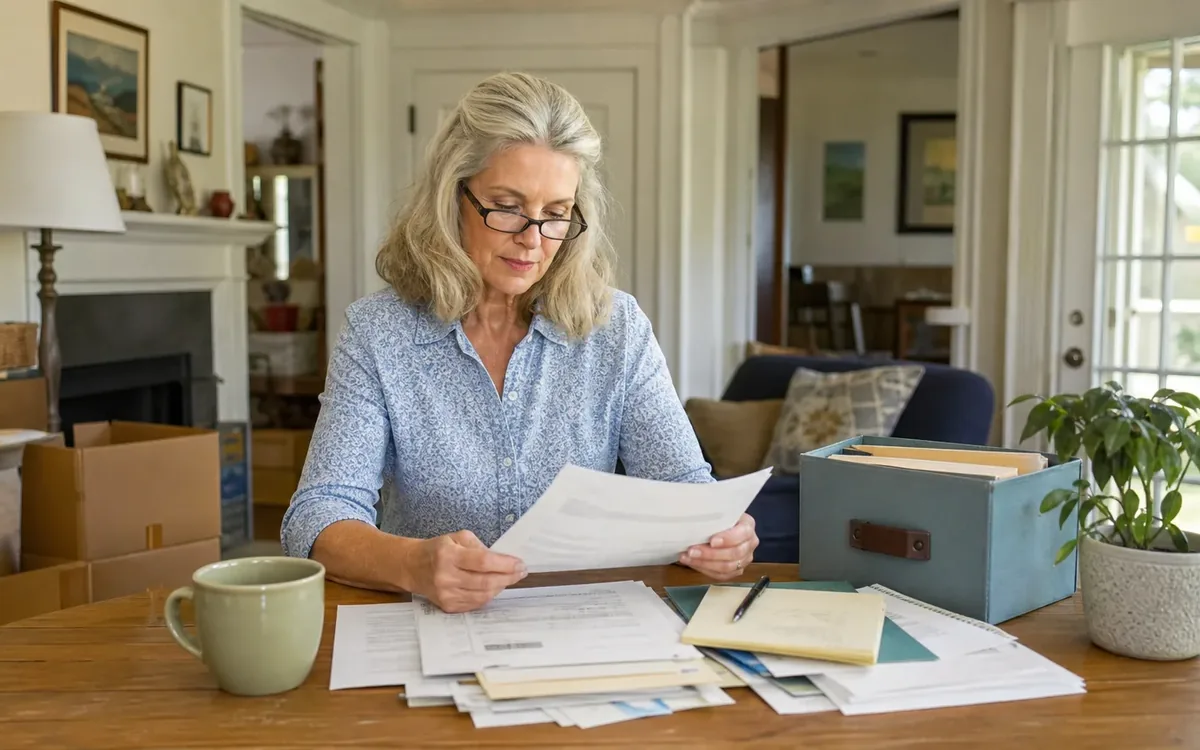
After an estate sale, keep the sale agreement, inventory, photographs, receipts, payment records, final settlement statement, expense invoices, tax documents, donation receipts, and written records showing what happened to unsold property. These documents help the personal representative, trustee, heirs, and professional advisers trace estate property and explain how sale proceeds were handled. The household can organize and preserve the file, but an attorney, accountant, appraiser, or court must decide legal, tax, valuation, and probate requirements.
Quick answer: Create one permanent estate-sale file containing the signed contract, pre-sale inventory, valuation records, sale results, expense documentation, deposit confirmation, and records for unsold items. Keep original legal and tax documents. Ask the estate attorney or tax professional how long each category must be retained before anything is destroyed.
Why do estate sale records matter after the event is over?
The sale may last only a few days, but administering an estate can continue much longer. A complete paper trail connects each significant item to a sale, distribution, donation, transfer, or disposal decision.
Good records can help the responsible person:
- Reconcile gross sales with fees, expenses, and net proceeds
- Show that sale money reached the correct estate or trust account
- Answer beneficiaries’ reasonable questions
- Support tax preparation and probate accounting
- Distinguish estate property from property belonging to another person
- Document donations and the disposition of unsold belongings
- Preserve valuation information for notable items
- Explain decisions if questions arise later
Documentation is especially important when several heirs are involved, ownership is disputed, the home contains consigned or borrowed property, or the sale occurs before the estate is closed.
A household may choose a clear filing method and gather missing documents. It should not independently decide whether a record satisfies a court, tax agency, trust, or probate requirement. Those judgments belong to the responsible professional or authority.

Start with the authority and sale agreement
Keep documents showing who had authority to approve the sale. Depending on the situation, these might include relevant portions of a will or trust, court-issued appointment documents, written owner authorization, or an agreement signed by the authorized representative.
Do not distribute complete copies of sensitive documents more widely than necessary. Preserve the originals or official copies securely and ask the estate attorney which parties should receive access.
Retain the complete estate sale agreement, including:
- The names of the contracting parties
- The property address or identified sale location
- Sale dates and access dates
- Commission or fee terms
- Advertising or labor charges
- Pricing and discount provisions
- Terms covering valuables, vehicles, firearms, or other regulated property
- Procedures for unsold items
- Cancellation terms
- Insurance or responsibility provisions stated in the contract
- Every amendment, addendum, email approval, and signed change
The household can compare the final statement with the written agreement. Questions about whether a contract term was properly applied should go to the sale company first, then to an attorney if the issue remains a legal dispute.
For households still planning a sale rather than closing one out, Clutter Cleaner of South Carolina provides information about auctions and estate sales. Service discussions may cover sorting, sale preparation, practical logistics, and what may happen to remaining contents. They do not replace legal approval from the person authorized to act for the estate.
Which inventory and valuation records should you preserve?
Keep the most complete pre-sale inventory available. It may be a spreadsheet, itemized report, group of room lists, tagged photographs, or export from a sale platform. Preserve its original format when possible rather than continually overwriting one working copy.
A useful inventory identifies:
- High-value individual items
- Groups of ordinary household goods
- Items excluded from the sale
- Property reserved for a beneficiary
- Items owned by someone other than the estate
- Consigned, rented, or borrowed property
- Items moved to another sale channel
- Unsold property and its eventual destination
Photographs provide context that a list cannot. Keep dated room photographs and clear images of notable pieces, maker’s marks, model numbers, serial numbers, condition issues, and sale tags when available. Avoid placing sensitive images or identifying documents in a broadly shared folder.
Preserve written appraisals, specialist opinions, auction estimates, and other valuation materials obtained before the sale. Also keep notes showing who prepared the opinion and when. An estate sale team may discuss market presentation or practical pricing strategy. A qualified appraiser determines an appraisal when one is needed, and tax authorities or courts decide whether a valuation is acceptable for their purposes.
If property was removed before the sale, note:
- What was removed
- Who authorized the removal
- Who received it
- The date of transfer
- Any stated value or valuation source
- A receipt or acknowledgment, if appropriate
This is not an invitation to create a value after the fact. If a value is required for probate, tax, insurance, or equitable distribution, ask the attorney, accountant, or qualified appraiser what documentation is appropriate.

Keep a full financial trail from sale to deposit
The final settlement packet should make the money easy to follow. Keep both summary records and detailed reports, even if the totals appear to match.
Preserve:
- Daily and final sales reports
- Cash, card, check, and online payment summaries
- Refund, return, chargeback, and disputed-payment records
- Buyer invoices for significant items
- Sales tax reports supplied by the operator
- Commission calculations
- Advertising, labor, security, hauling, and other charged expenses
- Copies of checks or electronic payment confirmations
- Deposit slips and relevant account statements
- The final net-proceeds statement
Reconcile the transaction in a simple sequence:
- Record reported gross sales.
- Identify refunds or payment reversals.
- List commissions and each additional expense.
- Calculate the expected net amount.
- Match that amount to the check, transfer, and deposit.
- Save a note explaining any unresolved difference.
Do not place estate funds into a personal account merely for convenience without professional guidance. The estate attorney, trustee’s counsel, financial institution, or accountant can explain the correct account and signing authority for the specific matter.
Keep tax records supplied with the sale paperwork, but do not assume they answer every tax question. Responsibility for sales tax administration, income reporting, basis, deductions, estate tax matters, and beneficiary reporting depends on facts beyond a cleanout or sale team’s role. Direct those questions to the sale operator, tax preparer, accountant, attorney, or appropriate government authority.
What should you document about unsold belongings?
Unsold property is often where the record trail breaks. Once the public sale ends, remaining items may be transferred to family, routed to another sale, donated, recycled, stored, or discarded. Document each path instead of recording everything as “leftovers.”
Create a post-sale disposition log with columns for:
- Item or category
- Quantity when useful
- Final destination
- Date removed or transferred
- Person authorizing the action
- Recipient or organization
- Receipt or acknowledgment number
- Notes about restricted or sensitive property
For donations, keep the receipt and a copy of the list provided to the receiving organization. A practical team may help identify and organize donation paperwork. It should not assign a tax-deductible value unless appropriately qualified to do so. The taxpayer and tax professional are responsible for substantiation and reporting decisions.
For property given to an heir or another recipient, obtain a dated acknowledgment when warranted. For discarded material, a brief category-level record may be enough for ordinary low-value contents, but ask the estate attorney before destroying papers, valuables, disputed items, or property potentially relevant to a claim.
Hazardous materials, medications, firearms, vehicle titles, identity documents, and regulated items require special attention. Follow instructions from the relevant authority or qualified professional. A cleanout or move team may discuss practical handling and sequencing, but it cannot make legal ownership, transfer, or compliance determinations.
If the next phase includes clearing the residence, the guide to the best way to clean out an estate explains how to separate decisions, records, valuables, donations, and removal work without treating the process as one rushed disposal project.
How should records be organized and stored?
Use a structure that another authorized person can understand without oral explanations. A single binder plus a matching digital folder works well for many estates.
Suggested folders include:
- Authority and legal documents
- Estate sale contract and amendments
- Inventory and photographs
- Appraisals and valuation materials
- Sales reports and buyer invoices
- Fees, expenses, and vendor invoices
- Payments, deposits, and bank confirmation
- Unsold-item disposition records
- Donations and recipient acknowledgments
- Tax and probate accounting materials
- Correspondence and issue resolution
Name digital files consistently. A format such as 2026-08-14_Final-Sales-Report.pdf sorts chronologically and explains the contents. Scan paper receipts before ink fades, but preserve originals when they may have legal or tax significance.
Back up digital records in at least two secure places. Restrict access because files may contain addresses, signatures, bank details, identification numbers, buyer information, and photographs of the home’s contents. Do not email an entire archive when a recipient needs only one document.
Create a one-page index listing the folders, key contacts, sale dates, gross proceeds, total expenses, net payment, deposit date, and unresolved items. The index is a navigation tool, not a substitute for the supporting documents.
How long should estate sale records be kept?
There is no responsible universal answer for every estate. Retention can depend on probate status, trust terms, tax filing dates, asset type, pending disputes, beneficiary issues, and instructions from a court or agency.
The household can separate records into practical categories:
- Permanent or core records: authority documents, final probate or trust accountings, important appraisals, settlement statements, and proof of major distributions
- Tax-related records: sale reports, expenses, donation paperwork, valuations, and deposit records connected to a return
- Working records: duplicate notes, scheduling messages, draft inventories, and routine logistics
- Sensitive records: bank details, identification documents, signatures, and buyer or beneficiary information
Before destroying anything, ask the estate attorney and tax professional for written retention guidance tied to the estate’s circumstances. Confirm that probate or trust administration is complete, applicable returns are resolved, claims periods have been considered, and no dispute or audit is pending.
When destruction is approved, shred sensitive paper and securely delete digital copies. Deleting a folder from one computer may not remove cloud backups, email attachments, shared links, or files stored on another device.
Who decides what after an estate sale?
Clear role boundaries reduce confusion.
The authorized household representative can usually decide:
- How to label and organize records
- Who receives routine copies, subject to privacy and authority
- Which practical tasks to delegate
- How to track open questions
- Whether to request corrected or missing sale paperwork
- Where approved records will be stored
An estate sale, cleanout, or move team may discuss:
- Available inventory and sale reports
- Practical sorting and documentation methods
- Sale preparation and removal sequencing
- Records generated by its contracted work
- Options for addressing unsold household contents
- Coordination needs before the home is prepared for its next use
The appropriate professional or authority decides:
- Who has legal authority to sell or distribute property
- Whether property belongs to the estate
- Probate, trust, creditor, and beneficiary requirements
- Tax treatment and record-retention periods
- Formal appraisal standards and values
- Real-estate disclosure, listing, title, and closing matters
- Inspection findings and required repairs
- Building, environmental, disposal, and code-compliance requirements
- Rules governing regulated or titled property
Clutter Cleaner of South Carolina can discuss practical estate cleanouts, downsizing and organizing, auctions and estate sales, move management, home sale preparation, and code compliance support statewide. Legal conclusions, formal valuations, real-estate representation, inspections, and government approvals remain with the responsible licensed professional or authority.
A focused closeout sequence
Instead of treating recordkeeping as a broad household checklist, complete this short sale-specific sequence:
- Collect the signed agreement and proof of authority.
- Freeze a final copy of the pre-sale inventory and photo set.
- Obtain detailed sales, fee, refund, and expense reports.
- Match net proceeds to the actual deposit.
- Record the destination of every meaningful unsold category.
- Gather acknowledgments, donation receipts, and transfer records.
- List missing documents and request corrections in writing.
- Send legal, tax, appraisal, or compliance questions to the appropriate professional.
- Create an indexed paper and digital archive.
- Obtain retention guidance before destroying records.
This sequence produces a defensible account of what occurred without asking a cleanout or sale provider to make decisions outside its role.
FAQ
Do I need to keep every individual sales receipt?
Keep detailed transaction records supplied by the sale operator, especially for significant items, refunds, disputes, or transactions tied to valuation questions. Ask the accountant or estate attorney whether every routine buyer receipt must be retained in the particular estate.
Should estate sale photographs be saved?
Yes. Preserve organized pre-sale and sale photographs, particularly images of notable property, condition, serial numbers, and room contents. Store them securely because they may reveal private information.
Who determines the value of donated leftovers?
The sale or cleanout team should not invent a tax value. Ask a qualified appraiser when an appraisal is required and a tax professional how charitable contribution rules apply.
Can records be discarded after probate closes?
Not automatically. Tax, trust, property, dispute, or other retention needs may continue. Obtain case-specific guidance from the estate attorney and tax professional before destruction.
What if the final payment does not match the sales report?
Compare gross sales, refunds, commissions, and itemized expenses. Request a written explanation and corrected statement from the operator. If the issue becomes a contractual, fiduciary, or legal dispute, consult an attorney.



