

Organize everyday belongings for someone with low vision by keeping familiar items in consistent places, choosing labels the resident can actually use, and making objects easier to distinguish from their surroundings. Start with the resident’s daily routines, not a goal of removing belongings. South Carolina families can adapt a household without replacing a familiar system that already works.
Quick answer: Ask the resident how they recognize and locate items. Agree on a home for each frequently used object, test a few contrasting or tactile labels, and keep shared household members from moving things without permission. Refer vision-specific adaptations to an appropriate vision professional, and keep medical, electrical, legal, and compliance decisions with the responsible professional or authority.
What helps someone with low vision find everyday belongings?
A useful system provides more than one way to identify an object. Depending on the resident’s preferences and usable vision, that might mean a readable label, a distinctive container shape, a tactile marker, or a remembered location. No single labeling method works for everyone.
Ask about actual tasks rather than making assumptions about eyesight. “How do you tell these bottles apart?” is more useful than “Would bigger labels help?” The person may already rely on the cap shape, bottle position, or an audio tool.
Discuss specific frustrations:
- Which items are difficult to distinguish from similar objects?
- Where does searching interrupt a daily routine?
- Which existing arrangements should stay unchanged?
- Are labels easier to read up close, at a particular angle, or with a preferred device?
- Do glare, crowded surfaces, or patterned backgrounds make identification harder?
If the resident uses a magnifier, screen reader, or another assistive tool, include it when testing the arrangement. A system should work during normal use, not only when someone else is standing nearby explaining it.
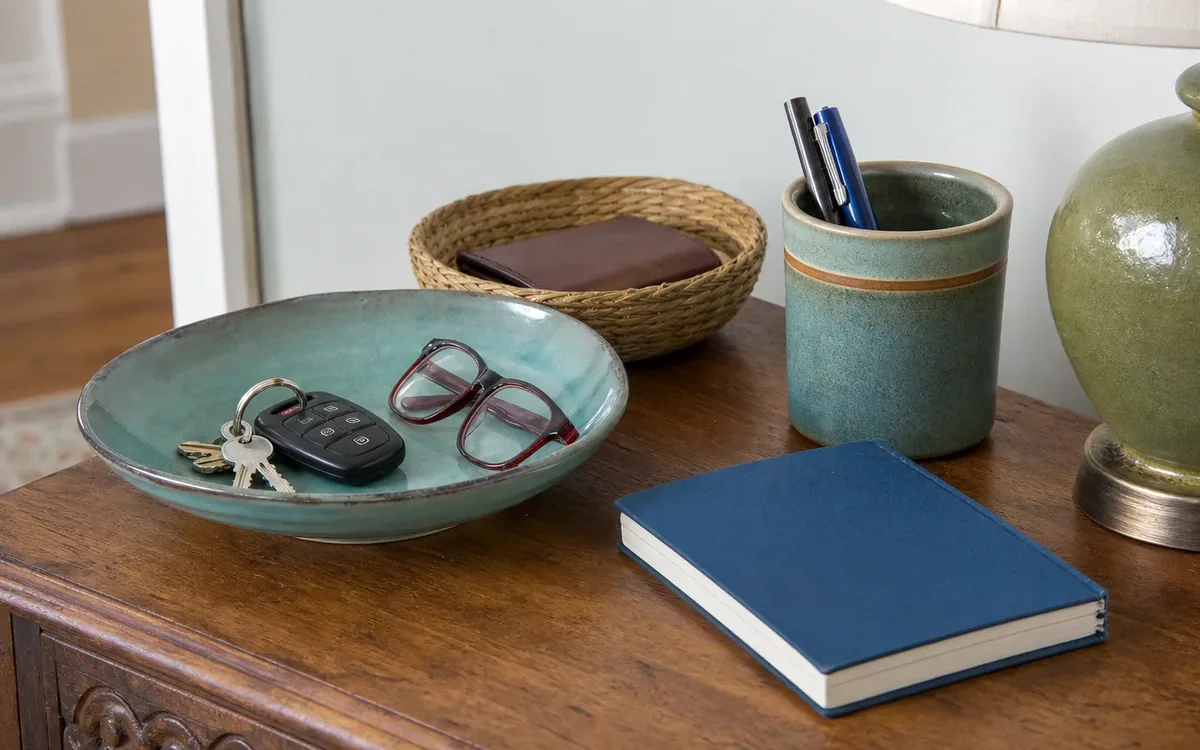
Preserve familiar locations before changing storage
Consistency can be more valuable than a visually tidy room. Moving keys from a familiar hook to a hidden drawer may improve the appearance of an entryway while making the resident’s routine harder.
Begin with one frequently used area. Ask the resident to show where items belong and what happens when someone puts them elsewhere. A drawer that looks disorganized to a visitor may contain a reliable left-to-right sequence.
Separate three kinds of belongings:
- Daily-use items: Keep them in agreed, easily reached locations.
- Occasional-use items: Give them a stable location with a usable identification method.
- Items awaiting a decision: Place them in a clearly identified holding area rather than quietly relocating them.
The household decides what stays, what moves, and what is no longer wanted. Downsizing and organizing support can be discussed when a family needs help arranging belongings, but accessible organization does not have to involve downsizing.
Avoid reorganizing several rooms at once. Let the resident try one changed area during ordinary activities before extending the approach elsewhere. If it creates more searching, revise it rather than insisting that the new arrangement is better.
How should you choose labels and contrast?
Let the resident compare a small selection of labels on the actual objects. A sample that looks clear on a table may be unreadable on a curved bottle or behind a reflective cabinet door.
Possible choices include:
- Large, plain lettering with enough space between words.
- Dark text on a light background, or the reverse if preferred.
- Matte labels where shiny surfaces create glare.
- Raised dots or other distinct tactile markers.
- Different container shapes for objects that otherwise feel alike.
- Audio labels or accessible digital records, if the resident already uses compatible tools.
Use color as an additional cue, not the only identifier. Two containers may look different to one person and nearly identical to another. A label such as “tea” paired with an agreed location can be more dependable than color alone.
Keep labels brief but meaningful. “Breakfast bowls” usually communicates more than “kitchen items.” Put labels where the resident expects to look or touch, and check that they do not interfere with opening, gripping, or cleaning the object.
Tactile markers also need clear meanings. Agree on what each marker indicates and avoid creating a code so elaborate that it requires constant explanation. Do not cover manufacturer warnings, instructions, expiration information, or medication labels.
A low-vision specialist or occupational therapist can advise on individualized accessibility methods. Family members and organizing teams can help arrange belongings, but should not prescribe vision aids or assume which technique is medically appropriate.

Build task zones rather than sorting everything by category
Traditional organization often puts every similar object together. For low-vision use, keeping the items needed for one task together may be more practical. The resident’s sequence of actions should guide the arrangement.
For making a morning drink, that could mean placing the preferred mug, tea or coffee, and spoon in a consistent area. It does not require moving every cup in the house. Keep appliance controls and necessary work surfaces unobstructed.
Useful task zones might include:
- An entry area for keys, a bag, and items carried outside.
- A reading area for glasses, a magnifier, and reading materials.
- A clothing area with familiar garment groupings and distinguishable dividers.
- A household paperwork area with separately identified incoming and completed documents.
Keep the organization specific to the resident. Someone who identifies shirts by fabric or button shape may not benefit from a system based on color names.
For bathrooms and kitchens, preserve separation between products that could be confused. Cleaning products should not share a task container with food or personal-care supplies. Ask a pharmacist about medication identification and storage rather than transferring medicines into look-alike containers.
Families handling inherited belongings alongside these changes may find the guide to cleaning out an estate useful for the separate question of sorting estate contents. Do not let that broader project displace the resident’s established daily-use locations.
Make shared spaces predictable without making them rigid
Accessible organization depends on everyone who uses the space. A well-labeled drawer will not help if its contents keep migrating to another room.
Agree on simple household rules:
- Return shared objects to their designated place after use.
- Ask before moving the resident’s personal belongings.
- Keep routes and frequently used surfaces free of temporary piles.
- Describe an agreed change directly rather than expecting the resident to notice it.
- Put uncertain items in the designated holding area, not in a random cupboard.
Use specific location descriptions. “Your keys are on the entry tray, beside the bag hook” is clearer than “over there.” If an item is temporarily unavailable, say where it went and who will return it.
For visitors, a short explanation may be enough: the placement is intentional, even if it differs from their preferences. Avoid attaching labels everywhere merely to instruct guests. Excess visual information can make the resident’s own labels harder to find.
A household location record can help caregivers or relatives maintain consistency. Keep it in a format those people can use, but do not make the resident dependent on someone else reading a chart to find everyday objects.
How can you test a new arrangement without disrupting routines?
Choose a task the resident wants to improve, such as finding the correct sweater or locating breakfast supplies. Ask permission before changing its storage area, and record the original arrangement so it can be restored.
Invite the resident to use the proposed setup in their usual way. Do not guide every movement. Ask whether the objects were easy to identify and whether the placement made sense.
Look for practical issues:
- A label is readable only after lifting a heavy container.
- Similar tactile markers are difficult to distinguish.
- A basket hides small objects at the bottom.
- An organizer reduces useful space or blocks a handle.
- A new location requires an awkward reach.
Make one adjustment at a time so the household can tell what helped. Keep successful features and remove unnecessary ones. The best outcome is a routine the resident can use comfortably, not a room that matches someone else’s picture of organization.
Changes in vision, mobility, or household routines may call for another review. Ask the resident what has changed before replacing a system that still works.
Plan cleanouts and moves around the established system
During a cleanout or move, familiar placement can disappear quickly. Before packing or sorting, identify the belongings the resident needs to keep available and the arrangements that should be recreated.
A practical organizing or move team may discuss:
- Which areas should remain untouched until the resident approves changes.
- How boxes and destination rooms will be identified.
- Which daily-use belongings should stay together and accessible.
- Who can approve relocation, donation, or removal.
- How the resident will review the new placement.
Clutter Cleaner of South Carolina is physically based in Mount Pleasant, with Charleston as its primary market and a service territory covering all of South Carolina. Its approved services include downsizing and organizing, estate cleanouts, and move management. Families can discuss the scope of a project without assuming that specialized accessibility products or clinical assessments are included.
Storage, contractor work, appraisals, and disposal arrangements are separate household or provider choices. An appraiser determines an appraisal opinion; an organizing team should not decide an object’s value. Legal questions about ownership or authority belong with the appropriate legal professional. Real-estate advice, inspections, electrical modifications, and compliance determinations likewise stay with the responsible professional or authority.
Short FAQ
Does low-vision organization require getting rid of belongings?
No. The main goal is dependable identification and placement. Removing unwanted items may help if the resident chooses it, but quantity reduction is not a substitute for a usable system.
Are clear containers always better?
No. Visible contents may help some residents, while reflections or overlapping objects may make identification harder for others. Test a container with its intended contents before replacing existing storage.
Should family members surprise the resident with an organized room?
Avoid surprise rearrangements. Ask first, preserve important locations, and involve the resident in testing changes. An unfamiliar system can make even well-intended help disruptive.
Who should approve changes to medication storage?
The resident and appropriate caregiver should discuss medication identification and storage with a pharmacist or prescribing clinician. An organizing team should not change doses, interpret instructions, or obscure original labels.
Keep the resident’s preferences at the center
Accessible organization is successful when the person can recognize belongings and find them where expected. Start with one meaningful routine, preserve what works, and make changes with permission.
For South Carolina households considering organizing or move support, contact Clutter Cleaner of South Carolina at (843) 972-7020 to discuss the project scope. Explain the resident’s preferred labels, contrast, and familiar locations so those priorities can guide the conversation.



