
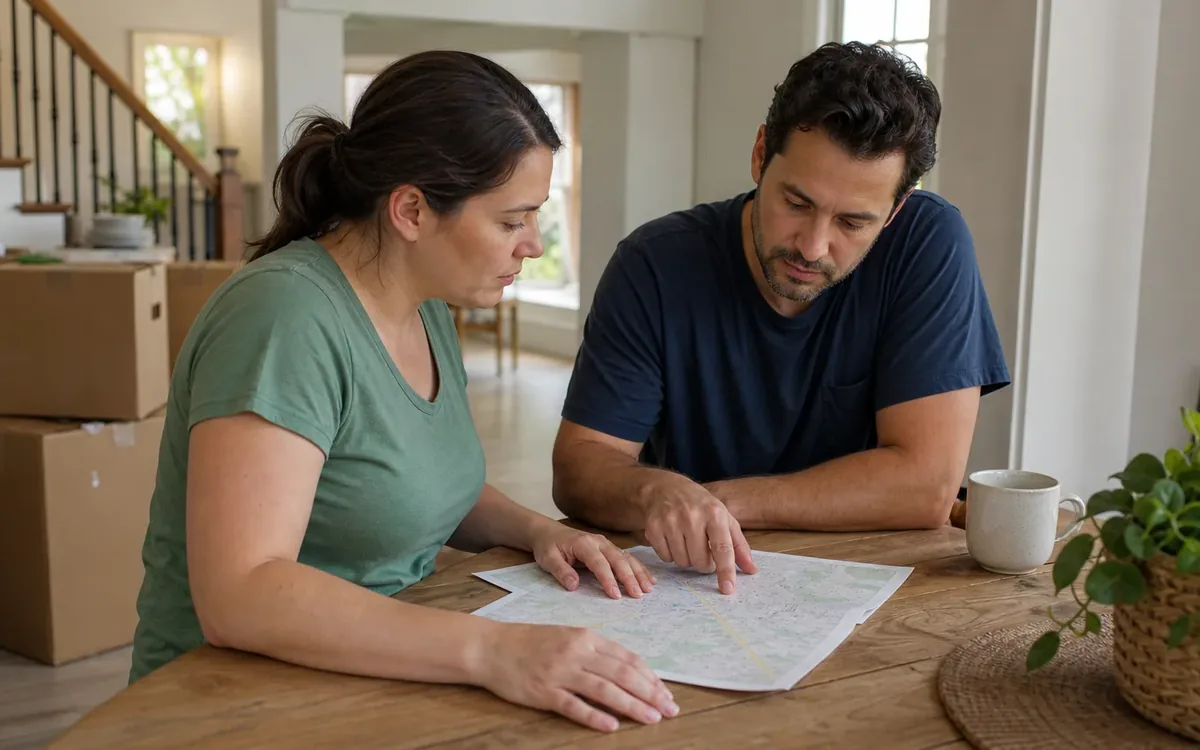
A move-day parking plan should identify a lawful truck position, relocate household vehicles, protect a clear loading path, and tell affected neighbors or property managers what to expect. In a South Carolina neighborhood, the household should confirm who controls each parking area before reserving space or placing signs. Municipal staff, law enforcement, an HOA, a landlord, or a property manager may need to decide what is permitted.
Quick answer: Mark the preferred and backup truck positions on a simple property sketch. Confirm parking rules with the authority responsible for the street or shared area. Move household vehicles before the truck arrives, keep sidewalks and emergency access open, and communicate with neighbors whose access could be affected. Do not assume cones, bins, or homemade signs legally reserve a public space.
This guide focuses on vehicle placement, loading access, and neighborhood coordination rather than packing or the broader move schedule. Households considering professional coordination can review move management services across South Carolina. The team may discuss practical access and sequencing, while parking permissions remain with the owner or responsible authority.
Why does move-day parking need its own plan?
Parking is often treated as a small detail until the moving vehicle reaches a narrow street, occupied curb, shared driveway, or controlled community entrance. A truck that cannot reach a workable position can create longer carrying routes, blocked vehicles, or conflict with neighbors.
A useful plan separates three different questions:
- Where can the vehicle physically fit? Consider width, turning room, overhead clearance, slopes, soft shoulders, gates, and parked cars.
- Where may it legally or contractually park? Public-street rules, posted restrictions, HOA documents, leases, and property-management policies can all matter.
- How will people and belongings travel between the home and truck? The shortest route is not necessarily appropriate if it crosses another property, blocks a sidewalk, or creates an unsafe blind spot.
The household can observe the site and propose a preferred location. A practical cleanout or move team may discuss truck access, carrying distance, and the order in which areas should be cleared. Only the responsible public authority or property controller can interpret or grant applicable parking permission.
Who controls the proposed parking space?
Start by identifying whether each possible location is a public street, private street, household driveway, shared driveway, assigned parking space, common area, or another person’s property. A curb directly in front of a home is not automatically reserved for that home.
For a public street, contact the municipality or other agency responsible for that road. Ask whether moving vehicles require a permit, temporary parking authorization, posted notice, or another form of approval. Also ask whether local rules address commercial vehicles, loading activity, traffic control devices, or temporary obstruction of travel lanes.
For a private community, review current HOA or condominium rules and contact the association or manager. For a rental, consult the lease and ask the landlord or property manager about moving procedures. Apartment and condominium communities may control entrances, loading areas, gates, elevators, or assigned spaces separately.
For a shared driveway, talk with every household whose access may be affected. One owner may not have authority to approve blocking the entire shared route. Property documents or advice from a qualified real-estate attorney may be needed if ownership or access rights are unclear.
Do not rely solely on what happened during a previous move. Signs, ordinances, management policies, construction conditions, and access arrangements can change.
Map the truck position before move day
Create a simple sketch rather than relying on memory. It does not need to be professionally drafted. Show the building, driveway, curb, intersection, neighboring driveways, mailbox locations, hydrants, sidewalks, gates, and the intended loading entrance.
Evaluate the proposed truck position using these concrete checks:
- The driver can enter and leave without using another owner’s property unless permission has been obtained.
- The surface appears suitable for the expected vehicle, subject to the driver’s judgment.
- The position does not cover a fire hydrant, marked restriction, driveway, crosswalk, or other protected area.
- Emergency access and the traveled portion of the road remain available as required.
- Doors and ramps can open without extending into an unsafe or prohibited area.
- Tree limbs, utility lines, balconies, gates, and roof overhangs have been considered.
- The loading route does not force workers or household members into uncontrolled traffic.
- A backup position is identified if the preferred space is occupied or rejected.
Measure uncertain spaces and give accurate details to the moving or cleanout provider. The driver or provider decides whether its particular vehicle can safely use the location. A household should not direct a driver into a space the driver considers unsafe.
Photographs can help explain the approach, but they do not replace an on-site decision. Include views from both travel directions, especially where streets are narrow or curves limit visibility.

How should resident vehicles be relocated?
Move household vehicles away from the loading area before truck arrival. This includes cars in the driveway, vehicles along the curb, trailers, recreational vehicles, and any non-operational vehicle that could restrict turning or access.
Choose lawful temporary locations for those vehicles. A neighbor’s driveway, guest space, grass verge, commercial lot, or association common area should not be used without permission. Assigned and accessible spaces must remain available to authorized users and should not be treated as general overflow parking.
Account for vehicles that may need to leave during loading. A resident going to work, a caregiver arriving, or a school pickup can become trapped if vehicles are parked in the wrong order. Place frequently needed cars beyond the active loading zone.
A clear vehicle-relocation plan should state:
- Which vehicles will move
- Who has each set of keys
- Where each vehicle may lawfully park
- Which vehicle needs first access after loading begins
- Whether a neighbor or property manager has approved any private-space use
- What happens if the planned overflow area is full
Keep keys with an identified adult rather than packed inside the home. If a vehicle cannot be moved, tell the move team while access options are still being discussed.
For households combining a move with an estate transition, how estate cleanouts work explains the broader decision process. Parking should still be planned separately so that donation, disposal, sale, storage, and moving vehicles do not compete for the same limited access.
Design a safe loading path
The loading path is the route between the home and the vehicle. Draw it on the site sketch and walk it while imagining people carrying bulky items with limited visibility.
Select a route that avoids unnecessary steps, loose gravel, low branches, hoses, toys, unstable pavers, wet leaves, and abrupt changes in level. Secure pets and keep children away from the active path. Remove only items the household has authority to move.
Do not create a route across a neighboring lawn or driveway merely because it is shorter. Obtain permission before using private property. If the path crosses a sidewalk or another area open to pedestrians, discuss safe handling with the provider and preserve public access as required by the responsible authority.
The household can decide which authorized door to use and can clear personal belongings from that route. A move or cleanout team may discuss carrying practicality, furniture clearances, ramp placement, and staging. Building alterations, railing removal, electrical work, tree trimming, or surface repair belong to appropriately qualified contractors selected by the household.
Protecting floors, doors, and landscaping should also be discussed with the provider. Do not assume a parking plan includes property protection products or contractor work unless those responsibilities are specifically agreed upon.
Plan for narrow streets and shared driveways
Narrow streets require more than finding an open curb. A truck may fit while still leaving inadequate room for other vehicles, emergency access, or safe ramp use. Street width, curves, parked cars, and turnaround options all affect feasibility.
Ask the vehicle provider what information it needs to assess access. Useful details include photographs, approximate measurements, surface conditions, gate instructions, bridge or weight-limit signs, and whether backing may be necessary. The provider remains responsible for decisions concerning its vehicle and operation.
For a shared driveway, write down when access could be restricted and which neighbors need uninterrupted entry. Avoid promising that a driveway will remain open if truck placement makes that impossible. Instead, revise the position or obtain an arrangement acceptable to everyone with authority over the area.
Never direct traffic or place traffic-control devices unless permitted and handled in accordance with the responsible authority’s requirements. Household members waving vehicles around a blind curve can create new risk. Ask the municipality, property manager, or relevant authority what measures are required if normal traffic flow may be affected.
A smaller vehicle, remote parking position, or different loading route may be worth discussing when direct access is unsuitable. These are provider and household planning choices, not guaranteed solutions. Any effect on the scope, contract, or cost should be addressed directly with the selected provider.
What should neighbors and managers be told?
Advance communication helps neighbors distinguish a planned move from an unexpected obstruction. Keep the message factual and limited to what is known.
Include:
- The date established with the provider
- The general area where loading is expected
- Any period when a shared driveway or private access may be affected
- A household contact for access concerns
- Requests to keep an agreed private area clear, if the recipient has authority over it
- Relevant gate, loading-zone, or building procedures supplied by management
Do not tell neighbors that public curb space has been reserved unless the responsible authority has actually approved that reservation. A courteous request is different from a legal parking restriction.
If the home is in an HOA, condominium, apartment, or managed community, ask whether notice must follow a particular form. Management may require coordination involving gates, elevators, loading areas, insurance documents, or protection of common property. Management decides its requirements, and the provider decides whether it can comply with operational requests.
Avoid sharing sensitive details about valuables, vacancies, disputes, or the reason for an estate transition. The communication needs to address access, not the household’s private circumstances.
Build a backup parking option
Even a confirmed plan can be affected by an occupied curb, road work, utility activity, weather, enforcement instructions, or a vehicle that is larger than expected. A backup should be a real, evaluated location rather than “somewhere nearby.”
Use this four-part fallback plan:
- Name the alternate position. Mark it on the same sketch and check who controls it.
- Recheck the carrying route. Identify additional crossings, slopes, gates, or private property.
- Set a decision contact. Choose the household member authorized to speak with the provider and property manager.
- Define the stop point. If no lawful, safe position is available, pause and contact the responsible parties instead of improvising.
Never solve a parking failure by blocking a hydrant, accessible space, driveway, intersection, sidewalk, or travel lane. Homemade cones and chairs may themselves be prohibited or create an obstruction. Ask the relevant authority what may be placed in a public area.
Weather can also change surface suitability. Grass, unpaved shoulders, and soft ground may not support a vehicle even when a property owner approves their use. The driver or vehicle provider makes the operational decision, while the property owner decides whether private land is available.
Keep parking decisions separate from other move decisions
A parking plan should not blur responsibility for the rest of a home transition. Different decisions belong to different people or providers.
The household or authorized decision-maker chooses what will move, remain, be sold, be donated, enter storage, or be discarded. A move team may discuss organization and handling logistics, but ownership disputes or unclear authority should be resolved before items leave the property.
A storage company determines its access rules, unit terms, and acceptance conditions. Contractors make decisions within their own qualified trades concerning repairs, alterations, landscaping, or building access. A qualified appraiser determines valuation conclusions. Real-estate professionals advise within their professional roles about listing and transaction matters.
Inspectors assess conditions within the scope of their inspections. Municipal or association representatives decide applicable parking, access, permit, and compliance questions. Attorneys and courts handle legal authority, ownership disputes, estate administration, and contested access rights.
Clutter Cleaner of South Carolina, based in Mount Pleasant and serving households statewide, may discuss practical move-management access as part of an agreed scope. That discussion does not replace permission from a municipality, HOA, landlord, property manager, property owner, or other authority.
A final parking-plan review
Before the moving vehicle arrives, review the plan with the selected provider and the household’s decision-maker. Confirm that the address, entrance, gate information, truck location, alternate location, and contact numbers are accurate.
Walk the route one final time. Look for newly parked cars, delivery vehicles, trash containers, landscaping work, low limbs, wet surfaces, or changes to posted restrictions. Keep the property sketch and any written permissions accessible.
A strong plan does not guarantee that every condition will remain unchanged. It gives the household and provider a clear way to respond without blocking access, arguing over assumptions, or making unsafe parking choices.
FAQ
Can a homeowner reserve the curb with cones?
Not necessarily. Public curb space is controlled by the responsible authority, and private objects may not create a lawful reservation. Ask the municipality or road authority what authorization and devices, if any, are allowed. On private property, obtain approval from the owner or manager.
Should the truck park in the driveway or street?
That depends on permission, dimensions, surface capacity, overhead clearance, loading safety, and the provider’s vehicle requirements. The property owner can authorize use of a private driveway, but the driver or provider decides whether its vehicle can safely use it.
What if a neighbor blocks the planned space?
Do not confront, tow, or move another person’s vehicle without proper authority. Use the approved backup position or contact the property manager, municipality, law enforcement agency, or other responsible authority as appropriate.
Who decides whether a permit is required?
The municipality, road authority, or private property controller responsible for the location determines its requirements. A move team can ask access questions but should not be treated as the source of legal or regulatory advice.
Can the loading path cross a sidewalk?
Conditions and local requirements vary. Keep pedestrian access and safety in mind, and ask the responsible authority about restrictions or required controls. The provider should evaluate whether its loading method is workable under those conditions.



