

A hurricane-season moving plan should identify who monitors official weather information, what conditions trigger a pause, where people and pets can stay, how documents and essential items remain protected, and which alternate dates or routes are acceptable. Make these decisions before packing begins, then confirm them with every provider involved in the move.
Quick answer: Build one primary move plan and one workable backup. Put safety decisions first, keep essential records with the household, identify alternate lodging and routes, and write down who has authority to postpone each part of the move. Follow evacuation orders and other instructions from the appropriate public authorities.
South Carolina households may face tropical-weather disruptions, particularly in coastal areas. A storm does not need to damage either home to affect a move. Road conditions, evacuation traffic, building access, utility interruptions, provider availability, and closing arrangements can all change.
The goal is not to predict a storm. It is to create clear decision points so the household can respond without improvising under pressure.
Why does a hurricane-season move need a separate backup plan?
An ordinary moving plan often assumes that the origin home, destination, route, utilities, and scheduled providers will all be available at the same time. Tropical weather can interrupt any one of those pieces.
A useful backup plan treats the move as several connected decisions rather than one appointment:
- Whether people and pets should travel
- Whether either property can be entered safely
- Whether roads and planned routes are open
- Whether utilities are operating at the destination
- Whether movers, cleaners, contractors, storage facilities, or other providers are available
- Whether a closing, inspection, appraisal, walkthrough, or building reservation has changed
- Whether belongings should remain in place, move to storage, or travel later
This separation matters because postponing one task does not automatically postpone every task. A household might delay transporting furniture while still protecting documents and leaving for safe lodging. Alternatively, access to the destination could change even when the origin property is unaffected.
For coordinated help with sorting, packing decisions, and move preparation, review the statewide move management service. The household should still make its own safety, travel, lodging, insurance, and legal decisions, while each provider confirms what it can safely and contractually do.

Who should monitor the weather and make the call?
Assign roles before weather becomes urgent. Avoid relying on a general understanding that someone will check conditions.
The household can decide:
- Who monitors official forecasts, emergency notices, evacuation instructions, and road information
- Who communicates with family members and providers
- Who has authority to approve a schedule change
- Who carries identification, medications, pet records, keys, and important documents
- Who checks conditions at the origin and destination, when safe and permitted
- Which household member is the backup contact if the primary contact cannot be reached
Use official public information for emergency and evacuation decisions. A move coordinator, mover, cleaner, organizer, or real-estate professional may discuss availability and practical alternatives, but those providers do not replace emergency-management authorities.
Ask each provider how weather changes are communicated. Relevant questions include:
- What number or email will be used for updates?
- Who can authorize rescheduling?
- What happens if access to one property is restricted?
- Can a partial task proceed safely if transportation is postponed?
- Are deposits, cancellation terms, or storage arrangements affected?
- Which decisions must be made by the customer, property owner, building manager, insurer, or another party?
Get important terms directly from the relevant provider and review written agreements. Do not assume that every company follows the same weather policy.
Build the plan around five decision points
A practical plan needs five clearly defined decision points.
- Monitoring point: Decide when active weather monitoring begins and which official sources the designated person will use.
- Review point: Identify the conditions that prompt the household to contact providers and reassess the plan. These may include official watches or warnings, evacuation instructions, building closures, unsafe road conditions, or utility disruption.
- Pause point: State who can stop packing, loading, travel, cleaning, or property access when conditions are unsafe or authorities restrict movement.
- Fallback point: Choose the alternate lodging, storage inquiry, route, destination access plan, and rescheduling contact sequence.
- Restart point: Require confirmation that people may travel, properties are accessible, routes are usable, and scheduled providers are ready before work resumes.
Write these points into a shared document. Include contact names rather than only company names, and keep a printed copy with the household’s essential items in case internet or device access is interrupted.
If the move includes clearing an inherited or long-occupied property, the guide to how estate cleanouts work can help separate sorting and removal choices from the weather plan. That distinction prevents urgency about the storm from becoming urgency to discard property that has not been reviewed.
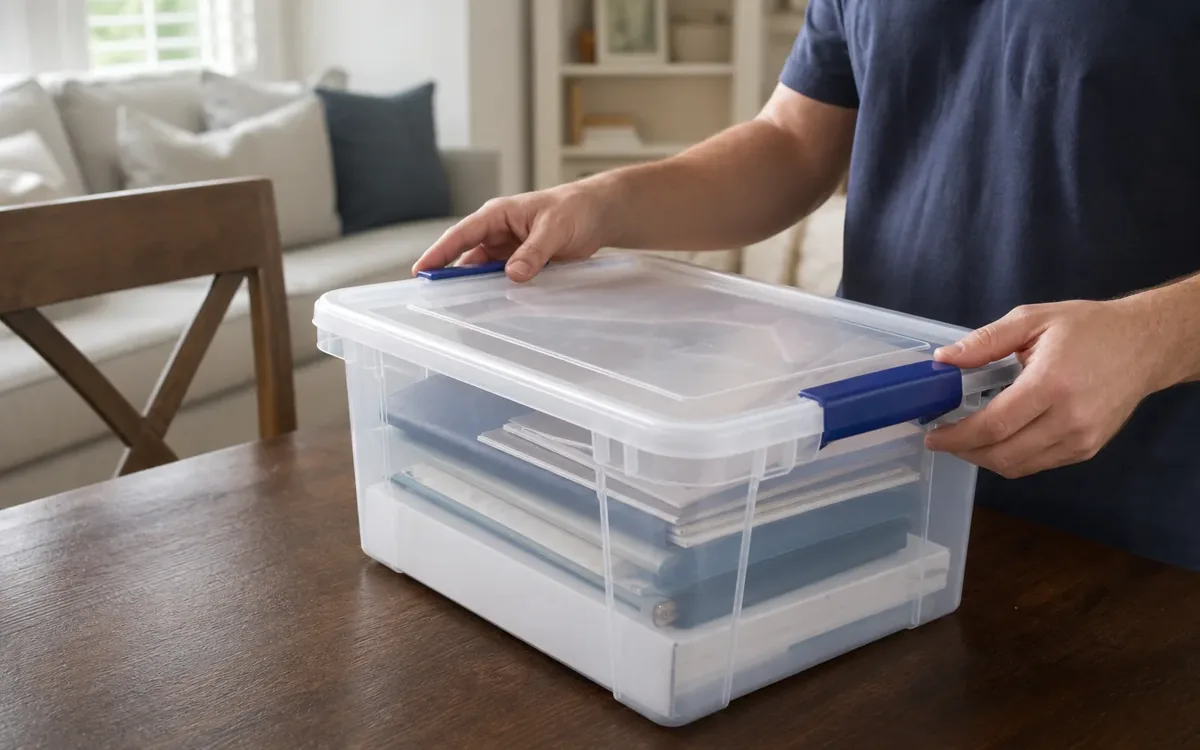
How should documents and essential items be protected?
Keep irreplaceable and immediately needed items under household control. Do not place them deep in a moving truck, an unattended property, or an unverified storage arrangement.
Create an essentials group that includes:
- Identification and travel documents
- Insurance information and relevant policy contacts
- Property, closing, lease, and moving documents
- Medication, prescriptions, and necessary medical information
- Phones, chargers, backup batteries, and written contact lists
- Keys, access cards, alarm information, and vehicle documents
- Pet identification, medication, food, carriers, and veterinary records
- Basic clothing and personal supplies for an unexpected lodging change
- Items required for children, older adults, or household members with accessibility needs
Use water-resistant containers or sealed interior bags where appropriate. Make secure digital copies of records when possible, but do not depend solely on cloud access. Protect account credentials and avoid sharing sensitive documents through unsecured group messages.
The household decides what stays personally accessible. A practical cleanout or move team may discuss labeling, room sequencing, packing categories, and which boxes should remain separate. Legal counsel, insurers, financial institutions, closing professionals, or government agencies should answer questions about original records, required documentation, claims, ownership, or legal retention.
Valuable property deserves its own decision process. A qualified appraiser determines valuation. An insurer explains coverage. An auction or estate-sale provider evaluates whether items fit its process. A moving or organizing team should not be treated as the authority on legal ownership, insured value, or authenticity.
Prepare lodging, route, and access alternatives
A backup plan should work even if the destination is temporarily unavailable. Identify more than a general idea of staying somewhere else.
Record:
- A primary and alternate safe lodging option
- Whether each option accepts pets and meets accessibility needs
- The reservation or confirmation process
- A primary route and a way to check official road conditions
- A secondary route considered suitable by the household based on current official information
- Parking, gate, elevator, loading-zone, or building access contacts
- A safe meeting point if household members travel separately
- A contact outside the affected area who can relay information
Do not choose a route solely because a mapping application shows a shorter trip. Conditions can change, and official closures or public instructions take priority.
Confirm destination access directly with the responsible person. For an apartment or managed property, that may be a property manager. For a purchase, it may involve the seller, real-estate agents, closing professionals, or other authorized parties. A move team can discuss practical loading or scheduling changes, but it cannot decide whether a property is legally available for possession.
Temporary storage is a separate household and provider choice. Ask a storage provider about access restrictions, weather procedures, insurance requirements, prohibited contents, payment terms, and what happens if roads or the facility are inaccessible. Never assume that storage protects items against every hazard.
What should be confirmed with each provider?
Contact every provider separately because one company’s availability does not control another’s. Use a concise written summary so all parties receive the same information.
Confirm these points:
- The correct service address and destination
- The household’s primary and backup contacts
- The planned work and what is not included
- The provider’s weather and rescheduling terms
- Access requirements at both properties
- The process for notifying the provider of an evacuation or closure
- Whether the provider will independently suspend work for safety
- How unfinished work, packed belongings, keys, and payments will be handled
- What must be confirmed before a new date is accepted
A practical move team may discuss packing sequence, labeling, sorting, donations, removal planning, furniture placement, or how to divide work into stages. The household remains responsible for approving what moves, stays, is donated, is sold, or is discarded, unless a legally authorized person makes those decisions.
Contractor work is separate from move coordination. Repairs, tree work, electrical service, plumbing, roofing, mold assessment, and structural work should be discussed with the appropriate contractor or specialist. Required permits, code interpretations, and compliance determinations belong to the responsible local authority or qualified professional. Code compliance support may help a household organize identified tasks, but it does not replace an inspector or authority.
Keep the backup from turning into a rushed cleanout
Storm preparation can create pressure to remove items quickly. That is especially risky when several relatives share decision-making responsibility or when a home contains estate property, business records, collections, or unidentified valuables.
Use four categories for uncertain belongings:
- Move: Approved for transport to the new home
- Protect: Important items that require secure household custody or specialist guidance
- Hold: Items awaiting family, legal, appraisal, sale, or donation decisions
- Remove: Items clearly authorized for disposal or another agreed destination
Label the hold category prominently. Do not let a weather-related schedule change silently convert held property into discarded property.
Disposal is also a separate decision. The household or authorized representative approves removal, while the chosen disposal, recycling, donation, hauling, or hazardous-material provider determines what it can accept. Local rules and facility requirements govern restricted materials. A move or cleanout team may identify questions and organize categories but should not make environmental or legal compliance rulings.
Recheck the home before departure and return
When conditions allow and authorities have not restricted access, use a property-specific departure review. Focus on preventing avoidable confusion rather than attempting repairs during unsafe weather.
Check that:
- Essential items are with the household
- Approved boxes are clearly labeled by destination or status
- Doors and windows are secured as appropriate
- Keys and access instructions are accounted for
- Utilities are handled according to provider and property instructions
- Outdoor items are addressed by the owner or appropriate contractor
- Vehicles have needed documents and supplies
- Family members know the lodging destination and communication plan
- Providers have received the current status
After the weather event, do not enter a property simply because travel appears possible. Follow official instructions and obtain any required permission. Watch for hazards such as standing water, damaged electrical systems, unstable materials, gas odors, contaminated areas, or blocked exits. Qualified inspectors, utilities, contractors, insurers, and public authorities should address conditions within their respective roles.
Before restarting the move, reconfirm access, utilities, routes, building procedures, and provider availability. Photographing visible conditions may be useful for household records, but an insurer should explain claim documentation requirements.
Short FAQ
Should the household cancel as soon as a storm is forecast?
Not automatically. Monitor official information, review provider policies, and use the preselected decision points. Evacuation orders, closures, and safety instructions take priority over the moving schedule.
Can a move team decide whether the home is safe to enter?
No. A team may decline work it considers unsafe, but structural, electrical, environmental, occupancy, inspection, or official access decisions belong to qualified professionals, utilities, property authorities, or public agencies.
What should never go into an unattended moving load?
Keep identification, medication, keys, financial and property records, essential devices, pet necessities, and other immediately needed or irreplaceable items with the household.
Who decides whether belongings go into storage?
The household or legally authorized representative makes that choice. The storage provider explains availability, access, accepted contents, contracts, and facility rules. Insurance questions go to the appropriate insurer.
How can Clutter Cleaner of South Carolina fit into the plan?
Clutter Cleaner of South Carolina, physically located in Mount Pleasant and serving households statewide, may discuss move management, downsizing and organizing, estate cleanouts, auctions and estate sales, home sale preparation, and code compliance support as relevant. Service scope and scheduling should be confirmed directly at (843) 972-7020. Emergency orders, legal authority, valuation, property inspection, real-estate decisions, contractor work, and regulatory determinations remain with the responsible household, professional, provider, or authority.



