

Matched sets should be identified, assigned one item ID, photographed together, and kept physically grouped before an estate sale. The central goal is to prevent one component from being sold, donated, packed, or discarded without the others. Household decision-makers can determine which pieces belong together and whether sentimental items are excluded, while estate-sale professionals, appraisers, and other qualified providers should handle valuation, sale strategy, and specialized advice.
Quick answer: Give every set a unique ID, such as SET-014. Put that ID on each detachable component using a safe label or bagged tag, record every piece on a set sheet, take overview and detail photos, and place small parts in a labeled container beside the main item. Do not split a set merely because its pieces were found in different rooms.
Why do matched sets get separated so easily?
An estate often reflects years of normal household use rather than orderly retail storage. A serving platter may be in a dining-room cabinet while its matching bowls are in the kitchen. A dresser mirror may be detached and stored in a closet. A camera body, lens, charger, case, and manual may occupy several drawers.
Separation also happens during the transition itself. Different relatives may work in different rooms, movers may pack by location, and donation or disposal decisions may begin before anyone recognizes a complete set. Once an unidentified component enters another box or leaves the property, restoring the set becomes difficult.
Common examples include:
- China, flatware, glassware, and serving pieces
- Bedroom, dining-room, or patio furniture groups
- Lamps with shades, finials, and matching bases
- Tools with cases, batteries, chargers, and attachments
- Electronics with remotes, cords, docks, and manuals
- Artwork, bookends, candlesticks, and decorative pairs
- Cameras with lenses, caps, straps, and accessories
- Board games, collectible series, and boxed holiday sets
- Linens with coordinated shams, napkins, or tablecloths
This sorting is different from pricing. A household may recognize that six chairs match a table, but an estate-sale professional or qualified appraiser should determine whether presenting them as one lot, several lots, or individual pieces makes sense.

Start with decision authority, not the objects
Before attaching labels, identify who has authority to make household decisions. Depending on the circumstances, that may be an owner, authorized family representative, personal representative, trustee, or another legally responsible party.
Sorting helpers should not assume that possession of a key or familiarity with the home provides authority to sell property. Questions about ownership, estate administration, wills, trusts, beneficiary rights, court instructions, or disputed items belong with the appropriate attorney, court, fiduciary, or other responsible authority.
The household’s authorized decision-maker can usually establish:
- Which items are excluded from sale
- Which family claims have already been approved
- Whether helpers may group and inventory property
- Which rooms or cabinets are within the current work scope
- Where uncertain or disputed items should be held
- Who may approve donations or disposal
Mark excluded property before sale sorting begins. A clearly defined hold area reduces the chance that sentimental, disputed, or reserved pieces become mixed with sale inventory.
If the broader project includes clearing a residence, the guide on the best way to clean out an estate explains how to separate decision-making from physical removal. Households considering professional sale coordination can also review the auctions and estate sales service offered statewide by Clutter Cleaner of South Carolina.
What counts as a matched set?
A matched set is not limited to identical objects. It may be a manufactured group, a functional system, a decorative pairing, or an assembled collection whose components make sense together.
Use four tests when deciding whether objects should be recorded as a set:
- Design: Do they share a pattern, material, maker’s mark, finish, scale, or construction style?
- Function: Does one piece depend on another, such as a charger and tool or a lid and serving dish?
- Documentation: Does a box, receipt, manual, photograph, or inventory indicate that the pieces belong together?
- Household knowledge: Does an authorized family member know the objects were purchased, displayed, or used as one group?
A visual resemblance is a clue, not proof. Similar silver-colored utensils may have different makers or compositions. Chairs that look alike from across the room may have different dimensions, repairs, or labels. Avoid forcing uncertain pieces into a set.
Create an “unresolved match” area for probable components. Record where each piece was found and allow the estate-sale professional, appraiser, or authorized decision-maker to review it. This preserves the connection without presenting an assumption as fact.
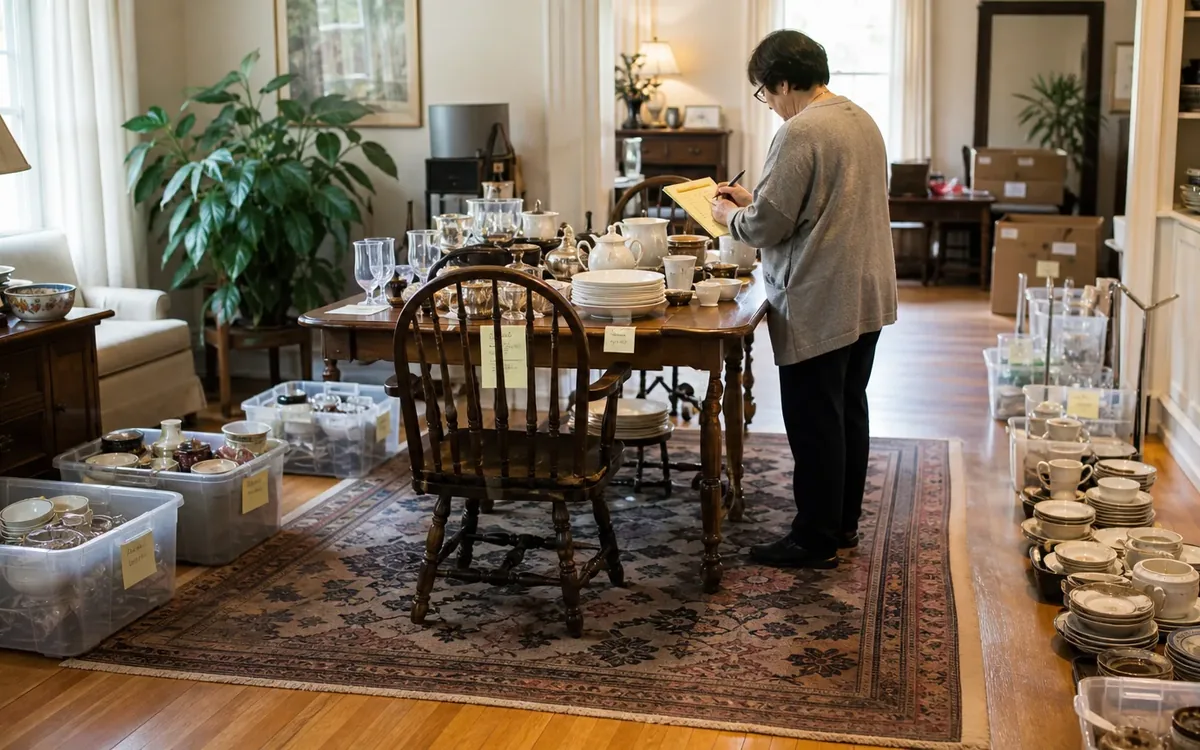
Build an item-ID system that survives handling
One shared ID should follow the set from discovery through sale preparation. Keep the system simple enough for every helper to use consistently.
A practical ID may combine a category and sequence number:
- SET-001 for the first confirmed set
- PAIR-007 for a decorative pair
- KIT-012 for a tool or equipment kit
- HOLD-004 for a group awaiting a decision
Do not encode an estimated price into the ID. Prices can change after professional review, while the identity of the set should remain stable.
For each ID, create a paper or digital set record with:
- Short description
- Total component count
- Original locations
- Identifying marks or model numbers
- Visible condition notes
- Missing components, if known
- Photo file names
- Current holding location
- Decision status
- Name or initials of the recorder
Describe only what is visible. “Small chip under rim” is more useful than “excellent condition.” Do not represent an item as authentic, complete, antique, safe, or operational unless the appropriate person has verified that statement.
Labels must not damage the object. Avoid placing adhesive directly on fragile finishes, paper, textiles, leather, unfinished wood, artwork, or surfaces where residue could matter. Instead, attach the ID to a string tag, acid-free enclosure chosen by the household, removable bag, box, or nearby shelf marker. A conservator or qualified specialist should advise on valuable or delicate materials.
How should you label sets with many small components?
Use a parent-and-component format. The entire group receives the main ID, while detachable pieces receive suffixes that preserve their relationship.
For example:
- KIT-012: cordless tool set
- KIT-012-A: drill
- KIT-012-B: battery one
- KIT-012-C: battery two
- KIT-012-D: charger
- KIT-012-E: molded case
Place loose parts in a clear, labeled bag or small container, then keep that container with the largest component. If the pieces should not touch, use separate protective enclosures with the same parent ID.
For dishware or flatware, record counts by type rather than labeling every ordinary piece directly. A set sheet might list eight dinner plates, seven salad plates, eight cups, and six saucers. This makes incompleteness visible without creating dozens of adhesive risks.
For furniture, label components where the tag can be found without harming the finish. Note removable leaves, hardware, support rails, mirror brackets, keys, and assembly pieces. Bag hardware, label the bag, and secure it in a way approved by the household or moving professional.
Cords and remotes should show both the parent ID and their purpose when known. Avoid guessing which electronic device they fit. An estate-sale professional or appropriate technician can discuss testing and presentation, but electrical safety or code questions belong to a qualified professional or authority.
Photograph each set as evidence of the grouping
Photographs help preserve context when a set must be moved or temporarily separated. They also let reviewers examine marks and condition without repeatedly handling delicate objects.
Capture these five views:
- One overview showing every component
- One image of the visible item ID
- Close-ups of maker’s marks, labels, or model numbers
- Close-ups of notable wear, chips, repairs, or missing areas
- A final image showing how the set was boxed, bagged, or staged
Include a simple count card in the overview when useful. It might read “SET-018, 12 components.” The card should document the grouping, not advertise a value or claim completeness.
Use stable file names such as SET-018-overview and SET-018-mark-1. Store the image list with the written record. If several people are photographing inventory, agree on one naming pattern before work starts.
Photographs assist organization, but they do not replace an appraisal, inspection, authentication, or condition report. A qualified appraiser decides the scope and method of an appraisal. The estate-sale professional decides what photography is appropriate for sale presentation.
Keep grouping separate from pricing and sale strategy
The sorting team should preserve accurate relationships without deciding that every set must be sold intact. A complete group can sometimes be more useful to buyers, but a sale professional may recommend another approach based on the item, condition, venue, or market.
The household can decide:
- Whether an authorized sentimental claim takes priority over sale
- Whether a set may be considered for sale
- Whether the family wants uncertain pieces held for review
- Whether approved items may be donated or discarded if unsold
- Who receives updates and approves final household choices
A practical cleanout, organizing, move, or estate-sale team may discuss:
- A workable labeling and staging system
- Safe pathways and physical sequencing
- Ways to keep parts together during packing
- Inventory handoffs between rooms or providers
- Whether more space is needed for organized review
- Which questions need referral to another professional
Other decisions remain with the relevant professional or authority:
- Appraisal: Value, appraisal purpose, research method, and formal reporting belong to a qualified appraiser.
- Legal: Ownership, authority, disputes, estate administration, and court requirements belong to attorneys, fiduciaries, courts, or other responsible authorities.
- Real estate: Listing strategy, disclosures, fixtures, and transaction advice belong to the responsible real-estate professional and seller.
- Inspection and safety: Structural, electrical, environmental, or equipment conclusions belong to qualified inspectors, contractors, technicians, or authorities.
- Compliance: Disposal rules, local requirements, permits, and code determinations come from the applicable agency or qualified professional.
A set attached to the house may not be ordinary personal property. Built-in appliances, mounted fixtures, window treatments, and similar items should not be removed based on a sorting decision alone. Ask the responsible real-estate or legal professional how the item is treated.
Plan the handoff without losing components
Once a set is documented, place it in a clearly marked zone such as sale review, appraisal review, family hold, move, donation review, or disposal review. These are decision categories, not automatic destinations.
Use a transfer log whenever a set changes locations. Record the item ID, old location, new location, date, and person responsible for the move. The log matters most when several family members, providers, or properties are involved.
Storage is a separate household choice and provider arrangement. If off-site storage is considered, the household should evaluate access, security, climate needs, insurance questions, contract terms, and retrieval responsibility. Do not assume a cleanout or sale provider supplies storage.
Likewise, contractor work should remain separate from inventory handling. Repairs, disassembly, fixture removal, hazardous-material work, and specialty transport may require an appropriate contractor or other qualified provider. Keep item records available so the contractor knows which components must remain together.
Donation and disposal should happen only after authorization. The household or responsible authority chooses approved destinations and confirms restrictions. Local programs, facilities, and rules can differ across South Carolina, so verify current requirements directly with the relevant organization or agency.
Run a set audit before sale staging
Before items are presented for sale, compare each physical group with its set record. This audit is meant to catch separation errors, not to establish value.
Check for:
- Matching IDs on the main item and accessory containers
- Component counts that agree with the record
- Hardware secured with the correct furniture or equipment
- Remotes, chargers, lids, keys, and manuals in the right group
- Photos showing all currently included pieces
- Clear notes about damage or known missing components
- Removal of family-hold or disputed property from sale staging
- Unresolved items routed to the correct reviewer
If something is missing, do not quietly reduce the count and present the group as complete. Update the record, mark the discrepancy, and notify the person managing the sale decision. Accuracy is more important than making a set appear finished.
When the sale professional recommends dividing a group, preserve the original parent ID in the records. New lot references can be added without erasing how the objects were originally associated.
Frequently asked questions
Should every matching object be sold together?
No. First document the relationship and keep the pieces together for review. The authorized household decision-maker and estate-sale professional can then discuss the sale format. An appraiser may be appropriate when value or identification requires specialized analysis.
What if part of a set is found after the sale inventory is prepared?
Label the piece with the likely parent ID, photograph it, and notify the person managing inventory. Do not place it on a table near similar items and assume the connection will be noticed.
Should damaged pieces remain with a set?
Usually they should remain documented with it until an authorized decision is made. Isolate sharp or unstable pieces safely, note their condition, and avoid repairs that could affect value or integrity. Restoration advice belongs to an appropriate specialist.
Can original boxes and manuals be discarded?
Do not discard them automatically. Boxes, fitted cases, certificates, instructions, and receipts may help identify the group or explain its history. The sale professional, appraiser, or authorized decision-maker can determine whether they should accompany it.
Who decides whether a disputed item can be sold?
That is not a sorting-team decision. Keep the item in a controlled hold area and refer the matter to the legally responsible person, attorney, fiduciary, court, or other appropriate authority.
Preserve the relationship before making the sale decision
The best matched-set process is deliberately narrow: identify the relationship, assign one ID, record every component, photograph the group, and maintain that connection through each handoff. This creates a reliable inventory without confusing physical organization with valuation, legal authority, or sale strategy.
Clutter Cleaner of South Carolina is based in Mount Pleasant, with Charleston as its primary market and a statewide service territory. For households coordinating multiple phases, the overview of how estate cleanouts work can help distinguish sorting, removal, and professional decision points. To discuss available estate cleanout, organizing, move management, home-sale preparation, or auctions and estate-sales support, call (843) 972-7020.



