

Sorting photographs before downsizing works best when you separate preservation from decision-making. First move photos into a dry, climate-controlled workspace, then group them broadly, remove obvious duplicates and damaged images, identify important people or events, and place the final collection in labeled photo-safe containers. Decide what to keep before discussing storage, distribution, sale, donation, or disposal.
Quick answer: Sort photographs in passes rather than evaluating every image at once. Create categories for keep, share, identify, duplicate, and release. Preserve original order when it carries meaning, write identifying details on separate notes, and protect selected photographs from South Carolina humidity with suitable archival materials and indoor storage.
Why should photographs be sorted before the rest of a downsizing project?
Photographs require different decisions from furniture, clothing, and ordinary household goods. Their financial value may be limited, but their family meaning can be irreplaceable. Once loose photographs are mixed into disposal piles or packed without labels, recovering context becomes difficult.
Early photo sorting also prevents albums, envelopes, and framed pictures from being scattered across unrelated boxes. A household can decide which images matter personally, who should receive copies or originals, and how much physical space the final collection may occupy.
If photographs are only one part of a larger transition, review the broader downsizing and organizing service to understand how household sorting may fit with other move decisions. Families handling inherited property may also benefit from the guide to the best way to clean out an estate.
Photographs should not become an obstacle to every other task. Give them a dedicated work area and decision process so furniture, documents, household goods, and move preparation can proceed separately.
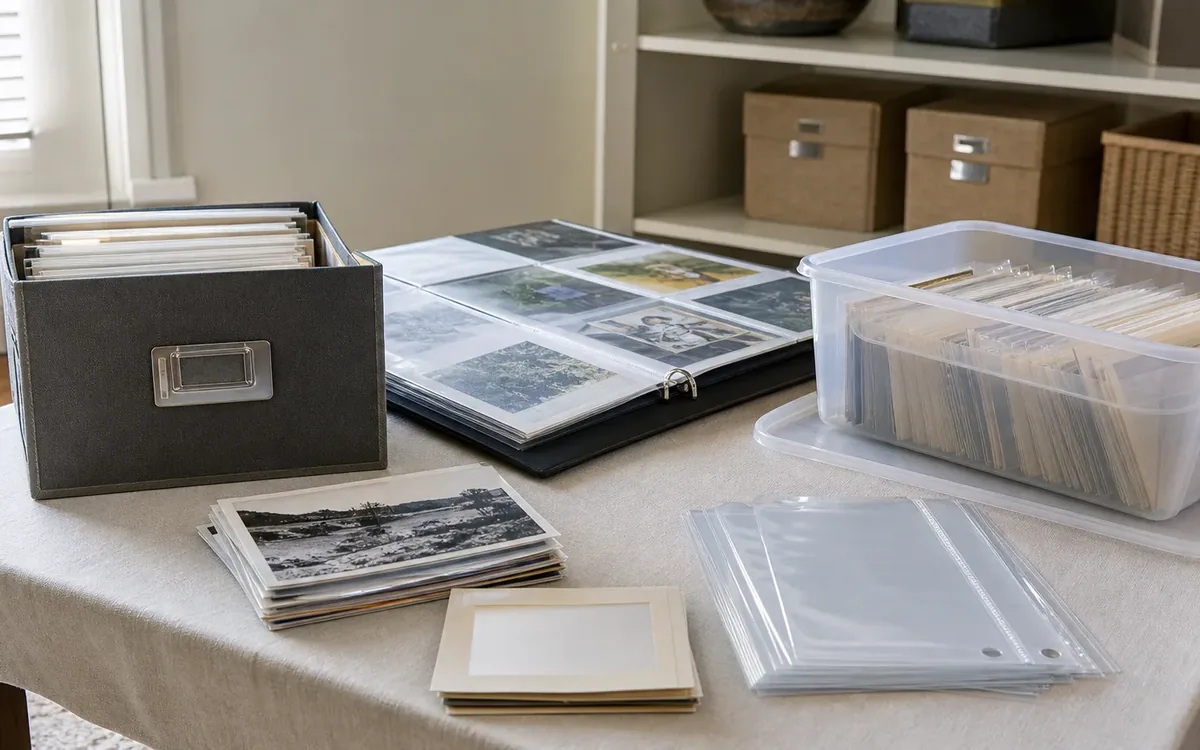
Set up a safe photo-sorting area
Choose an indoor room with stable conditions. Avoid garages, sheds, porches, attics, damp basements, and areas near open windows. In South Carolina, humidity can encourage photographs to curl, stick together, or develop mold. Heat and direct sunlight can also accelerate fading and deterioration.
Prepare a clean table large enough for several clearly labeled groups. Wash and dry your hands before handling photographs. Food, drinks, household cleaners, tape, rubber bands, and pens should stay away from the work surface.
Useful supplies include:
- Clean boxes or trays for temporary categories
- Soft pencils for writing on paper dividers
- Acid-free, lignin-free folders or envelopes
- Photo-safe sleeves and album pages
- Archival boxes sized to prevent slumping
- Index cards or plain paper for temporary notes
- Removable labels placed on containers, not photographs
- A notebook for questions and family assignments
Clean, dry hands are often suitable for ordinary prints. If gloves are used for delicate materials, they must fit well enough to avoid bending or dropping an image. Handle photographs by their edges whenever possible.
Do not force apart photographs that are stuck together. Water, cleaning solutions, heat, and household tools can cause permanent damage. A qualified photograph conservator should assess fused, moldy, brittle, or otherwise fragile materials. The household decides whether professional conservation is worth pursuing, while the conservator determines appropriate treatment.
How do you sort a large collection without getting overwhelmed?
Use several passes, with each pass answering only one kind of question. This keeps the first stage quick and reduces emotional fatigue. Follow these five passes:
- Gather without reorganizing. Collect albums, framed photographs, loose prints, envelopes, slide boxes, and negatives from around the home. Keep labeled groups intact.
- Create broad categories. Sort by household branch, person, event, location, or general period. Use whichever structure is easiest to recognize.
- Remove clear extras. Set aside exact duplicates, blurry snapshots, empty frames, and images with no personal meaning. Do not discard questionable items yet.
- Identify priority photographs. Mark images that document close relatives, major life events, former homes, community connections, or stories the family wants to retain.
- Refine and rehouse. Divide selected photographs into final categories, add written context, and place them in photo-safe storage.
A simple staging system can include:
- Keep: Photographs staying with the downsizing household
- Share: Originals or duplicates intended for relatives or friends
- Identify: Images requiring help with names, places, or dates
- Duplicate: Extra copies that may be offered to others
- Review: Uncertain items needing another decision
- Release: Images approved by the responsible household member for disposal
Do not create too many categories at the beginning. A box labeled “maternal relatives” is more useful during early triage than separate piles for every person. Detailed organization can happen after the overall volume has been reduced.
Set aside legal and administrative records found among photographs. Passports, military papers, certificates, deeds, tax records, and correspondence should enter a document-review process, not a photo-disposal pile. An attorney, accountant, executor, personal representative, or relevant agency should address questions about retention and legal significance.
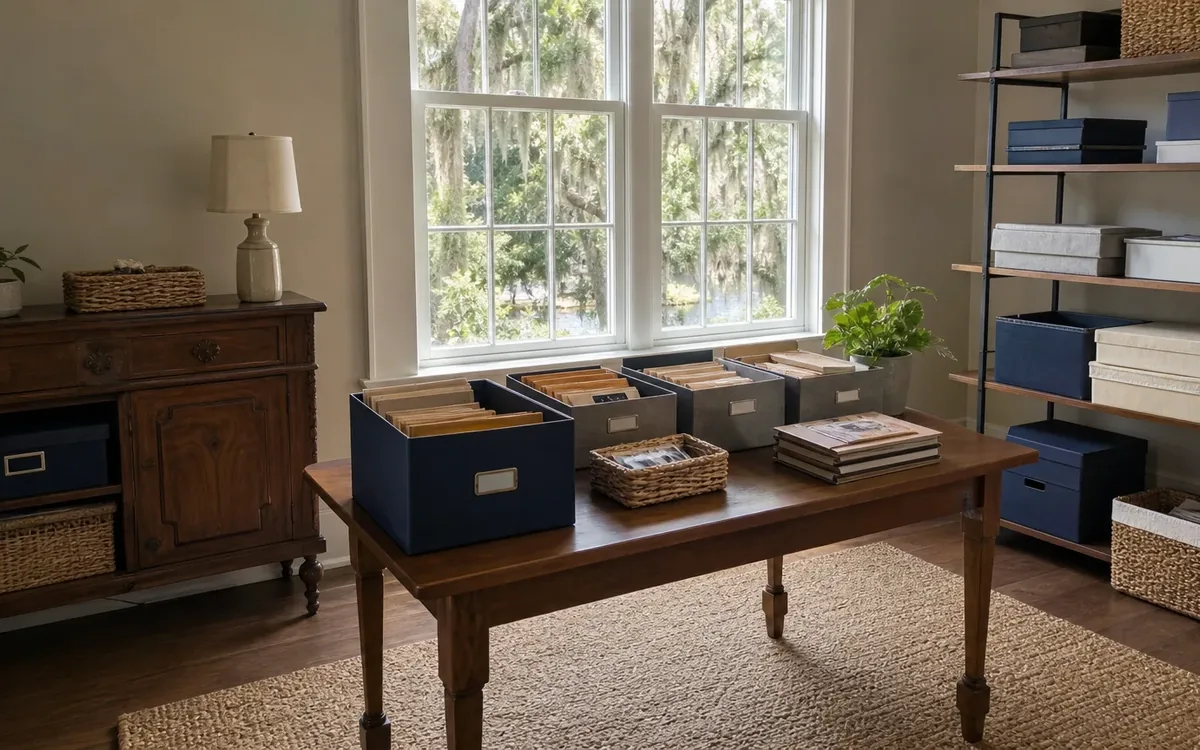
Preserve original order when it tells a story
Albums, labeled envelopes, and carefully arranged boxes may already contain valuable context. The order of photographs can show a trip, family relationship, home history, or sequence of events. Before removing anything, examine the container for names, dates, captions, studio marks, and addresses.
Keep an album intact when its arrangement is meaningful and its materials appear stable. If pages are damaging photographs, consult a qualified conservator before attempting removal. Adhesive pages, pressure-sensitive tape, corner mounts, and brittle paper can make extraction risky.
When taking photographs from an ordinary box for sorting, preserve the original group with a divider and a brief note. For example, write “Found together in upstairs desk, labeled 1980s reunions” on an index card. That note retains useful provenance without marking the prints.
Avoid rewriting uncertain information as fact. Use question marks and identify the source of a guess. “Possibly Evelyn, according to Pat” is more responsible than assigning a definite name that may be wrong.
How should you choose which photographs to keep?
The goal is not to retain every acceptable image. It is to build a collection that reflects the people and stories the household values while fitting the available space.
Use these questions during selection:
- Is this the best version of the image?
- Does it show a person, place, object, or event important to the family?
- Is there identifying information unavailable elsewhere?
- Does the photograph support a story someone still remembers?
- Would a relative value this original or duplicate?
- Is the image rare, or are there many nearly identical views?
- Does it fit the space allocated for the final collection?
For repeated scenes, select the clearest photograph with the strongest composition or most recognizable faces. Keep additional versions only when they add people, context, or useful details.
Do not let photographic paper size determine importance. A small snapshot may hold more family history than a large studio portrait. Likewise, age alone does not establish personal or market value.
If a photograph may have financial value because of its maker, subject, age, or historical significance, a qualified appraiser should evaluate it. A cleanout or move team may help isolate the item and record its location, but it does not replace an independent appraisal. The owner, executor, or other authorized decision-maker chooses whether to seek that evaluation and what to do afterward.
Label photographs without causing damage
The safest description is usually kept beside the photograph rather than written directly on it. Place an acid-free note in the same sleeve or write identifying information on an archival folder. Keep inked notes from touching the image surface.
Useful label details include:
- Full names, including birth or former surnames when relevant
- Approximate date or clearly marked date range
- Location
- Event or occasion
- Relationship among the people pictured
- Photographer or studio, if known
- Name of the person who supplied the identification
Use consistent wording. If the family recognizes someone only as “Aunt May,” add the relationship or full name when it can be verified. For uncertain identifications, retain the uncertainty instead of turning a guess into a permanent caption.
Numbering can connect photographs with a separate index. A family might assign a short code to a folder and list its contents in a notebook. Do not place ordinary adhesive labels on photographs. Rubber bands, paper clips, staples, and pressure-sensitive tape can stain, dent, or tear paper.
This project focuses on physical triage and organization, not digital scanning. If the household later chooses digitization, it should be planned as a separate project with its own file naming, backup, privacy, and provider decisions.
Protect selected photos from South Carolina humidity
Photo-safe packaging helps, but it cannot compensate for poor storage conditions. Keep photographs in the conditioned living area of the home where temperature and humidity are comparatively stable. Avoid placing boxes directly against exterior walls, under plumbing, or on floors where leaks could reach them.
Choose enclosures sold for photographic preservation. Look for materials identified as acid-free, lignin-free, and appropriate for photographs. Some materials that appear clean or sturdy can still release chemicals or trap moisture.
Store boxes so photographs are supported rather than bent or tightly compressed. Separate damaged or questionable items from healthy photographs, especially if there are signs of mold. Do not brush or clean suspected mold in the living space. A conservation or remediation professional should advise on safe handling and treatment.
Storage is a household choice and may involve a separate storage provider. Ask that provider about environmental controls, access rules, insurance limitations, and prohibited materials. A practical downsizing or move team may discuss packing sequence, container labeling, and where designated boxes need to go. It should not guarantee preservation conditions maintained by another provider.
Divide photographs among family members fairly
Distribution can become difficult when several people want the same original. Start by asking each interested person to identify priorities rather than dividing boxes immediately.
The household can choose among several approaches:
- Keep a core collection with one designated family custodian
- Distribute photographs by family branch
- Divide images according to the people pictured
- Offer duplicate prints before assigning unique originals
- Use a rotating selection process for contested items
- Delay disputed decisions and place the photographs in a labeled review box
Record every assignment. Write the recipient’s name on the outer folder or container and maintain a simple distribution list. Confirm that the person receiving the collection wants it and has suitable storage space.
An executor, personal representative, trustee, or owner must make decisions within their actual authority. Questions about ownership, inheritance, estate instructions, privacy, or disputes belong with a qualified attorney or the appropriate court or authority. Family consensus does not automatically override controlling legal documents.
Coordinate photographs with the wider move
Keep finalized photo boxes separate from ordinary packing. Use clear labels such as “Family photographs, retain, destination bedroom closet.” Avoid vague labels like “miscellaneous” or “old papers.”
A practical cleanout or move team may discuss:
- Which rooms still contain photographs
- How photo boxes will be distinguished from removal items
- Who has authority to approve decisions
- Which containers are moving, staying, or going to relatives
- Whether uncertain boxes need a protected holding area
- How photo decisions fit with overall household sorting
The household decides what photographs to retain, release, or give away. A team can support organization and movement based on those directions, but it should not decide emotional importance or ownership.
Contractor work, such as repairing a damp room or addressing a leak, is a separate service arranged by the property owner or responsible party. A home inspector may identify property concerns, while licensed tradespeople determine appropriate repairs within their fields. Real-estate agents advise on listing preparation and buyer expectations. Code officials and other authorities determine compliance. None of those decisions should be treated as part of photo sorting.
If photographs are discovered during an estate transition, stop before removing them with general contents. The guide explaining how estate cleanouts work provides additional context for separating family decisions from the physical handling of household property.
What should happen to photographs no one wants?
Review the release group one final time after the important collection has been organized. Check backs, envelopes, frames, and album pages for names or notes. Make sure the authorized person has approved the decision.
Some historical societies, archives, schools, religious organizations, or community groups may consider relevant photographs, but acceptance is never automatic. Contact the organization first and ask about its collecting policy. Do not leave unsolicited photographs.
Ordinary photographs may also contain private or sensitive information. The household should decide whether images need to be destroyed rather than placed in general waste. Ask the selected disposal provider what materials it accepts and how they are handled. Disposal rules and facility requirements are determined by the relevant provider or local authority.
Avoid passing unidentified collections to relatives merely to avoid making a decision. A smaller, labeled collection is usually more usable than several unsorted boxes transferred without context.
Short FAQ
Should photos be removed from old albums?
Not automatically. Preserve albums whose order carries meaning. If pages, adhesives, or covers appear to be damaging photographs, ask a qualified photograph conservator about safe removal and rehousing.
Can names be written on the back of a photograph?
A separate archival note or labeled sleeve is safer. If direct marking is necessary, seek preservation guidance and avoid pens, markers, adhesive labels, and heavy pressure.
Who decides whether inherited photographs can be discarded?
The owner or legally authorized estate representative makes that decision. An attorney or appropriate authority should address disputed ownership, estate instructions, or questions about legal authority.
Where should the finished collection be stored?
Use photo-safe enclosures in a clean, dry, climate-controlled living area. Avoid attics, garages, sheds, damp spaces, direct sunlight, exterior walls, plumbing, and floor-level locations vulnerable to water.
Can a downsizing team determine which photos are valuable?
A team may help create categories, label containers, and isolate possible appraisal items. Financial valuation should be completed by a qualified appraiser, while the household or authorized representative decides whether to sell, keep, donate, or distribute an item.
A successful photo sort ends with a collection that is smaller, safer, understandable, and assigned to a destination. Protect context as carefully as the images themselves, keep uncertain decisions visible, and separate sentimental choices from appraisal, legal, real-estate, inspection, contractor, storage, disposal, and compliance responsibilities.



