
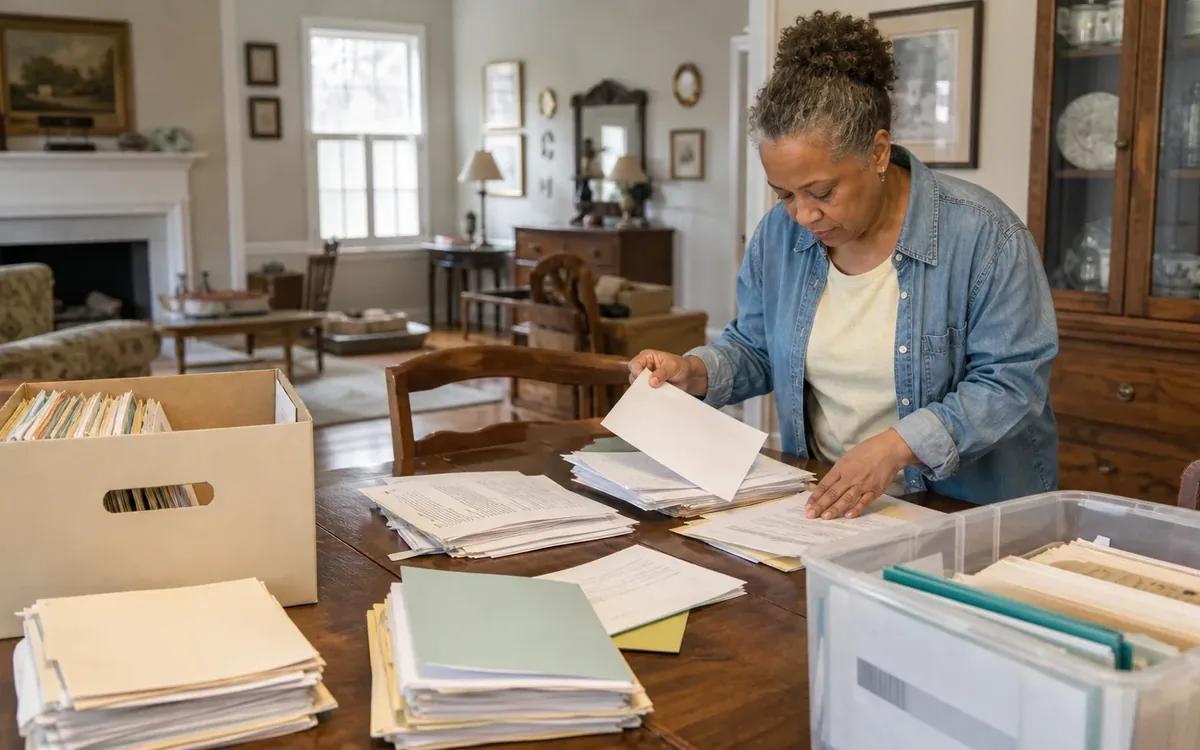
Before an estate sale, remove personal papers from every room that buyers, sale staff, photographers, or appraisers may enter. Sort documents into clearly marked groups for immediate action, professional review, secure retention, family review, and secure destruction. Do not leave papers inside desks, books, bags, filing cabinets, or furniture being sold.
Quick answer: Treat every piece of paper as private until someone with appropriate authority has reviewed it. Set up a paper-only sorting area outside the sale rooms, inspect all possible hiding places, and release furniture or containers only after they have been checked and marked clear.
This guide focuses narrowly on protecting personal papers before merchandise is displayed or sold. For broader decisions about belongings, rooms, and disposal, read the best way to clean out an estate. Households considering professional sale coordination can also review auctions and estate sales support.
Why should papers be removed before an estate sale?
An estate sale opens parts of a home to people who do not need access to the household’s private records. A single forgotten drawer can contain account numbers, medical information, signatures, passwords, tax identifiers, legal correspondence, or details about living relatives.
The concern is not limited to filing cabinets. Personal papers often remain in:
- Desk drawers and rolltop compartments
- Nightstands, dressers, and kitchen drawers
- Purses, wallets, briefcases, and luggage
- Books, photo albums, and recipe boxes
- Coat pockets and folded clothing
- Safes, lockboxes, and cash boxes
- Baskets, shopping bags, and decorative boxes
- Vehicles, workshops, sheds, and home offices
- Envelopes taped beneath drawers or shelves
Removing papers early also makes sale decisions clearer. An appraiser or estate-sale professional can examine an item without sorting through private information. Family members can review documents without customers moving through the same room.
Do not assume a closed drawer will stay closed during a sale. If the furniture is available for purchase, its compartments should be empty of private material before it enters the sale area.

Who has authority to review estate papers?
The person legally responsible for the estate should establish who may handle records. Depending on the circumstances, that may involve a personal representative, executor, administrator, trustee, surviving owner, or another authorized person. Titles and authority depend on the governing documents, ownership, and applicable law.
Family relationship alone does not necessarily settle the question. When authority is unclear, pause the document review and consult the appropriate South Carolina attorney, probate court, financial institution, or other responsible authority. A cleanout or move team should not decide who inherits records, interpret a will, provide legal advice, or determine whether a document can legally be destroyed.
The authorized household representative can generally set practical handling rules, such as:
- Which room will serve as the secure sorting area
- Who may enter that room
- Who will receive family photographs and correspondence
- Which papers should be referred to legal, tax, financial, or appraisal professionals
- Which cleared rooms may be prepared for the sale
A practical cleanout or move team may discuss workflow, room sequencing, labeled containers, and how to keep reviewed material apart from sale inventory. Decisions about legal significance, retention duties, estate ownership, taxes, appraisal value, real-estate disclosure, or regulatory compliance remain with the responsible professional or authority.
How do you create a secure paper-sorting area?
Choose a space that will not be used for sale display, photography, buyer access, or general staging. A room with a door is preferable. If that is not possible, use covered containers in a controlled area away from outgoing merchandise.
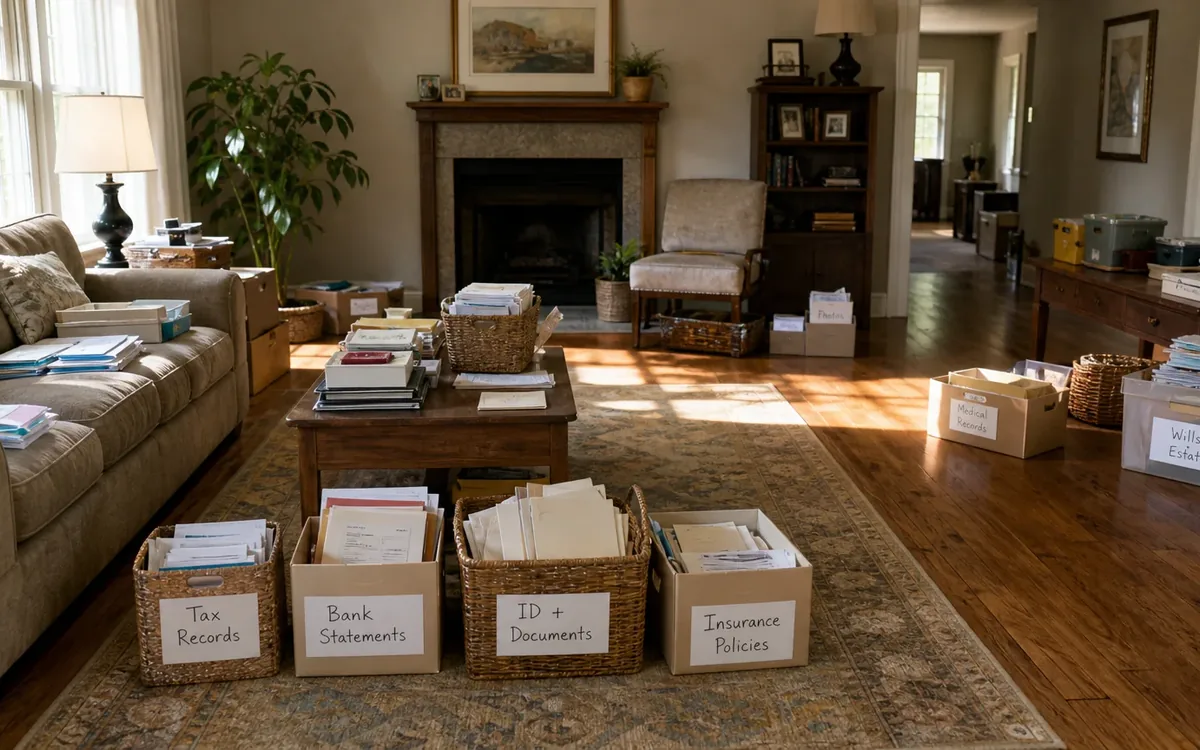
Set up five distinct destinations:
- Immediate action: Bills, deadlines, active insurance matters, property notices, and other documents requiring prompt attention.
- Professional review: Papers that may need examination by an attorney, accountant, tax preparer, financial institution, appraiser, real-estate professional, inspector, or government office.
- Secure retention: Records the authorized person has determined should be preserved.
- Family review: Photographs, letters, recipes, cards, journals, and genealogy material that relatives may want to examine.
- Secure destruction: Papers approved for destruction by the person with authority to make that decision.
Use labels that describe status rather than making unsupported legal conclusions. “Attorney review” is safer than “legally required.” “Possible tax record” is safer than guessing at a retention rule.
Keep an additional container labeled “Uncertain.” It prevents rushed decisions when a document does not fit neatly into another group. Uncertainty is a reason to hold a paper for review, not to discard it.
What papers should be pulled from sale rooms?
Remove any document that identifies a person, account, asset, obligation, medical issue, legal matter, or private relationship. Some papers may look obsolete but still contain usable personal information or evidence relevant to estate administration.
Priority categories include:
- Wills, trusts, codicils, powers of attorney, and court papers
- Deeds, titles, plats, surveys, leases, and mortgage records
- Bank, investment, pension, and retirement statements
- Tax returns, tax forms, receipts, and supporting files
- Insurance policies, claims, and correspondence
- Birth, death, marriage, divorce, military, and citizenship records
- Medical bills, benefit statements, prescription records, and care files
- Employment, payroll, and business ownership documents
- Loan records, credit reports, and credit-card statements
- Password lists, recovery codes, PINs, and security questions
- Keys or access instructions paired with addresses or account details
- Signed checks, blank checks, deposit slips, and signature samples
- Mail identifying beneficiaries, creditors, advisers, or account contacts
Also pull apparently ordinary materials that contain handwritten notes. Calendars may list appointments and contacts. Address books can contain family details. Notepads may include passwords or account numbers. A newspaper or magazine may conceal an envelope.
Do not mix original records into a general keepsake box. If an original appears important, place it in a protective folder and identify where it was found. Avoid writing directly on the document.
How should desks, books, and containers be cleared?
Use a consistent search pattern so that an item is not declared sale-ready after only a quick glance. Keep the inspection focused on personal papers rather than trying to complete the entire estate cleanout at the same time.
A six-step inspection works well:
- Identify the object: Note the desk, cabinet, bookcase, bag, or other container being examined.
- Empty removable contents: Take out papers, envelopes, folders, and loose objects for separate review.
- Open every compartment: Check small drawers, false-looking panels, interior pockets, and removable trays without forcing locks or damaging property.
- Inspect between materials: Look inside books, albums, folders, stacked linens, framed items, and manuals.
- Separate papers immediately: Move them to the secure sorting area rather than making detailed decisions in the sale room.
- Mark the object as checked: Use a removable tag or another agreed system so household members and sale staff know the inspection is complete.
Locked furniture, safes, or containers require special care. Do not force access without authorization. The responsible person should decide whether a locksmith, attorney, law-enforcement agency, safe specialist, or another appropriate provider needs to be contacted.
Books deserve individual attention. Important papers may have been used as bookmarks, while inscriptions can affect family interest or potential value. A qualified appraiser or sale professional should address value. The household should address privacy and family significance.
Which documents need professional review?
A paper does not have to look formal to affect an estate. Handwritten agreements, old stock certificates, property diagrams, loan notes, and business ledgers may warrant review before sale or destruction.
Refer documents according to the question involved:
- Legal meaning or probate responsibility: A qualified South Carolina attorney or the relevant court authority
- Tax treatment or record retention: A qualified tax professional or appropriate tax authority
- Account access or beneficiary procedures: The financial institution or plan administrator
- Market value: A qualified appraiser familiar with that property type
- Home condition or defects: A qualified inspector or relevant contractor
- Real-estate listing and disclosure: The responsible property owner and qualified real-estate or legal professional
- Government records or compliance: The agency or authority responsible for the requirement
A sale or cleanout team can flag papers for review and keep them out of customer areas. It should not decide that a deed is valid, a debt is unenforceable, a record has no tax significance, or a signature transfers ownership.
Appraisal is also separate from paper sorting. A signed letter, historic document, collectible autograph, manuscript, or archive may have potential value. The household can isolate it, but an appropriate appraiser should assess value. Do not send such material to shredding merely because it contains personal information.
How can the family prevent papers from returning to sale inventory?
Separation fails when reviewed and unreviewed items cross paths. Use visible controls that everyone involved understands.
Helpful controls include:
- One door or boundary beyond which sale inventory cannot pass
- Different-colored labels for “unchecked,” “checked,” and “not for sale”
- Closed containers for private papers
- A written list of furniture already inspected
- A single authorized person for resolving uncertain items
- A final drawer and compartment check before furniture is displayed or removed
Avoid labels containing sensitive details. A box marked “Bank and tax review” reveals less than one listing account names or beneficiaries.
If several relatives are reviewing papers, record who took each group and for what purpose. This can be a simple transfer log. Do not place full account numbers or other unnecessary private information on the log.
Storage is a household choice and a separate service decision. If records need off-site storage, the responsible person should evaluate security, access, climate needs, insurance, and provider terms. A cleanout team may help discuss physical separation, but storage suitability and document-retention decisions belong to the household and its advisers.
What should happen to papers approved for destruction?
Private papers should not be placed loose in ordinary trash or recycling. Once the authorized person and any necessary professional have approved destruction, use a method appropriate to the sensitivity and volume of the records.
Possible choices include a household shredder or an independent secure-destruction provider. The household should assess the provider’s handling process, documentation, and acceptance rules. A practical team may help keep approved destruction material separate, but it should not make the legal retention decision.
Before destruction, check for items that should not be fed into equipment, such as plastic cards, metal clips, electronic media, photographs, or bound materials. Ask the chosen provider what it accepts.
Electronic records require a separate plan. Deleting a visible file may not securely erase a device. Password handling, data backup, device ownership, and secure erasure should be addressed by the authorized person and an appropriate technology professional when needed. Computers and phones should not be included in a sale until private data has been handled.
When is a sale room ready to open?
A room is ready only when its paper risks have been addressed, not merely when surfaces look tidy. Before releasing it for staging, confirm that:
- Every drawer, shelf, pocket, and container has been checked
- Personal papers have moved to the secure sorting area
- Uncertain documents are held for review
- Furniture marked for sale is empty of private material
- Books and albums have been checked page by page where practical
- Devices have been removed or cleared through an appropriate process
- “Not for sale” items are physically separated
- The authorized household representative has approved the room’s release
Contractor work, property repairs, inspection findings, and code compliance are separate matters. A cleanout or move team may discuss access or sequencing around that work. Qualified contractors, inspectors, property professionals, and responsible authorities determine technical requirements and compliance outcomes.
For a wider explanation of how removal, sorting, and handoff may fit together, see how estate cleanouts work. Clutter Cleaner of South Carolina has a physical business location in Mount Pleasant, serves Charleston as its primary market, and has an approved statewide South Carolina service territory. Scope and availability should be confirmed directly for a particular property.
Short FAQ
Should old personal letters be removed even if they have no financial information?
Yes. Letters may reveal private family, medical, legal, or relationship information. Put them in the family-review group. The authorized household representative can decide who may review them and whether professional advice is needed.
Can a filing cabinet be sold with files still inside?
It should not be released for sale with personal files inside. Empty and inspect every drawer, including the space beneath removable drawers. Mark the cabinet clear only after the review is complete.
Should canceled checks and old statements be shredded?
Do not make that decision solely from age or appearance. They may relate to taxes, property, debts, business matters, or estate administration. The authorized person should obtain tax or legal guidance when retention is uncertain.
What if documents are found after the sale has started?
Remove the document and, if necessary, the surrounding item from public access. Notify the authorized household representative. Do not photograph, share, discard, or interpret the paper while deciding what should happen next.
Who decides whether a paper has collectible value?
A qualified appraiser or suitable specialist should evaluate potential market value. The family can identify sentimental importance, while the legally responsible person determines how estate property may be handled.
Can family photographs stay in albums offered for sale?
Review every album first. Remove photographs and notes containing private or family material unless the authorized person has deliberately approved their disposition. An appraiser can address potential value, but not the family’s privacy preferences or legal authority.



