
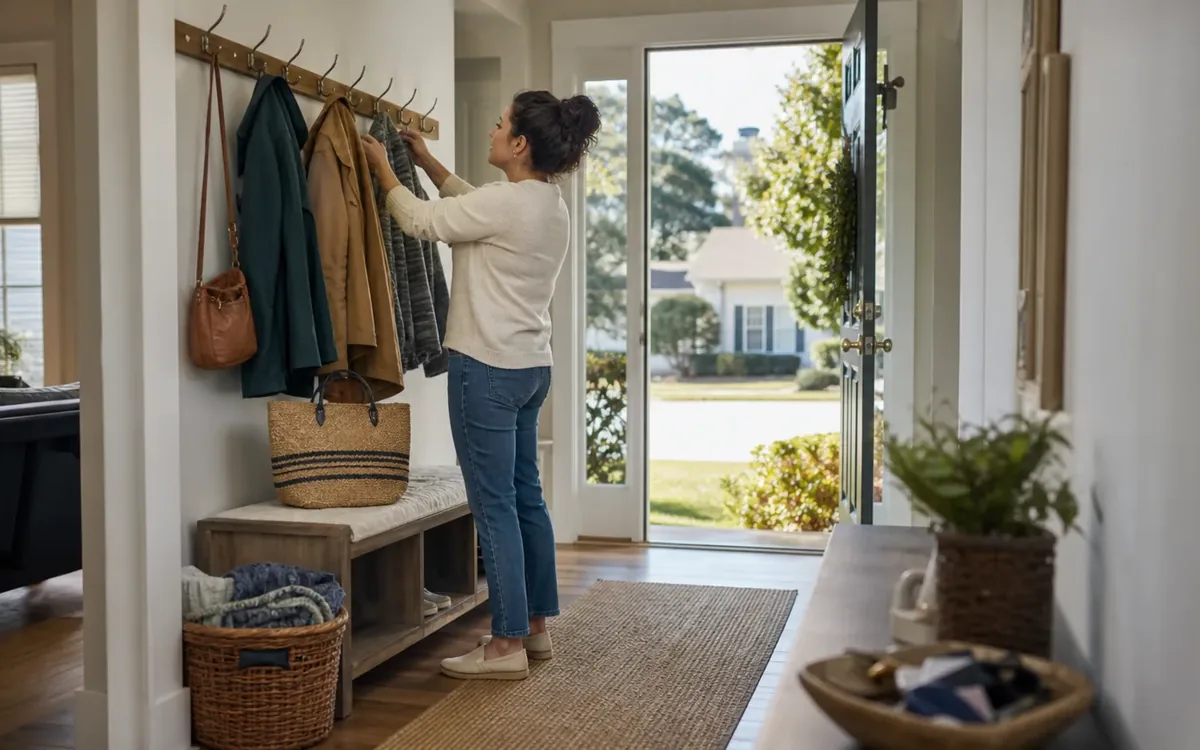
A shared entryway should let buyers enter safely, understand the home’s boundaries, and focus on the property instead of everyday clutter. Before showings, separate household belongings from neighbors’ items, preserve a clear walking path, remove sensitive information, and confirm who controls each part of the space. The goal is not to make a common entrance look privately owned. It is to present your portion honestly while respecting other residents and any building rules.
Quick answer: Keep the route to your door clear, reduce belongings attached to your household, and create a simple place for items still needed each day. Do not move a neighbor’s property or alter a common area without permission. Ask the real-estate professional how the entrance should be presented, and direct access, safety, repair, or compliance questions to the owner, association, landlord, inspector, contractor, or authority responsible for them.
Why does a shared entryway need its own showing plan?
An entryway may be shared in several ways. It could be a common interior hall, a porch used by more than one household, a vestibule, an exterior stair landing, or a passage leading to separate doors. The seller may control only part of it even though every buyer must pass through the whole area.
That overlap creates a narrower task than preparing a private foyer. You need to improve the arrival experience without suggesting that shared property comes with the home or interfering with another resident’s routine.
A useful plan accounts for three zones:
- The approach: The route from an authorized entrance or parking area to the home’s door.
- The shared zone: Space used or controlled by multiple residents, an association, or a landlord.
- The private threshold: The seller’s door, mat, hardware, nearby storage, and interior landing, where applicable.
Treating these as separate zones helps the household decide what it can organize directly and what requires approval. It also prevents a common mistake: clearing the private area while leaving bags, shoes, deliveries, or cleaning supplies in the buyer’s path.
If the entry is part of broader sale preparation, review Clutter Cleaner of South Carolina’s home sale preparation service to see how sorting and household transition support may fit into the larger project. The real-estate professional, not a cleanout or move team, decides how the property should be positioned and marketed.

What belongs to your household, and what is shared?
Start by identifying ownership and control before relocating anything. Visual proximity is not proof that an item belongs to the seller. A bicycle beside your door may belong to a neighbor, and a bench used by your family may be association property.
The household can sort its own belongings into five practical groups:
- Keep at the entrance: Only items needed for regular access, such as a current doormat or mobility aid.
- Move inside: Daily-use shoes, bags, umbrellas, pet equipment, and children’s items that can have a defined indoor home.
- Pack for the move: Seasonal decorations, duplicate outerwear, sports gear, and rarely used accessories.
- Donate, sell, recycle, or discard: Household-owned items no longer needed, using an appropriate recipient or disposal option.
- Review before touching: Anything of uncertain ownership, anything attached to the building, and anything located in a shared storage area.
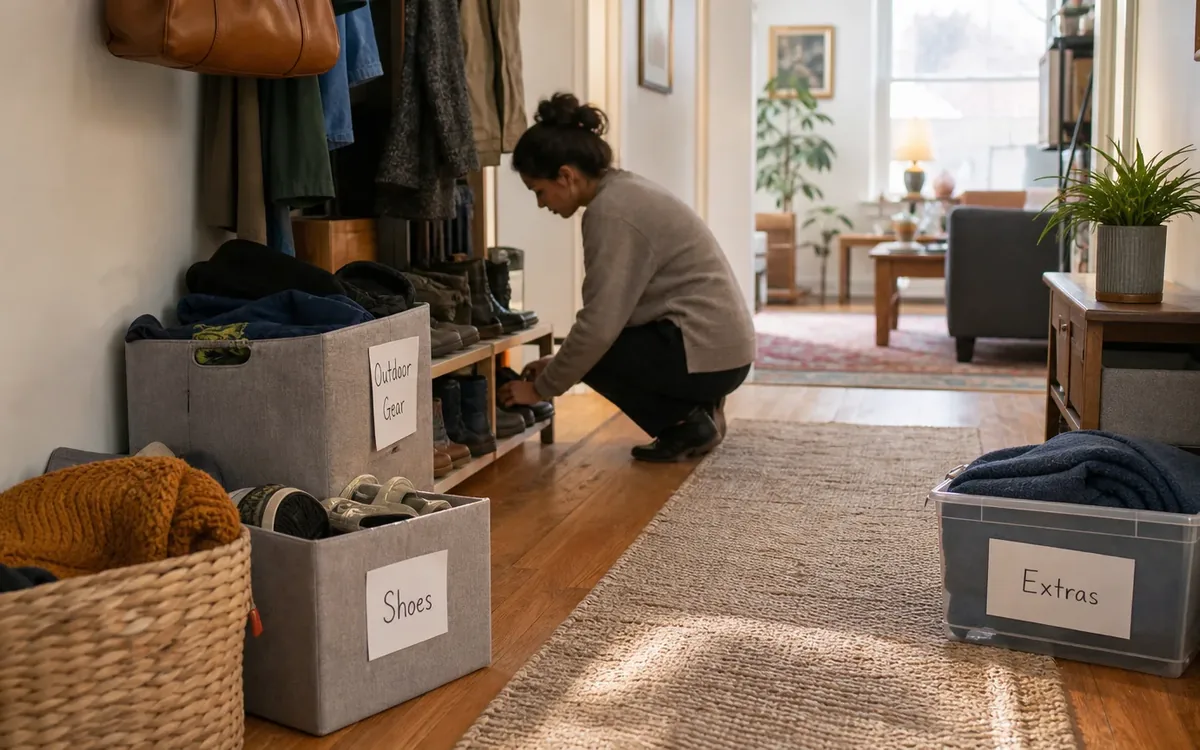
Labeling household boxes by destination is more useful than creating an unsorted pile elsewhere. For example, mark containers as “new home,” “temporary household storage,” or “decision pending.” Keep the labels neutral because buyers may see them.
A practical cleanout or move team may discuss sorting categories, packing sequence, pathways, and relocation of household-owned belongings. If the transition involves an estate, the guide to how clean should a house be for showings explains why authority and decision-making should be established before property is removed.
Questions about ownership, tenancy rights, association responsibilities, or estate authority belong with the responsible owner, property manager, association, attorney, personal representative, or other qualified professional. A cleanout team should not decide disputed ownership.
How should daily traffic work while the home is listed?
A showing-ready entrance must still work for the people who live there. An arrangement that looks tidy but blocks a resident’s mobility device, delivery access, or safe route is not a sound solution.
Build the routine around the predictable flow of daily items. Give each frequently used object a place that does not narrow the shared route. A small interior basket may hold keys and pet supplies. Shoes can go in an interior closet or a closed container inside the home. Packages should be collected promptly by the intended recipient rather than moved without authorization.
Use this four-part traffic check:
- Walk the full route: Approach the property as a visitor would, using only the authorized path.
- Notice hand and foot conflicts: Look for objects near locks, railings, steps, door swings, or places where people change direction.
- Test ordinary routines: Consider residents leaving with groceries, walking a pet, receiving a package, or using an accessibility aid.
- Reset after use: Return household-owned items to their assigned places rather than staging them temporarily in the common area.
Household members can agree on simple responsibilities, such as bringing in personal deliveries, keeping their own footwear inside, and checking the threshold before leaving. Neighbors do not need to participate in the seller’s staging plan unless they choose to and have authority to do so.
Do not obstruct an exit, stair, fire equipment, utility access, or required clearance. Whether a condition violates a lease, association rule, building requirement, fire code, or accessibility obligation is a decision for the responsible authority or qualified professional. If the route appears unsafe, pause the staging task and seek the appropriate review.
Prepare the private threshold without overstaging it
The area immediately associated with the home should be simple and truthful. Buyers need to identify the correct entrance, operate the door as authorized, and transition indoors without navigating personal belongings.
Concentrate on details under the household’s control:
- Remove shoes, shopping bags, toys, sports equipment, and loose pet items.
- Replace visibly worn household-owned paper signs with clear, necessary information approved for the showing process.
- Wipe the household’s door, handle, bell, and nearby trim when these surfaces can be cleaned without damaging finishes.
- Keep lockbox access available to the real-estate professional according to their instructions.
- Move keys, mail, documents, medication, and identifying information out of sight.
- Check that household-owned mats lie flat and do not interfere with the door.
- Keep the interior landing free of boxes that make entry awkward.
Avoid decorative excess. Several planters, signs, baskets, and seasonal pieces can make a small threshold feel crowded and may blur the distinction between private and common space. One restrained item is often easier to manage, provided it is permitted and does not impede access.
Do not paint, replace hardware, install lighting, mount hooks, pressure-wash surfaces, or repair common property based only on a showing preference. Those actions may require owner, landlord, association, contractor, or permitting approval. A qualified contractor should assess repair methods and building conditions.
What should you do about a neighbor’s belongings?
Do not throw away, donate, pack, hide, or relocate a neighbor’s belongings simply because a showing is scheduled. Even a well-intended move can create conflict, damage property, or place an item where it obstructs another route.
Instead, separate presentation concerns from property rights. Photographing or documenting a concern may help the authorized parties discuss it, but avoid recording sensitive information unnecessarily. Contact the person or entity designated to manage the shared area, such as the owner, landlord, property manager, or association representative.
Keep any request narrow and courteous. Identify the specific item, explain that access or a showing is planned, and ask whether the person responsible is willing to move it. Do not promise a buyer, agent, or neighbor that the common area will be changed unless the authorized party has agreed.
If the belongings appear abandoned, the responsible owner or property authority should determine the correct process. Rules for notices, disposal, and possession may depend on the property arrangement and circumstances. An attorney or appropriate authority should answer legal questions.
For the showing itself, ask the listing professional how to address visible shared-area conditions accurately. The agent may recommend disclosure, scheduling coordination, or a different arrival instruction. Those are real-estate decisions, not cleanout decisions.
Create a low-friction showing reset
A shared entrance can change between preparation and a showing. Deliveries arrive, residents pass through, and weather brings dirt or moisture into the approach. A light reset makes more sense than repeatedly staging the whole area.
Keep a small kit inside the home, not in the shared path. It might contain:
- A cloth appropriate for household-owned surfaces
- A lint roller or small handheld cleaning tool
- A bag for collecting the seller’s loose items
- A box for personal papers or mail
- Supplies for attending to pet-related messes
Before leaving, check the route from the authorized entry point to the private interior. Remove only your household’s belongings. Confirm that the door, mat, and lock access are unobstructed. Bring personal packages and documents inside.
Cleaning shared surfaces may be subject to building policies or maintenance arrangements. Confirm responsibility before applying products. Mixing cleaners or using a product on an unknown finish can damage the surface or create a hazard.
If a contractor’s repair creates dust, tools, cords, or restricted access, coordinate through the person managing that work. The contractor determines work methods and site controls. The real-estate professional decides whether a showing should proceed around active work.
Decide where removed belongings will go
Clearing an entryway is incomplete if everything is transferred to the living room. Choose destinations based on whether an item is needed before the move, after the move, or not at all.
Interior household storage can work for daily necessities when closets or closed cabinets have capacity. Avoid compressing so much into one area that buyers cannot reasonably view the storage feature.
Off-site storage is a household choice involving a separate provider. Review access terms, insurance questions, prohibited items, climate needs, and retrieval plans directly with that provider. A cleanout or move team may help identify what the household intends to store, but should not make contractual or insurance decisions for the customer.
Sale or appraisal requires another decision path. The household or authorized estate representative decides whether to seek an appraisal. A qualified appraiser determines value within the scope of the appraisal. An auction or estate-sale professional can explain their own acceptance criteria and sale process. Do not assume an item is valuable or disposable from its appearance.
Donation, recycling, and disposal depend on item condition, recipient requirements, and applicable rules. The household selects the destination, while the receiving organization or disposal provider determines what it accepts. Paint, chemicals, batteries, electronics, and other regulated or restricted materials may require instructions from the relevant local program or authority.
Clutter Cleaner of South Carolina may discuss downsizing and organizing, move management, estate cleanouts, auctions and estate sales, home sale preparation, and code compliance support within its statewide service scope. The exact fit should be confirmed for the property and project. These discussions do not replace legal advice, an appraisal, inspection findings, contractor judgment, real-estate representation, or official compliance decisions.
Coordinate roles before the first showing
A written division of responsibility can prevent confusion in a shared entrance. Keep it brief and specific to the property.
The household can decide:
- Which household-owned items stay, move, or leave
- Who resets the private threshold
- Where personal documents and deliveries are secured
- Whether to explore storage, donation, sale, or disposal options
- Who communicates with the listing professional and shared-area manager
A practical cleanout or move team may discuss:
- Sorting and packing household belongings
- Creating labeled destination groups
- Keeping work materials out of access routes
- Sequencing the entryway with other transition tasks
- Coordinating agreed household-item removal
Other professionals retain their own decisions. The real-estate agent advises on presentation, buyer access, scheduling, and listing strategy. An inspector reports conditions within the inspection scope. A contractor evaluates repairs and work methods. An appraiser develops an independent opinion of value. An attorney advises on legal rights and obligations. An owner, association, landlord, municipality, fire official, or other authority interprets and enforces applicable requirements within its jurisdiction.
When these roles are clear, the entryway can remain functional without asking a staging task to resolve ownership, repair, or legal questions it cannot answer.
Short FAQ
Should all shoes disappear during showings?
Remove the seller’s loose shoes from the shared route and private threshold. Keep currently needed pairs in an orderly interior location. Do not move footwear that belongs to another resident.
Can I put the neighbor’s packages inside for a cleaner appearance?
Not without permission and an appropriate arrangement. Contact the intended recipient or responsible property manager. Handle only your own deliveries unless you are expressly authorized to do otherwise.
Who decides whether the common entry needs repair?
The responsible owner, landlord, association, or other controlling party decides whether to pursue work. A qualified contractor evaluates repair methods, and applicable authorities make permitting or compliance determinations. The listing professional can explain how the condition may affect showings.
Should valuables be stored near the entrance for easy moving?
No. Keep jewelry, keys, documents, medication, financial records, and small valuables secured away from the showing path. For valuable personal property, the household may consult appropriate insurance, appraisal, storage, or legal professionals.
Can Clutter Cleaner decide what shared items may be discarded?
Ownership and disposal authority must come from the household or other authorized party. A practical team may help sort or discuss removal plans for authorized belongings, but it should not decide disputed ownership or legal disposal rights.
A successful shared-entryway plan is modest: clear the household’s belongings, protect everyday access, respect the limits of the seller’s control, and direct specialized decisions to the right professional. That creates a calmer arrival for buyers without turning common property into a source of avoidable conflict.



