

Preparing a home for an estate sale means making rooms safe to enter, separating sale inventory from excluded property, and giving the estate-sale professional enough orderly space to evaluate and display items. Do not empty the house first. Preserve potentially valuable contents, document household decisions, and let the appropriate professional handle appraisal, legal, inspection, and compliance questions.
Quick answer: Start by confirming who has authority to make decisions. Then identify private and excluded areas, clear safe walking routes, group related household items without over-sorting them, and reserve space for evaluation and display. Ask the estate-sale professional what should remain in place before discarding, donating, repairing, or moving anything.
What should you do before the estate-sale professional arrives?
Prepare access, not a finished showroom. The first goal is to let the professional see the home and its contents without unnecessary obstacles or premature disposal.
Take these six steps:
- Confirm the decision-maker. Identify the executor, personal representative, trustee, owner, or other person authorized to approve household decisions. If authority is unclear, pause and seek guidance from the appropriate attorney or court.
- Name one household contact. A single contact can gather family questions, record decisions, and reduce conflicting instructions.
- Identify excluded property. Mark items that will stay with the family, transfer to a beneficiary, or require professional review. Keep excluded items together when practical.
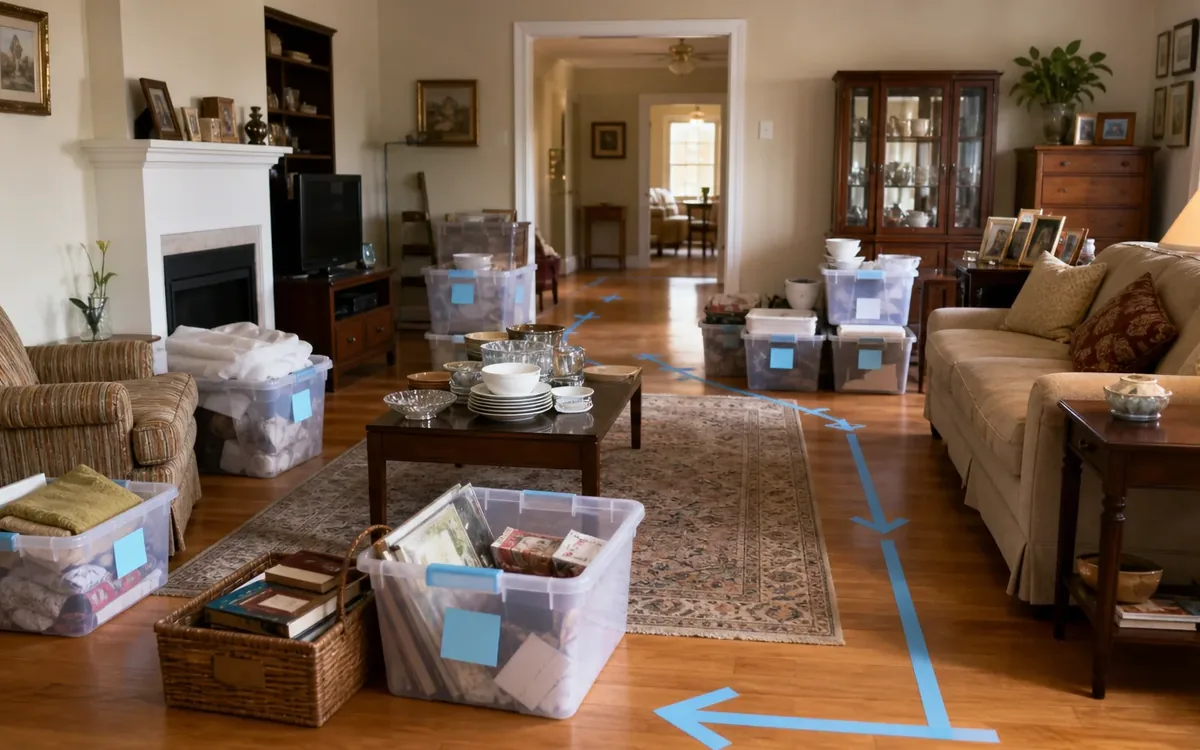
- Open useful access routes. Make entrances, halls, stairs, and main room paths passable without dismantling promising groupings of sale inventory.
- Leave uncertain items visible. Do not discard an object solely because it looks worn, outdated, incomplete, or ordinary.
- Prepare questions. Ask how the sale operator wants rooms arranged, which areas may be used for display, and what should remain untouched.
Families who are also coordinating removal can review the best way to clean out an estate before deciding what belongs in sale preparation and what belongs in a later cleanout phase.

Establish decision zones before moving household contents
A useful room plan separates property by status rather than forcing an immediate keep-or-discard judgment. Labels should be clear enough that relatives, organizers, movers, and sale personnel understand them consistently.
Consider creating these zones:
- Potential sale inventory: Items available for evaluation by the estate-sale professional.
- Family or beneficiary property: Clearly identified items that are not available for sale.
- Professional review: Art, jewelry, collections, documents, vehicles, firearms, or other property that may call for specialized legal, appraisal, transfer, or sales advice.
- Undecided: Items awaiting an authorized household decision.
- Personal records: Papers and digital devices kept outside public sale areas until properly reviewed.
- Later removal: Property approved for donation, recycling, disposal, or another destination after sale planning is complete.
Use removable labels that do not damage finishes. A simple room inventory can note the object, its location, its current zone, and who approved that status.
Avoid using unlabeled piles. A pile that means “family will review” to one person may look like sale inventory or rubbish to someone else.
If the household needs broader planning support, the auctions and estate sales service overview explains how sale coordination fits within a larger home transition. Availability and the exact scope should be discussed directly rather than assumed.
How should rooms be opened for safe access?
Concentrate first on circulation. Visitors and workers should not have to step over boxes, squeeze between unstable furniture, or enter areas that the household has not approved for access.
Walk the likely route from the entrance through each room. Look for:
- Loose rugs with curled edges
- Unstable stacks of boxes or books
- Cords crossing walkways
- Furniture blocking doors or stairs
- Low objects hidden beside beds or tables
- Broken glass, exposed nails, or sharp metal
- Weak shelving or overloaded cabinets
- Poorly lit steps and corners
- Pet items, household chemicals, or tools in traffic areas
Household members can move ordinary obstructions if they can do so safely. Heavy furniture, unstable structures, electrical concerns, damaged flooring, pests, mold, or hazardous materials may require an appropriate contractor, inspector, remediation provider, or other qualified professional.
Do not represent a cleared path as proof that the property complies with building, fire, accessibility, or occupancy requirements. Those determinations belong to the relevant authority or responsible professional. An estate-sale operator can discuss the practical layout needed for the planned sale, but does not replace an official inspection.
Prepare display space without erasing useful context
A home does not need to look empty. In fact, intact household groupings can help an estate-sale professional understand what is present. The practical aim is to reduce visual obstruction while preserving information.
Clear flat surfaces selectively. A dining table might become a useful display area, but first photograph and group anything originally stored there. Empty boxes can be flattened or set aside if the authorized decision-maker approves, while boxes containing unknown objects should remain available for review.
Keep related items together when possible:
- Dinnerware with matching pieces
- Tools with compatible accessories
- Electronics with remotes and power cords
- Lamps with shades and finials
- Furniture with loose hardware or keys
- Collectibles with their cases, certificates, or descriptive records
- Small appliances with attachments
Avoid polishing, refinishing, repainting, or repairing items merely to make them look newer. Cleaning can damage delicate surfaces, erase identifying marks, or alter an item that an appraiser or sale professional would prefer to inspect as found.
Basic dust control may be reasonable if the material and method are safe. Ask before cleaning art, metals, textiles, old paper, jewelry, fragile ceramics, or unfamiliar finishes.
What should remain untouched until professional review?
Leave any item alone when its value, ownership, transfer requirements, or safe handling is uncertain. The household decides what it intends to sell only when the authorized person has the right to make that choice. Specialists decide matters within their own fields.
Items that may merit separate review include:
- Fine art and signed works
- Jewelry, watches, coins, and precious metals
- Antiques and specialized collections
- Firearms, ammunition, and regulated items
- Vehicles, boats, and titled property
- Wine, spirits, medicines, and controlled substances
- Tax records, deeds, titles, and estate documents
- Computers, phones, drives, and other data-bearing devices
- Items that may belong to a beneficiary or third party
- Objects with uncertain provenance or authenticity
A qualified appraiser can provide appraisal opinions. An attorney can advise on estate authority, ownership, creditor issues, beneficiary rights, and legally restricted transfers. Relevant agencies or licensed professionals address regulated property. Real-estate professionals advise on listing strategy, while inspectors and contractors assess property conditions within their qualifications.
A cleanout, organizing, move, or sale team may help identify questions and create physical separation. It should not make legal rulings, authenticate objects, promise value, or substitute for professional appraisal.
Control rooms, keys, and private areas
Decide which spaces may be entered and which must remain closed. This matters in homes with family property, sensitive records, medications, occupied rooms, or unfinished work areas.
Use a written access map if the layout is complex. Note sale rooms, staging rooms, staff-only areas, excluded rooms, bathrooms approved for use, and exterior areas that require permission.
Control all keys deliberately, including keys for:
- Exterior doors
- Interior rooms
- Cabinets and desks
- Safes and lockboxes
- Vehicles and equipment
- Storage units or detached structures
Do not leave a key with an item unless the household has approved the key’s transfer and confirmed what it opens. Avoid labels that reveal security information to visitors.
Private papers are only one part of access control. Clothing, photographs, medical equipment, digital devices, family mementos, and beneficiary property also need clear boundaries. If a room cannot be reviewed before the sale, it may be safer to exclude and secure the entire room than to rely on scattered notes.
Coordinate the sale with cleanout and moving decisions
Estate-sale preparation, cleanout, moving, storage, donation, disposal, and contractor work are separate decisions. They can affect one another, but they should not be blended into a single vague instruction to “clear the house.”
A practical sequence is:
- Resolve authority and exclusions. Confirm who may approve sale inventory and identify property that cannot be sold.
- Request sale guidance. Let the estate-sale professional review the home before major removal.
- Create access and display areas. Make approved rooms workable while retaining useful item groupings.
- Complete the sale process. Follow the operator’s plan for setup, access, and handling of unsold contents.
- Address remaining property. The household can choose cleanout, donation, recycling, disposal, moving, or storage providers as appropriate.
- Prepare the property for its next use. Real-estate agents, inspectors, contractors, cleaners, or compliance authorities can address their respective parts of a future occupancy or sale.
If removal will follow the sale, how estate cleanouts work can help the household distinguish cleanout planning from the earlier inventory and display phase.
Clutter Cleaner of South Carolina has a physical business location in Mount Pleasant, serves Charleston as its primary market, and has an approved statewide service territory. Estate cleanouts, downsizing and organizing, move management, home-sale preparation, and sale coordination may be discussed according to the household’s needs and the confirmed scope. Storage, repairs, appraisals, legal advice, inspections, and regulated disposal remain separate household or specialist arrangements unless explicitly established otherwise with an appropriate provider.
Align room preparation with the property’s next step
Do not let future listing plans cause premature changes before the estate sale. Painting a room, replacing fixtures, or moving furniture may interfere with evaluation and display. Conversely, leaving every post-sale project undecided can create confusion about what happens after the event.
Create two plans: one for the sale environment and one for the property’s next use. The first covers access, inventory, display, private zones, and sale-day boundaries. The second can cover remaining contents, repairs, cleaning, inspection findings, and real-estate preparation.
The household can choose goals and approve spending. A real-estate professional can recommend listing strategy. An inspector can report observed property conditions. Contractors can define and price their own work. Local or state authorities determine applicable compliance requirements. An appraiser addresses value opinions within the appraisal assignment.
A practical home-transition team may discuss sequencing and physical readiness, but should not decide that a repair is legally required, certify code compliance, or state that a change will increase the property’s value.
Final room-readiness check
Before setup begins, walk every approved area with the household’s designated contact. Confirm that labels still match current decisions and that no family member has quietly moved items between zones.
Check the following:
- Entry and interior routes are passable
- Excluded rooms are secured or plainly identified
- Beneficiary property is separated from sale inventory
- Uncertain items remain available for review
- Display surfaces are stable and accessible
- Small components stay with their matching items
- Keys are controlled and documented
- Hazards are isolated for appropriate attention
- Private information and digital devices are protected
- Post-sale instructions are recorded separately
Photograph room arrangements if documentation would help the household track changes. Photos are organizational records, not appraisals, condition reports, or proof of ownership.
Ask the estate-sale professional to confirm the practical setup they expect before further rearranging. The final display and operating plan belongs with the chosen sale provider, subject to the property owner’s authorization and any applicable requirements.
Short FAQ
Should the house be emptied before an estate sale?
Usually, no. Emptying rooms can remove sale candidates, separate matching parts, and eliminate context the estate-sale professional needs. Ask for a review before broad donation, disposal, or removal.
Can family members choose what is not for sale?
The person with proper authority can approve exclusions. Family preferences should go through that decision-maker. Questions about an executor’s powers, beneficiary rights, disputed ownership, or court requirements belong with an attorney or the responsible authority.
Should everything be cleaned before display?
No. Ordinary dusting may be appropriate for durable items, but aggressive cleaning can damage surfaces or reduce useful evidence of age and condition. Ask before treating fragile, valuable, or unfamiliar materials.
Who decides whether an item needs an appraisal?
The household or authorized representative can choose to seek an appraisal. An estate-sale or cleanout team may flag an item for consideration, but only a qualified appraiser should provide an appraisal opinion.
What happens to items that do not sell?
The household decides among retention, transfer, another sales channel, donation, recycling, disposal, moving, or storage. Confirm the estate-sale agreement’s terms and arrange any separate provider rather than assuming unsold contents will be removed.
Can code or repair issues be handled during sale preparation?
They can be identified for follow-up, but official compliance decisions belong to the relevant authority, and repair assessments belong to appropriate inspectors or contractors. Keep those decisions separate from room staging and inventory work.



