

Planning a move to a smaller home starts with the destination, not the packing boxes. Confirm what will fit, decide what the new home must support, assign every possession a destination, and coordinate moving, disposal, sale, donation, storage, and professional decisions as separate tasks. This order helps South Carolina households avoid paying to move items that cannot be used in the new space.
Quick answer: Obtain an accurate floor plan, choose furniture before small belongings, sort by destination, and prepare a room-by-room placement plan. Keep legal, appraisal, inspection, real-estate, contractor, and compliance decisions with the appropriate professionals or authorities. If the project involves extensive sorting or coordination, review available move management support before deciding which tasks to handle yourself.
Why should the smaller home guide the plan?
A smaller-home move is a space-allocation project. The central question is not simply what to keep. It is what can fit, function, and remain accessible in the destination.
Start by identifying the new home’s fixed limits:
- Room dimensions and ceiling heights
- Door, hallway, stair, and elevator clearances
- Number and size of closets
- Kitchen cabinet and pantry capacity
- Garage, shed, attic, or basement availability
- Building rules affecting move access
- Accessibility needs and safe walking paths
- Outdoor storage restrictions
Use measurements supplied by a reliable source, or measure the property with permission. A listing photograph or estimated room size is not enough for deciding whether a large cabinet, sectional, or table will fit.
Then define what daily life should look like. A dining room might also need to support hobbies. A guest room might need to function as an office. Someone with mobility concerns may need wide paths and frequently used items within easy reach.
These functional choices belong to the household. A move team may help document measurements, build inventories, label destinations, and discuss placement options. A contractor should evaluate alterations. An inspector evaluates property conditions within the scope of the inspection. Neither a mover nor a cleanout team should substitute for those professionals.

What should you decide before sorting belongings?
Make four decisions before opening every drawer and cabinet. These prevent the sorting process from becoming a series of disconnected choices.
-
Define the purpose of each destination room. Write down the essential activities for every room. This reveals which furnishings and supplies deserve space.
-
Set practical capacity limits. Assign boundaries such as one linen closet, one bookcase, or a specific cabinet section. The limits should come from the new home rather than an arbitrary reduction target.
-
Identify nonnegotiable belongings. Include items needed for health, work, mobility, important records, daily routines, or meaningful family traditions.
-
Name decision-makers. Clarify who can approve donations, sales, disposal, storage, and distribution to relatives. If ownership or authority is uncertain, pause and consult the appropriate attorney, personal representative, trustee, or other responsible party.
This planning is especially important when downsizing overlaps with an estate transition. The process may involve ownership questions, family distributions, valuable property, and records that should not enter an ordinary discard pile. The guide to how far in advance should i plan a move explains those broader cleanout stages without treating a downsizing move as an estate administration decision.
Build a destination-based inventory
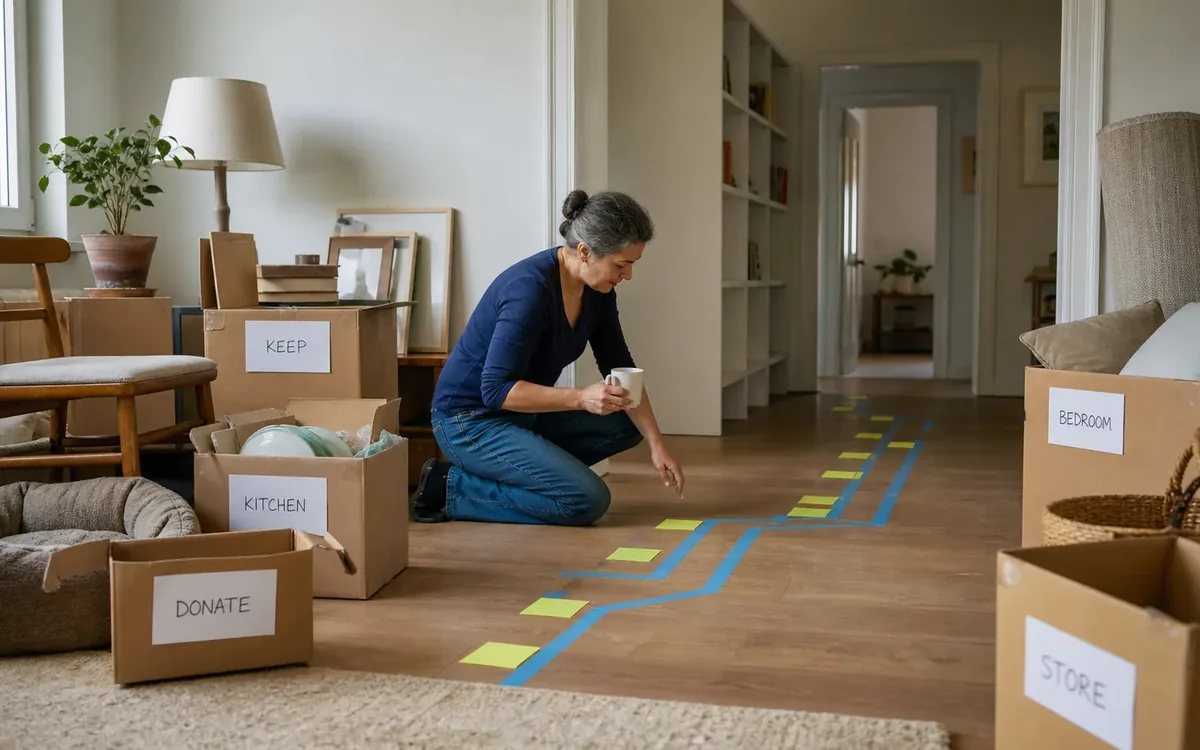
Traditional room-by-room sorting can hide the real issue: every kept item needs a destination. Instead, label belongings by where they are going.
Useful destination categories include:
- New home
- Family or named recipient
- Sale or appraisal review
- Donation
- Recycling
- Disposal
- Document review
- Temporary storage
- Unresolved ownership
Avoid a large miscellaneous pile. If a decision cannot be made, record exactly why. For example, “measure bedroom wall,” “ask personal representative,” or “obtain appraisal advice” is more useful than “maybe.”
A basic inventory can include the item, present location, destination, responsible person, and next action. Photographs can help family members review furniture or collections remotely, but sensitive records and personal information should be handled carefully.
Deal with obvious volume first. Duplicate kitchen equipment, excess linens, unused decorative pieces, and furniture with no destination can occupy substantial space. Sentimental papers and photographs often require more concentration, so consider reviewing them separately rather than during fast physical sorting.
How do you choose furniture for a smaller home?
Choose furniture by function, dimensions, access, and placement. Sentimental value may influence the decision, but it cannot make an oversized item pass through a doorway or leave a safe walking path.
For each major piece, check:
- Width, depth, and height
- Door, stair, hallway, or elevator route
- Space required to open drawers and doors
- Clearance around beds, tables, and seating
- Outlet, vent, radiator, and window locations
- Whether the piece duplicates another function
- Whether assembly or disassembly is possible
- Whether it can be used safely in the planned location
Create a scaled floor plan when possible. Mark the furniture footprint rather than merely listing a piece for a room. Also test the daily path between the entrance, bedroom, bathroom, kitchen, and seating area.
Select the essential pieces first. A bed, appropriate seating, a practical eating surface, and necessary storage take priority over occasional furniture. After those footprints are assigned, evaluate accent pieces.
Do not assume that a storage unit solves a furniture mismatch. Storage can postpone a decision while adding another provider, location, access arrangement, and household expense. The household should select the facility and terms, decide what deserves temporary storage, and set a clear reason for later retrieval. A move or cleanout team may discuss sorting and transport coordination, but storage availability, security, coverage, and contracts belong to the selected storage provider and customer.
Separate possessions from records and regulated materials
Not everything in a home belongs in the same sorting stream. Establish protected categories before physical removal starts.
Set aside items such as:
- Identification, financial, tax, and insurance records
- Property, vehicle, trust, probate, or business documents
- Medication and medical equipment
- Keys, access devices, and security information
- Firearms, ammunition, or other regulated property
- Chemicals, fuel, paint, batteries, and unknown substances
- Digital devices containing personal information
- Jewelry, currency, and potentially valuable collections
The household or legally authorized person decides who may review private documents and property. An attorney or relevant authority should address legal ownership, estate authority, retention obligations, and regulated transfers. A qualified appraiser should advise on value when an independent appraisal is needed.
Disposal requirements may vary by material and location. Confirm current instructions with the receiving facility, municipality, county, retailer, or other responsible authority before transport. A practical cleanout or move team may identify categories that need special handling, but it should not invent disposal rules or make legal determinations.
Decide what help the move actually requires
A smaller-home move may involve several separate providers. Define each scope so important work does not fall between them.
A household might need:
- A move manager for planning, inventory, sequencing, and coordination
- A mover for packing, transport, and agreed placement
- A cleanout team for approved contents removal
- An auction or estate-sale provider for selected sale candidates
- An independent appraiser for valuation
- A real-estate professional for listing and market decisions
- An inspector for property-condition findings
- A contractor for repairs or alterations
- A storage provider for items retained off-site
- An attorney or other authorized professional for legal questions
Clutter Cleaner of South Carolina lists move management, downsizing and organizing, estate cleanouts, auctions and estate sales, home sale preparation, and code compliance support within its statewide scope. That does not mean every property needs every service or that one provider replaces the others.
Ask any practical move or cleanout team what its proposed scope includes. Topics may include inventory methods, sorting areas, packing coordination, removal categories, donation or sale pathways, destination labeling, and communication with designated household contacts.
The household remains responsible for approving what happens to possessions unless a legally authorized person has that role. Real-estate agents handle listing strategy within their professional relationship. Inspectors report within their inspection scope. Contractors determine and perform agreed trade work. Authorities determine compliance. Attorneys advise on legal rights and obligations.
How should sale, donation, disposal, and storage decisions be made?
Use suitability, authority, and effort as separate tests. An item that appears valuable may require professional review. An item suitable for donation may not be accepted by a particular organization. Something no longer wanted may still require special disposal.
Consider each pathway independently:
Sale: Identify candidates before removal and ask the chosen sale professional about condition, demand, process, and acceptance. An auction or estate-sale provider may decline items. Do not treat an informal opinion as a formal appraisal.
Donation: Confirm what the organization currently accepts, how goods must be prepared, and whether delivery or pickup is available. Acceptance policies belong to that organization.
Disposal or recycling: Separate ordinary household material from electronics, chemicals, medications, batteries, and regulated items. Verify current instructions with the responsible facility or authority.
Family distribution: Label the recipient and establish who will arrange collection or transport. Do not leave promised items mixed with removal piles.
Storage: Use it for a defined purpose, such as delayed family collection or a pending housing decision. Record the contents and account holder, and review the provider’s contract and access terms.
For jointly owned, inherited, or disputed items, stop the physical decision until the authorized person or legal professional resolves the question.
Sequence the move around firm dependencies
A useful sequence follows decisions that unlock later work. Dates will depend on the property, contracts, provider availability, and the household’s circumstances.
-
Confirm authority and destination details. Establish who can approve decisions and obtain reliable access information and measurements.
-
Plan the new home’s layout. Assign essential furniture and define capacity limits.
-
Create destination categories. Prepare labels and an inventory method before broad sorting begins.
-
Protect records and special materials. Remove them from ordinary packing and cleanout streams.
-
Resolve sale and appraisal candidates. Allow the relevant professional to review items before they are donated or discarded.
-
Pack and label kept belongings. Mark both room and specific placement where useful.
-
Move essentials and approved contents. Keep medications, documents, keys, chargers, basic clothing, and immediate household needs accessible.
-
Address remaining contents and property work. Coordinate approved donation, disposal, cleaning, repairs, or sale preparation through the appropriate providers.
-
Verify both properties. Check cabinets, closets, storage areas, outdoor spaces, keys, utilities, and agreed work before final handoffs.
If the former home will be sold, let the responsible real-estate professional guide listing and market decisions. Repairs require contractor evaluation and household approval. Code questions should go to the authority with jurisdiction or a qualified professional. Code compliance support can help organize practical tasks, but the authority decides whether a property complies.
Prepare for the first days in the new home
A successful downsizing move is not finished when boxes arrive. The new home should support essential routines without creating immediate clutter or safety problems.
Prepare an accessible essentials group containing:
- Medications and health supplies
- Identification and important contacts
- Basic bedding and towels
- Toiletries and a change of clothes
- Phone chargers and necessary electronics
- Simple kitchen supplies
- Pet essentials, if applicable
- Keys, remotes, and access instructions
- Basic tools for ordinary setup
Direct boxes to their final rooms and avoid filling walkways, exits, utility panels, or access to essential equipment. Unpack by function: sleep, hygiene, meals, clothing, then secondary activities.
Keep some storage space open. Filling every shelf immediately can make the smaller home difficult to use and leaves no room for items discovered late in the transition.
Short FAQ
Should everything be sorted before requesting move help?
No. It is useful to identify decision-makers, protected items, destination measurements, and obvious nonnegotiables first. A move management provider may then discuss a workable sorting and coordination scope. The household or authorized representative still approves possession decisions.
Is an appraisal necessary before selling belongings?
Not for every object. If value affects an estate, insurance matter, equitable distribution, tax question, or important sale decision, ask a qualified appraiser or appropriate professional what type of valuation is needed. A resale estimate is not automatically an appraisal.
Can unwanted belongings simply be left for removal?
Only after an authorized person approves their disposition and restricted or sensitive materials are separated. Confirm what the selected provider accepts and how donation, recycling, or disposal will be handled.
Who decides whether the former home is ready to list?
The owner or legally authorized representative makes the decision with guidance from the responsible real-estate professional. Inspectors, contractors, appraisers, and authorities each address their own scope. A home sale preparation or cleanout provider can complete agreed practical tasks but does not make legal, market, inspection, or compliance determinations.
Where can South Carolina households discuss move management?
Clutter Cleaner of South Carolina is physically located in Mount Pleasant, serves Charleston as its primary market, and has a statewide South Carolina service territory. Households can call (843) 972-7020 to discuss the property’s location, the decisions already made, and the practical scope still needed.



