

Measure each furniture piece at its widest, deepest, and highest points, then compare those dimensions with every doorway, hallway, stair, elevator, and room entrance along the moving route. Record removable parts and required turning space too. This lets you decide what can realistically move into a smaller South Carolina home before paying to transport pieces that will not fit.
Quick answer: Create two sets of measurements: one for the furniture and one for the full path into the new home. A piece should fit through the narrowest opening, around each turn, and within any building access limits. If the fit is close, ask the mover to review your numbers rather than assuming the piece can be tilted or disassembled.
This guide focuses on measuring before a move, not arranging furniture after arrival. Households that need help sorting what will move, sell, donate, or leave the property can learn about downsizing and organizing. If the move is part of settling a property, this guide to how estate cleanouts work explains the broader process.
Why measuring the furniture alone is not enough
A sofa may fit comfortably inside the destination room but still fail at the front door. A dresser may pass through a doorway but not turn from a narrow hall into a bedroom. A tall cabinet may clear the first floor yet be impossible to angle beneath a stair landing.
Successful measurement therefore involves three separate questions:
- Does the piece fit through the smallest opening?
- Can it turn through halls, landings, and corners?
- Can it be transported under the property’s access rules?
The third question matters in apartments, condominiums, senior communities, and managed buildings. An elevator may have a large interior but a smaller door opening. A loading area may impose vehicle, scheduling, or protective-material requirements. Building management, an association, or the responsible property representative must confirm those requirements.
Do not rely on a listing’s room dimensions to answer access questions. Listing information may help with early planning, but it does not replace measurements taken at the property. The real-estate professional or seller should address questions about listing information, while the appropriate inspector or contractor should evaluate building conditions.

What furniture dimensions should you record?
For every piece, record width, depth, and height in inches. Measure the greatest dimension in each direction, including trim, curved arms, overhanging tops, feet, handles, and decorative details.
Use a rigid tape measure when possible. A soft tape can follow curves and produce a number that does not represent the piece’s maximum straight-line dimension.
Sofas and upholstered chairs
Measure:
- Outside arm to outside arm for overall width
- Frontmost point to backmost point for overall depth
- Floor to the highest fixed point for height
- Floor to the top of the back after removable cushions are taken off
- Width and height of removable feet, if applicable
- Diagonal depth from the highest back corner to the front lower edge
Diagonal depth can help a mover assess whether a sofa might pass through an opening while tilted. It is not a guarantee. Frame construction, ceiling height, landing space, and the ability to rotate the piece all matter.
Tables and desks
Measure the top at its widest and deepest points, then record total height. Note whether the legs, leaves, hutch, return, or modesty panel detach.
Do not assume screws mean a piece is designed for repeated disassembly. Particleboard, glued joints, old hardware, and fragile finishes may be damaged when taken apart. A qualified furniture repair professional should evaluate uncertain construction or valuable pieces.
Dressers, cabinets, and bookcases
Include projecting tops, bases, knobs, pulls, and trim. For a tall cabinet, measure both the full height and the diagonal from one bottom corner to the opposite top corner.
Also note:
- Whether shelves are removable
- Whether doors or drawers can be secured or removed
- Whether glass panels require special handling
- Whether the piece separates into upper and lower sections
- Whether a tip-restraint device is attached
Removal or reinstallation of wall anchors should be addressed by an appropriate installer or contractor, particularly when wall materials or hidden utilities are uncertain.
Beds
Measure the frame, not only the mattress. Headboards, footboards, rails, posts, and adjustable bases can exceed mattress dimensions.
Record each component separately if the bed disassembles. For powered or adjustable beds, consult the manufacturer’s instructions and the mover about safe preparation. Electrical or mechanical repair questions belong with a qualified technician.
How do you measure the route into the smaller home?
Start at the unloading point and trace the exact route to the destination room. Measure every restriction rather than only the front door.
Create a route sheet with these categories:
- Exterior approach: Note gates, steps, railings, porches, slopes, and tight walkways.
- Entry opening: Measure clear width and height with the door open as far as it normally opens.
- Interior halls: Record the narrowest width and lowest ceiling point.
- Turns: Measure the available width on both sides of each corner.
- Stairs: Record stair width, landing depth, ceiling clearance, and railing projections.
- Elevators: Measure the clear door opening, interior width, depth, and height.
- Room entrance: Measure the final doorway and any immediate turn inside it.
Measure clear openings, not the distance from the outside edges of the trim. An open door, hinge, closer, threshold, handrail, or security device may reduce usable space.
Take each measurement twice and label it immediately. A number written as “34” is not useful later if no one remembers whether it describes a door, hall, or cabinet.
Photographs can support the notes. Capture the tape measure in the frame where practical, along with corners and overhead restrictions. Photos do not replace dimensions, but they can help a mover understand the route before move day.
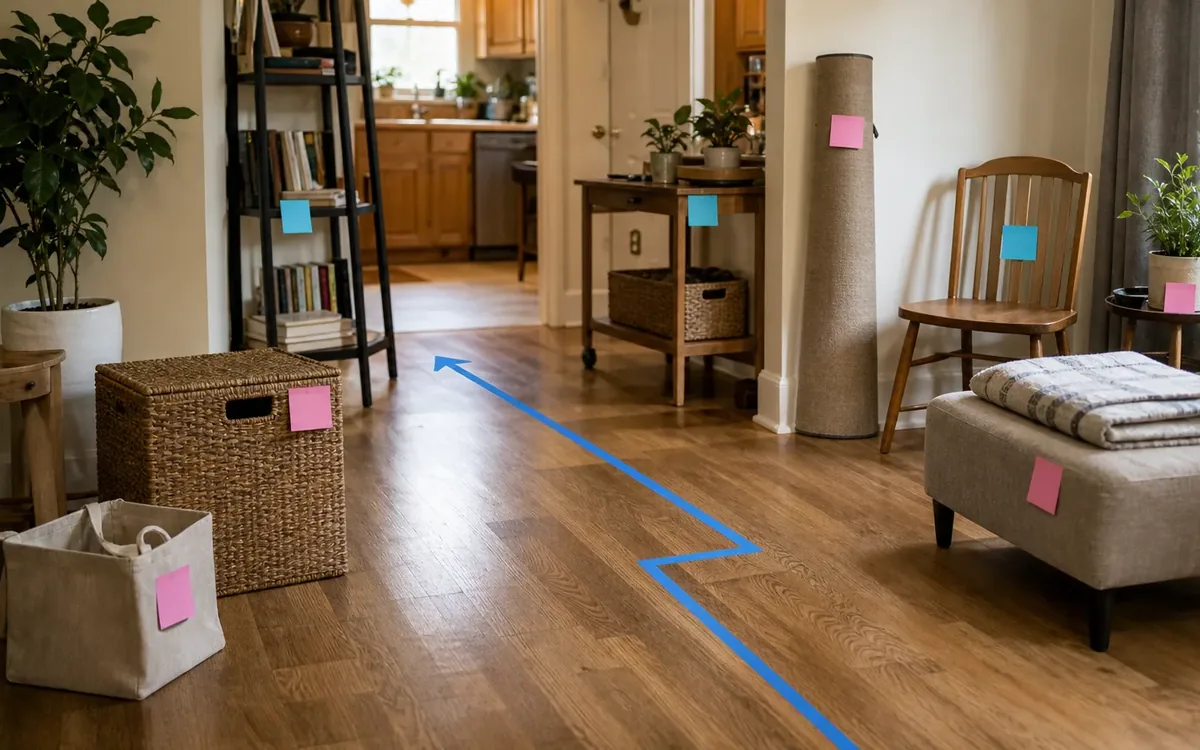
How can you check whether a piece will turn a corner?
Comparing sofa width with doorway width is only the beginning. Turning requires enough open area to rotate the piece without striking a wall, ceiling, fixture, or railing.
For each turn, sketch a simple overhead view. Add:
- Hall width before the turn
- Hall width after the turn
- Door position and swing
- Distance to the opposite wall
- Ceiling height
- Fixed projections such as rails or counters
Next, make a scaled paper rectangle representing the furniture’s maximum footprint. For example, one square on graph paper could equal six inches. Move the rectangle through the sketched route to identify obvious conflicts.
This method is useful for screening, but it cannot fully represent tilting a three-dimensional object. Irregular furniture, low ceilings, and stairs make the problem more complex. If clearance is only an inch or two, provide all measurements and photos to the mover for review.
Avoid planning around removal of doors, railings, windows, or building fixtures unless the responsible owner approves it and an appropriate professional confirms that it is safe and permitted. A cleanout or move team may discuss practical handling options, but it should not make structural, code, association, or property-authority decisions.
Use a furniture measurement worksheet
A consistent worksheet makes comparison easier and reduces memory-based decisions. Create one row per item with these fields:
| Item | Width | Depth | Height | Diagonal | Removable parts | Destination | Route concern | Decision |
|---|---|---|---|---|---|---|---|---|
| Sofa | Cushions, feet | Living room | Entry turn | |||||
| Dresser | Drawers, mirror | Bedroom | Hall width | |||||
| Dining table | Legs, leaf | Dining area | Elevator |
Assign each piece one of four statuses:
- Move: Measurements provide reasonable clearance, subject to mover confirmation.
- Review: Clearance is close, the route is complicated, or disassembly is uncertain.
- Do not move: The piece clearly exceeds an opening or access limit.
- Pending: Destination or authority information is missing.
Use consistent names on the worksheet and physical labels. “Tall walnut dresser” is more reliable than “dresser,” especially when several similar items are being sorted.
Add the date and the name of the person who measured. If construction, repairs, or flooring work later changes an opening, measure again.
How much clearance should you allow?
There is no universal clearance number that guarantees a successful move. Furniture shape, weight, fragility, wrapping material, hand placement, stairs, and the crew’s handling method all affect what is practical.
Do not treat a piece and an opening with identical dimensions as a fit. Protective wrapping adds thickness, measurements may vary slightly, and walls or frames may not be perfectly square. Hands and equipment also need working room.
A useful decision rule is qualitative:
- Comfortable difference: Keep the item in the move plan, then share the route details with the mover.
- Close difference: Flag it for professional review before committing to transport.
- No difference or negative difference: Do not assume tilting will solve the problem.
- Unknown route dimension: Leave the decision pending until it is measured.
The household can decide how much uncertainty it is willing to accept and whether an item is important enough to justify additional evaluation. The mover determines whether its team can safely handle the piece under the actual access conditions and its operating practices.
For antiques, art furniture, heirlooms, or pieces with uncertain value, an independent qualified appraiser should address value. A practical team may help identify items that require a decision, but it should not substitute for an appraisal.
Decide what earns space in the move
Once measurements eliminate pieces that physically cannot enter, use the smaller-home transition itself to make the remaining choices. This is not a post-move layout exercise. It is a pre-move test of whether each large item is worth transporting.
Ask of every qualifying piece:
- Does it serve a necessary function in the new home?
- Is a smaller item already available for that function?
- Will its condition justify the handling effort?
- Does it need repair before safe use?
- Is it personally important enough to receive priority?
- Does another household member or beneficiary have a valid claim to it?
Keep legal ownership separate from preference. In an estate, trust, divorce, guardianship, or shared-property situation, the authorized representative and relevant legal professional should resolve ownership, authority, and distribution questions. Do not sell, donate, discard, or move disputed property merely because it does not fit.
When the authorized household has decided, a practical downsizing, cleanout, or move-management team may discuss sorting categories, sequence, labeling, packing preparation, and removal planning. It may also help keep items intended for a sale, auction, donation, recycling, or disposal from becoming mixed.
Final acceptance, valuation, sale method, and proceeds depend on the appropriate organization or professional. Local disposal and building rules should be confirmed with the responsible facility, municipality, county, property manager, or other authority.
Make a no-surprises packet for the mover
Combine the useful information into a short packet before requesting a move assessment. Include:
- Furniture worksheet
- Route measurements
- Photos of narrow openings and turns
- Notes about removable parts
- Building access instructions
- Elevator dimensions and reservation details
- Parking or loading information confirmed by the property authority
- Items requiring unusual care
- Contact information for the authorized decision-maker
Mark any measurement that is estimated rather than verified. Avoid rounding down. If an elevator interior is deep but its door is narrow, list both figures clearly.
Tell the mover about weight concerns such as sleeper sofas, stone tabletops, safes, large mechanical bases, or solid-wood cabinets. Dimensions alone do not establish whether an item can be handled safely.
A practical move team may ask about access, packing state, disassembly, staffing, or equipment. The team decides what it can undertake. Building management determines building access rules, while contractors, inspectors, or code authorities address alterations, hazards, and compliance within their respective roles.
Common measuring mistakes to avoid
Small errors can lead to unnecessary transport costs, delays, or rushed decisions at the destination. Watch for these problems:
- Measuring between door trim edges instead of the clear opening
- Ignoring the open door and its hardware
- Recording a sofa’s seat width instead of overall width
- Forgetting knobs, feet, trim, or overhanging tops
- Assuming furniture can always be stood upright
- Measuring elevator interiors but not elevator doors
- Ignoring low ceilings above stairs and landings
- Treating removable cushions as structural disassembly
- Assuming a railing or door may be removed
- Using room dimensions as proof of route clearance
- Failing to remeasure after renovation work
- Mixing inches, feet, and rounded estimates
Another common mistake is moving first and deciding later. Measuring early creates time to resolve sentimental, ownership, appraisal, sale, donation, or disposal questions without move-day pressure.
Short FAQ
Should I measure the old home too?
Yes. Measure the exit route from the current home as well as the entry route at the smaller home. Furniture may have entered before a renovation, railing installation, or doorway change.
Can doors be removed to create more space?
Possibly, but do not assume this is allowed or sufficient. The property owner or manager must approve it, and an appropriate professional should handle work involving fixtures, closers, security systems, unusual hinges, or uncertain conditions.
Who should decide whether an heirloom is sold?
The owner or legally authorized representative makes that decision. An attorney may need to resolve authority or estate questions, and a qualified appraiser should address value when needed.
What if I cannot access the new home to measure?
Ask the owner, seller, property manager, or real-estate professional what verified measurements are available. Keep affected furniture decisions pending until access dimensions can be confirmed. Do not rely only on photographs.
Can a downsizing team guarantee that furniture will fit?
A team may discuss measurements, sorting, preparation, and practical options. The mover responsible for transport should evaluate the route and handling plan. Structural, building-rule, inspection, and compliance decisions remain with the appropriate professional or authority.
When should measuring begin?
Begin as soon as the destination is known and access is available. Early measurement gives the household time to make authorized decisions and prevents nonfitting pieces from consuming packing and transportation effort.



