

The easiest way to label moving boxes is to give every box a destination room, a short contents summary, an unpacking priority, and any handling instruction. Put the information on the top and at least two sides so it stays visible when boxes are stacked. Use the same wording and color system throughout the move, and record each box on a simple inventory.
Quick answer: Label each box with room + box number + contents + priority + handling note. For example: KITCHEN K-04 | Baking pans and mixing bowls | Priority 2 | Heavy. Keep personal records, medication, keys, valuables, and immediate-use items with the household rather than packing them into the general load.
This approach works for moves within Charleston, across South Carolina, or between states because it does not depend on memory or a particular floor plan. It also gives movers, relatives, organizers, and the household one shared set of directions.
What information belongs on every box?
A useful label answers four questions without requiring anyone to open the box:
- Where does it go? Name the destination room, not the room it came from.
- What is inside? List a few categories rather than every object.
- When should it be opened? Assign an unpacking priority.
- Does it need special handling? Note fragile contents, weight, or orientation.
A complete label might read:
PRIMARY BEDROOM PB-07
Linens, pillows, mattress protector
Priority 1 | Open before first night
Avoid labels such as “miscellaneous,” “house items,” or “stuff.” They save a few seconds during packing but create extra searching later. A description such as “desk supplies, charging cables, stationery” is brief and still useful.
If a move involves extensive sorting, donation decisions, or coordinating several parts of the transition, review the available move management service in South Carolina. For households also clearing inherited property, the guide to what to do first when unpacking explains that separate process and the decisions it may involve.

How should you create room names that stay clear?
Choose destination names before packing begins. Write them on a master room list and use those exact terms on every box, door sign, and inventory entry.
Room names should distinguish similar spaces. Instead of labeling three boxes “bedroom,” use names such as:
- Primary bedroom
- Front bedroom
- Upstairs guest room
- Child bedroom
- Hall bathroom
- Downstairs bathroom
- Kitchen
- Breakfast area
- Garage workbench
- Climate-controlled storage, if separately arranged
Names based only on a person can become confusing when helpers do not know the household. If personal names are useful, combine them with the room location, such as “Jordan, upstairs front bedroom.”
For a move into a smaller home, label according to the new layout. A box packed in a former dining room may belong in the new kitchen, office, or storage area. The destination should control the label.
Post matching room signs at the new home before unloading starts. Large, readable signs help the move crew place boxes without repeatedly asking for directions. If a room has more than one entrance, place a sign where it can be seen from the normal delivery route.
What is the simplest priority system for unpacking?
A three-level system is usually enough. More levels can become difficult to apply consistently.
- Priority 1: Open first. Daily medication kept under household control, bedding, basic cookware, toiletries, chargers, work materials, pet supplies, and accessibility equipment.
- Priority 2: Open after essentials. Regular clothing, most kitchenware, books used often, office supplies, and frequently used household items.
- Priority 3: Open later. Seasonal decor, archives, collections, extra linens, infrequently used serving pieces, and display items.
Use both a number and a word or phrase. A large “1” is quick to spot, while “OPEN FIRST” prevents someone from misunderstanding the system.
Priority labels do not replace a personal essentials bag. Each household member should keep critical medication, identification, keys, phone chargers, travel documents, mobility aids, and a change of clothing accessible. Sensitive financial and legal records should remain under the responsible person’s control.
An “open first” box can hold ordinary setup supplies such as paper towels, basic tools, trash bags, soap, and toilet paper. Mark it clearly and arrange for it to be loaded where it can be retrieved without unloading everything else.
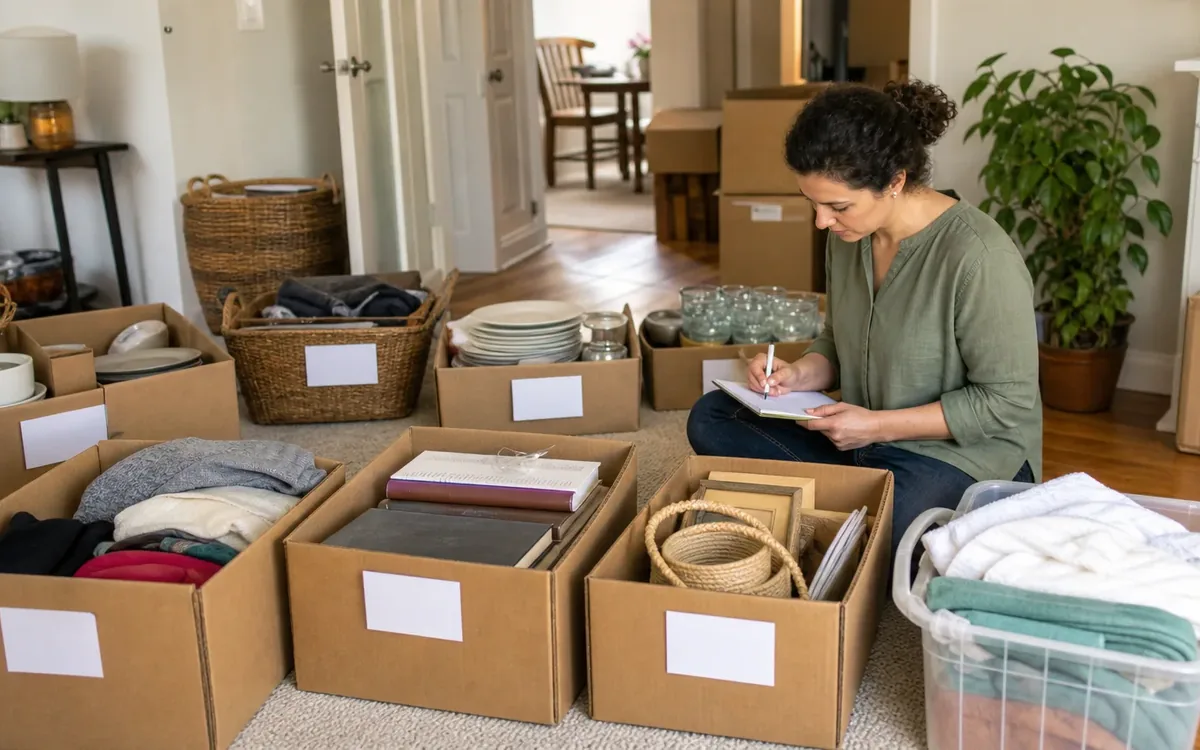
Build a box numbering and inventory system
Numbering distinguishes boxes that otherwise look identical. Use a room abbreviation followed by a sequential number:
- K-01, K-02, K-03 for kitchen
- PB-01, PB-02 for primary bedroom
- OF-01, OF-02 for office
- GR-01, GR-02 for garage
Keep a matching inventory on paper, in a spreadsheet, or in a shared note. Record enough detail to find an item without producing a full household catalog.
A practical entry could be:
K-04 | Baking pans, mixing bowls, measuring cups | Priority 2 | Heavy
Number labels also make missing or misplaced boxes easier to identify. If K-03 is present and K-05 has arrived but K-04 cannot be found, the gap is immediately visible.
Do not put a detailed description of valuables on the exterior. Use a neutral identifier and keep the private inventory securely with the household. Photographing the closed box and its identifying number may be useful for personal records, but photographs do not establish value, condition, insurance coverage, or liability.
An appraiser determines value when a qualified appraisal is needed. Insurers, carriers, or other responsible providers determine their own documentation requirements. A labeling or move team can discuss practical organization, but it does not make appraisal, coverage, or liability decisions.
Use color without relying on color alone
Color coding makes destinations easier to recognize at a glance. Assign one color to each room or zone, then use matching tape, stickers, or marker blocks on the boxes and room signs.
For example:
- Blue: kitchen
- Green: primary bedroom
- Yellow: office
- Orange: living room
- Purple: storage destination
Always pair color with written text. Colors may look similar in dim spaces, labels can tear, and some people have difficulty distinguishing certain colors. “BLUE = KITCHEN” on the master list is more reliable than an unexplained blue sticker.
Place labels in consistent locations. One label on top and matching labels on two adjacent sides allow the destination to remain visible in a stack. Do not place the only label across a seam that will be cut when the box opens.
Use a marker that contrasts with the label. Test specialty tape before applying it to rented containers, finished furniture, or delicate surfaces. The household or container provider should decide what adhesives are acceptable.
How do you label fragile, heavy, or unusual items?
Handling instructions should be direct and visible. Write “FRAGILE,” “HEAVY,” “THIS SIDE UP,” or “DO NOT STACK” on more than one face when the instruction matters.
Use these notes accurately. If nearly every box is marked fragile, the warning becomes less informative. Separate delicate items from dense, heavy contents rather than packing both together.
Label unusual items according to their actual needs:
- Electronics: Name the destination and device category. Keep associated cords together and identify where they connect.
- Hardware: Place screws and small parts in a sealed bag labeled with the furniture item. Decide whether to attach the bag safely or keep all hardware in a controlled parts container.
- Artwork and mirrors: Identify orientation and room destination without claiming a packing method will eliminate damage.
- Liquids: Check carrier rules before packing. Preventing leaks and determining what a carrier will accept are separate from labeling.
- Tools: Mark heavy boxes and avoid vague descriptions. Restricted fuels, chemicals, and similar materials require appropriate provider or authority guidance.
- Documents: Use neutral labels, maintain a private index, and keep critical originals secure.
A label communicates handling needs, but it does not make poor packing safe. Packing materials, box strength, carrier requirements, and loading decisions still matter. The mover or transportation provider should address what it will accept and how it handles special items.
Label for the destination, not just the moving truck
Think beyond unloading. A box placed in the correct room can still slow unpacking if the label does not explain where it belongs within that room.
Add a secondary destination where useful:
- Kitchen, baking cabinet
- Office, file area
- Primary bedroom, closet
- Garage, workbench
- Living room, media console
For a multistory home, include the floor. For rooms with similar names, add a location such as “upstairs rear bedroom.” Confirm those names against the actual destination layout rather than assuming the new home mirrors the old one.
If some belongings are going to separate destinations, create clearly different destination codes. Examples could include “NEW HOME,” “FAMILY PICKUP,” and “STORAGE.” Storage is a separate household and provider choice. Confirm container rules, access arrangements, environmental conditions, insurance questions, and prohibited items directly with the selected storage provider.
Do not use moving labels as final disposition decisions. Items marked for donation, sale, recycling, disposal, family distribution, or storage should be kept in separate zones before packing. Mixing those categories creates avoidable uncertainty.
Coordinate labels with everyone involved
A labeling system works only when everyone uses it. Before packing, share a one-page key showing room names, colors, abbreviations, and priority levels.
A household can decide:
- Which belongings will move
- Destination room names
- Unpacking priorities
- Which items stay personally controlled
- Whether possessions are retained, offered to family, donated, sold, recycled, discarded, or placed in separately arranged storage
- Who is authorized to change those decisions
A practical cleanout or move team may discuss:
- Box and room identification
- Staging areas
- Inventory formats
- Unpacking order
- Coordination points among approved participants
- How household decisions affect physical workflow
Other matters stay with the responsible professional or authority. Attorneys or estate representatives address ownership, authority, wills, probate, and disputes. Qualified appraisers address value. Real-estate professionals advise on listing and market strategy. Inspectors evaluate property conditions within their scope. Contractors decide how repair work will be performed. Government authorities determine applicable disposal, permitting, code, and compliance requirements.
Clutter Cleaner of South Carolina is physically located in Mount Pleasant, with Charleston as its primary market and a stated service territory covering South Carolina. Availability and the exact scope of any requested work should be confirmed directly at (843) 972-7020.
Perform a label check before boxes leave
Review labels while each box is still accessible. A focused check catches missing information before stacking and transport make corrections harder.
Confirm these six points:
- The box closes securely and has no visible damage.
- The destination room appears on the top and two sides.
- The box number matches the inventory.
- The contents summary is specific enough to be useful.
- Priority and handling notes are visible.
- The box belongs in the move rather than another disposition category.
Update the inventory if contents change. Do not place a late item into a sealed box and rely on memory. Add it to the written record or assign it to another accurately labeled box.
At the destination, check box numbers as they enter and direct them to the matching room signs. Unpack Priority 1 items first, but keep empty boxes intact until their contents and condition have been reviewed. The household should retain records needed for any discussion with the mover, insurer, seller, or another provider.
Short FAQ
Should every item be listed on the box?
No. Use a concise category summary outside and keep greater detail in the inventory when needed. Avoid advertising valuables or sensitive records on exterior labels.
Is color coding enough by itself?
No. Pair every color with a written room name and box number. Written information remains usable if a sticker falls off or colors are hard to distinguish.
Should boxes be labeled by the old room or new room?
Use the destination room. The label should tell the unloading team where the box belongs at the new property.
Who decides whether an item is moved, stored, sold, or discarded?
The owner or other properly authorized decision-maker does. A practical team may help organize approved categories, but legal authority, disputed ownership, appraisal, sale, and compliance questions remain with the appropriate person or professional.
What should stay out of the general moving boxes?
Keep identification, keys, medication, critical legal and financial records, valuables, essential electronics, and immediate personal supplies under household control. Ask the selected carrier about prohibited or restricted items.
What is the best label format?
Use destination room + box number + contents summary + priority + handling note. Consistency matters more than decorative labels or a complicated tracking system.



