
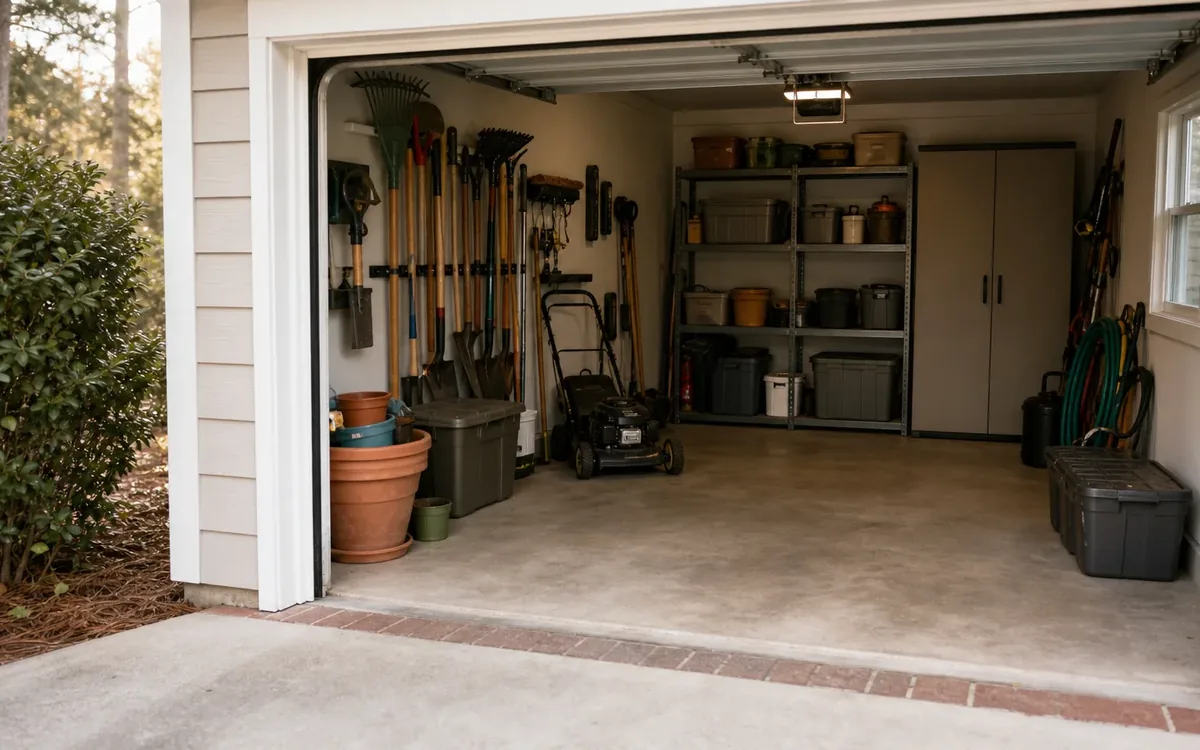
Downsizing outdoor tools starts with the property you are moving to, not the equipment you currently own. Confirm what outdoor space and storage the smaller home provides, identify the maintenance tasks that will remain your responsibility, and keep only the tools that fit those needs safely. Sell, donate, transfer, recycle, or properly dispose of everything else according to its condition and local requirements.
Quick answer: Make a list of the outdoor tasks required at the new home. Match one practical tool to each task, measure available storage, separate fuel-powered equipment and chemicals, and choose an appropriate exit path for every item that will not move. Property rules, hazardous-waste requirements, equipment values, and repair decisions should be confirmed with the relevant association, authority, appraiser, dealer, or contractor.
South Carolina households moving from a detached home to a condo, townhome, apartment, retirement community, or smaller lot may have more lawn and garden equipment than the new setting can support. The goal is not simply to remove clutter. It is to build a smaller, safer collection around the next property.
What outdoor work will the new home actually require?
Before sorting the shed or garage, clarify who will maintain the new property’s exterior. A condo association may handle some landscaping, while residents remain responsible for patios, balconies, planters, or limited private areas. A smaller detached home may still require mowing, pruning, irrigation checks, and storm cleanup.
Ask the property manager, homeowners association, landlord, real-estate professional, or seller for written information about maintenance responsibilities and storage restrictions. Do not assume that a shared community eliminates every outdoor task.
The household can decide which tasks it wants to perform. The responsible property representative determines what the governing documents or lease require. Useful questions include:
- Is lawn care included, and what areas are covered?
- Who handles shrubs, trees, irrigation, and leaf removal?
- Are residents allowed to store gasoline, propane, fertilizers, or pesticides?
- Can tools be kept on a balcony, patio, carport, or porch?
- Is there a private garage, closet, shed, or storage cage?
- Are grills, generators, ladders, or powered equipment restricted?
- Must outdoor belongings be concealed from view?
Wait for reliable answers before deciding to retain a mower, trimmer, blower, ladder, pressure washer, or fuel container. If the move is part of a broader household transition, Clutter Cleaner of South Carolina’s downsizing and organizing service explains the practical support that may be discussed.
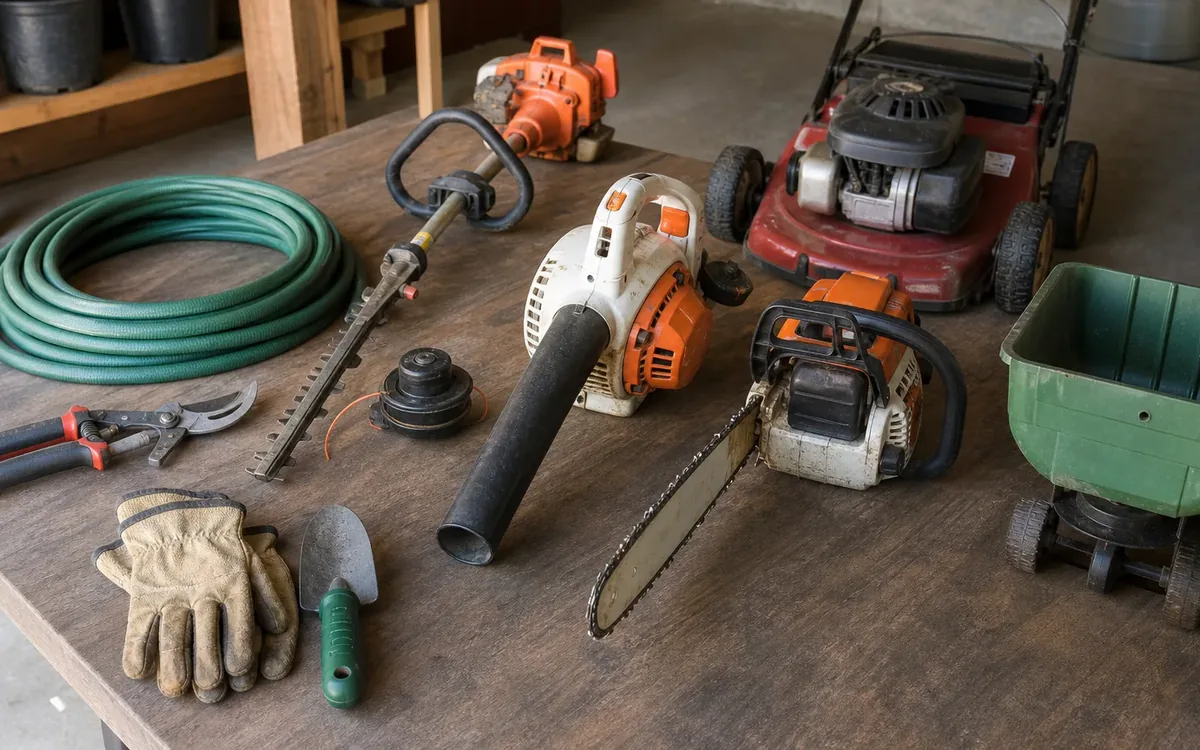
Build an outdoor-equipment inventory before sorting
Outdoor belongings are often scattered among a garage, shed, porch, utility room, vehicle, and yard. An inventory prevents duplicate tools from slipping into the move simply because they were stored in different places.
Group items by function rather than by current location:
- Lawn care: mowers, trimmers, edgers, blowers, spreaders, and grass seed
- Gardening: shovels, rakes, hoes, trowels, cultivators, kneeling pads, and plant supports
- Pruning: hand pruners, loppers, pole saws, hedge trimmers, and chainsaws
- Watering: hoses, nozzles, sprinklers, timers, reels, and watering cans
- Cleaning: pressure washers, scrub brushes, squeegees, buckets, and outdoor vacuums
- Access and transport: ladders, step stools, carts, wheelbarrows, and hand trucks
- Power systems: batteries, chargers, extension cords, fuel cans, oil, and replacement parts
- Garden inputs: soil amendments, fertilizers, pesticides, herbicides, and seed
- Seasonal gear: storm supplies, covers, heaters, fans, and snow or ice tools retained from a previous location
Record each item’s condition, size, power source, related accessories, and intended use at the new home. Photograph model and serial labels when present. Keep chargers, batteries, guards, manuals, and attachments with their matching equipment.
This inventory also helps families distinguish an outdoor-tool project from a complete property cleanout. For that broader situation, read how estate cleanouts work, including how decisions and removal planning can be organized.
Which lawn and garden tools deserve space in the move?
A useful tool should pass three tests: it has a defined job at the new property, the resident can use it safely, and it has an approved storage location. Sentimental value or past cost may influence a household decision, but neither creates space or a future need.
Use these five decision filters:
- Future task: Name the specific job the tool will perform after the move.
- Storage fit: Check the tool’s dimensions against the actual storage area, including door clearance.
- Safe handling: Consider weight, grip, balance, noise, vibration, and maintenance demands.
- Condition: Look for corrosion, cracks, leaks, damaged cords, missing guards, or unreliable batteries.
- Duplication: Keep the most practical version instead of several tools that perform the same job.
For hand tools, a compact set might cover routine planting and patio care without filling an entire cabinet. One sturdy shovel may be more useful than several specialized digging tools. A bypass pruner may remain relevant for container plants even when a pole saw does not.
Powered equipment deserves stricter review. A mower has little value in a home where landscaping is fully managed. A large pressure washer may be unnecessary when exterior washing is an association or contractor responsibility. Conversely, a lightweight blower might still have a defined use if permitted and if the resident maintains a private patio.
Do not treat physical capability as permanent. If lifting, starting, fueling, or controlling a machine has become difficult, discuss alternatives with household members. A qualified equipment dealer or repair professional can assess mechanical condition. A medical professional or occupational therapist is the appropriate source for individual physical-safety guidance.
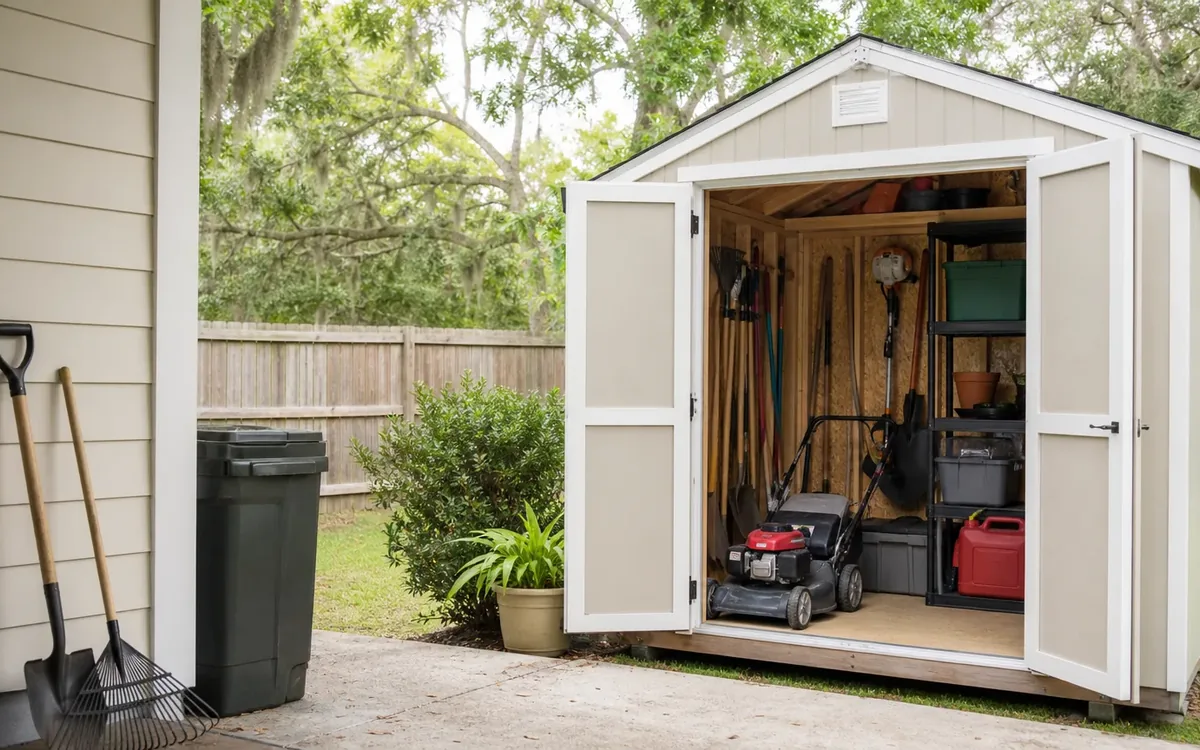
Measure storage before choosing what to keep
A vague plan to “put it in the garage” often fails when the garage must also hold a vehicle, mobility equipment, waste carts, or household storage. Measure the usable space rather than the room’s total dimensions.
Check:
- Interior width, depth, and height
- Door and hallway clearances
- Shelf weight limits supplied by the manufacturer
- Space needed to remove and return each item
- Access to electrical outlets for approved charging
- Ventilation and temperature limitations for stored products
- Association, lease, fire-safety, and building restrictions
Sketch zones for long-handled tools, small hand tools, watering equipment, and permitted power equipment. Frequently used items should be reachable without moving heavy machines. Sharp tools need stable placement away from walkways. Nothing should block electrical panels, exits, doors, sprinklers, or mechanical equipment.
The household can select cabinets, wall systems, or freestanding racks after confirming fit. Installation, structural capacity, electrical changes, and code questions belong with the property manager and qualified contractors or inspectors. A cleanout or move team may discuss sorting, labeling, packing, and removal logistics, but it should not decide whether a wall can support a rack or whether a storage arrangement meets applicable rules.
Off-site storage is a separate household purchase, not an automatic solution. Compare the ongoing need for each item with the cost and effort of retrieving it. Confirm the facility’s rules for fuel, batteries, propane, chemicals, and powered equipment directly with the storage provider.
How should fuel, batteries, chemicals, and propane be handled?
Separate regulated or potentially hazardous items before donation, sale, hauling, or moving. Gasoline, mixed fuel, motor oil, pesticides, herbicides, fertilizers, pool chemicals, propane cylinders, lead-acid batteries, and damaged lithium-ion batteries should not be placed into an ordinary removal load without confirmation.
Create distinct, clearly marked groups:
- Equipment containing fuel or oil
- Portable fuel cans and unidentified liquids
- Lawn and garden chemicals in original containers
- Rechargeable batteries and chargers
- Propane cylinders and other compressed-gas containers
- Used oil, filters, and oily absorbent material n Do not mix products, pour them onto soil, place leaking containers in a moving box, or transfer chemicals into food or drink containers. Keep labels attached and isolate damaged packaging without creating an unsafe chemical combination.
Requirements can differ by product and jurisdiction. Contact the appropriate local solid-waste or household hazardous-waste authority for current acceptance rules and instructions. A moving company should confirm what it will transport. A property manager or fire authority can clarify site restrictions. Equipment dealers or manufacturer guidance may help with batteries, fuel preparation, and machine-specific procedures.
A practical cleanout or move team may identify questionable materials, segregate them from ordinary belongings, and discuss possible next steps. Final acceptance and disposal decisions remain with the authorized facility or government program. Transportation of restricted materials must follow applicable requirements.
Choose the right exit path for usable equipment
Once the keep group is established, assign every remaining item an exit path. Avoid a single “get rid of it” pile because usable equipment, scrap material, chemicals, and trash require different handling.
Transfer to family or neighbors
Ask whether the recipient has a genuine need, safe storage, and a suitable way to transport the item. Include the manual, guards, keys, attachments, and charger where available. Be candid about known defects.
Sell
Condition, brand, age, included accessories, season, and local demand may affect value. The household can choose whether selling is worth the preparation and coordination. An equipment dealer, auction professional, estate-sale provider, or qualified appraiser should address market value and sale suitability. A cleanout team should not present an informal opinion as an appraisal.
Donate
Contact the organization before loading anything. Ask what categories, conditions, power sources, and accessories it accepts. Donation policies belong to the receiving organization and may change.
Recycle or scrap
Metal tools and nonworking machines may contain recyclable components, but fluids, batteries, tires, and mixed materials can require separation. Confirm preparation and acceptance rules with the recycler or scrap facility.
Dispose
Broken plastic tools, contaminated supplies, rotten hoses, and unsafe equipment may have no reusable value. The responsible waste authority determines whether an item is ordinary waste, bulky waste, electronic waste, or hazardous material.
Keep written notes about promised items and scheduled pickups. Remove sold or donated equipment from the inventory only after it has actually left the property.
What should stay until the old home is sold?
Downsizing too early can create avoidable contractor bills or leave the property harder to maintain. Some equipment may still be needed for mowing, pruning, watering, leaf cleanup, or minor exterior preparation before closing.
Coordinate with the real-estate professional and any hired landscaping or maintenance contractor. Decide who is responsible for each remaining task and which tools support it. Home sale strategy belongs with the responsible real-estate professional. Repair scope belongs with qualified contractors, and questions about property condition belong with the appropriate inspector.
Keep only the equipment needed for defined pre-move tasks. Label it “use until departure” and store it separately from items designated for sale or removal. Include a final destination for each piece so it does not become an unplanned addition to the moving truck.
Do not leave chemicals, fuel, spare parts, or outdoor equipment for a buyer unless the parties and their real-estate or legal professionals have addressed the arrangement appropriately. Items that appear useful can still create confusion about ownership, condition, or disposal responsibility.
Coordinate sorting, removal, and moving without mixing roles
The household remains responsible for deciding what to keep, gift, sell, donate, recycle, or discard unless an authorized representative has that decision-making power. Written labels and a simple inventory reduce confusion when relatives, movers, buyers, and service providers are involved.
A practical cleanout or move team may discuss:
- Creating sorting zones for outdoor equipment
- Pairing tools with batteries, chargers, and accessories
- Packing clean, permitted tools for relocation
- Separating items that need specialized handling
- Coordinating approved donation, sale, or removal paths
- Preparing cleared storage areas for the property transition
Separate professionals should handle specialized judgments. Appraisers determine value within their scope. Real-estate professionals advise on sale preparation and transactions. Inspectors evaluate property conditions within their role. Contractors assess repairs and installations. Attorneys address ownership, estate authority, contracts, and disputes. Government agencies, associations, facilities, and other responsible authorities interpret and enforce their applicable requirements.
Clutter Cleaner of South Carolina is physically located in Mount Pleasant and serves households across South Carolina, with Charleston as its primary market. Any requested project should be discussed directly to determine scope and fit. Outdoor storage construction, equipment repair, formal appraisal, legal advice, and hazardous-material acceptance are separate decisions or services handled by the appropriate providers.
A focused final review before moving day
Conduct a final outdoor-only review rather than mixing tools into the general household packing process. Confirm that each retained item has a purpose and destination.
Check the following:
- Every powered tool has its correct battery, cord, key, or charger.
- Fuel and chemical products are separated for authorized handling.
- Sharp edges and cutting heads are guarded or securely contained.
- Dirt and plant debris have been removed where practical.
- Hoses and cords are drained, dry, and coiled.
- Items promised to others are labeled with the recipient’s name.
- Sale and donation decisions have been confirmed with the receiving party.
- Tools needed at the old home remain accessible until their tasks are complete.
- The new storage plan complies with confirmed property rules.
Photograph packed equipment and keep the inventory with move records. This is particularly helpful when similar-looking batteries, attachments, and garden tools are divided among several destinations.
FAQ
Should I keep a lawn mower for a condo move?
Keep it only if the new property includes lawn maintenance that is your responsibility, the mower is permitted, and suitable storage exists. Confirm responsibilities and restrictions with the association, landlord, or property manager.
Can lawn chemicals go on the moving truck?
Do not assume they can. Ask the moving company what it accepts and contact the relevant waste authority about products that cannot move. Leaking, unidentified, or restricted materials need specialized guidance.
Is old outdoor equipment worth selling?
It may be, depending on condition and demand. An equipment dealer, auction professional, estate-sale provider, or qualified appraiser can provide appropriate value guidance. Factor in the work required to clean, test, list, and transfer it safely.
What if family members disagree about inherited tools?
Pause disposal or sale until the person with legal authority confirms the decision. An attorney or estate representative should address ownership and authority questions. A cleanout team can organize clearly approved items but should not resolve legal disputes.
Should rarely used tools go into storage?
Compare their likely use with storage rules, retrieval effort, and ongoing cost. Renting equipment or hiring a suitable contractor later may be alternatives, but those are household choices based on the future property and budget.
Who can help organize the outdoor downsizing project?
Family members may handle decisions independently, or the household can discuss sorting, organizing, move coordination, and approved removal needs with a practical transition provider. Call Clutter Cleaner of South Carolina at (843) 972-7020 to discuss the requested scope.



