

Downsizing for aging in place means reducing possessions and rearranging the home around safe, manageable daily routines, without assuming a move is required. Start with pathways, essential rooms, and frequently used belongings. Make household decisions about what to keep, give away, sell, or remove, while leaving medical, structural, legal, appraisal, and code questions to the appropriate professionals.
Quick answer: Work in this order: define how the home needs to function, clear safe routes, simplify one essential room at a time, decide where possessions will go, and only then organize what remains. Avoid beginning with sentimental storage or an entire house purge. The goal is not the fewest belongings. It is a home that is easier to navigate, use, maintain, and adapt.
What does downsizing for aging in place actually involve?
Aging-in-place downsizing is different from preparing to fit everything into a smaller home. The available square footage may not change at all. Instead, the household reduces the amount of reaching, lifting, bending, searching, and room-to-room travel required during an ordinary day.
That creates a focused test for every item and storage location:
- Is it used often enough to deserve accessible space?
- Can it be reached without a step stool or deep bending?
- Does it interfere with a clear walking route?
- Is it difficult to clean around or maintain?
- Could one useful item replace several duplicates?
- Would another person reasonably value it more?
- Is the household keeping it only because no exit decision has been made?
This process does not require getting rid of meaningful collections or making the home look sparse. It does require choosing which belongings support present routines and which ones create avoidable work or obstacles.
Households that want structured sorting and removal help can review downsizing and organizing services. A practical team may discuss sorting zones, sequencing, donation and disposal plans, packing, move coordination, or home sale preparation when relevant. The household still controls personal keep-or-release decisions unless a legally authorized representative is responsible.

How should you define the goal before sorting?
Write down what aging in place should make easier over the next few years. This prevents the project from becoming an unfocused cleanout driven by guilt, available boxes, or the preferences of visiting relatives.
Useful goals might include:
- Keeping the main walking routes open
- Using the kitchen without frequent overhead reaching
- Having everyday clothing on one accessible level
- Reducing the number of rooms that require regular upkeep
- Creating a stable location for bills and household records
- Making space for mobility equipment if it becomes necessary
- Allowing a family member or caregiver to assist without moving piles
- Reducing outdoor maintenance supplies that are no longer used
Separate goals into three time frames:
- Now: Correct immediate obstacles and make essential items easy to reach.
- Soon: Simplify rooms, storage, paperwork, and recurring maintenance.
- Later: Identify changes that might require a medical, construction, inspection, or real-estate professional.
This plan should reflect the resident’s routines and priorities. Family members can help document decisions, carry items, arrange appointments, or research destinations. They should not quietly discard possessions or treat age alone as proof that someone cannot decide.
If capacity, ownership, guardianship, estate authority, or power of attorney is uncertain, pause consequential decisions and consult the responsible attorney, court, fiduciary, or other qualified authority. A cleanout or organizing provider cannot determine legal authority.
Begin with routes and daily functions, not crowded closets
The best first target is usually the space used every day. Clearing an attic may feel productive, but it does little to improve daily function if the route between the bedroom and bathroom remains obstructed.
Walk through a typical day and notice where movement slows down. Focus first on:
- Entrances and exits
- Routes between the bed and bathroom
- Access to a frequently used chair
- Kitchen work areas
- Laundry access
- Paths to medications and household records
- Access to phones, chargers, and important contacts
Remove loose boxes, low furniture, unstable stacks, and items parked in passageways. Keep exits and electrical panels unobstructed. Do not place retained items in a different route just to finish one room.
A household can decide that an unused table, duplicate chair, or decorative floor item no longer earns its space. Whether a route meets building, fire, accessibility, or other regulatory requirements is a different question. Those determinations belong to the relevant inspector, building official, fire authority, contractor, occupational therapist, or other qualified professional.
When a property also contains estate belongings, disputed ownership, or items belonging to several family members, the sequence may need additional controls. The guide on how to downsize without feeling overwhelmed explains why authority, item destinations, and documentation should be settled before broad removal begins.
Which rooms should be downsized first?
After routes are open, work through rooms according to daily importance rather than visual clutter. A practical order is bedroom, bathroom storage, kitchen, living area, entry, laundry, paperwork area, then secondary rooms and long-term storage.
Bedroom
Keep clear access to the bed, lighting, telephone, and clothing used in the current season. Move rarely used items out of prime drawers. Reduce excess linens to a quantity the household can wash and store comfortably.
Do not position heavy storage where it could make cleaning or access difficult. Questions about anchoring furniture, electrical placement, medical equipment, or safe transfer space should go to the appropriate qualified professional.
Bathroom storage
Discard ordinary empty packaging and separate expired or unused products for the correct disposal route. Do not advise another person to stop using medication or medical supplies. Pharmacists, prescribers, and official disposal programs are the appropriate sources for medication guidance.
Keep daily toiletries within easy reach and move surplus stock elsewhere. Avoid storing items on the floor.
Kitchen
Create an everyday zone for a manageable set of dishes, cookware, food containers, and small appliances. Put the most-used items between comfortable waist and shoulder height when possible.
Good candidates for release include:
- Duplicate utensils and gadgets
- Damaged containers without matching lids
- Appliances that are no longer used
- Oversized serving pieces that no longer match current routines
- Excess dishes retained for rare gatherings
Food safety, pest concerns, appliance condition, electrical issues, and renovation decisions may require the relevant qualified professional or authority.
Living area
Preserve seating that is comfortable and useful. Reduce unstable side tables, excess floor decor, trailing cords, and furniture that narrows movement. Keep meaningful displays, but give them deliberate boundaries such as one cabinet, shelf, or wall.
Secondary rooms
Once essential rooms work well, address guest rooms, hobby spaces, garages, sheds, and attic storage. These areas often contain delayed decisions rather than things the household actively uses.
How do you make decisions without exhausting yourself?
Use short sessions with a narrow category. One shelf, one drawer, or one type of item is enough. Decision quality usually falls when a session becomes physically or emotionally tiring.
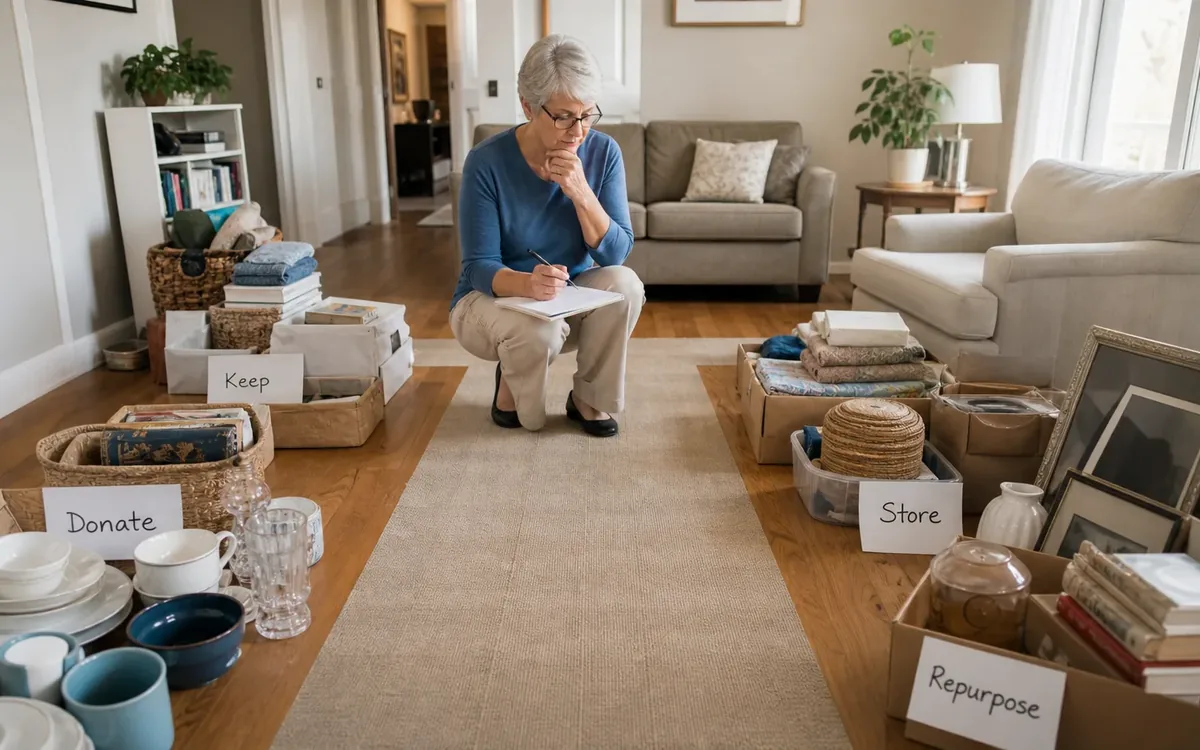
Set up clearly marked destinations:
- Keep here
- Keep elsewhere in the home
- Give to a named person
- Sell or seek valuation
- Donate if accepted
- Recycle where accepted
- Dispose through the appropriate channel
- Review with a professional
- Undecided with a review date
The undecided category must be limited. Use one container, a written list, and a firm date for review. An unlimited “later” pile simply relocates the problem.
For each item, ask:
- Do I use, need, or genuinely value this now?
- Is there a realistic place for it?
- Would keeping it add maintenance or block useful space?
- Does another person have a claim to it?
- Could it contain personal, financial, or legal information?
- Does it need appraisal or specialist handling before removal?
Stop when decisions become rushed. Downsizing is safer when choices are recorded and completed in stages rather than made during one stressful weekend.
Handle sentimental possessions with boundaries, not pressure
Sentimental belongings often combine family history, identity, and unfinished promises. They should not be used as the starting point for a project. Build decision momentum with straightforward categories before opening old photographs, letters, or inherited collections.
Give meaningful possessions a defined amount of space. This might be one archival box per family branch, one display cabinet, or a specific shelf. A boundary protects the most important pieces from being buried among less meaningful material.
Useful approaches include:
- Keep representative pieces rather than every example
- Label photographs with names and dates while someone can identify them
- Offer specific objects to specific people instead of asking who wants “anything”
- Record the story connected to an item
- Photograph bulky items when the memory matters more than the object
- Create a deadline for relatives to collect accepted belongings
Photographs are not substitutes for every cherished object. They are one option when size, condition, or maintenance makes keeping the original impractical.
Do not assume that age, appearance, or family tradition establishes market value. An auction professional, qualified appraiser, or relevant specialist should advise on potential value. A practical cleanout team may help isolate items for review, but it should not present an unsupported opinion as a formal appraisal.
Decide each exit route before removing anything
A downsizing plan is incomplete until released items have realistic destinations. Donation centers, recycling programs, waste facilities, auction channels, and hazardous-material programs may have changing acceptance requirements. Confirm current rules directly with the recipient or responsible authority before loading a vehicle.
Use this sequence:
- Identify the destination.
- Confirm what it accepts and any preparation requirements.
- Separate records, valuables, hazardous materials, and personal data.
- Pack and label items by destination.
- Schedule help or transportation if needed.
- Record significant transfers when appropriate.
- Remove items promptly so they do not return to household storage.
Paper containing account numbers, medical details, tax information, signatures, or identifying data should be reviewed before disposal. An attorney, accountant, tax professional, records custodian, or responsible agency can advise on retention when the answer is unclear.
Paints, chemicals, fuels, batteries, compressed cylinders, medications, electronics, and similar materials may require special handling. Follow manufacturer instructions and current local or state program requirements. A cleanout team may discuss logistics within its scope, but disposal and compliance rules remain with the responsible facility or authority.
What can a practical cleanout or move team help with?
A team can reduce the physical and logistical burden after the household has established authority, priorities, and item destinations. Depending on the agreed scope, topics may include:
- A room-by-room work sequence
- Sorting and labeling stations
- Packing and unpacking support
- Moving retained belongings within the plan
- Coordinating move-related tasks
- Discussing auction or estate-sale pathways
- Removing approved items through suitable channels
- Organizing remaining possessions
- Preparing a home for sale
- Supporting physical cleanup tied to cited code issues
Clutter Cleaner of South Carolina lists downsizing and organizing, estate cleanouts, auctions and estate sales, move management, home sale preparation, and code compliance support among its services across South Carolina. The specific scope should be discussed before work begins.
The household or legally authorized decision-maker controls personal property decisions. A service team does not decide who owns an item, whether someone has legal capacity, what a home is worth, whether a modification is structurally sound, whether work passes inspection, or whether a property complies with law.
Those questions belong to the appropriate attorney, appraiser, real-estate professional, contractor, engineer, inspector, health professional, code official, or other responsible authority.
Build a home that stays manageable
Downsizing succeeds only if possessions stop accumulating faster than the home can support them. Finish by giving retained items simple, accessible homes and setting modest limits.
Try these maintenance rules:
- Keep floors and primary routes free of storage
- Return everyday items to consistent locations
- Use labels that are easy to read
- Avoid filling deep shelves beyond easy visibility
- Review one small category each month
- Remove donations on a planned schedule
- Reassess seasonal items after each season
- Limit bulk purchases to available storage
- Keep an updated list of important household contacts
Review the setup after several weeks. An item that seemed logically placed may still require too much bending or walking. Adjust the system around observed routines rather than preserving an organizing plan that does not work.
If health or mobility changes affect how the home should be used, consult a physician, occupational therapist, physical therapist, or another qualified health professional. Contractors, inspectors, engineers, and permitting authorities should address physical alterations and compliance questions.
FAQ
Does aging-in-place downsizing mean emptying most of the home?
No. The goal is to reduce obstacles, maintenance, and difficult access while retaining useful and meaningful belongings. The right amount depends on the resident, home, routines, and future plans.
Should family members take valuables home for safekeeping?
Only with the owner’s or legally authorized decision-maker’s clear approval. Create a written record of who took each item and why. Seek legal guidance if ownership or authority is disputed.
Should we renovate before or after downsizing?
Usually, reduce movable clutter first so professionals can evaluate the actual space. A qualified contractor, design professional, inspector, occupational therapist, or permitting authority should guide renovation, structural, accessibility, and compliance decisions.
What if the household may move later?
Organize retained possessions so they could be packed by category, but do not force a relocation-sized purge before a move is decided. If a move becomes likely, reassess furniture and belongings against the confirmed destination.
How can we begin with professional support?
Define the resident’s goals, identify the authorized decision-maker, list priority rooms, and note any items requiring appraisal or specialist review. Then call Clutter Cleaner of South Carolina at (843) 972-7020 to discuss a practical scope for downsizing and organizing anywhere in South Carolina.



