
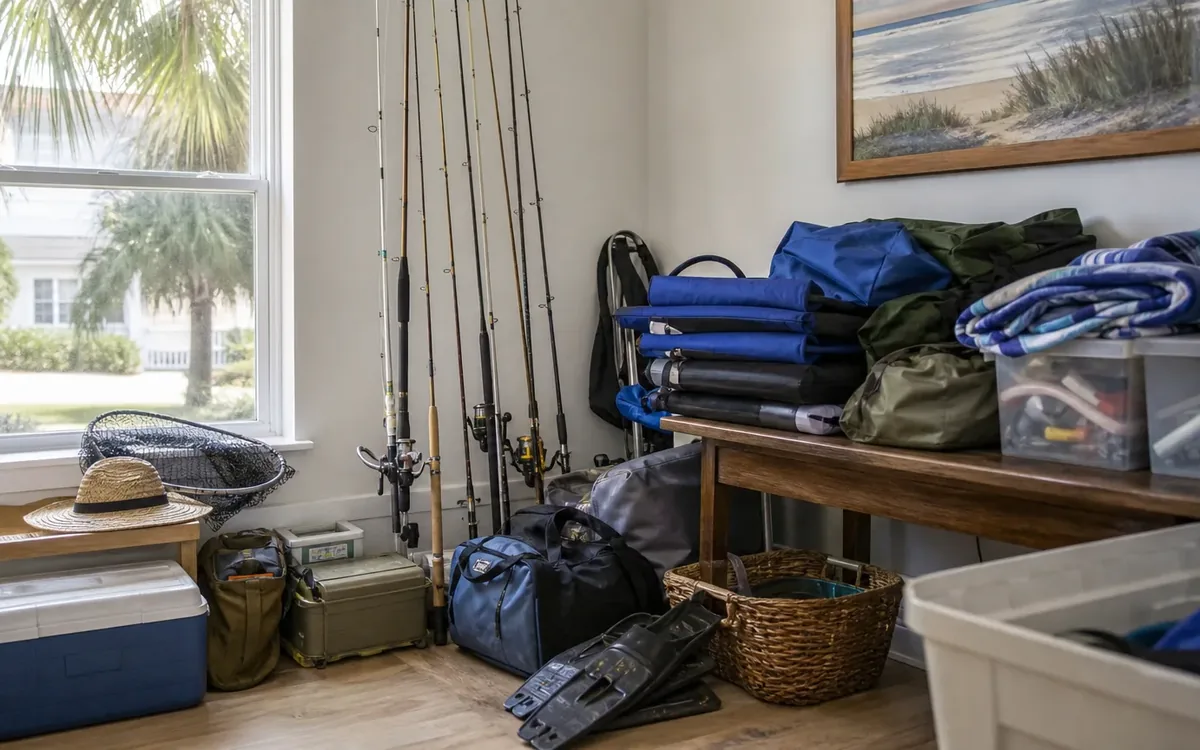
Downsize fishing, boating, and beach gear by deciding which activities will continue, identifying storage at the next destination, checking each item’s condition and safety, and keeping only equipment that fits all three. Sort specialized gear by activity instead of treating it as ordinary garage clutter. This makes it easier to recognize duplicates, incomplete sets, expired safety items, and equipment that no longer matches the household’s plans.
Quick answer: Keep outdoor gear that supports a realistic future activity, fits the destination storage space, remains safe and usable, and would be inconvenient to replace. Sell, donate, recycle, or properly dispose of items that are redundant, damaged, incompatible, prohibited, or unlikely to be used again.
South Carolina households may accumulate equipment for coastal outings, lake weekends, river trips, fishing, boating, and beach days. The challenge is not simply reducing volume. Rods, tackle, flotation devices, batteries, fuel-related equipment, carts, coolers, and water-sports gear require different decisions. A focused sorting method protects useful equipment while preventing questionable items from being packed into a new home.
Why Should Outdoor Gear Be Sorted by Activity?
Fishing, boating, and beach equipment often overlap physically but not functionally. A garage corner may contain fishing rods beside life jackets, chairs, umbrellas, inflatables, coolers, and boat-maintenance supplies. Sorting only by size or material can separate components that need to be evaluated together.
Begin with activity zones such as:
- Shore, pier, or bank fishing
- Boat fishing
- Kayaking or paddleboarding
- Recreational boating
- Beach outings
- Swimming or water play
- Boat cleaning and maintenance
- Outdoor food and drink storage
Place related components together. Rods should be reviewed with compatible reels, cases, and tackle. Inflatable gear should be paired with its pump and fittings. Anchoring equipment should be considered with the vessel for which it was selected. A beach canopy should be assessed with its frame, stakes, anchors, and carrying bag.
This method reveals whether an item is complete and whether the household still participates in the activity it supports. It also prevents keeping a useful-looking component that cannot function without a missing or damaged counterpart.
Households preparing for a broader transition can review downsizing and organizing support to understand how sorting may fit into a larger home project.
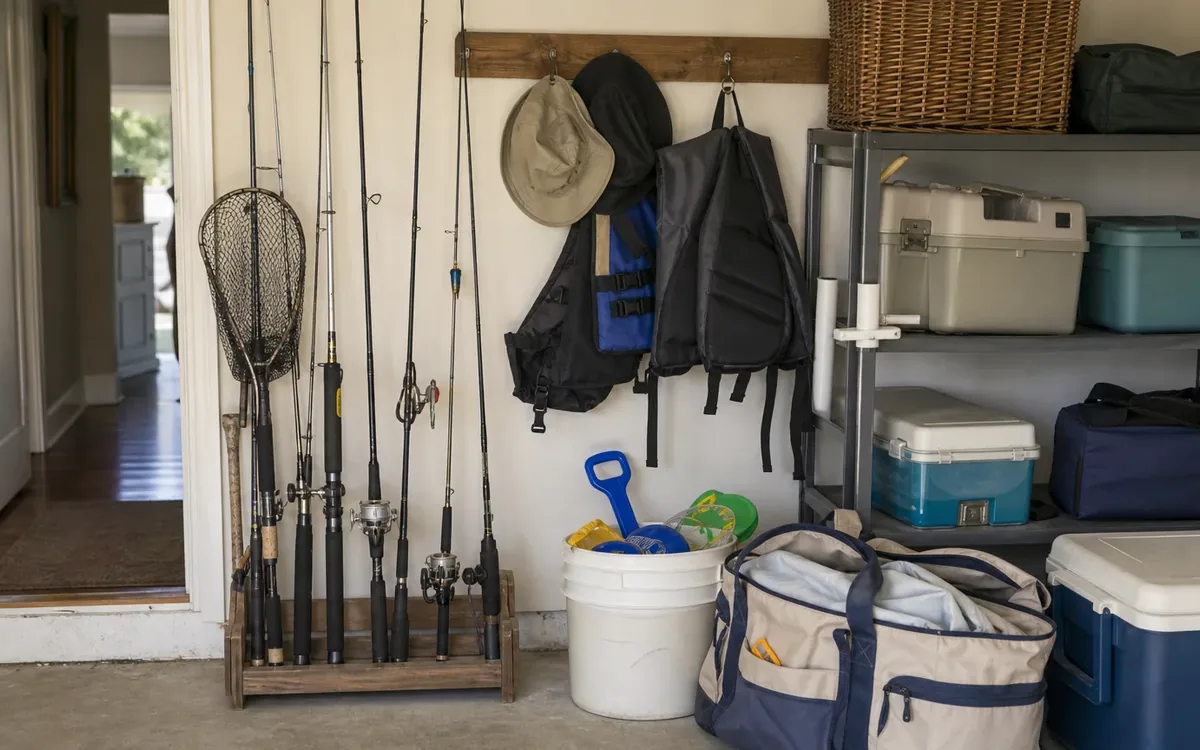
Use Four Filters for Every Item
A tight decision process keeps sentiment, possible future use, and replacement anxiety from controlling the entire cleanout. Evaluate every category through these four filters:
- Activity frequency: Does the household currently use the equipment for a specific activity, or is future use only a vague possibility?
- Destination storage: Is there an identified, suitable place for it at the next home, marina, storage facility, or family member’s property?
- Condition and completeness: Is it functional, cleanable, and complete enough to use without disproportionate repair or replacement?
- Safety and compliance: Is it appropriate for the intended user and use, with any required inspection, servicing, registration, or disposal handled by the responsible professional or authority?
An item that passes all four filters is a strong candidate to keep. If it fails one, determine whether the problem can realistically be resolved. If it fails several, moving it usually transfers the decision rather than solving it.
Avoid a large “maybe” pile. Use a small review area for items requiring information such as measurements, ownership confirmation, an appraisal, or guidance from a disposal facility. Write the unresolved question on a removable tag so the next action is clear.
For a transition involving inherited belongings, the guide on how estate cleanouts work explains how sorting and removal can fit into the wider estate process.
What Fishing Gear Is Worth Keeping?
Keep fishing equipment that matches the household’s likely fishing locations, methods, physical abilities, and storage conditions. A high-quality item is not automatically useful if it was chosen for a type of fishing that no one intends to continue.
Group rods and reels by intended use. Check whether each pairing makes sense, whether pieces are missing, and whether corrosion or damage is visible. Do not test questionable equipment in a way that could cause injury. A tackle shop or qualified repair provider can assess uncertain rods, reels, line, and specialized components.
Review tackle in shallow trays rather than dumping everything together. Separate:
- Hooks, lures, weights, and terminal tackle
- Line and leaders
- Tools and fish-handling equipment
- Bait containers and aeration components
- Electronics and their cables or mounts
- Licenses, manuals, and purchase records
- Bags, boxes, and rod cases
Discard decisions require care. Loose hooks, blades, lead tackle, old line, chemicals, and batteries may not belong in ordinary household trash or recycling. Ask the relevant local facility or waste authority how it accepts a specific material. Do not assume every donation organization will accept sharp, corroded, or incomplete fishing gear.
Sentimental fishing items deserve a separate pass. A family member may want a particular rod because of its history even if it will not be used. Designate it as a keepsake, document its story, and store it accordingly. This is better than leaving sentimental equipment mixed with active gear where its purpose remains unclear.
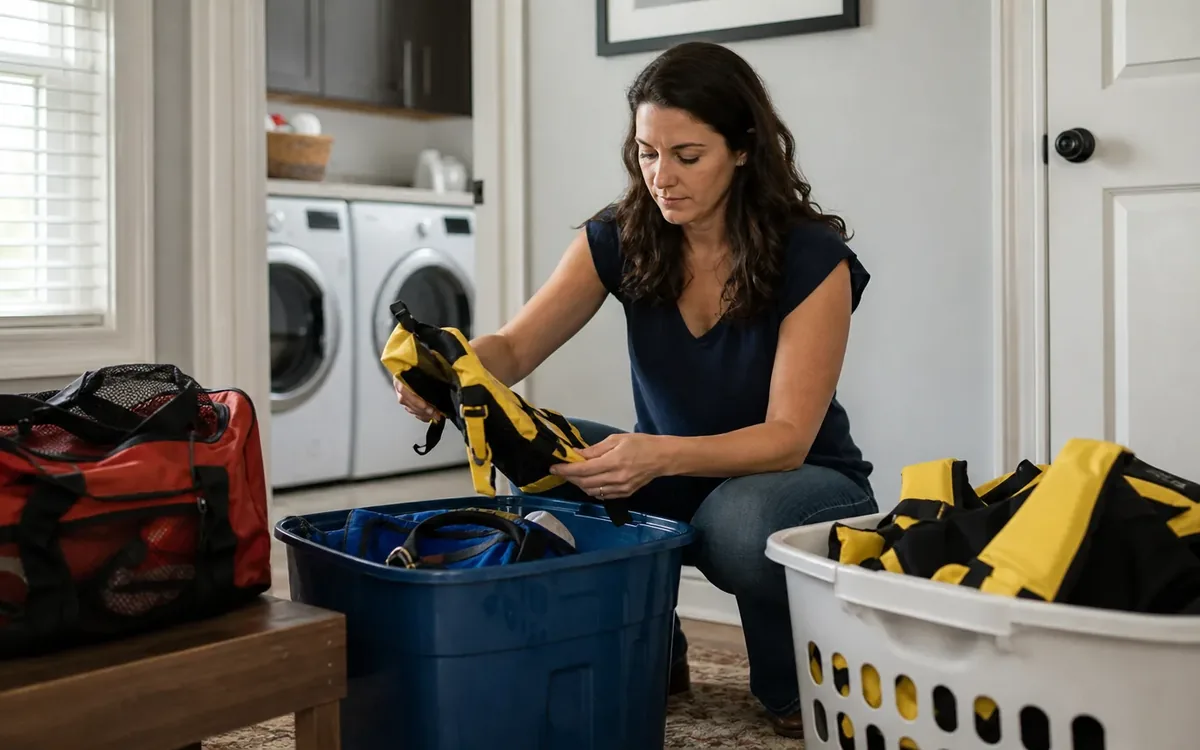
How Should Boating and Water-Safety Equipment Be Reduced?
Start by separating personal equipment from vessel-specific equipment. Personal items may include flotation devices, dry bags, water shoes, and foul-weather clothing. Vessel-specific items may include covers, lines, fenders, anchors, navigation components, electronics, keys, and maintenance supplies.
Match equipment to the boat, kayak, canoe, or paddleboard it serves. Label uncertain parts rather than guessing. If the related vessel has already been sold or transferred, check whether its accessories were supposed to go with it before selling or discarding them separately.
Safety gear needs professional or official guidance when its suitability is uncertain. The household can inspect for visible damage and gather model information, but it should not independently certify that an item complies with current requirements. Flotation devices, signaling equipment, fire extinguishers, navigation lights, emergency beacons, and similar items may have condition, approval, servicing, or carriage requirements.
A practical cleanout or move team may discuss sorting, access, packing priorities, removal categories, and destination placement. It should not determine whether marine safety equipment is legally compliant or seaworthy. Those questions belong with the appropriate authority, manufacturer, certified technician, marina professional, or other qualified provider.
Treat fuel, oil, solvents, cleaners, paints, compressed cylinders, batteries, and unidentified liquids as controlled decision categories. Keep containers upright and avoid mixing substances. Contact the appropriate facility or authority for instructions. A moving company or storage facility may also restrict these materials, so confirm its rules before packing day.
How Much Beach Gear Fits the Next Home?
Destination storage should set the limit. Measure the actual closet, garage section, storage cage, balcony box, or vehicle area intended for beach equipment. Confirm property rules before planning to use balconies, common areas, hallways, parking spaces, or exterior storage.
Create a complete outing kit based on how the household actually visits the beach. It might include seating, shade, towels, a cooler, a cart, and a limited set of recreation items. Then compare duplicates within each category.
For example, assess chairs according to:
- Comfort and ease of getting in and out
- Frame and fabric condition
- Folded dimensions
- Carrying weight for the intended user
- Resistance to rust or trapped sand
- Fit in the vehicle and destination storage
Open umbrellas, canopies, carts, and folding tables only where there is enough safe space. Check whether frames lock correctly and whether all required pieces are present. Do not donate equipment with hidden breakage or unstable supports.
Inflatables can occupy little space while still creating clutter. Keep only those that hold air, suit the intended users, and have compatible pumps or valves. Follow local disposal or recycling guidance for damaged plastics rather than assuming curbside recycling accepts them.
Decide What Happens to Boats and Other High-Value Items
A boat, motor, trailer, fishing collection, marine electronics package, or specialized watercraft should not be handled like a box of household goods. Establish ownership and gather records before deciding on a transfer.
Useful documents may include titles, registrations, serial or identification numbers, service records, manuals, keys, loan information, and bills of sale. The required paperwork and transfer process should be confirmed with the responsible agency or qualified professional.
The household or legally authorized decision-maker decides whether to keep, sell, gift, or otherwise transfer an item. If ownership is disputed, an estate is unsettled, a lien may exist, or authority to sell is unclear, pause. An attorney, personal representative, lender, agency, or other responsible party must address that issue.
Value is also a separate question. A practical cleanout team may identify items that appear to merit further evaluation, but a qualified appraiser, dealer, auction professional, or market specialist should provide valuation guidance. Repair estimates should come from an appropriate technician or contractor.
Do not invest in repairs solely because an item once cost a great deal. Compare its present purpose, likely value, repair needs, transport requirements, and destination storage. A professional in the relevant field can help supply the information, but the authorized household decision-maker chooses the outcome.
Build a Destination Plan Before Packing
Packing should follow decisions, not replace them. Give each retained category a named destination such as “garage wall rack,” “boat locker,” “hall closet,” or “off-site storage under household contract.” If no destination exists, reconsider whether the item should move.
Use packaging appropriate to the equipment:
- Rod tubes or rigid protection for vulnerable fishing rods
- Lidded containers for clean, dry tackle
- Ventilated storage for fully dried flotation devices
- Original or protective cases for electronics
- Separate containment for sharp tools
- Clearly labeled bags for canopy and umbrella components
Clean salt, sand, bait residue, and moisture from retained items before packing. Allow textiles, flotation devices, tents, and inflatables to dry fully. Household members can perform ordinary cleaning when safe, while mold, contamination, extensive corrosion, electrical concerns, or hazardous substances may require a specialized provider.
Off-site storage is a household choice involving a separate storage provider. Review access, environmental conditions, insurance implications, prohibited items, and contract terms directly with that provider. Moving items into storage without an exit plan can preserve the same decision problem at another address.
What Can a Cleanout or Move Team Help Discuss?
A practical team can help turn household decisions into an organized workflow. Discussions may cover activity-based sorting zones, packing order, accessibility, labeled destinations, items designated for sale or donation, and removal categories accepted for the project.
The team may also ask who has authority to make decisions and which items must remain untouched until another professional responds. That boundary is especially important during an estate cleanout, property sale, or move involving several family members.
Certain decisions remain outside a cleanout or move team’s role:
- Legal authority and ownership: An attorney, court-appointed representative, agency, lender, or other responsible authority addresses these questions.
- Appraisal and valuation: A qualified appraiser, dealer, auction professional, or relevant specialist evaluates value.
- Property transactions: Real-estate professionals and closing parties guide listing, disclosure, contract, and closing matters.
- Condition and safety findings: Inspectors, marine technicians, electricians, contractors, manufacturers, and other qualified providers assess their respective areas.
- Compliance and disposal rules: Government agencies, waste authorities, marinas, moving companies, storage providers, or receiving facilities determine their requirements.
Clutter Cleaner of South Carolina is physically located in Mount Pleasant and serves households across South Carolina, with Charleston as its primary market. Project scope should be discussed directly based on the property, equipment, decision-makers, and intended outcomes.
A Focused Final Review
Once the obvious decisions are complete, perform a final review by activity rather than walking through the space randomly. Confirm that every retained activity has a coherent set of equipment and that every set has a destination.
Look specifically for orphaned items: one paddle without the intended craft, electronics without cables, a canopy without anchors, a reel without a suitable rod, or a trailer accessory for a vessel no longer owned. These pieces often survive because they look useful in isolation.
Then separate outcomes visibly. Use labels such as keep, family transfer, professional review, sell, donate, recycle, and disposal guidance needed. Do not use unlabeled piles, which are easy to confuse during packing or removal.
The goal is not to eliminate recreation. It is to preserve the gear that supports realistic fishing, boating, and beach plans while removing equipment that creates maintenance, storage, safety, or transfer problems.
FAQ
Should old life jackets be donated?
Only if the receiving organization accepts them and they are appropriate for reuse. Visible condition alone may not establish safety or compliance. Consult the manufacturer, relevant authority, or a qualified marine-safety professional when uncertain.
Can fishing tackle go in household trash?
It depends on the material and local acceptance rules. Hooks, line, lead items, batteries, chemicals, and sharp tools may require separate handling. Ask the appropriate waste or recycling facility for instructions.
Should valuable-looking reels or marine electronics be sold immediately?
Not before confirming ownership, completeness, condition, and whether professional valuation is warranted. An appraiser, dealer, auction professional, or category specialist can address value; the authorized household decision-maker chooses whether to sell.
Is a storage unit a good solution for extra gear?
It can be if each stored item has a purpose and an exit plan. Storage terms, restricted materials, access, environmental conditions, and insurance questions should be reviewed with the storage provider.
Who decides whether a boat or trailer can be transferred?
The legally authorized owner or representative makes the decision, subject to applicable title, registration, lien, estate, and transfer requirements. Confirm those requirements with the responsible agency or legal professional.



