

Decide what to donate with four checks: ownership, safe usable condition, recipient acceptance, and delivery feasibility. Ask: Is the item safe and usable, does a recipient currently accept it, and can it be delivered in the required condition? Set aside personal records, hazardous materials, recalled products, and anything belonging to someone else. Then match acceptable belongings to confirmed destinations before loading a vehicle or scheduling removal.
Quick answer: Donate clean, complete, functional items that a specific organization has confirmed it will accept. Do not assume every nonprofit takes furniture, mattresses, appliances, medical equipment, building materials, or large quantities. Sort first, verify current rules directly, and label donations by destination.
Start With Destination Planning, Not a Donation Pile
A common cleanout mistake is creating one large donation area without knowing where its contents can go. That approach often leads to rejected loads, rushed disposal decisions, and extra handling.
Instead, identify possible destinations before sorting deeply. Acceptance policies can change because of storage limits, staffing, safety requirements, seasonal demand, or the condition of an organization’s facilities. A recipient may also accept an item at one location but not another.
For each potential recipient, confirm:
- The categories it currently accepts
- Required condition and cleanliness
- Size, age, or quantity restrictions
- Whether all pieces and accessories must be included
- Drop-off hours and location
- Whether an appointment is required
- Whether pickup is offered and, if so, its limits
- How tax receipts are handled
Write the answers on a destination sheet or shared phone note. Do not rely on an old flyer, a previous donation, or a general national policy when a South Carolina location may follow different procedures.
If the project involves a full property rather than a few rooms, review the practical stages of an estate cleanout before setting deadlines. Donation planning works best when it is coordinated with document review, family decisions, moving tasks, and preparation of the home.

Use a Four-Part Donation Test
Every possible donation should pass four practical tests. The household can apply these tests without estimating an item’s resale or appraisal value.
1. Is it safe?
Check for sharp edges, exposed wiring, unstable parts, contamination, mold, pests, strong odors, leaking batteries, missing safety restraints, or other hazards. Children’s products deserve particular caution because recalls and current safety standards may affect whether they are suitable.
Do not donate something merely because it feels wasteful to discard it. Passing a problem to a nonprofit transfers the burden rather than helping the recipient.
2. Is it functional and complete?
Test ordinary functions when it is safe to do so. Pair remotes with electronics, lids with containers, hardware with furniture, and power cords with devices. Marking an untested item as working is not appropriate.
For sets, ask whether missing pieces make the remaining contents impractical. One missing dinner plate may not matter, while missing bed-frame hardware or a required appliance component may make an item unusable.
3. Is it clean enough to use?
Donation quality is not the same as perfection, but belongings should be reasonably clean and free of avoidable residue. Empty drawers and pockets. Remove pet hair, wipe hard surfaces, and launder washable textiles when appropriate.
Avoid donating items with water damage, mildew, heavy staining, smoke saturation, pest evidence, or odors that remain after reasonable cleaning. The intended recipient, not the household, has the final say on its acceptance standards.
4. Is there a confirmed recipient?
An item is not truly donation-ready until an organization confirms that it fits current rules. Keep a separate holding area for good belongings that do not yet have destinations. Give that area a decision deadline so it does not stall the cleanout.
For more planning topics that may intersect with a household transition, browse the South Carolina cleanout and moving resources on the what to get rid of first when downsizing.
Sort by Recipient Category
Organizing by destination category is usually more efficient than sorting into one vague group marked “donate.” Use boxes, colored tape, or large paper labels that remain visible after items are stacked.
Possible categories include:
- Everyday clothing and shoes
- Professional or interview clothing
- Household linens
- Kitchenware and small household goods
- Books and educational materials
- Furniture
- Working electronics
- Tools and home-improvement materials
- Unopened personal-care supplies
- Pet supplies
- Mobility or medical equipment
- Art, craft, school, or office supplies
These are planning categories, not promises that a particular organization accepts them. Verify each destination independently.
Specialized items often need specialized recipients. For example, a general thrift store might decline building materials, while a reuse-focused organization may have detailed standards for them. A medical-equipment recipient may require particular models, sanitization, paperwork, or inspection. Animal organizations may accept some unopened supplies but decline medications or opened food.
Keep a simple routing list with four columns:
- Item category
- Intended recipient
- Acceptance confirmed and date checked
- Drop-off, pickup, or other next step
This prevents a helper from taking the wrong box to the wrong destination.
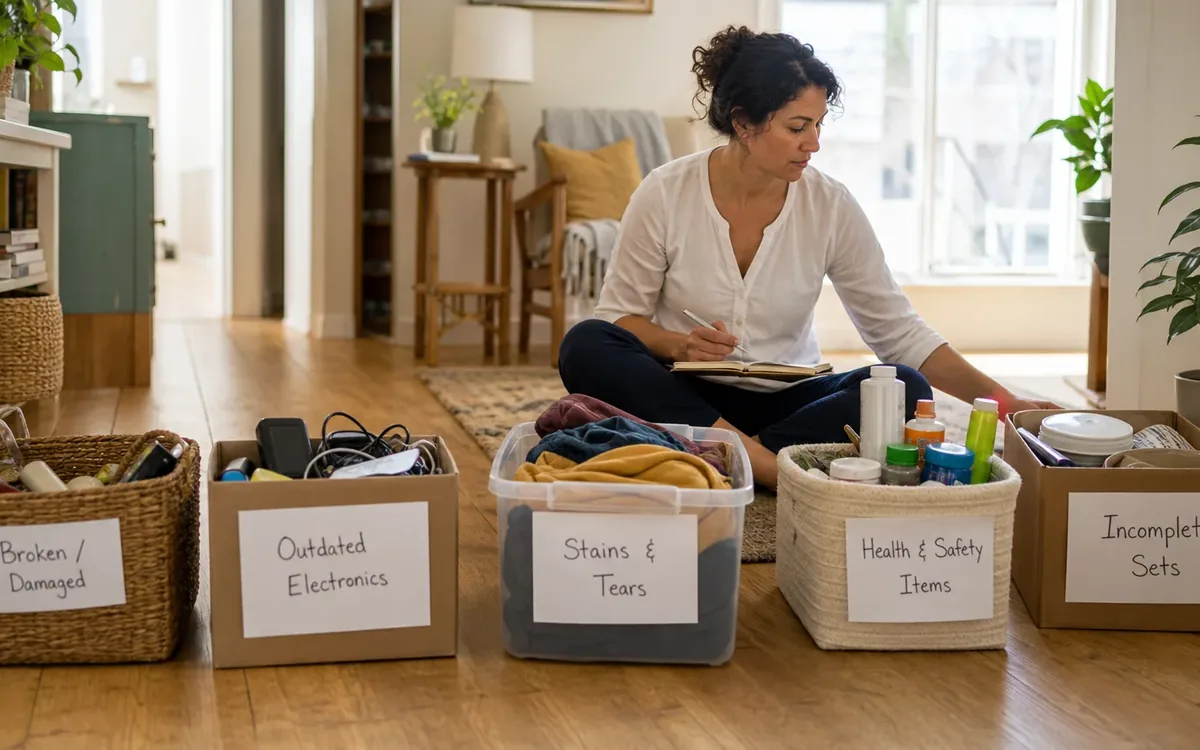
Know What Should Not Enter the Donation Stream
Some belongings require more review before anyone labels them for donation. Set them aside immediately in clearly marked zones.
Personal and protected materials
Separate identification documents, financial statements, tax records, medical paperwork, legal files, account information, photographs, address books, keys, and digital devices containing personal data. The responsible household member should decide what to retain and how to securely destroy sensitive records that are no longer needed.
A cleanout team may help identify and consolidate papers, but it should not make legal retention decisions or determine who has authority over records.
Hazardous or regulated materials
Paint, fuel, chemicals, pesticides, ammunition, medications, compressed cylinders, batteries, and similar materials should not be mixed casually with donations or ordinary trash. Follow current instructions from the appropriate local or state authority, facility, pharmacy, manufacturer, or waste program.
Rules and collection options can vary by material and jurisdiction. A practical team may isolate questionable items and discuss logistics, but the governing authority or approved facility determines compliance and acceptance.
Recalled or unsafe products
Do not donate recalled products or items that cannot reasonably be checked for safety. Cribs, car seats, helmets, space heaters, and other safety-sensitive products may be subject to age, history, condition, or recall concerns. Confirm current manufacturer and government information rather than guessing.
Items not owned by the decision-maker
Rental property, borrowed belongings, leased equipment, family property, and items involved in an estate dispute should be held. Donation should wait until the person with proper authority approves it.
Handle Sentimental Belongings Without Freezing the Project
Donation decisions become difficult when usefulness and memory are intertwined. The goal is not to remove emotion from the process. It is to prevent emotionally significant items from being donated by accident while allowing routine sorting to continue.
Create three temporary groups:
- Clearly keep: Items a decision-maker has already chosen to retain
- Family review: Belongings another relative or authorized person should see
- Memory pending: Sentimental items with no immediate decision
Set a physical limit for the pending group, such as one shelving unit or a defined number of containers. Also set a review date. Without limits, nearly every uncertain item can migrate into the sentimental category.
Useful questions include:
- Is the memory tied to this exact object or to the person and event?
- Is another family member more closely connected to it?
- Would a photograph preserve the story adequately?
- Can one representative item stand for a larger collection?
- Is the item likely to be used, displayed, or cared for?
- Has the person with authority approved donation?
Never use pressure, surprise deadlines, or an unattended donation truck to resolve family disagreement. Pause disputed items and continue with less sensitive areas.
Plan Around Condition, Access, and Transportation
An item can be acceptable in principle but impractical to donate because of stairs, narrow doors, weight, disassembly requirements, or transportation limits. Address those constraints before promising it to a recipient.
For large items, record:
- Dimensions of the item
- Doorway, hallway, stair, and elevator clearance
- Whether safe disassembly is possible
- Number of pieces and loose components
- Floor or wall protection needed
- Vehicle dimensions and load security
- Recipient unloading requirements
- Confirmed pickup restrictions, if applicable
Do not leave donations outside a closed facility or beside a collection bin. This can expose items to weather, create hazards, burden the property owner, and make otherwise useful belongings unusable.
Pack with the recipient in mind. Use smaller boxes for books and dense kitchenware. Keep matching parts together in sealed, labeled bags. Protect breakables, but avoid making boxes so heavy that volunteers or family members cannot move them safely.
South Carolina heat, humidity, and sudden rain can damage textiles, paper, furniture, and electronics during staging. Keep donation-ready items in a dry, secure location and minimize time in uncovered vehicles. This is practical climate planning, not a statement about any particular recipient’s facilities.
Divide Decisions Among the Right People
A successful cleanout depends on knowing who can decide what. The household or properly authorized representative generally decides which owned belongings may leave the property, what must stay, which relatives should be consulted, and what deadlines are realistic.
A practical cleanout or move team may discuss:
- Room-by-room sorting order
- Labeled staging zones
- Packing and handling needs
- Access constraints
- The volume and categories of potential donations
- Questions to ask prospective recipients
- Transportation sequencing
- Coordination with other household-transition tasks
The team should not decide ownership disputes, beneficiary rights, document retention duties, tax treatment, or legal authority. Those questions belong with the executor, personal representative, property owner, attorney, tax professional, court, or other responsible party, depending on the circumstances.
Likewise, these decisions remain with qualified professionals or authorities:
- Appraisal: Authentication, valuation, or specialized appraisal conclusions
- Real estate: Listing strategy, disclosures, contracts, and transaction advice
- Inspection: Structural, electrical, environmental, or other inspection findings
- Compliance: Official interpretation of codes, disposal rules, permits, or agency requirements
- Tax: Deductibility, fair-market-value documentation, and tax reporting
A donation receipt does not establish a tax value by itself. Ask a qualified tax professional what records are needed and who must assign value.
Build a Donation Schedule That Protects the Cleanout
Donation should support the larger house transition rather than become an open-ended search for a perfect destination. Establish decision dates based on closing, move, lease, family, or property-preparation requirements.
A workable sequence is:
- Confirm who has authority to approve removal.
- Secure records, valuables, medications, and disputed items.
- Identify realistic recipient categories.
- Sort and inspect possible donations.
- Confirm current acceptance rules.
- Pack and label by destination.
- Schedule transportation with time for contingencies.
- Record what left, when, and where it went.
- Reassess rejected or unmatched items promptly.
Build in a backup plan. A recipient may change capacity, reject an item after seeing its condition, or be unable to accommodate the quantity. The backup might be another verified recipient, recycling where appropriate, household retention, or lawful disposal. It should not be an unapproved drop-off.
Photographing loaded groups and keeping receipts can help the authorized person maintain a basic project record. For estates, trusts, shared households, or contested situations, ask the responsible attorney, fiduciary, or tax professional what documentation is appropriate.
Avoid Common Donation Mistakes
Small process errors can create disproportionate delays. Watch for these recurring problems:
- Promising an item before checking ownership
- Treating “free” as the same as donation-ready
- Mixing trash, documents, and donations in identical bags
- Assuming a recipient will repair damaged goods
- Sending incomplete furniture or electronics without cords
- Overfilling boxes
- Failing to label fragile contents
- Loading before the destination is confirmed
- Waiting until the final property deadline
- Leaving rejected items at a donation site
- Assigning tax values without qualified guidance
One useful rule is that every donation container should answer three questions at a glance: What is inside, where is it going, and who approved it? If any answer is missing, return it to the holding area.
Make the Final Donation Review
Before anything leaves, have the authorized decision-maker conduct a brief final review. This is especially important in an estate cleanout, downsizing project, or move involving several family members.
Check that:
- Recipient rules were confirmed recently
- Items are clean, functional, complete, and safely packed
- Pockets, drawers, books, and containers were inspected
- Personal data and documents were removed
- No borrowed, rented, disputed, or excluded property is included
- Each box or item has a destination label
- Transportation and unloading are realistic
- Receipts or records will go to the correct person
- A plan exists for anything rejected
Clutter Cleaner of South Carolina can discuss practical sorting, staging, move coordination, and cleanout logistics across the statewide service territory. The household retains control over donation choices, while legal, appraisal, real-estate, inspection, tax, and compliance questions should be directed to the appropriate professional or authority.
The most responsible donation is not simply an unwanted object in usable condition. It is an approved item, matched to a willing recipient, prepared to that recipient’s standards, and moved without compromising safety, privacy, ownership rights, or the cleanout timeline.



