

Estate liquidation has no reliable universal duration. Legal authority, the amount and type of property, appraisal needs, sale method, and disposition of unsold items all affect the sequence.
Quick answer: Build a sequence from confirmed authority and inventory through valuation, sale preparation, payment, and final disposition. Obtain estimates from each responsible professional for the specific property. Physical cleanout is only one part of the process.
This guide focuses on the timeline for valuation, sale, and disposition, rather than the labor hours needed to empty a home.
What does the estate liquidation timeline include?
Estate liquidation turns personal property into sale proceeds or directs it to another appropriate destination. Depending on the household, that can include furniture, jewelry, tools, vehicles, collectibles, art, household goods, documents, and everyday belongings.
A typical timeline has five broad phases:
- Authority and goals: Confirm who can make decisions and what deadlines matter.
- Inventory and sorting: Identify property to retain, sell, appraise, donate, recycle, or discard.
- Valuation and sale preparation: Research ordinary items and obtain qualified opinions for property that warrants specialist review.
- Marketing and sale: Conduct an estate sale, auction, online sale, direct sale, or a combination.
- Settlement and disposition: Collect payments, release purchases, address unsold property, and organize available records.
These phases can overlap, but they should not be confused. Photographing a collection does not establish its value. Clearing a room does not prove that every item was authorized for sale. Accepting bids does not necessarily mean funds are immediately available for distribution.
Households comparing sale formats can review Clutter Cleaner of South Carolina’s auctions and estate sales service overview. If the property also needs to be emptied, the guide on how estate cleanouts work explains that separate process.

How long does each stage usually take?
No single estimate fits every estate, but planning ranges can help families build a realistic schedule.
Initial authority and planning: estimate from the actual scope
The responsible person first needs to determine whether property may be moved, transferred, or sold. A living owner may be able to direct the process immediately. After a death, authority may depend on estate documents, court appointment, ownership, beneficiary rights, or advice from a South Carolina attorney.
Planning also includes:
- Identifying participating family members or beneficiaries
- Recording known claims to particular items
- Locating wills, trusts, titles, and financial records
- Establishing access to the home
- Noting insurance, lease, mortgage, or real-estate deadlines
- Deciding who will approve prices and disposition choices
A practical liquidation or move team may ask who has authority and how approvals will be documented. It should not interpret a will, decide ownership disputes, or tell a personal representative how South Carolina law applies.
Inventory and preliminary sorting: estimate from the actual scope
A small, organized home may be documented quickly. A packed property, outbuilding, workshop, or major collection can take longer.
This phase is not simply a room-by-room count. It should identify items that require special handling, individual valuation, title research, family review, or exclusion from sale.
Appraisal and valuation: estimate from the actual scope
Everyday household goods may be assessed as part of sale planning. Jewelry, fine art, coins, firearms, vehicles, antiques, rare books, or specialized collections may justify review by an appraiser or knowledgeable specialist.
Scheduling and research can extend the timeline. Formal appraisal reports may also take longer than informal market guidance. The responsible fiduciary, attorney, tax professional, insurer, lender, court, or other authority should determine what type of appraisal is required for a particular purpose.
Sale preparation and marketing: estimate from the actual scope
Preparation may involve grouping property, photographing items, writing descriptions, selecting starting prices or reserves, arranging display, and advertising the sale. Online auctions may need cataloging and a defined bidding period. An in-home estate sale needs adequate setup and buyer information.
More preparation time is not automatically better. The goal is enough time to present property accurately and reach suitable buyers without missing a hard deadline.
Sale, payment, and pickup: estimate from the actual scope
An in-person sale may run for a limited number of days, but preparation and buyer pickup widen the actual window. An online auction has a bidding period followed by invoicing, payment, and collection.
Large furniture, equipment, vehicles, and shipped purchases can create scheduling gaps. A sale is not operationally complete until purchases have been paid for and removed according to the agreed terms.
Unsold-property disposition and closeout: estimate from the actual scope
Most household sales leave something behind. The responsible person may authorize another sale channel, donation, family distribution, recycling, or disposal.
Closeout can include:
- Confirming purchased items were collected
- Reconciling available sale records
- Removing sale labels and supplies
- Separating donations or recyclable materials
- Scheduling authorized removal of remaining property
- Preserving documents for the responsible person and advisers
Distribution of estate proceeds is a separate legal and financial matter. An attorney, personal representative, trustee, accountant, court, or other responsible professional determines when and how funds may be distributed.
What can make estate liquidation take longer?
The most common delays are decision and documentation problems, not the number of chairs or boxes in the home.
Unclear authority
If no one can show who is permitted to approve sales, work may need to pause. Disagreement among relatives does not transfer decision-making authority to a liquidation team.
Family selections are unfinished
A sale cannot be prepared accurately if family members are still choosing property. Repeatedly adding and removing items also creates catalog, labeling, and buyer-confusion risks.
High-value or unusual assets need review
Specialized property may require authentication, condition assessment, provenance research, title work, or a qualified appraisal. Selling too quickly can be more costly than waiting for appropriate input.
The chosen sale method does not fit the property
An in-home sale may suit a broad mix of usable household goods. A targeted auction may better reach buyers for a specialized collection. Direct sale may be practical for certain vehicles or equipment. Multiple methods can improve fit but add coordination time.
Property condition limits access
Leaks, unsafe flooring, blocked exits, electrical concerns, pests, mold, or structural problems can affect whether workers and buyers should enter. Qualified inspectors, contractors, insurers, fire officials, code officials, or other authorities should evaluate conditions within their roles.
A home-sale deadline controls the schedule
Closing, listing photography, staging, lease termination, or possession dates may create a firm endpoint. The real-estate agent, attorney, closing professional, lender, buyer, landlord, or other responsible party should confirm the actual requirements.
Which decisions can the household make?
The owner or legally authorized representative can usually set practical goals, subject to governing documents and professional advice. These decisions may include:
- Which authorized items family members will retain
- Whether speed, market exposure, convenience, or another goal is the priority
- Which sale methods to consider
- Whether ordinary unsold goods may be donated, recycled, or discarded
- Who receives updates and approves routine choices
- What access windows work for the property
- Whether the project should proceed by room, category, or sale phase
The household can also create a decision rule before work starts. For example, one designated person might approve ordinary pricing questions while jewelry, titled assets, or disputed belongings are held for separate review.
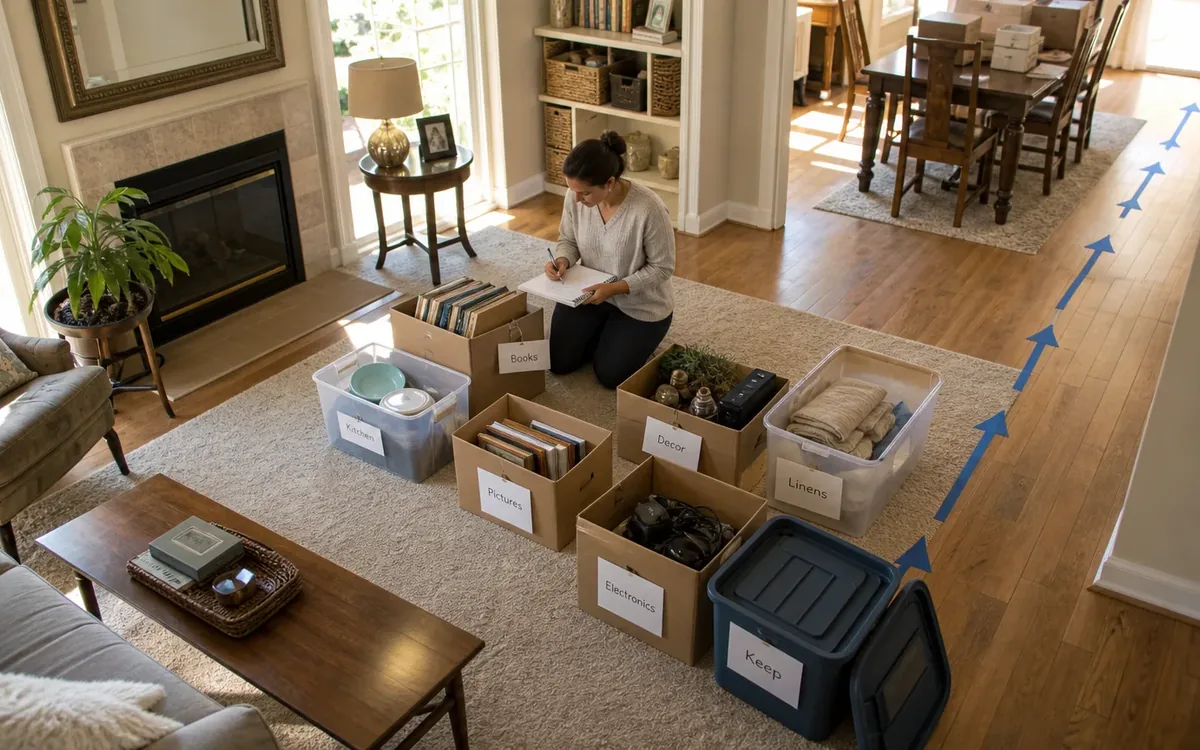
A practical cleanout, move, or liquidation team may discuss workflow, sorting categories, access, staging, sale format, likely buyer pickup needs, and authorized disposition options. It may also help identify property that appears to need specialist attention.
The team should not decide:
- Who owns disputed property
- Whether a will or trust authorizes a transfer
- Whether probate is required
- The value required for tax, insurance, court, or equitable-distribution purposes
- Whether a building condition is safe or code compliant
- What must be disclosed in a real-estate transaction
- When estate proceeds may be distributed
Those decisions belong to the authorized individual and the relevant attorney, appraiser, accountant, real-estate professional, inspector, court, agency, or other qualified authority.
How can a family shorten the timeline without rushing?
The safest time savings come from reducing uncertainty early, not compressing appraisal or approval work.
Name one primary contact
A single contact can gather questions, document decisions, and avoid conflicting instructions. Other stakeholders can still receive updates without directing daily work.
Create protected categories before broad sorting
Mark and separate:
- Personal papers and financial records
- Wills, trusts, deeds, titles, and tax files
- Medication and medical equipment
- Photographs and irreplaceable keepsakes
- Jewelry, coins, firearms, and small valuables
- Items specifically claimed or disputed
- Property that may belong to someone else
Nothing in a disputed or protected category should enter a sale simply to meet a deadline.
Match review effort to the asset
Not every kitchen utensil needs individual research. Conversely, a signed artwork, coin collection, or unfamiliar vintage item should not be treated as an ordinary household good merely because its value is uncertain.
Use triage:
- Routine goods: Group and assess for the chosen sale format.
- Potentially valuable goods: Hold for focused market research or specialist input.
- Legally sensitive goods: Obtain direction from the responsible professional or authority.
- Unsellable goods: Plan an authorized disposition route early.
Set decision deadlines
Give family members a specific date to select approved keepsakes. Establish a separate deadline for unresolved claims. Confirm what happens if no decision is received, but have the authorized representative and legal adviser approve that approach where appropriate.
Work backward from the real deadline
If the property must be ready for listing, closing, turnover, or another event, reserve time for buyer pickup and leftovers. Do not schedule the final sale day as the day before the property must be empty.
Is an auction faster than an estate sale?
Sometimes, but not automatically. The total duration depends on preparation, buyer reach, payment, pickup, and leftover property.
An online auction often follows this sequence:
- Inventory and lot selection
- Photography and catalog writing
- Review of descriptions and terms
- A scheduled bidding period
- Invoicing and payment
- Pickup or shipping coordination
- Unsold-lot decisions
An in-home estate sale commonly involves:
- Sorting and family removal
- Display and pricing
- Advertising
- One or more public sale days
- Purchased-item removal
- Remaining-property decisions
A direct sale may be quickest for a clearly identified asset with an established buyer, but convenience and speed are not the same as obtaining broad market exposure. The authorized representative should choose the method based on the estate’s goals and any fiduciary or legal guidance.
Hybrid liquidation can be practical. Specialized pieces might go to auction, useful household goods to an estate sale, and authorized leftovers to donation or recycling. That approach may produce a better fit, although it requires more coordination.
How should Charleston-area households plan around a property sale?
Charleston-area families should begin with the dates that are actually confirmed, not assumed. A proposed listing date can move. A closing may have conditions. A lease or community arrangement may have access requirements. Statewide South Carolina projects can also involve decision-makers who live elsewhere.
Build a timeline with four buffers:
- Authority buffer: Time to confirm who can approve sale and disposition.
- Specialist buffer: Time for appraisers or other professionals to review selected assets.
- Buyer buffer: Time for payment and removal after the sale ends.
- Contingency buffer: Time for unsold property, access issues, or schedule changes.
A real-estate professional can advise on listing strategy and presentation. An inspector or qualified contractor can address property conditions. An attorney can advise on ownership, contracts, probate, or estate authority. A liquidation or move team can coordinate authorized personal-property tasks, but it should not replace those roles.
A practical sample liquidation schedule
The sequence below is a planning model, not a duration estimate or service promise.
Stage 1: Authority and scope
- Identify the authorized decision-maker
- Secure documents and protected belongings
- Record deadlines and access limits
- Establish communication and approval procedures
Stage 2: Inventory and triage
- Separate family-retained property
- Flag disputed or potentially valuable items
- Group routine sale property
- Identify items that require titles or specialist review
Stage 3: Valuation and sale design
- Obtain appropriate appraiser or specialist input
- Select auction, estate sale, direct sale, or hybrid channels
- Confirm sale terms, pickup needs, and excluded property
Stage 4: Cataloging and marketing
- Photograph and describe property
- Arrange lots or displays
- Review key details
- Publish approved sale information
Stage 5: Sale and payment
- Conduct the sale or close bidding
- Process payments under the selected method
- Schedule buyer pickup or authorized shipping
Stage 6: Disposition and records
- Verify sold property has been removed
- Decide what happens to unsold goods
- Complete authorized donation, recycling, or disposal steps
- Organize available transaction records for the responsible person
If specialist appraisals, legal authority, family disputes, or titled assets are unresolved, pause the affected property rather than forcing it into this model.
Short FAQ
Can estate liquidation begin before probate is complete?
Possibly, but the answer depends on ownership, estate structure, court status, and who has authority. Ask a South Carolina estate attorney or the relevant court professional before selling property when authority is uncertain.
Does every item need a formal appraisal?
Usually not. Formal appraisals may be appropriate for selected assets or specific legal, tax, insurance, or fiduciary purposes. The responsible professional should say what standard is required. Ordinary sale pricing is not automatically a formal appraisal.
What happens if items do not sell?
The authorized person may choose another sale channel, family distribution, donation, recycling, or disposal. Restrictions may apply to particular materials or regulated property, so use the appropriate professional or authority when needed.
Can liquidation happen while the home is listed?
It can, if access, staging, security, buyer visits, and contract obligations are coordinated. The real-estate professional and authorized representative should determine how the schedules interact.
Is liquidation the same as an estate cleanout?
No. Liquidation focuses on valuation, sale, and disposition. A cleanout focuses on physically removing authorized property and preparing the space. They may overlap, but they have different timelines and decision points.
Plan the timeline around decisions, not just volume
The size of a household matters, but unresolved authority, specialist review, sale design, and leftover disposition usually shape the schedule more than square footage alone. A realistic plan gives valuable or sensitive property enough review while keeping routine goods moving.
Clutter Cleaner of South Carolina can discuss practical coordination for auctions and estate sales, estate cleanouts, downsizing and organizing, move management, home sale preparation, and code compliance support within its statewide South Carolina service territory. Legal interpretation, formal appraisal, real-estate advice, inspections, and official compliance determinations remain with the appropriate professionals and authorities.
For timeline discussions, households can contact Clutter Cleaner of South Carolina at (843) 972-7020.



