
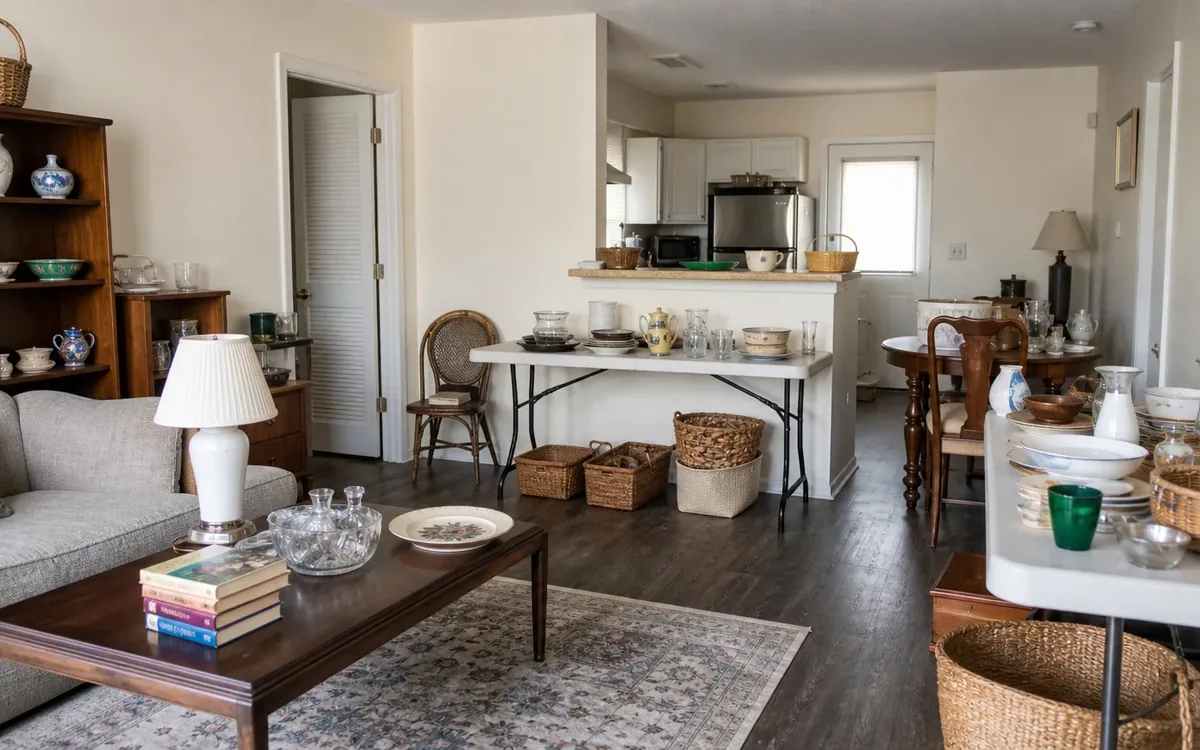
Yes, you can hold an estate sale in a small home or apartment, but the decision depends less on square footage than on inventory, safe access, parking, building rules, and the sale format. In a Charleston-area condo, apartment, or cottage, an online auction, appointment-based sale, consignment plan, or hybrid approach may work better than opening the residence to unrestricted foot traffic.
Quick answer: First confirm who has authority over the property and belongings, then review the lease, association rules, and building procedures. Ask an estate-sale or auction provider whether the inventory supports an in-person sale. If access is too limited, consider online bidding, consignment, or selling selected items separately. A cleanout or move team can help discuss sorting and removal logistics, but attorneys, property managers, associations, appraisers, inspectors, and local authorities make decisions within their respective roles.
What makes a small-space estate sale workable?
A small residence is not automatically unsuitable. The central question is whether buyers can view and collect the available items without creating unsafe congestion or violating property rules.
The household can begin by considering:
- How many saleable items remain after family keepsakes are removed
- Whether the collection includes furniture, art, jewelry, tools, collectibles, or useful household goods
- Whether buyers could move through the rooms without climbing over boxes
- How large purchases could leave the residence
- Whether there is controlled entry from the street, lobby, elevator, or stairway
- Where shoppers, staff, and pickup vehicles could park legally
- Whether neighbors share hallways, gates, entrances, or elevators
An estate-sale provider can assess whether the likely proceeds and practical demands make a conventional sale appropriate. That provider, rather than a cleanout crew, determines its willingness to accept the sale and sets its selling procedures.
Clutter Cleaner of South Carolina offers statewide support for auctions and estate sales. A discussion can help a household compare formats and coordinate the physical transition, but no sale method should be selected before authority, access, and building restrictions are understood.

Who has the right to approve the sale?
Before advertising or moving anything, identify the person legally authorized to make decisions. That may be an owner, executor, personal representative, trustee, authorized family member, or another responsible party. A service provider should not decide ownership or resolve disputes among heirs.
The responsible household representative can decide which undisputed items to keep, offer for sale, donate, recycle, store, or discard. If ownership is unclear, pause the item rather than treating it as sale inventory.
Questions involving probate authority, a will, a trust, creditor claims, jointly owned property, contested belongings, or required notices belong with a qualified South Carolina attorney or the appropriate court. A landlord, property manager, or homeowners association may separately control use of common areas and resident access. Those permissions do not establish ownership of the contents.
If valuables may materially affect the estate, the responsible party can seek an independent qualified appraiser. An estate-sale company may discuss marketability or selling strategy, but a formal appraisal is a separate professional service unless clearly stated otherwise by that provider.
Will condo or apartment rules allow buyers inside?
Rules vary by property, so the household should obtain the actual lease, association documents, building policies, or written management instructions. Do not assume that a private residence can host a public event simply because the contents belong to the resident.
Ask the landlord, property manager, or association about:
- Whether public or appointment-based sales are permitted
- Guest registration and building access procedures
- Limits on signs, advertising, or door postings
- Loading-zone and parking restrictions
- Elevator reservations and protective padding
- Approved moving hours or restricted access periods
- Insurance or vendor-document requirements
- Use of lobbies, sidewalks, courtyards, and other common areas
- Rules for door supervision, keys, gates, and entry codes
- Waste, recycling, and bulk-item procedures
Written confirmation is useful when multiple parties are involved. A practical move or cleanout team can discuss how to stage items, protect pathways, and sequence removals within approved rules. It cannot waive a lease condition, association restriction, fire-safety requirement, or municipal rule.
Questions about permits, public right-of-way use, occupancy, fire access, or code compliance should go to the authority responsible for that requirement. The household remains responsible for securing necessary permissions before the event.

Which sale format fits a small residence?
There are five main formats worth comparing.
-
Controlled in-person sale. Buyers enter in limited groups while staff monitor doors and rooms. This can preserve the experience of a traditional estate sale while reducing congestion. It still requires adequate access, permission, and a workable checkout area.
-
Appointment-based sale. Interested buyers reserve access rather than arriving at once. This may suit a secured building or a residence with limited parking, although the building must still permit the activity.
-
Online auction with scheduled pickup. Items are cataloged and offered online, and winning buyers collect them under a pickup plan. This reduces browsing traffic but does not eliminate the need for parking, elevator access, safe lifting, and supervision.
-
Consignment or specialist sale. Selected objects go to an outside consignment business, auction house, dealer, or specialty marketplace. This can be useful when the home lacks room for shoppers or when a focused market is more appropriate. Each provider sets acceptance standards, commissions, transport terms, and payment policies.
-
Hybrid sale. Higher-interest items are offered through an online auction or specialist, while practical household goods are sold, donated, or otherwise handled separately. This often keeps a small residence from becoming an overcrowded showroom.
No format guarantees that every item will sell. Ask each selling provider how it handles photographs, reserves, unsold items, pickup defaults, fees, payment, buyer disputes, and final accounting before signing an agreement.
How should you prepare without overcrowding the home?
Preparation should create clarity, not fill every surface. Begin with decisions that only the household or authorized representative can make.
Separate belongings into clearly marked groups:
- Items the family or beneficiaries will retain
- Documents and photographs requiring private review
- Property awaiting an ownership decision
- Items for an appraisal or specialist opinion
- Likely sale inventory
- Potential donations
- Materials for recycling or lawful disposal
Do not place medications, personal records, financial papers, keys, identification, digital devices, firearms, or disputed property into general sale inventory. Seek appropriate guidance for regulated or sensitive items.
Use the available rooms deliberately. Keep walkways, stairs, exits, electrical panels, and building systems unobstructed. Avoid stacking items where buyers must reach overhead or move one object to inspect another. A provider conducting the sale should decide its own merchandising and buyer-control setup.
The broader guide to the best way to clean out an estate explains how to establish authority, preserve important materials, and sort before removal. That process is especially relevant in a compact home because premature hauling can mix sale property with keepsakes or records.
A practical cleanout or move team may discuss staging space, removal order, donation destinations, disposal logistics, and coordination with a sale provider. The household chooses whether to use storage, and a storage company controls its own terms and availability. Contractors separately handle repairs or specialty work under their agreements.
Can furniture pickup work with tight stairs or elevators?
It can, provided the route is measured and building procedures are followed. A buyer’s willingness to purchase a large item does not mean it can leave safely through the available path.
Before listing bulky pieces, check:
- Item width, height, depth, and weight considerations
- Door, hallway, stair, and elevator dimensions
- Turns, landings, thresholds, railings, and ceiling clearance
- Whether legs, doors, shelves, or frames can be removed safely
- Loading-area access and legal vehicle placement
- Required elevator reservations or floor protection
- Who is responsible for labor, equipment, and damage
A seller can establish pickup conditions with the selling provider. Those conditions should make clear whether buyers must bring labor, tools, blankets, dollies, and suitable vehicles. Building management may impose additional requirements.
Do not promise that an item will fit based on appearance alone. A mover or other qualified professional should evaluate difficult removals. Electrical, plumbing, gas, built-in cabinetry, mounted equipment, or structural attachment may require an appropriate contractor. The sale team and cleanout team should not make trade-specific determinations outside their roles.
How can buyer traffic be controlled?
Small-space sales depend on controlled flow. The sale operator should select procedures appropriate to the property, inventory, and governing rules.
Possible controls include:
- Entry by appointment or queue
- A cap on the number of shoppers indoors
- A single monitored entrance and exit
- Off-limits rooms with closed doors and clear signs
- A designated payment point away from stairs
- Separate pickup instructions for large items
- No use of common areas for merchandise
- Advance notice that parking and access rules will be enforced
Never publish a gate code, lockbox code, alarm detail, or vulnerable-building instruction in a public listing. Coordinate approved guest access with property management. Keep personal documents, medications, keys, mail, and valuables outside public areas.
The household can decide its desired level of privacy and which rooms may be entered. The selling provider can determine whether those limits are compatible with its operating model. Building management controls common-property access, while law enforcement and public authorities handle public-safety matters within their jurisdiction.
What happens to items that do not sell?
An exit plan should be established before the sale begins. Otherwise, a small home can remain blocked by unsold furniture, boxes, and packing material when the property needs to be transferred or prepared for listing.
The responsible party can choose among resale through another provider, consignment, family distribution, donation, storage, recycling, or lawful disposal. These are distinct choices with different costs, acceptance rules, and responsibilities.
Ask the sale provider whether its agreement addresses:
- Items that receive no bids or offers
- Buyer pickup failures
- Minimum prices or reserves
- Packaging and transport
- Donation coordination
- Final removal responsibilities
- Settlement records and sale documentation
A cleanout team may discuss the removal of authorized remaining contents and coordinate around a move or property-preparation plan. Donation organizations decide what they accept. Disposal facilities and local programs set their own rules. Hazardous, regulated, or restricted materials require instructions from the appropriate facility or authority.
If the residence will be sold, the real-estate professional determines listing strategy, not the cleanout or estate-sale team. Inspectors evaluate property conditions within their scope. Licensed or otherwise qualified contractors determine repair methods. Appraisers provide valuation opinions under their professional standards.
Planning a Charleston-area small-space sale
Charleston-area condos, apartments, and compact cottages can present practical limits involving shared entrances, narrow interiors, parking, stairs, and building procedures. The right response is not to assume that an in-person sale is impossible. It is to select a format that respects the actual property.
Clutter Cleaner of South Carolina is physically located in Mount Pleasant and serves households throughout South Carolina, with Charleston as its primary market. The company can discuss estate cleanouts, downsizing and organizing, auctions and estate sales, move management, home sale preparation, and code compliance support within the needs of a transition.
That coordination does not replace legal advice, appraisal, brokerage, inspection, property-management approval, contractor judgment, or government authority. For a small residence, clearly separating those roles helps prevent rushed decisions and conflicting instructions.
To discuss the practical parts of a small-space estate transition, contact Clutter Cleaner of South Carolina at (843) 972-7020.
Short FAQ
Is there a minimum home size for an estate sale?
There is no universal minimum size. A provider will consider the amount and type of inventory, access, safety, building rules, parking, and whether the likely sale suits its business model.
Is an online auction always better for an apartment?
No. It can reduce browsing traffic, but bidders still need a compliant pickup process. Photography, cataloging, payment, moving labor, elevator access, parking, and uncollected purchases must be addressed.
Can items be moved elsewhere for the sale?
Possibly. The authorized representative may choose off-site consignment, an auction facility, storage, or another lawful location. Confirm transport responsibilities, insurance questions, provider terms, and building rules before moving anything.
Who decides whether an item needs an appraisal?
The authorized owner or estate representative decides whether to seek an appraisal, often with guidance from an attorney, fiduciary, insurer, tax professional, or other relevant adviser. A qualified appraiser provides the valuation opinion.
Can a cleanout happen before the sale?
Selective removal can help, but indiscriminate clearing may eliminate saleable property or important records. First secure private papers and keepsakes, resolve authority, identify possible valuables, and coordinate the sale plan. Then authorize removal of clearly designated materials.



