
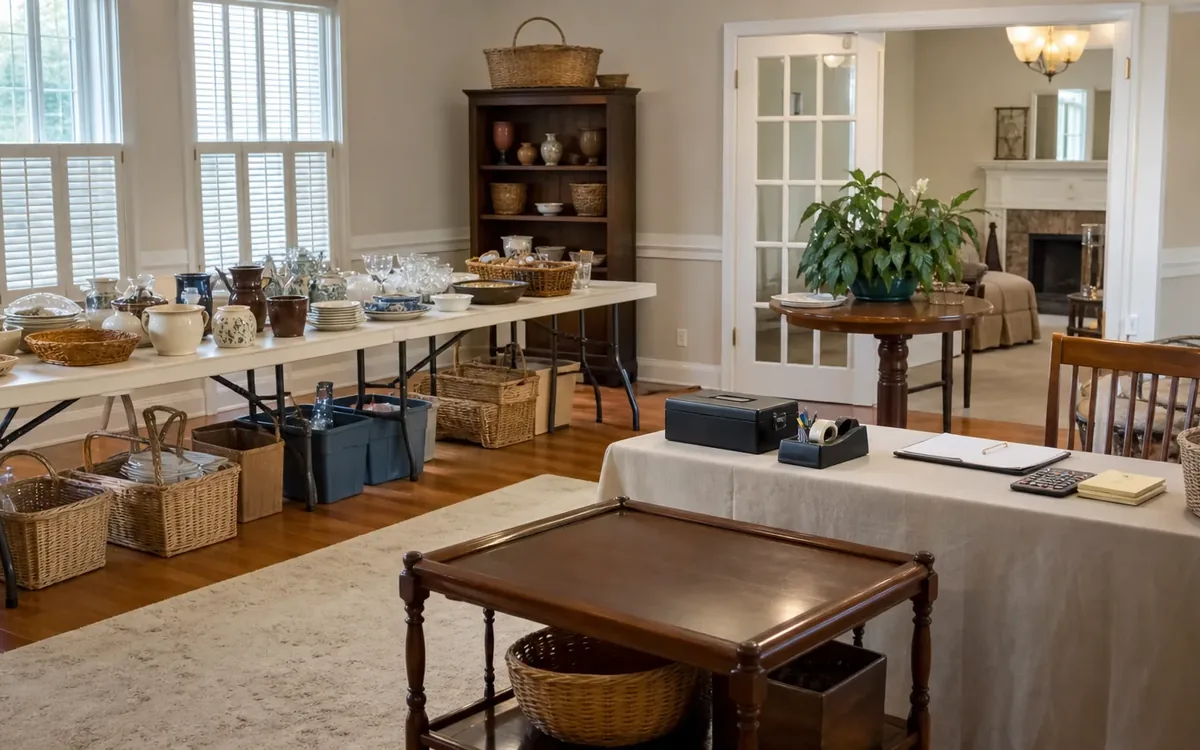
A good estate sale checkout system puts payment, sold tags, holds, receipts, and pickup records under one clear process. Place the checkout near the controlled exit without blocking the doorway, assign defined staff roles, use visibly different tags for unpaid holds and paid purchases, and record every paid item left for later pickup.
Quick answer: Create one checkout point near the exit, but leave enough room for a line and safe furniture movement. Give every item one status: available, on temporary hold, or sold and paid. Never use a sold tag before payment is confirmed. For paid items remaining in the home, record the buyer’s name, contact information, item description, payment confirmation, pickup instructions, and release status.
This guide focuses narrowly on the physical checkout area and the records that prevent confusion. It does not replace decisions by an estate representative, appraiser, attorney, tax professional, payment processor, property professional, or local authority.
What should an estate sale checkout area include?
The checkout area should be a controlled work zone rather than a spare table placed wherever space remains. It needs to support payment, tagging, packing, recordkeeping, and buyer questions without interrupting traffic through the home.
A practical station may include:
- A sturdy table and appropriate seating
- A cash box or other chosen payment equipment
- Receipt books or a digital receipt process
- Pens, markers, tape, and removable tags
- Separate hold and sold tags
- A master pickup log
- Bags, boxes, and basic wrapping supplies
- A calculator and price reference sheet
- A clearly labeled area for small paid purchases
- Contact information for the person supervising the sale
Keep money, payment devices, keys, personal records, and buyer contact details out of public reach. Avoid displaying full pickup records where other shoppers can read them.
Before opening, test the complete path. A shopper should be able to approach the table, present an item or claim ticket, pay, receive a receipt, and leave without crossing the incoming line.
Families comparing hands-on sale support with other disposition options can review the auctions and estate sales service overview. The household should confirm the exact scope in advance, including who prices items, accepts payments, keeps sale records, supervises pickup, and handles anything left afterward.

Where should the checkout table be placed?
Place checkout close enough to the final exit that purchases can be verified, but not so close that the table blocks the doorway. The best location has good visibility across the sale area, room for a defined queue, and a separate route for moving bulky purchases.
Look for these features:
- A clear view of people approaching the exit
- Enough floor space to form an orderly line
- Access to electrical power if selected equipment requires it
- Protection from weather if any part of the station is outside
- A route for furniture that does not cross the payment line
- Space behind the table that shoppers cannot casually enter
- Adequate lighting for reading labels, currency, and receipts
Do not place checkout at the bottom of stairs, in a narrow hallway, or where a line would cover merchandise. Keep doors, steps, ramps, utility panels, and emergency routes unobstructed. Questions about occupancy, accessibility, fire safety, parking, signs, or local sale requirements belong with the applicable property professional or authority.
Use simple signs to make the flow obvious. “Checkout,” “Line Starts Here,” and “Paid Pickup Check-In” are usually more useful than long instructions. If the home has several exits, the household should decide which doors remain closed to shopper traffic and how staff will monitor the approved route.
For broader planning before merchandise is staged, the guide on the best way to clean out an estate explains how sorting, family review, sale decisions, donations, and disposal fit into the larger transition.
How should sold tags and hold tags work?
Sold tags and hold tags should never mean the same thing. A hold is a temporary shopping status. Sold means payment has been accepted and recorded under the sale’s rules.
Use different colors, shapes, or large printed headings so staff can identify each status from across a room:
- Available: The original price label remains visible, with no hold or sold marker.
- Hold: A temporary tag identifies the shopper and the person who approved the hold.
- Sold and paid: A sold tag connects the item to a receipt or transaction record.
- Released: A pickup record shows that the item left with an authorized person.
A useful hold tag can contain the buyer’s first name or assigned number, item description, staff initials, and the condition that ends the hold. Avoid writing unnecessary personal information on a tag visible to the public.
A sold tag can include:
- Receipt or transaction number
- Short item description
- Buyer identifier
- Payment-confirmed notation
- Pickup status
- Staff initials
Do not mark an item sold merely because a shopper says they intend to buy it. The household or sale operator should establish the payment and hold rules before opening, then apply those rules consistently.
Attach tags without damaging finishes, fabric, paper, or collectibles. Do not use aggressive adhesive on delicate surfaces. For grouped pieces, identify every included component. A dining table, leaves, pads, and chairs can easily become separated if the tag only says “table set.”

How can staff prevent tag swapping and duplicate sales?
The simplest control is to connect every paid item to one checkout record. A visible sold tag helps on the sales floor, but the master payment or pickup record determines whether the item was actually purchased.
Use these five controls:
- Number the transaction. Put the same receipt or transaction number on the sold tag and the checkout record.
- Describe the item precisely. Record color, material, room, distinguishing marks, and all included pieces.
- Restrict tag access. Keep blank sold tags behind checkout and have designated staff complete them.
- Mark every component. Tag detached shelves, cushions, cords, remotes, keys, and hardware associated with the purchase.
- Reconcile before release. Match the buyer’s receipt or approved identifier to the pickup log and physical item.
For small portable goods, it is often safer to move the paid item to a supervised pickup area rather than leave it on display. Larger furniture may need to stay in place. In that case, position the sold tag where it is obvious but unlikely to be removed accidentally.
If two shoppers claim the same item, stop the release and compare the checkout record, payment confirmation, and tag number. Staff should not improvise ownership decisions from memory. Refunds, disputed payments, chargebacks, and ownership disagreements should follow the seller’s written policy and the guidance of the appropriate payment, legal, or estate professional.
What belongs in the paid-item pickup record?
A pickup log protects both the estate and the buyer when a paid item stays at the property. It should be detailed enough for a different staff member to identify the purchase and verify release.
Record these fields:
- Transaction or receipt number
- Buyer name or assigned identifier
- Buyer contact information kept in a controlled record
- Complete item description
- Number of pieces and accessories
- Payment-confirmed status
- Location within the property
- Agreed pickup instructions
- Name of an authorized alternate pickup person, if allowed
- Release date and staff initials after removal
- Notes about property access or item condition
The sale organizer should state the pickup rules before accepting payment. Those rules may address who must appear, what identification or receipt is needed, which entrance to use, and whether buyers are responsible for labor, tools, packing, and suitable vehicles.
Do not promise that sale staff will dismantle, carry, load, install, or transport purchases unless that work is specifically assigned to an appropriate provider. Heavy lifting, appliance disconnection, wall-mounted items, plumbing, electrical work, and structural alterations may require qualified contractors or other responsible professionals.
Photographs can help identify a large purchase and its included parts, but they do not replace a transaction record. The person managing the sale should also decide how buyer data and transaction records will be stored, shared, and disposed of after they are no longer needed.
Who decides the sale rules and professional issues?
The household, authorized estate representative, or contracted sale operator can decide operational matters such as checkout placement, accepted payment methods, hold rules, discount authority, receipt format, pickup procedures, and which team member may attach sold tags. These choices should be written down before shoppers arrive.
A practical cleanout, move, or sale-support team may discuss:
- Room flow and checkout placement
- Sorting items into sale, keep, donate, recycle, or disposal categories
- Staging and labeling approaches
- Paths for moving furniture
- Post-sale cleanout coordination
- Records needed to track paid items awaiting pickup
Other decisions remain with the responsible professional or authority:
- Legal authority and ownership: An attorney, executor, personal representative, trustee, or other properly authorized party determines who may sell estate property.
- Value and appraisal: A qualified appraiser or appropriate specialist evaluates items when formal valuation is needed.
- Real estate: A licensed real estate professional advises on listing strategy, showing preparation, and transaction requirements.
- Property condition: Inspectors and qualified contractors evaluate defects, repairs, utilities, and building systems.
- Tax and financial treatment: Accountants, tax professionals, financial institutions, and payment providers address reporting and transaction questions.
- Compliance: Local or state authorities determine permit, signage, parking, safety, waste, and other applicable requirements.
Storage is also a separate household choice. The responsible party should choose the facility, contract, insurance approach, access rules, and payment terms. A move or cleanout team may discuss logistics, but storage availability and protection should not be assumed.
How should the checkout team divide responsibilities?
Clear roles reduce errors when several buyers reach the table together. Even a small team benefits from knowing who can approve a hold, confirm a payment, issue a sold tag, and release a purchase.
Possible roles include:
- Greeter or floor monitor: Explains sale flow and directs buyers to checkout.
- Cashier: Confirms prices, accepts approved payment methods, and issues receipts.
- Tag coordinator: Creates sold tags and updates the pickup log.
- Packing-area attendant: Controls paid small items and packing materials.
- Pickup verifier: Checks receipts and records the final release of larger goods.
- Sale supervisor: Resolves pricing or policy questions within assigned authority.
One person may cover several roles when traffic permits. The important point is that duties do not conflict. For example, a cashier actively processing payments should not have to leave the table to find furniture or supervise loading.
Prepare a written exception process for missing labels, disputed prices, separated sets, damaged merchandise, and buyers who arrive without their receipt. Staff should refer unusual matters to the authorized supervisor rather than changing the rules independently.
End-of-sale checkout reconciliation
At closing, compare physical items and tags with the transaction and pickup records. The goal is to identify paid property still awaiting collection, unresolved holds, merchandise moved behind checkout, and records requiring follow-up.
Review the following:
- Every sold tag has a matching transaction record
- Every paid item left onsite appears in the pickup log
- Released purchases are initialed or otherwise closed out
- Temporary holds are removed or resolved under the stated policy
- Small paid items remain in the controlled pickup area
- Keys, remotes, cords, hardware, and detachable pieces stay with their main items
- Buyer information and payment records are secured
- Remaining property is returned to the correct sale or disposition category
Unsold items should not automatically be discarded. The authorized household representative decides whether they will be retained, offered through another sale channel, donated, stored, recycled, or disposed of. Appraisal questions belong with an appropriate appraiser, while hazardous materials and regulated items may require guidance from the relevant disposal provider or authority.
A post-sale estate cleanout is a separate phase. Its scope should clearly identify what may be removed and what must remain for the household, buyer, real estate process, contractor, inspector, or appraiser.
Short FAQ
Should buyers remove sold tags themselves?
No. Designated staff should control sold tags and update the corresponding record. Buyers can present a receipt or assigned identifier when collecting an item.
Can a hold tag be treated as proof of payment?
No. A hold only shows temporary shopping intent under the sale’s policy. Payment confirmation and the checkout record establish sold status.
What if a paid buyer sends someone else for pickup?
Follow the written pickup policy. If alternate pickup is allowed, record the authorized person’s name and specify what receipt, confirmation, or identification is required. Privacy and identity-verification questions should be addressed by the responsible professional.
Who should decide whether an item is valuable enough for appraisal?
The authorized estate representative makes the initial decision and can engage a qualified appraiser or specialist. Checkout staff should not present informal pricing opinions as formal appraisals.
Can Clutter Cleaner of South Carolina help with the broader transition?
Clutter Cleaner of South Carolina, physically based in Mount Pleasant and serving households across South Carolina, offers estate cleanouts, downsizing and organizing, auctions and estate sales, move management, home sale preparation, and code compliance support. Exact responsibilities should be confirmed for each project. For scope questions, call (843) 972-7020.
A controlled checkout table, distinct hold and sold tags, and a complete pickup record create a reliable chain from selection through release. Set those rules before the sale begins, keep authority with the correct decision-maker, and document every paid item that remains on the property.



