
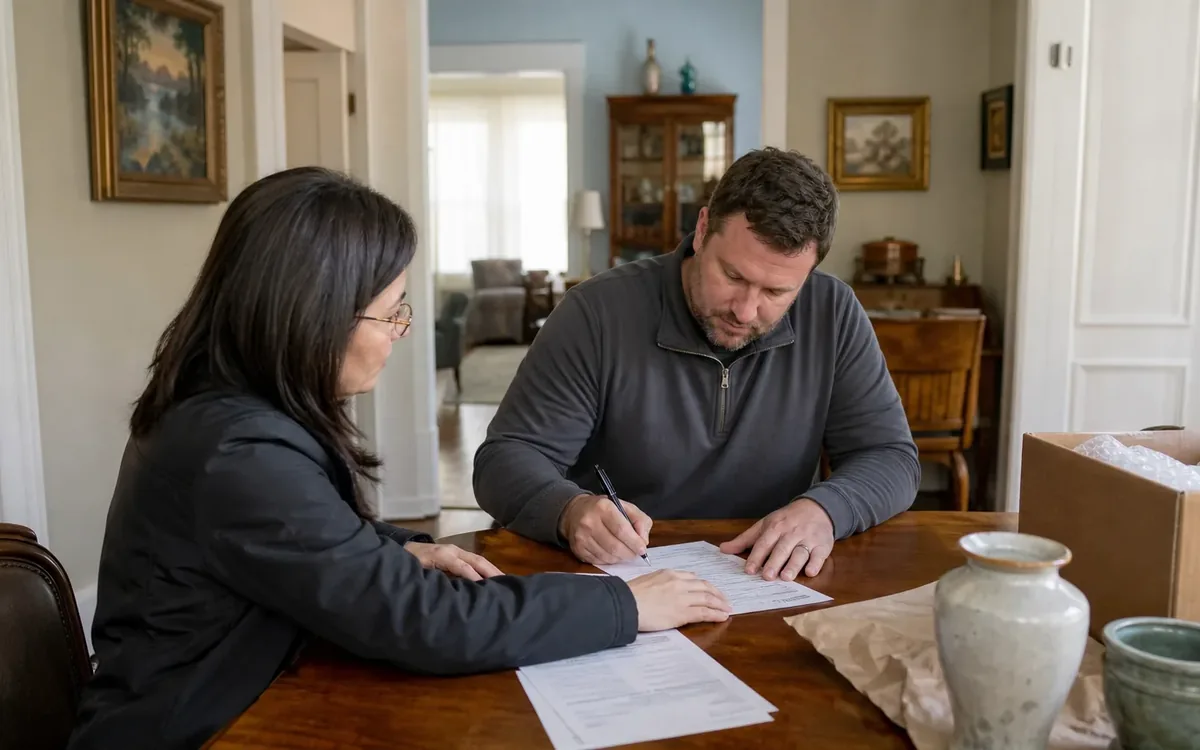
Proxy pickup at an estate auction works best when the buyer, auction representative, and pickup person confirm the same information before any property is released. The household should establish a written authorization process that connects the buyer’s identity, the representative’s identity, paid invoice, lot numbers, and pickup instructions. Auction terms, ownership disputes, taxes, regulated items, and legal authority must remain with the auctioneer, attorney, executor, personal representative, or appropriate authority.
Quick answer: Require written authorization from the registered buyer, verify the buyer and proxy separately, match every item to a paid invoice and lot number, document who received it, and pause the release if any detail conflicts. Do not rely on a text saying, “My friend will get it,” when the invoice, names, or lots are unclear.
Why does proxy pickup need a formal workflow?
An ordinary auction pickup already involves several moving parts. A third-party pickup adds another person who may not have attended the sale, inspected the property, read the terms, or communicated directly with the auction company.
That creates practical questions:
- Did the registered buyer authorize this specific person?
- Is the invoice paid and cleared for release?
- Which lot numbers may the proxy receive?
- Does the person’s identification match the authorization?
- Is the proxy collecting everything or only selected lots?
- Who is responsible for packing, loading, transport, and damage?
- What happens if an item is missing, oversized, disputed, or regulated?
A consistent workflow reduces ambiguity. It does not determine legal ownership or replace the auction terms. The auctioneer or sale administrator controls release under those terms, while the estate’s authorized representative addresses estate authority. An attorney should evaluate contested ownership, fiduciary powers, or conflicting legal instructions.
For households still deciding how auction activity fits into the wider property transition, the auctions and estate sales service overview explains the broader planning context. If removal is part of a larger property project, the guide to the best way to clean out an estate can help separate auction inventory from donations, disposal, family distributions, and retained belongings.

What information should written authorization contain?
Written authorization should identify the transaction precisely enough that staff can compare it with the invoice and the proxy’s identification. The auction company may provide its own form or specify an approved method in the sale terms. Follow that method rather than creating a conflicting process.
A useful authorization record generally includes:
- Registered buyer’s full name
- Buyer or bidder number
- Auction name, sale number, or sale address
- Invoice number
- Authorized pickup person’s full legal name
- Pickup company name, if applicable
- Specific lot numbers approved for release
- Clear statement if all invoiced lots are included
- Buyer’s phone number and email address
- Proxy’s phone number
- Any loading or access limitations already disclosed
- Date the authorization was submitted
- Buyer’s signature or confirmation through the auction platform’s accepted method
Avoid descriptions such as “the furniture,” “my purchases,” or “the items upstairs” when numbered lots appear on the invoice. Lot-level authorization makes partial pickup easier to verify and document.
A buyer hiring a delivery provider should also clarify whether that company may use multiple employees or subcontractors. The auctioneer decides whether a named driver, company authorization, bill of lading, or other documentation satisfies the auction’s release policy.
Do not place sensitive identity documents in an unsecured group message. The party controlling the auction records should decide how identification details are collected, stored, and handled.
A six-step verification workflow
The following six steps create a practical chain from initial request to final release. They can be adapted to the auction company’s written terms and the estate representative’s instructions.
-
Confirm that third-party pickup is permitted. Review the auction terms before accepting the request. Some lots may have special transfer rules, restricted handling, or pickup conditions. Questions about enforceability belong with the auctioneer or legal counsel.
-
Collect authorization from the registered buyer. The message or form should come through an approved channel and name the proxy exactly as shown on identification. Record the invoice and lot numbers rather than relying only on photographs or informal descriptions.
-
Confirm payment and release status. Authorization is not proof of payment. The auctioneer, platform, or designated payment administrator must confirm that the invoice is eligible for release. A screenshot supplied by the buyer may not satisfy the auction’s policy.
-
Verify the arriving proxy. Compare the person’s identification with the authorization. If a delivery company sends a different driver, pause and obtain approval through the designated contact instead of informally substituting a name.
-
Match and document each lot. Use the invoice, catalog record, lot tag, and any applicable condition notes. Mark only the lots physically transferred. Photographing or obtaining a signature for the released group may support the record if the auction’s privacy and documentation policies permit it.
-
Close the pickup record. Note the recipient, date, released lots, withheld lots, and unresolved exceptions. Give the buyer or proxy any receipt or release record required by the auction company.
This workflow separates identification from entitlement. A matching ID proves who arrived. It does not, by itself, establish that the person may take the property.

How should lot numbers and partial pickups be controlled?
Lot numbers are the most reliable bridge between the auction catalog, invoice, physical property, and release record. Names and room descriptions help locate an item, but they should not replace the numbered record when numbers are available.
Create a pickup sheet with one line per lot. It can show:
- Lot number
- Short catalog description
- Quantity or component count
- Paid or release status
- Physical staging location
- Released, withheld, or not found status
- Recipient initials or signature, if required
- Exception notes
Component count matters for grouped lots. A dining set may include a table, leaves, chairs, and pads. A tool lot may contain several cases. The pickup team should compare the actual components with the auction record rather than assuming that everything nearby belongs to the buyer.
For a partial pickup, identify exactly what remains. Do not mark an invoice complete merely because the proxy signs once. The closeout record should distinguish collected lots from uncollected lots and note whether another authorized person is expected.
Catalog descriptions and condition statements are controlled by the auction company. A practical move or cleanout team may discuss staging, pathways, wrapping needs, vehicle access, and loading order. It should not reinterpret an appraisal, alter a catalog description, promise authenticity, or decide a condition dispute.
What should happen when names or records do not match?
A mismatch is a reason to pause, not improvise. Property should remain in place until the designated decision-maker resolves the discrepancy.
Common exceptions include:
- Proxy’s name differs from the authorization
- Driver works for the named company but is not individually listed
- Buyer forwards an invoice under another person’s name
- Lot number is absent from the authorization
- Authorization says “all lots,” but the invoice has changed
- Payment appears pending or disputed
- Physical item does not match the catalog record
- Another family member objects to the release
- Item cannot be located
- Proxy requests additional nearby property
Use a short exception record stating what did not match, who was contacted, what instruction was received, and whether the lot was released or withheld. Do not erase the original entry after a correction. Preserve a clear sequence of decisions according to the auction company’s recordkeeping policy.
The buyer may update an authorization through an approved channel. The auctioneer may resolve catalog or invoice questions. The estate’s personal representative may address estate instructions within that person’s authority. An attorney should handle disputed title, conflicting fiduciary directions, probate questions, or threats of legal action.
Law enforcement, courts, licensing bodies, or other authorities may control certain restricted-property or legal issues. A household, mover, cleanout crew, or delivery driver should not make those determinations.
Plan the physical handoff before the proxy arrives
Verification protects the records, but the property still needs a workable handoff plan. Before pickup, identify where released lots will be staged and whether the route is suitable for the item.
Discuss practical conditions such as:
- Stairs, narrow halls, gates, elevators, and uneven surfaces
- Furniture dimensions and doorway clearance
- Whether disassembly is permitted
- Fragile, heavy, or awkward components
- Parking and vehicle placement
- Packing materials and moving equipment
- Areas that remain off-limits
- Weather exposure during loading
- Items attached to walls, floors, plumbing, or electrical systems
The buyer and delivery provider should decide who supplies labor, tools, wrapping, and transportation. If contractor work is needed to disconnect, detach, repair, or modify part of the property, the household should select an appropriate contractor and confirm the scope separately.
A cleanout or move team may discuss sequencing and safe access. For example, auction lots can be clearly separated from family keepsakes and later cleanout material. That team should not guarantee that a carrier will accept an item, that a wall-mounted object can be removed safely, or that a particular vehicle is adequate.
Storage is also a separate decision. If the buyer cannot take possession under the auction terms, the buyer and auctioneer must determine whether another authorized arrangement is allowed. Any storage provider should be selected under its own agreement, with responsibility for access, fees, insurance, and release addressed directly.
Separate household choices from professional decisions
Clear boundaries prevent a pickup procedure from drifting into decisions it cannot properly answer.
The household or authorized estate representative can decide
- Which non-auction personal property to retain, donate, move, or discard
- Which areas may be accessed during pickup
- Who serves as the practical contact at the property
- How family keepsakes are separated from sale inventory
- Whether to hire independent movers, contractors, storage providers, or cleanout help
- Which property-preparation tasks follow the auction, subject to legal obligations
A practical cleanout or move team may discuss
- Staging zones and labeling
- Clear walking and loading paths
- Order of removal
- Packing and handling considerations
- Coordination between pickups and later cleanout work
- Segregation of retained, sold, donated, and disposal-bound material
- Basic documentation useful for the physical handoff
The responsible professional or authority must decide
- Whether auction terms permit a proxy release
- Whether payment is final and an invoice is releasable
- Legal ownership and contested title
- Executor, personal representative, agent, or power-of-attorney authority
- Appraised value, authenticity, and formal condition opinions
- Real-estate disclosures, contract terms, and closing requirements
- Inspection findings and required repairs
- Disposal rules for regulated or hazardous materials
- Code, permit, environmental, firearm, vehicle-title, and compliance questions
Clutter Cleaner of South Carolina has a physical business location in Mount Pleasant and serves households across South Carolina. Its listed work includes estate cleanouts, downsizing and organizing, auctions and estate sales, move management, home sale preparation, and code compliance support. Any requested scope should be confirmed directly at (843) 972-7020. Legal, appraisal, inspection, brokerage, contractor, transport, storage, and regulatory work remains with the appropriately responsible provider or authority.
Build one release packet for each buyer
Scattered emails and texts make mistakes more likely. Assemble one release packet for each buyer, whether digital or printed, according to the auction company’s privacy and retention policies.
The packet can contain:
- Paid invoice or approved release document
- Buyer authorization
- Proxy’s verified name
- Lot checklist
- Special handling notes
- Exception record
- Recipient acknowledgment, if required
- Final list of released and withheld lots
Keep family notes separate from the official auction record. A sticky note saying that a relative wants an item may be important, but it does not resolve whether the lot was legally included in the auction or sold to a buyer. Escalate that conflict before release.
After all authorized items leave, inspect the staging area against the lot sheet. A remaining drawer, detached shelf, hardware bag, framed component, or accessory can be easy to overlook. Record the discovery rather than quietly adding it to unrelated property.
Short FAQ
Can a family member collect an auction purchase for the buyer?
Potentially, if the auction terms permit third-party pickup and the registered buyer provides acceptable authorization. Family relationship alone is not proof of authority. The auctioneer determines the required release documentation.
Is a photo of the buyer’s ID enough?
Not necessarily. Identification practices should follow the auction company’s policy and applicable privacy requirements. A buyer’s ID also does not replace payment confirmation, proxy identification, or lot authorization.
Can a delivery company pick up several buyers’ lots?
It may be possible when each buyer is separately authorized and each invoice is eligible for release. Keep the release packets and lot records separate so one buyer’s property is not mixed with another’s.
Who decides whether a disputed item leaves?
The party with authority under the auction terms and estate documents must decide. Ownership or probate disputes may require an attorney or court direction. A pickup crew should hold the item rather than decide the dispute.
What if the proxy cannot remove the item safely?
Stop the loading attempt and discuss alternatives with the buyer and auction representative. The buyer may need a different mover, equipment provider, contractor, vehicle, or permitted storage arrangement. Safety and property modifications should not be improvised at pickup.
Should unsold property be loaded with the buyer’s lots?
No, unless there is separate, documented authority for that transfer. Unsold estate property should remain distinct from purchased lots and from material designated for donation or disposal.



