
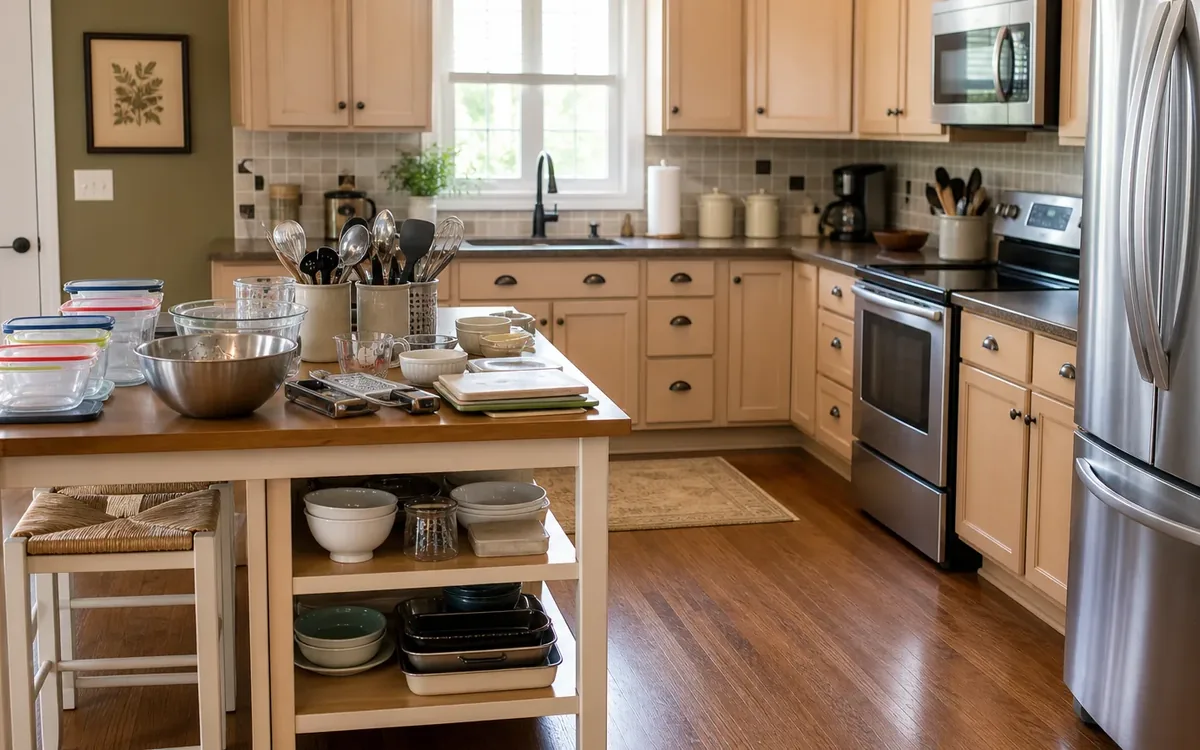
Reduce duplicate kitchen tools before downsizing by comparing the jobs they perform, not just their names. Keep the tools that support meals you actually prepare, fit the smaller kitchen, and feel comfortable to use. Let go of overlapping tools when another item does the same work without making cooking harder. For South Carolina households, everyday habits are a better starting point than an imagined future of elaborate entertaining.
Quick answer: Group tools by function, test the strongest candidates on familiar meals, and assign each retained item a realistic storage spot. Keep a duplicate only when it solves a specific problem, such as simultaneous cooking, different capacities, or an accessibility need. Decide ownership and value questions separately from practical kitchen choices.
Start with meals, not drawers
A drawer can make five utensils look unrelated even when they all perform the same job. Conversely, two similar pans may serve genuinely different purposes. Downsizing works better when you examine cooking functions across the whole kitchen.
Write down the meals your household prepares regularly. Include breakfast, simple lunches, leftovers, and food you make when tired. A kitchen designed only around special occasions can leave everyday cooking awkward.
Next, connect each meal to the tools it requires. For example:
- Eggs and toast may need a skillet, spatula, and toaster.
- Soup may need a pot, knife, cutting board, and ladle.
- Roasted vegetables may need a sheet pan, knife, and mixing bowl.
- A familiar baking recipe may require measuring tools and a particular pan.
This small menu map reveals your working kitchen. It also separates tools you use from tools that represent a hobby you might someday resume.
Do not automatically eliminate occasional-use items. A holiday baking pan can earn its space if the tradition still matters and the pan has a feasible home. The point is to make that exception deliberately.
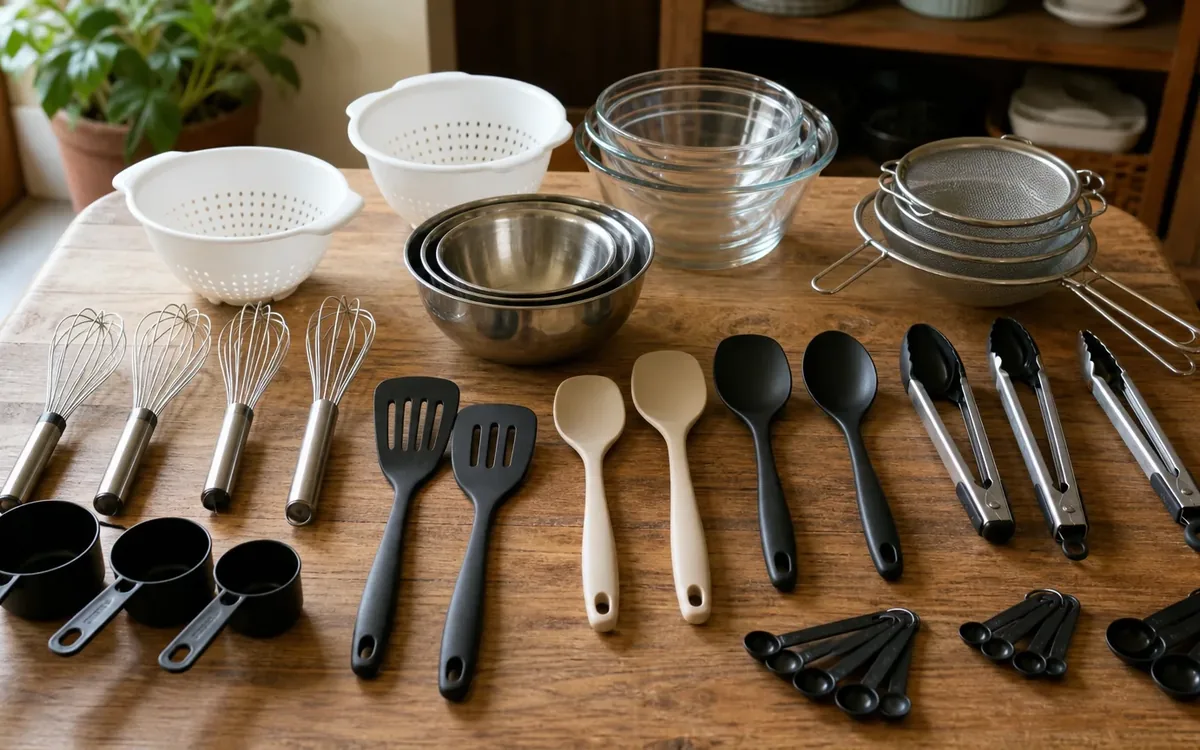
Which kitchen tools are actually duplicates?
True duplicates compete for the same task under the same conditions. A stick blender and a countertop blender overlap, but they are not interchangeable for every recipe. A small saucepan and a stockpot share a category without necessarily sharing a purpose.
Gather tools into functional groups rather than sorting by material, brand, or drawer location:
- Cutting: chef’s knives, paring knives, choppers, slicers, and kitchen shears.
- Mixing and blending: whisks, hand mixers, stand mixers, and blenders.
- Draining and straining: colanders, mesh strainers, and salad spinners.
- Cooking: skillets, saucepans, stockpots, baking dishes, and sheet pans.
- Measuring: cups, spoons, scales, and liquid measures.
- Storing: food containers, reusable bags, jars, and their lids.
Within each group, ask whether each item provides a different capability. A mesh strainer may handle fine sauces that a colander cannot. Two nearly identical vegetable peelers may offer no meaningful difference unless one is easier for a household member to grip.
For help organizing those comparisons, explore downsizing and organizing services. A practical discussion can focus on your cooking priorities and destination layout, while the household retains the decisions about what belongs in its kitchen.
Compare overlapping functions before choosing a winner
Use the same comparison for every competing pair. This prevents an expensive appliance or attractive set from getting a pass simply because it feels important.
Consider these criteria:
- Actual use: Which tool appears in your regular cooking routine?
- Results: Does either tool produce a result the other cannot reasonably achieve?
- Handling: Which is comfortable to lift, grip, operate, and wash?
- Cleanup: Does assembly or cleaning discourage you from using it?
- Storage: Can it fit where you need it without blocking other items?
- Completeness: Are essential lids, attachments, cords, or parts present?
A food processor and a knife illustrate the tradeoff. The processor may simplify a batch of chopped vegetables, but its bowl and attachments need washing and storage. The knife may suit small meals better. Neither automatically wins because it is newer, smaller, or more versatile.
Likewise, a multipurpose appliance is not necessarily the best downsizing choice. If its controls are confusing or its weight makes it difficult to move, a simpler tool may serve the household better.
Choose for the person who will actually cook. Someone else may admire a device without wanting to maintain or operate it.
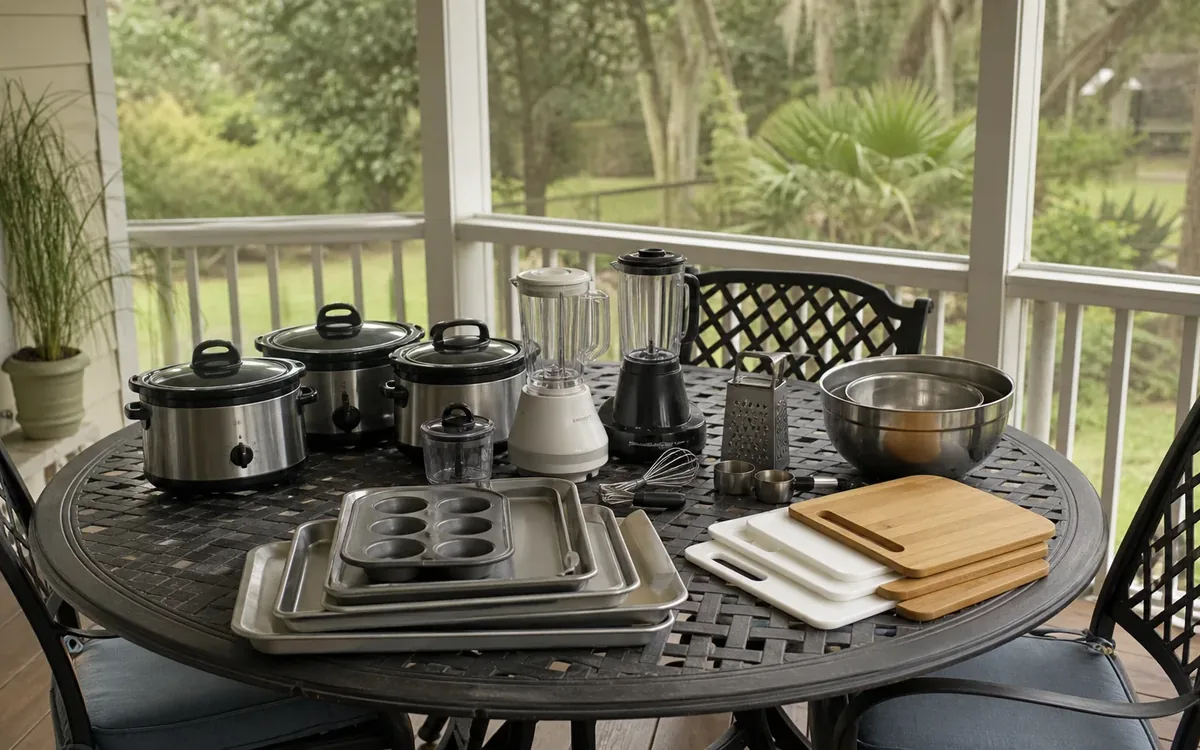
How many backups does your cooking routine need?
A backup should answer a practical question: what happens when the preferred tool is occupied, dirty, unavailable, or unsuitable for the portion being prepared?
Two sheet pans can be useful for a meal that cooks on both at once. A second cutting board may support a household’s food-handling routine. Two skillets may serve different household members who cook separately.
By contrast, several identical serving spoons kept for unspecified future gatherings may occupy space needed for everyday utensils. The distinction is not the number alone. It is whether you can describe the second item’s job.
Try these prompts:
- Do we use both at the same time?
- Would washing the first item solve the problem easily?
- Does the second size suit a meal we genuinely make?
- Does a household member need a different grip, weight, or design?
- Is the backup for a real routine or an unlikely scenario?
If you cannot name its role, set the extra aside while you continue cooking with the preferred item. Keep the trial focused on familiar meals rather than buying ingredients just to justify a gadget.
Inherited kitchen collections need an additional distinction: duplicates are not automatically available for one person to remove. The guide to the best way to clean out an estate provides broader context when kitchen sorting is part of an estate cleanout. Ownership, authorization, and family agreements should be settled before items leave.
Test the finalists in ordinary cooking
Comparing tools on the counter is helpful, but using them often exposes differences that appearance hides. A favorite pan may have a handle that no longer feels secure. A compact chopper may take more effort to clean than the knife it replaces.
Prepare familiar food with the tools you expect to retain. Notice the entire task, including retrieving the item, preparing the food, washing it, and putting it away.
Keep brief notes such as:
- “Large skillet works for our usual portions but feels heavy to wash.”
- “Small whisk reaches the saucepan corners better.”
- “Blender earns its space because we make smoothies regularly.”
- “Matching containers stack neatly, but several lids are missing.”
Those observations are stronger evidence than memory alone. They also make conversations with another household member less personal. You are discussing performance, not criticizing someone’s purchase.
Do not test equipment that appears damaged or unsafe. Follow manufacturer instructions, and leave electrical or appliance repair questions to an appropriate repair professional. Sorting does not establish whether a questionable device is safe.
Let the smaller kitchen set the storage boundary
A useful tool still needs a usable home. Before packing the finalists, compare them with the destination kitchen using available measurements, photographs, or a floor plan. If access is possible, examine cabinet openings and drawer interiors rather than guessing from the room’s overall size.
Pay particular attention to:
- Tall appliances that may not fit beneath cabinets.
- Pan handles that interfere with cabinet doors.
- Heavy items assigned to difficult-to-reach shelves.
- Lids and attachments stored separately from their equipment.
- Countertop tools that compete with food preparation space.
Assign the frequently used tools first. Then see what room remains for occasional items. Avoid giving every specialty gadget an equal claim on limited space.
One practical approach is to sketch storage zones for preparation, cooking, baking, and food storage. Each retained item should have a plausible location within a zone. A box marked “find space later” is not a storage plan.
If the destination is not yet confirmed, keep choices provisional and avoid buying organizers to fit an unknown cabinet. New racks or bins can become another layer of duplicates.
Separate storage is a household choice involving a separate provider when needed. It does not resolve whether an item belongs in the everyday kitchen, and it should not be treated as a guaranteed part of a downsizing service.
What should you do with sentimental or valuable duplicates?
An inherited rolling pin and a modern rolling pin may do the same job while carrying very different meaning. Treat function and sentiment as separate questions.
First ask whether the sentimental item can safely and comfortably serve its intended purpose. If not, decide whether you want it as a keepsake rather than kitchen equipment. Give that keepsake a specific home instead of counting it as a working tool.
Useful options include:
- Keeping one representative item from a larger collection.
- Photographing a set before releasing pieces the household owns.
- Offering an item to an interested relative, subject to ownership and authorization.
- Retaining the tool linked to a meaningful recipe rather than the whole drawer.
Do not assume age, a recognizable brand, or family stories establish market value. An appropriate appraiser or knowledgeable specialist can address valuation questions. An auction or estate-sale discussion is separate from an appraisal and does not guarantee that an item will sell.
Where an estate, disputed ownership, or another person’s property is involved, the authorized decision-maker and any relevant legal professional determine what may be transferred. A cleanout team should not be asked to decide inheritance rights.
Turn the decisions into a clear packing handoff
Once the comparisons are complete, mark the chosen items clearly. Packing is easier when a team does not have to infer which of several similar pans is staying.
Create a concise handoff that identifies:
- The tools moving into the everyday kitchen.
- Sentimental items needing separate protection.
- Items awaiting family, ownership, or valuation decisions.
- Equipment with detachable parts that must stay together.
- Items the household has approved for a separate outgoing arrangement.
A practical cleanout or move-management team may discuss sorting priorities, packing organization, labeling, and coordination. Confirm the actual scope with the provider rather than assuming appliance repair, appraisal, off-site storage, or every disposal option is included.
Donation acceptance and disposal requirements should be checked with the receiving organization or appropriate local authority. Contractor changes to cabinets, inspection findings, real-estate representations, and compliance decisions remain with the responsible professionals or authorities.
Clutter Cleaner of South Carolina is based in Mount Pleasant, with Charleston as its primary market and a statewide service territory. South Carolina households can discuss downsizing and organizing or move management at (843) 972-7020, using their cooking priorities as the starting point.
Short FAQ
Should I break up a matching cookware set?
Yes, if you own it and only some pieces support your cooking. A complete set is not automatically more useful than a smaller selection of well-chosen pans. Consider value questions separately before dispersing anything potentially collectible.
What if two people disagree about a duplicate?
Identify who uses each item and for what task. Test both during ordinary cooking, then discuss the storage tradeoff. A tool used comfortably by one person may deserve space even if the other prefers something else.
Should I replace several tools with one new appliance?
Only after checking that it handles your actual tasks, fits the destination, and is easy to use and clean. Downsizing does not require buying a replacement. Your existing tools may already provide the simplest solution.
When is the kitchen ready to pack?
When each retained tool has a defined purpose and a plausible storage location, and unresolved ownership or value questions are clearly separated. The goal is a kitchen that supports your next home, not merely fewer boxes.



