
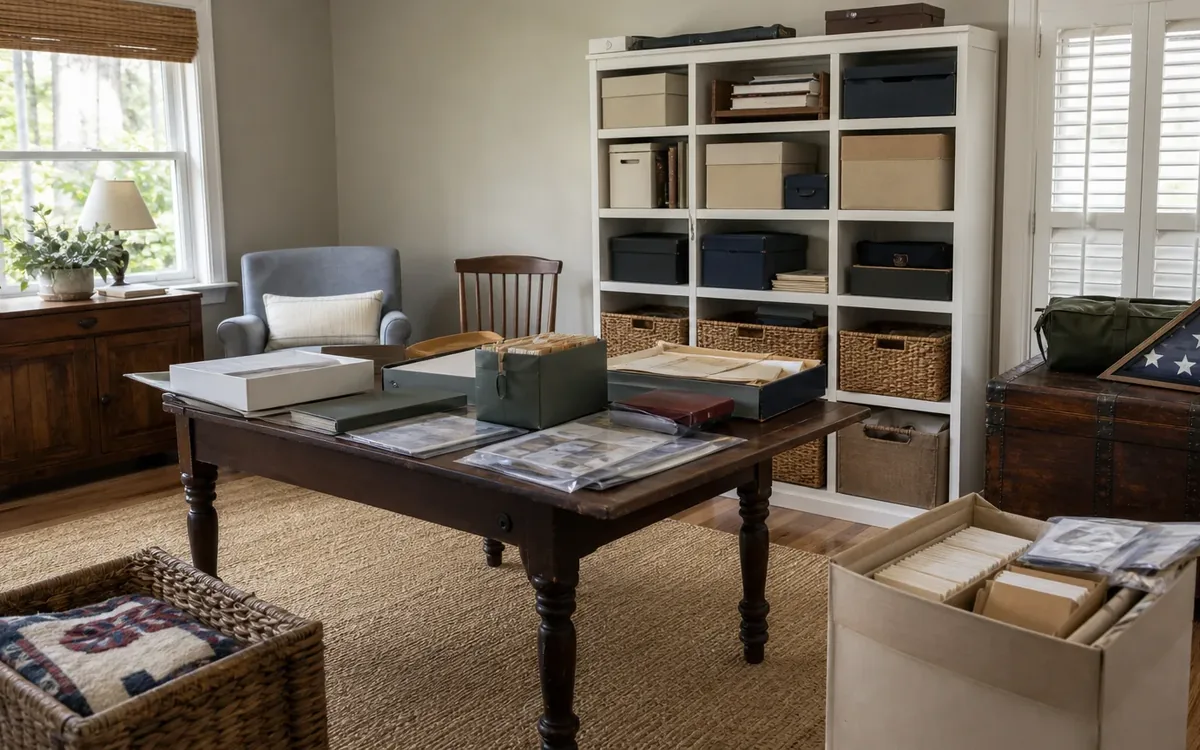
Military memorabilia should be downsized by separating essential service records from sentimental objects, protecting private information, selecting a small group of display pieces, and offering meaningful items to family before considering donation or sale. Firearms, ammunition, explosives, and potentially hazardous military materials require a separate process and should not enter an ordinary household cleanout.
Quick answer: Secure discharge papers, personnel records, benefit documents, and identity-bearing materials first. Then sort medals, uniforms, photographs, correspondence, books, and souvenirs by personal significance. Decide what fits the next home, ask relatives what they genuinely want, and consult qualified museums, appraisers, auction professionals, or authorities when an item falls outside normal household decision-making.
South Carolina veteran households may hold decades of service history in footlockers, closets, attics, garages, and display cases. The challenge is not simply reducing volume. It is preserving the records and objects that matter while making careful decisions about privacy, family ownership, historical value, and available space.
Why does military memorabilia require a separate downsizing plan?
Military collections often combine several categories that should not be handled in the same way. A framed photograph may be purely sentimental. A discharge document may be essential for administrative purposes. A medal may have family meaning beyond its market value. An unidentified piece of equipment may require research before anyone moves, donates, or discards it.
Start by distinguishing among:
- Official service and discharge records
- Benefit, medical, pension, and insurance papers
- Medals, ribbons, badges, insignia, and awards
- Uniforms, caps, boots, and field gear
- Photographs, letters, journals, and scrapbooks
- Books, maps, manuals, and unit histories
- Flags, plaques, certificates, and presentation pieces
- Souvenirs, models, patches, and challenge coins
- Unidentified equipment or potentially restricted materials
This separation prevents important papers from disappearing into boxes marked simply “military.” It also makes later conversations with relatives, appraisers, museums, or other professionals more productive.
A household that needs help structuring the broader project can review downsizing and organizing services across South Carolina. A practical team may help establish sorting areas, group ordinary possessions, prepare selected items for a move, and coordinate the physical flow of the project. The household remains responsible for deciding what carries personal meaning and who is authorized to receive it.
Which service records should be protected first?
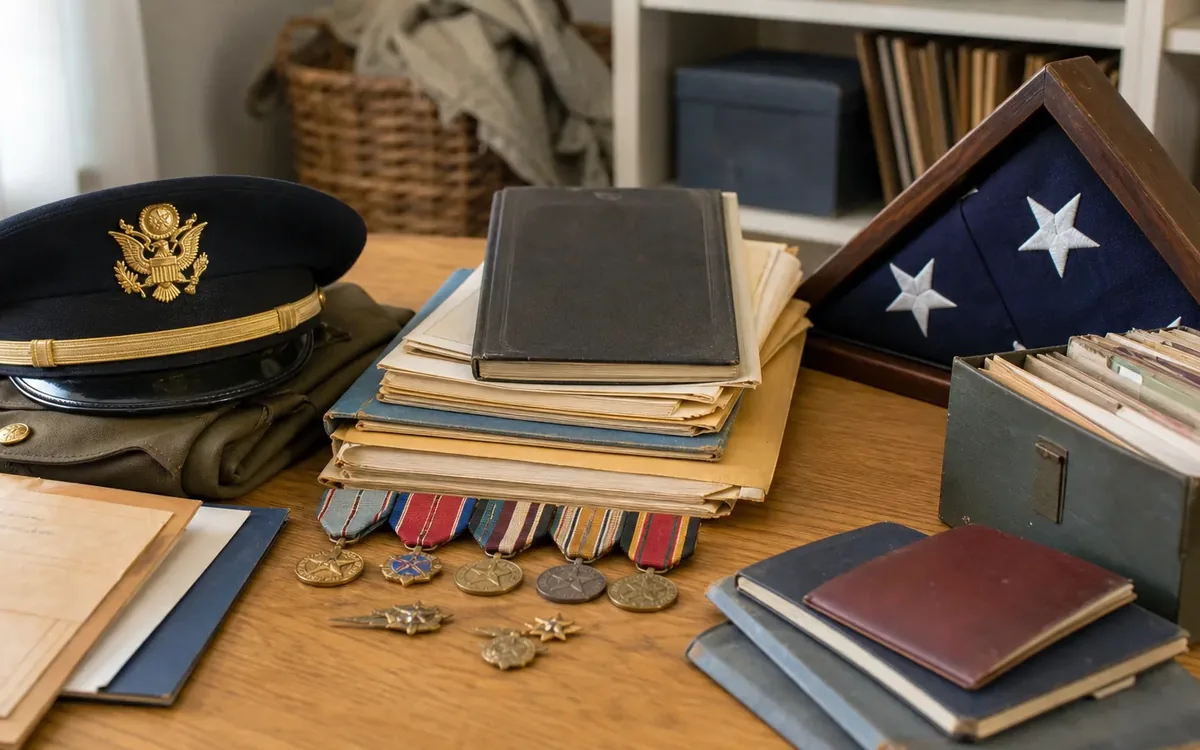
Secure records that establish identity, service, discharge status, benefits, medical history, or financial rights before sorting display objects. These papers should not be left loose in a garage, donation box, sale pile, or unattended staging area.
Priority documents may include:
- Discharge or separation papers, including DD Form 214 records
- Enlistment, commissioning, promotion, and retirement papers
- Department of Veterans Affairs correspondence
- Military medical and disability records
- Pension, survivor, and life insurance documents
- Burial, cemetery, or memorial instructions
- Benefits-related marriage, birth, adoption, and death certificates
- Orders, citations, and award documentation
- Records containing a Social Security number, service number, date of birth, or financial information
Place originals in clean folders or archival-quality sleeves when appropriate. Avoid stapling, laminating, writing on, or applying adhesive tape to original records. Keep documents dry and away from direct sunlight.
Create a basic index so an authorized family member can understand what exists. The index might identify the document, whose service it concerns, whether it is an original or copy, and where it will be stored. A digital scan can improve access, but it is not automatically a substitute for an original record.
The household can choose who may view and hold private records. Questions about whether a particular copy is legally sufficient, who is entitled to request government records, or which document is needed for a benefit belong with the relevant agency, attorney, veterans service professional, or records authority. A cleanout or move team should not interpret benefits eligibility or determine the legal importance of official papers.
If military materials are being handled as part of a deceased person’s household, this guide to the best way to clean out an estate explains how to establish authority and protect important documents before removing property.
How should medals, uniforms, and photographs be sorted?
Sort these pieces according to meaning and future use rather than forcing an immediate keep-or-discard choice. A useful approach is to create five clearly labeled groups:
- Keep and display: Items that will have a defined place in the new home.
- Preserve in storage: Fragile or significant pieces that should remain protected but do not need to be displayed.
- Offer to family: Objects connected to a relative, story, unit, or period that another person may value.
- Research: Pieces with uncertain identity, ownership, historical importance, or market value.
- Release: Ordinary items authorized for donation, sale, recycling, or disposal.
Keep sets together while decisions are pending. A medal is more meaningful when it remains with its citation, photograph, original box, or service history. Photograph each grouping before distributing it, and label the image with the service member’s name and known details.
For uniforms, check pockets and linings before packing or releasing anything. Notes, identification cards, pins, patches, and small keepsakes are easily overlooked. Do not wash, dry-clean, alter, or repair an older uniform before obtaining preservation advice if it may be historically significant. Cleaning methods suitable for modern clothing can damage old fabric, dyes, stitching, or insignia.
Photographs and letters need calm, deliberate review. Names, dates, locations, and unit information written on the back can be more valuable to the family than the image alone. Use a soft pencil on an archival enclosure rather than writing directly on the front or back of a historic photograph.
How do you choose display pieces for a smaller home?
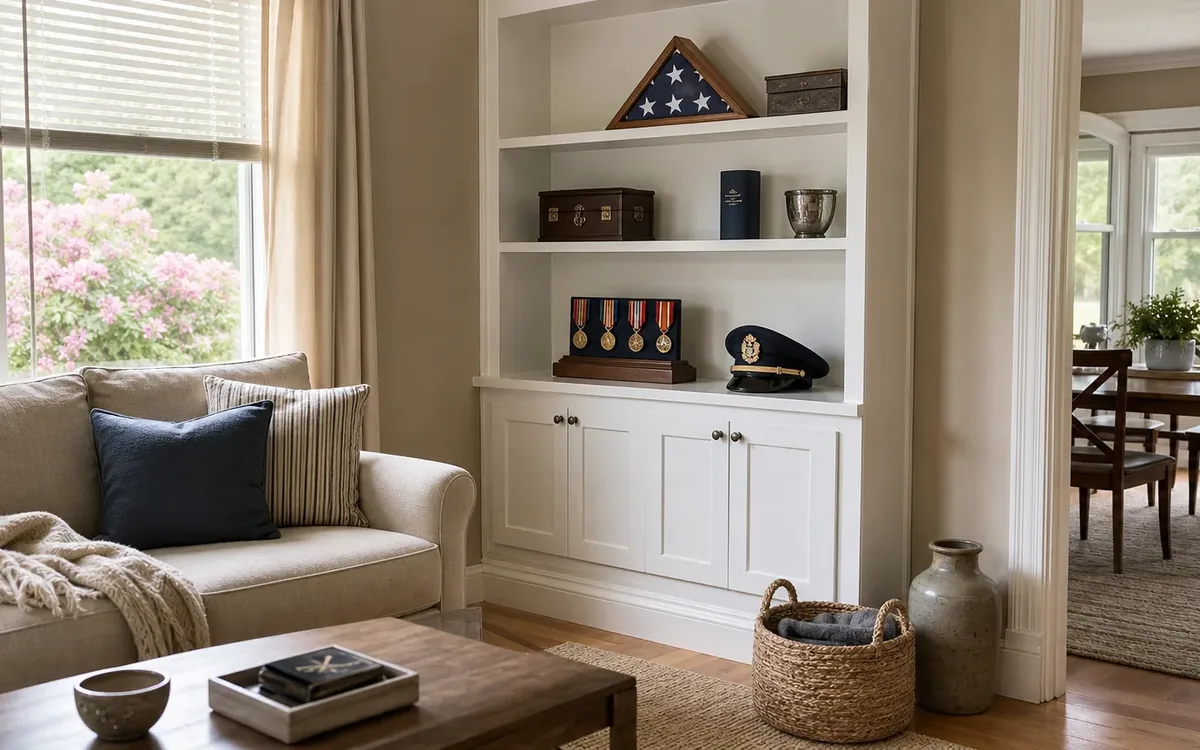
Choose pieces that tell the service story without requiring the new home to hold the entire collection. Measure available walls, shelves, cabinets, and closets before deciding what will move.
A focused display might include:
- One formal portrait or meaningful candid photograph
- A medal set with its citation or a concise identification label
- A folded flag in a suitable case
- One uniform element, such as a cap or jacket
- A plaque, model, or unit item tied to a specific story
- A small digital photo frame containing scanned images
Think in terms of a narrative rather than quantity. A portrait, medal, and brief written account may communicate more than several unmarked boxes. If multiple relatives want to remember the same service member, high-quality copies of photographs and records can accompany one original object that stays with an agreed custodian.
The household decides what fits emotionally and physically in the next home. A practical move team may discuss measurements, packing needs, destination-room labels, and the order in which approved items should be moved. It should not decide which heirloom matters most or promise that delicate military artifacts can be safely treated without specialist input.
Storage is a separate household choice. Before renting space, identify exactly what would be stored, who will manage it, how documents will be protected from moisture and pests, and when the contents will be reviewed. A storage provider should answer questions about its facility and agreement. A conservator should advise on preservation conditions for valuable or fragile materials.
What should happen before offering items to relatives?
Make a simple inventory before family members select objects. It does not need to be elaborate. Assign each item or group an identification number, take clear photographs, and record the known story.
Include details such as:
- Service member’s full name
- Branch, unit, rank, or service period if known
- Description of the object
- Related documents or photographs
- Condition and visible damage
- Current location
- Decision status
- Intended recipient
Share the inventory rather than passing around unsorted boxes. Give relatives a way to identify first choices and explain personal connections. If several people request the same object, the family can discuss rotation, shared digitization, reproduction, or an agreed selection method.
Do not promise or transfer property until the authorized decision-maker confirms that it may be distributed. In an estate, a will, trust, court appointment, ownership record, or instruction from the responsible attorney or personal representative may control the decision. A cleanout company cannot determine inheritance rights or resolve conflicting ownership claims.
When an item changes hands, include its story. A short note identifying the person, occasion, unit, and related photograph can keep an object from becoming an unexplained possession in the next generation.
When might a museum, archive, appraiser, or auction professional help?
Professional input may be worthwhile when an item has uncertain historical significance, unusual provenance, possible market value, or specialized preservation needs. Different professionals answer different questions.
- Museums and archives decide whether an object fits their collection policy. Contact them before delivering anything. An institution may decline an item, request documentation, or accept only a defined portion of a collection.
- Qualified appraisers provide value opinions within their area of competence. Ask what types of military material they evaluate and whether they have a conflict involving a later sale.
- Auction and estate-sale professionals can discuss market interest, presentation, sale terms, and whether a collection suits their format. They do not determine legal ownership.
- Conservators advise on stabilizing, cleaning, mounting, and storing fragile artifacts.
- Real-estate professionals advise how remaining collections affect photography, showings, staging, and a home-sale schedule. They do not authenticate memorabilia.
- Inspectors or compliance authorities determine whether property conditions or unusual materials raise safety, building, environmental, or code issues.
A practical cleanout team may discuss access, staging areas, packing order, approved removal categories, and coordination with separately selected providers. Appraisal conclusions, museum acceptance, sale strategy, title questions, and compliance rulings remain with the relevant professional or authority.
Avoid assuming that age creates value. Family importance, historical significance, and resale value are different considerations. Written provenance, original documentation, condition, rarity, and collector demand may affect an expert’s assessment.
What must be excluded from the ordinary cleanout?
Firearms are excluded from this memorabilia process. Keep firearms, ammunition, explosives, edged weapons that require special handling, and suspicious or potentially hazardous military materials out of general sorting, donation, hauling, and disposal areas.
Do not place an unidentified object in a moving box merely because it resembles a souvenir. Avoid handling anything that may be live, pressurized, explosive, chemically contaminated, or otherwise dangerous. Secure the area and seek direction from an appropriate law-enforcement agency, bomb squad, hazardous-material authority, licensed firearms professional, or other responsible authority based on the item and circumstances.
The household should also separate controlled access cards, current government property, classified-looking materials, and items that may belong to an agency or organization. The relevant authority should determine whether and how they must be returned or destroyed.
A practical cleanout or move team can identify items it will not handle and pause work around a concern. It cannot declare ammunition inert, establish whether possession is lawful, deactivate weapons, or decide compliance requirements. Those determinations belong to qualified authorities and professionals.
Build a careful release process
Once records and restricted materials are secured, use a documented release process for everything else. Confirm each box before it leaves the home, especially when several destinations are involved.
Use destination labels such as:
- New home
- Named family recipient
- Museum inquiry pending
- Appraisal pending
- Auction or estate-sale review
- Approved donation
- Paper shredding
- Ordinary recycling or disposal
Sensitive records should go to secure shredding only after an authorized person confirms they are no longer needed and that no retention requirement applies. Remove personal notes, address labels, identification numbers, and private correspondence from books or objects before donation or sale when appropriate.
Keep a final inventory of retained and transferred pieces. For especially meaningful groups, include photographs of how the materials were packed and identify where associated records are stored. This reduces the risk that a medal, citation, and photograph become separated during the move.
Contractor work is also a separate decision. If built-in display cases, wall-mounted objects, safes, or structural repairs are involved, the household should select an appropriate contractor. That provider should evaluate the work, permits, wall conditions, and installation requirements. A cleanout team may coordinate access but should not make construction, inspection, or permit decisions outside its role.
Short FAQ
Should discharge papers be displayed with memorabilia?
Usually, the original should be protected because it may contain sensitive personal information. A redacted copy can be considered for display. Ask the relevant agency or legal professional before altering, discarding, or relying on a copy for an official purpose.
Can military uniforms be donated?
Some organizations may accept them, but policies vary. Remove private documents and check pockets first. Confirm the recipient’s current acceptance rules before delivery, and obtain specialist advice before releasing a historically significant uniform.
Is it better to divide a medal group among relatives?
Keeping the group with its citations and records often preserves context. Families may instead share photographs or reproductions. Ownership instructions and estate authority must be respected before any division.
What if nobody knows what an item is?
Move it to a research area rather than discarding it. Photograph markings without aggressive cleaning. If it could be hazardous, restricted, or weapon-related, do not handle it further and contact the appropriate authority.
Can a museum be expected to accept a veteran’s collection?
No. Museums and archives follow their own collection policies, available space, and research priorities. Contact a suitable institution with photographs, dimensions, provenance, and an inventory before arranging delivery.
Who decides whether memorabilia should be sold?
The lawful owner or authorized estate representative makes that decision. An appraiser or sale professional can provide information, but cannot settle ownership or inheritance disputes.
Preserve the story, not every object
Successful downsizing does not require keeping every uniform, manual, plaque, or photograph. It requires protecting official records, retaining context, separating hazards, and making deliberate choices about the pieces that will continue telling the service member’s story.
Clutter Cleaner of South Carolina is based in Mount Pleasant, serves households across South Carolina, and works primarily in the Charleston market. For a military-memorabilia project, the household can discuss practical sorting, downsizing, move management, estate cleanout, sale preparation, or coordination needs by calling (843) 972-7020. Legal decisions, appraisals, museum acceptance, real-estate advice, inspections, contractor work, storage agreements, and compliance determinations should remain with the responsible specialist or authority.



