
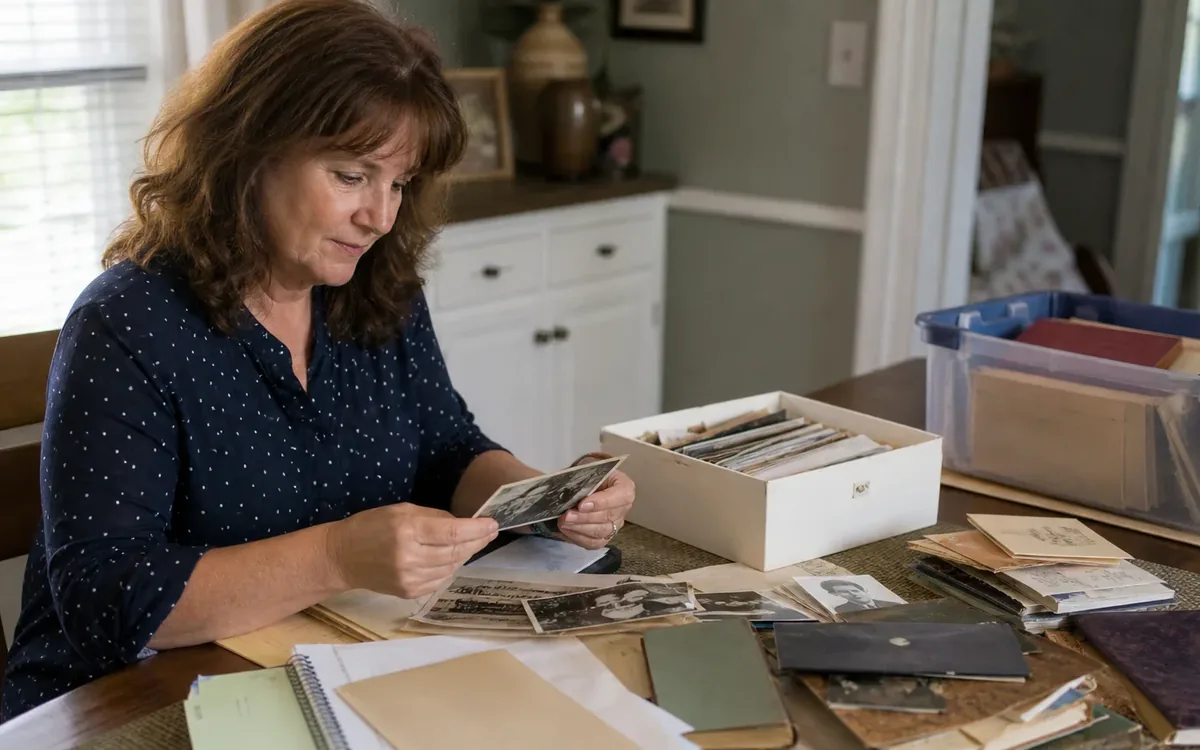
Downsizing genealogy records safely starts with separating unique evidence from duplicate paper, labeling anything uncertain instead of discarding it, digitizing selected records, and naming a future custodian. The goal is not to preserve every sheet. It is to retain the information, context, and family connections that make the collection useful.
Quick answer: Create a protected “do not discard” group first. Sort the rest by family line or record type, remove only verified duplicates and replaceable clutter, label unidentified material, scan important originals, and document who will receive both the paper and digital collections. Ask qualified professionals to address appraisals, legal ownership, archival conservation, and repository requirements.
Why are genealogy records difficult to downsize?
Family-history collections often combine irreplaceable originals with copies, notes, downloaded records, correspondence, photographs, and research that was never finished. A page that looks unimportant may identify a person in an unlabeled photograph or explain why a family moved between South Carolina counties.
The challenge is context. A courthouse copy may be replaceable, but a handwritten note on its reverse may not be. A church bulletin may seem ordinary until it proves a marriage, funeral, or family relationship. A cemetery transcription could preserve wording from a marker that has since become difficult to read.
Genealogy files may also contain records tied to:
- South Carolina churches and congregations
- Cemetery plots, inscriptions, and burial locations
- County probate, tax, court, or land records
- Military service and pension research
- Family Bibles and handwritten registers
- Deeds, plats, maps, and property descriptions
- Oral-history notes and recorded interviews
- Correspondence with relatives or other researchers
This makes a page-by-page review more appropriate than clearing whole boxes based only on their labels.
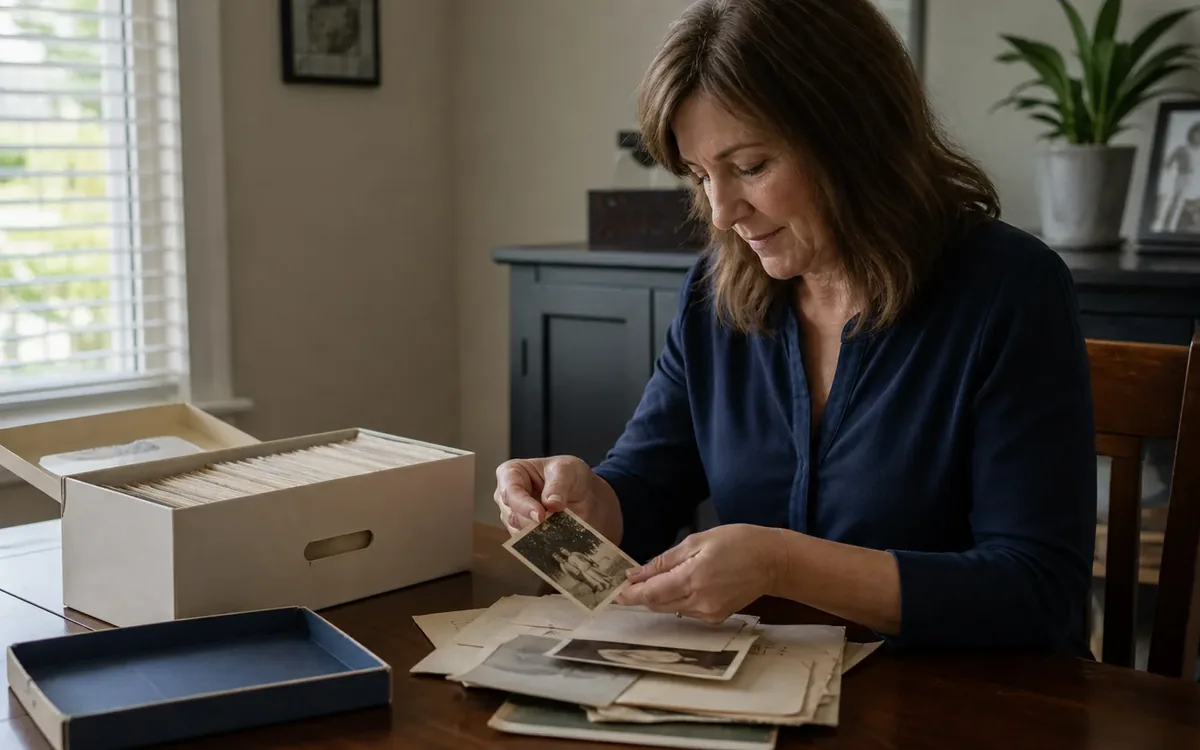
Start with a protected-record rule
Before sorting, establish a category for material that must not be discarded during the initial review. This prevents uncertain items from being lost when attention is divided among packing, moving, preparing a home, or settling an estate.
Place the following in the protected group:
- Original certificates, deeds, letters, diaries, and photographs
- Family Bible pages or handwritten family registers
- Documents bearing original signatures, seals, annotations, or stamps
- Research notes whose sources are not obvious
- Unidentified photographs and negatives
- Audio, video, film, disks, drives, and memory cards
- Fragile items needing archival or conservation advice
- Materials that may belong to an estate, organization, church, or another person
Mark the container clearly. “Genealogy: review before removal” is more useful than “old papers.” If several people are involved, explain that the protected designation is temporary. It means the material requires review, not that everything must be kept permanently.
A household dealing with genealogy alongside a broader transition can review downsizing and organizing support separately from decisions about historical significance. A practical team may help establish work zones, group containers, prepare inventories, and coordinate household logistics. Family members or designated decision-makers still determine what the collection means and who should receive it.
How should you sort a mixed family-history collection?
Choose one primary arrangement and apply it consistently. Family line is often useful when records cover several branches. Record type may work better for a focused collection containing many deeds, photographs, or military documents.
Use these six sorting groups:
- Unique originals: Letters, journals, annotated records, original photographs, certificates, and other items that cannot simply be downloaded again.
- Working research: Notes, correspondence, family-group sheets, hypotheses, and source lists that show how conclusions were reached.
- Reference copies: Photocopies, printouts, publications, and downloaded documents available elsewhere.
- Unidentified material: People, places, dates, handwriting, or relationships that remain uncertain.
- Duplicates and low-value paper: Exact copies, blank forms, empty folders, obsolete supply catalogs, and unrelated material.
- Restricted or sensitive records: Material containing Social Security numbers, financial details, medical information, adoption information, or details about living people.
Do not begin by making a detailed inventory of every page. First create broad, stable groups. Detailed descriptions can be added to the records that survive the initial reduction.
Use pencil on archival-safe folders or removable labels on protective sleeves. Avoid writing directly on photographs or original documents. A simple label might read: “McLeod line, possible Anderson County connection, identities unconfirmed.” That preserves uncertainty instead of turning a guess into a fact.
If genealogy is only one part of an inherited household, the guide to how estate cleanouts work can help distinguish overall cleanout planning from the slower review that family archives require.
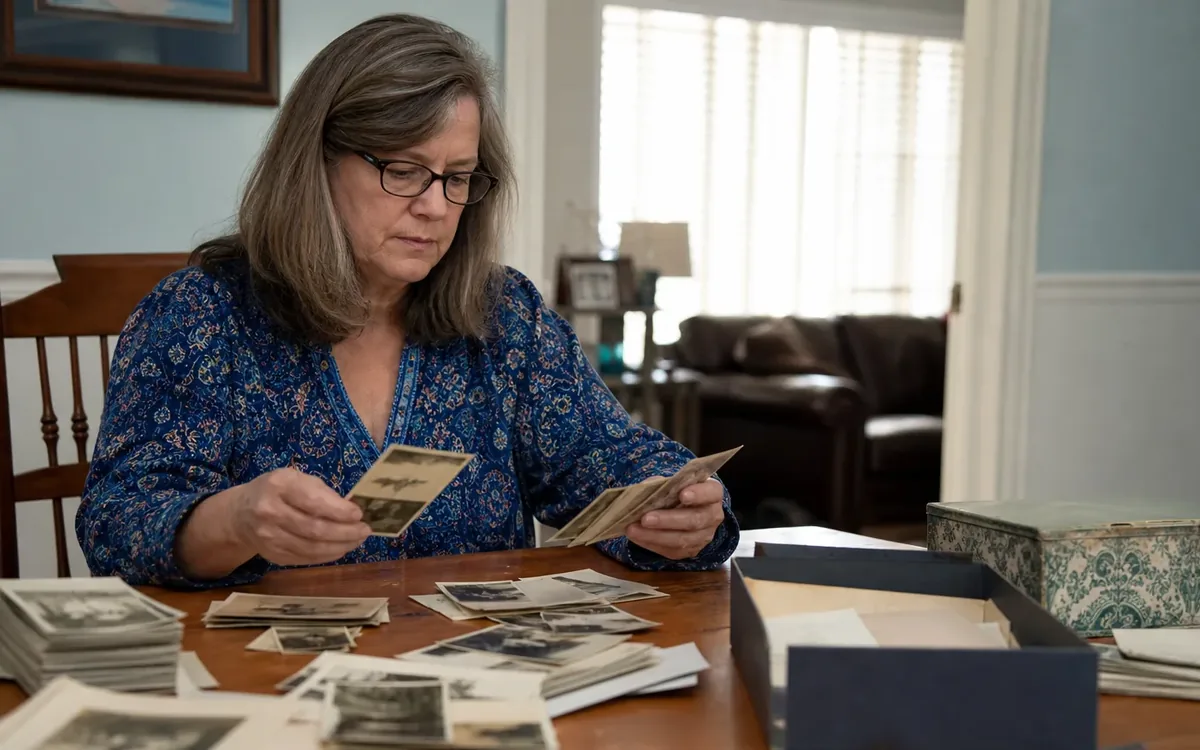
Remove duplicates without removing evidence
Duplicate reduction is usually the safest way to shrink a genealogy collection. It still requires comparison. Two copies of the same-looking record may contain different notes, image quality, page backs, attachments, or source information.
Before removing a duplicate, check:
- Whether every page is present
- Whether either copy has handwriting or highlighting
- Whether one image is clearer
- Whether the reverse side contains information
- Whether a cover letter identifies the source
- Whether the files belong to different family branches
- Whether one copy has a citation and the other does not
Keep the clearest complete copy with the best source information. If handwritten comments add value, retain that copy or scan the annotations before consolidating.
Printed database results, blank pedigree charts, old search instructions, and repeated public-record printouts may be candidates for removal after verification. Sensitive paper should not be placed casually in household trash. The household should choose an appropriate secure-destruction option and confirm that it meets its privacy needs.
Discarding paper is a household or authorized fiduciary decision. If ownership is uncertain, pause. An executor, personal representative, attorney, court, organization, or other responsible authority may need to determine whether material can be transferred or destroyed.
What should be digitized, and what should remain on paper?
Digitization improves access and reduces dependence on bulky working copies, but it does not automatically replace an original. Scan for use and backup, then make a separate retention decision about the physical item.
Prioritize these materials for digitization:
- Unique photographs and negatives
- Handwritten letters, diaries, and research notes
- Family Bible entries
- Fragile clippings with identifying context
- Annotated deeds, plats, and military records
- Oral histories and older audiovisual formats
- Documents frequently shared among relatives
Create files that another person can understand without opening every image. A practical filename can include surname, given name, record type, place, and date when known. For example: Ravenel_Thomas_land-plat_Charleston-County_1912.
When a detail is uncertain, say so. Use terms such as unidentified, possibly, or circa rather than presenting an assumption as established fact.
Preserve source details in the file metadata, a companion spreadsheet, or a text document. Note where the original came from, who owned it, what the image depicts, and how names were identified. A scan without context can become another unidentified object.
Keep more than one digital copy in separate locations or systems selected by the household. Check that files open before disposing of any replaceable paper. Storage vendors, cloud accounts, hard drives, and media-conversion companies are separate choices. Review their security, access, format, and account-transfer terms directly.
An archivist or conservator should advise on fragile originals, mold, adhesive albums, brittle paper, damaged photographs, or unusual media. A cleanout or move team may discuss handling zones and packing logistics, but conservation treatment belongs with an appropriately qualified professional.
Label unidentified records instead of guessing
Unidentified material deserves its own structured category. Do not write a confident name on a photograph because one relative thinks the face looks familiar. Record the proposed identity and the source of that opinion.
Use four fields when labeling an unknown item:
- What is visible: Clothing, uniform, building, studio mark, cemetery, or landscape
- Possible identity: Include the word “possible” or a question mark
- Reason: Resemblance, album position, handwriting, location, or family statement
- Source of the claim: Name of the relative, note, album caption, or record comparison
For example: “Possibly Lila Grant, based on identification by cousin Anne in an undated note; studio mark indicates Columbia, South Carolina.” This is more useful than either discarding the photograph or assigning an unsupported identity.
Keep unidentified items near the most likely family group, but use a distinct folder so assumptions remain visible. A digital “unknowns” folder can also be shared with relatives who may recognize people or places.
Preserve South Carolina context with each record
Place names matter in South Carolina genealogy. County boundaries, church affiliations, cemetery names, military units, and land descriptions can distinguish people who share the same name. Preserve the wording found on the record, even if current terminology differs.
For county or land material, keep deeds, plats, abstracts, maps, and research notes together when they explain one another. Do not assume an old property document establishes present ownership, boundaries, market value, or legal rights.
Those conclusions belong to the relevant professionals or authorities. An attorney addresses legal interpretation. A surveyor addresses boundary work. An appraiser provides a qualified valuation. A real-estate professional advises on listing and transaction matters. Inspectors and government authorities address inspection or compliance requirements within their roles.
Likewise, church or cemetery records may be meaningful without granting the holder authority over burial rights, access, or organizational records. Contact the responsible church, cemetery, archive, county office, or other repository about its policies.
Keep research citations and repository details attached to copies. If a page came from a county office, church register, archive, website, book, or family collection, record that origin. Context is often more important than the paper itself.
Choose a future custodian, not just a recipient
A person willing to inherit boxes is not necessarily prepared to manage a family archive. A future custodian should understand what exists, where it is stored, how digital access works, and which materials carry restrictions.
Discuss these points with the proposed custodian:
- Which family lines and locations the collection covers
- Which items are original, fragile, or especially significant
- How paper folders correspond to digital folders
- Where passwords and account-transfer instructions are maintained
- Whether other relatives should receive copies
- What may eventually be offered to a repository
- Which conclusions are proven, disputed, or still being researched
Create a concise collection guide. It can list major surnames, South Carolina counties, churches, cemeteries, military connections, land records, storage locations, and digital file locations. Include a “start here” folder containing the guide, a family tree overview, and the strongest source notes.
Ownership and inheritance should not be assumed. Wills, estate instructions, donor agreements, copyright, privacy, and fiduciary duties may affect who can keep, copy, publish, donate, or destroy records. The responsible attorney, personal representative, court, repository, or rights holder should resolve those issues.
Keep cleanout logistics separate from historical judgment
During a move or household cleanout, physical organization and historical evaluation are different tasks. Combining them can cause rushed decisions.
The household or authorized decision-maker can determine:
- Which relatives should review the collection
- What family lines take priority
- Which verified duplicates can go
- What should be scanned
- Who may receive paper or digital copies
- What privacy level is appropriate
A practical cleanout or move team may discuss:
- Establishing keep, review, and removal zones
- Grouping labeled genealogy containers
- Packing selected records for a move
- Coordinating genealogy work with broader household tasks
- Keeping protected material separate during home preparation
Other decisions remain with separate professionals or authorities. Appraisers evaluate financial value. Real-estate professionals advise on property transactions. Contractors handle specialized property work under their own terms. Inspectors and agencies determine applicable requirements. Attorneys and courts address legal authority. Archives, libraries, churches, cemeteries, and historical organizations decide what they accept.
Storage, disposal, shredding, media conversion, conservation, appraisal, and donation are also separate household or provider choices. Confirm scope, terms, and suitability before authorizing work.
A focused final review
After consolidation, review the collection for continuity rather than volume. Someone unfamiliar with the research should be able to identify the main families, understand the filing system, locate important originals, and see which questions remain open.
Check that:
- Unique originals are protected and labeled
- Retained copies include source information
- Unidentified items remain clearly marked as uncertain
- Sensitive information has controlled access
- Digital files open and have understandable names
- Paper and digital folders follow a compatible structure
- A future custodian has agreed to the role
- Legal or ownership questions have been referred appropriately
The best result is a smaller collection with stronger context. Removing repetition while preserving evidence makes the family history easier to use, share, and continue.
FAQ
Should every original genealogy document be kept?
Not automatically, but do not discard an original merely because it was scanned. Consider uniqueness, condition, annotations, provenance, family meaning, privacy, ownership, and repository interest. Seek archival, appraisal, or legal guidance when those issues exceed the household’s expertise.
Can old genealogy papers be donated?
Possibly. Contact the relevant archive, library, church, historical organization, cemetery organization, or other repository before packing or delivering anything. Each institution sets its own collecting scope, condition requirements, ownership documentation, and transfer terms.
What if no relative wants the collection?
Create a collection summary and identify institutions connected to its strongest geographic, religious, military, or family themes. Ask whether they are interested before arranging a transfer. The authorized owner must approve donation or disposal.
Is a phone photo enough for digitization?
It may be useful for quick reference, but important records benefit from complete, readable images, consistent filenames, source notes, and verified backups. Fragile or unusual materials may require advice from an archivist, conservator, or media specialist.
How can Clutter Cleaner of South Carolina fit into the process?
Clutter Cleaner of South Carolina, physically based in Mount Pleasant and serving households across South Carolina, may discuss downsizing, organizing, estate cleanouts, move management, home sale preparation, auctions and estate sales, or code compliance support as applicable to the household transition. The family or authorized representative makes retention decisions, while legal, appraisal, archival, real-estate, inspection, and compliance judgments remain with the responsible professional or authority.



