

When moving from a larger South Carolina home to a smaller one, choose artwork by starting with the walls available in the new home, not by sorting pieces in isolation. Measure usable wall areas, assign each area a purpose, and keep the pieces that combine personal meaning, suitable scale, good condition, and a realistic hanging location. Then make separate plans for artwork that may need appraisal, sale, gifting, storage, donation, or disposal.
Quick answer: Create a measured wall plan for the smaller home. Match favorite pieces to specific locations, allowing room around furniture, doors, windows, switches, and vents. Keep only what has both meaning and a plausible place. Set aside potentially valuable work for an independent qualified appraiser, then decide separately what to gift, sell, store, donate, or discard.
Why should you measure the new home before sorting the art?
Downsizers often have more art than walls because a larger home may include long hallways, guest rooms, formal dining spaces, multiple living areas, and generous stair landings. A smaller home changes both the amount and proportions of display space.
Without measurements, it is easy to keep too many large pieces or assume several frames will form a gallery wall somewhere. Measuring turns a vague emotional decision into a practical design problem.
Record the width and height of each usable wall section. Do not count every painted surface as display space. Account for:
- Furniture height and width
- Doors and their swing paths
- Windows and trim
- Light switches, thermostats, and control panels
- Air returns, vents, and electrical panels
- Built-in shelving and cabinets
- Television placement
- Existing picture rails or hanging systems
- Areas exposed to strong sunlight, humidity, or cooking residue
Create a simple sketch of each room. Label possible locations such as “over sofa,” “entry wall,” or “bedroom dresser.” Exact interior design decisions remain with the household or its chosen designer, but even a rough plan reveals whether a piece has a credible destination.
If artwork decisions are part of a broader household reduction, review the downsizing and organizing service to understand how a practical team may help structure sorting and move preparation across South Carolina.

Build an artwork inventory tied to actual wall space
Before deciding what stays, make one inventory of paintings, prints, photographs, mirrors, textiles, shadow boxes, certificates, and other framed pieces. Include items already on the walls as well as pieces in closets, attics, cabinets, and storage areas.
For each item, record:
- A short description or photograph
- Overall framed width and height
- Orientation, such as portrait, landscape, or square
- Frame depth if clearance may matter
- Condition of the artwork, glazing, mat, frame, and hanging hardware
- Personal or family significance
- Artist name, signature, label, receipt, or ownership record
- Current room and proposed destination
- Whether professional valuation may be appropriate
Measure the outer edge of the frame rather than the visible image. That is the space the piece will occupy. For grouped artwork, measure each item and estimate the gaps between frames.
Use labels such as “living room option A” or “possible hallway group” rather than deciding immediately. This keeps the first pass focused on gathering facts.
Artwork can also become mixed into a larger estate or household project. The guide on how estate cleanouts work explains how sorting, decision-making, removal, and separate professional roles can fit together without treating every possession the same way.
How do you decide which pieces deserve limited wall space?
Use meaning and fit together. Sentimental importance alone may produce an overcrowded home, while size alone may eliminate the pieces that make the new residence feel familiar.
Evaluate each piece through five questions:
- Would I choose to see this regularly? A piece may be important without needing permanent display.
- Does it fit a measured location? Identify a real wall rather than an imagined future spot.
- Does its scale suit the nearby furniture? A frame that worked above a wide mantel may overwhelm a compact room.
- Is its condition acceptable? Look for fading, moisture marks, cracked glazing, loose corners, pests, or unstable backing.
- Does it duplicate another piece’s role? Several family portraits, landscapes, or commemorative items may compete for the same limited area.
A useful priority order is:
- Irreplaceable pieces with strong personal meaning
- Works that define the household’s preferred style
- Pieces appropriately scaled for known walls
- Art that connects rooms through color or subject
- Flexible small works that can rotate seasonally
Avoid making every selection based on who gave the item. A gift can be appreciated without remaining on display forever. Similarly, an inherited piece can be documented, offered to relatives, or professionally assessed before the household decides its future.
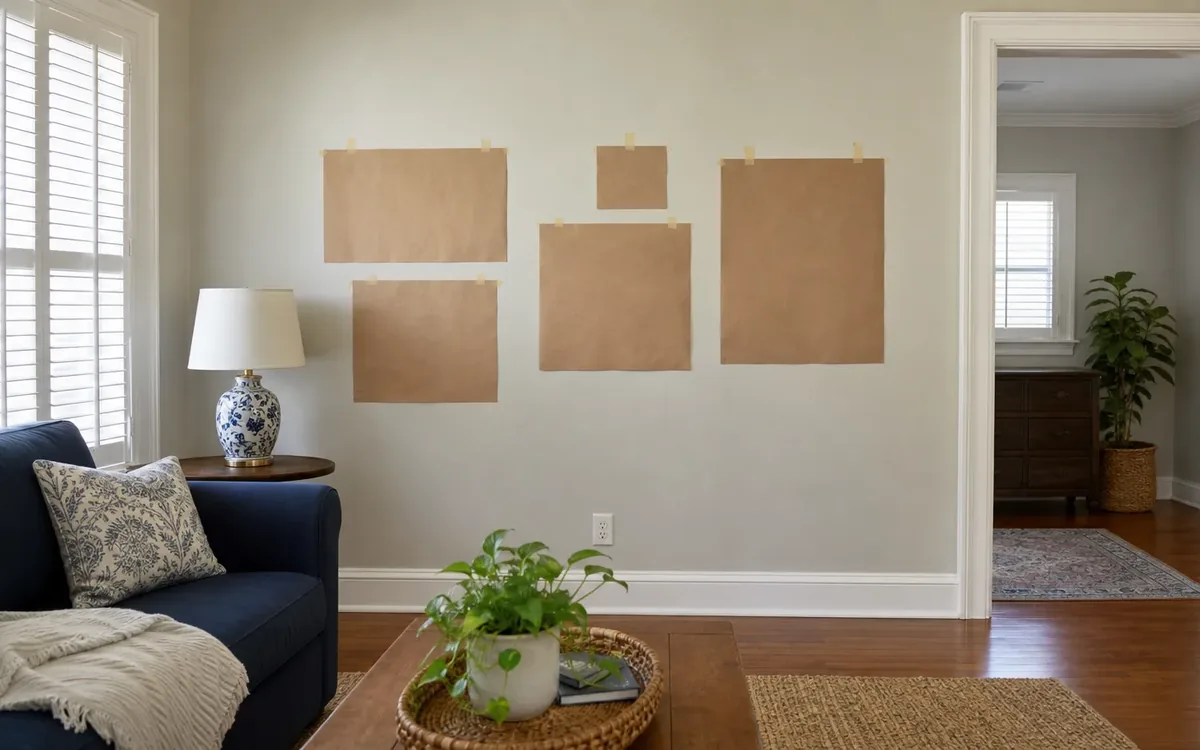
Test placement without hanging everything
A floor plan indicates whether a piece can fit, but a wall template shows how it will feel. Cut paper or reusable material to the framed dimensions, label it, and position it with removable painter-safe products appropriate for the wall finish. Follow product directions and test finishes where needed.
Templates help answer practical questions:
- Does the frame crowd nearby trim?
- Is the piece too high or low relative to the furniture?
- Will a grouping look balanced?
- Can doors and cabinets open fully?
- Does the room have too many visual focal points?
- Is glare likely to interfere with viewing?
Do not assume existing hooks are safe or correctly positioned. The household can select locations, but a qualified installer or appropriate contractor should determine suitable fasteners for heavy, fragile, or unusually shaped pieces. Wall composition, frame weight, anchoring requirements, wiring, plumbing, and lease or building rules may affect installation.
For valuable or delicate artwork, consult a professional art handler, conservator, or installer about packing and hanging. A cleanout or move team may discuss sequencing, access, sorting zones, and whether items should be kept apart during the transition. It should not substitute for conservation or structural expertise.
Create a clear hierarchy instead of filling every wall
A smaller home generally benefits from intentional focal points. Trying to transfer every arrangement from the previous home can make rooms feel unsettled and can increase the risk of damage.
Choose a primary piece or grouping for each main space. Secondary pieces should support it rather than compete with it. Leaving some walls open can make the selected artwork more noticeable.
Consider these arrangement strategies:
- Use one strong piece where several small items previously hung.
- Keep a coordinated set together if separating it weakens its meaning.
- Break up a casual collection when individual works fit different rooms.
- Limit dense groupings to walls with adequate viewing distance.
- Use shelves only when their load capacity and item stability are appropriate.
- Rotate lightweight pieces if safe storage is available between displays.
Mirrors require separate thought. They reflect light and views, so their effect depends on what faces them. Heavy mirrors also need appropriate anchoring. Decorative plates, quilts, tools, masks, and dimensional objects may require specialized mounts.
Photographs and documents can sometimes be scanned to preserve their information even when the original frame is not kept. Digitization is a household choice or a separate provider service. It does not determine whether an original has financial, historic, or archival value.
What should happen to artwork that does not fit?
Give every nonselected piece a named destination. Avoid a single “later” stack, which merely transfers the decision to the new home.
Possible destinations include:
- Family or friends: Offer specific pieces to specific people and set a clear process for responses and collection.
- Professional appraisal: Separate items whose artist, provenance, age, or market may justify expert review.
- Sale: An auctioneer, estate-sale provider, gallery, dealer, or consignment business can discuss suitability and terms.
- Donation: Ask the receiving organization what it accepts before transporting framed work.
- Storage: Use only when there is a defined reason, suitable conditions, and a future review plan.
- Reframing or conservation: Consult an appropriate framer or conservator before altering significant work.
- Disposal: Reserve this for pieces that are unwanted, unsafe, badly damaged, or not accepted elsewhere.
Do not treat appraisal and sale as the same decision. An appraisal prepared for insurance, estate, charitable, or equitable-distribution purposes may involve different standards and intended uses. A qualified appraiser should identify the appropriate valuation scope. A sale provider decides what it is willing to accept and under what agreement.
Ownership questions also come first. Executors, trustees, personal representatives, co-owners, or beneficiaries may have authority or interests that an organizer cannot resolve. Direct questions about title, inheritance, estate administration, tax effects, charitable deductions, or required records to the responsible attorney, accountant, fiduciary, or other qualified professional.
Plan safe packing as a separate step
Once the household has identified what will move, organize artwork by destination and handling need. Do not place framed pieces loosely into a general household-removal pile.
Before packing, consider:
- Whether glass or acrylic covers the work
- Whether the frame or backing is loose
- Whether the surface can tolerate contact with packing material
- Whether climate or moisture exposure poses a concern
- Whether insurance documentation is needed
- Whether a professional art mover should handle the piece
Use clear destination labels that do not adhere directly to artwork or delicate frames. Keep appraisal candidates and ownership documents together, but do not place paperwork where it can rub against a work’s surface.
A practical cleanout or move team may discuss room sequencing, staging areas, pathway clearance, labeling, and which items require separate providers. The household decides what will move and who receives it. Art handlers, movers, storage facilities, insurers, appraisers, conservators, and contractors remain responsible for the work within their respective agreements and expertise.
Storage deserves particular caution. A storage provider should explain its unit conditions, access rules, insurance requirements, and prohibited items. A conservator or art-storage specialist can advise on environmental needs. No general organizer or cleanout team should guarantee that ordinary storage will preserve artwork.
Coordinate artwork decisions with the wider move
Artwork should be settled early enough that it does not block other rooms or become vulnerable during furniture removal. It should also stay visible long enough for decision-makers to inspect it.
A practical sequence is:
- Inventory and measure the framed collection.
- Measure usable walls in the smaller home.
- Assign preferred pieces to specific locations.
- Isolate appraisal, ownership, or conservation questions.
- Choose destinations for the remaining pieces.
- Arrange packing and transport with appropriate providers.
- Confirm installation requirements after furniture placement.
This sequence contains seven steps, each addressing a different decision. It prevents valuation questions from becoming mixed with ordinary donation or disposal and keeps installation separate from selection.
Clutter Cleaner of South Carolina is based in Mount Pleasant and serves households across South Carolina, with Charleston as its primary market. For a project involving downsizing and organizing, move management, estate cleanouts, auctions and estate sales, home sale preparation, or code compliance support, call (843) 972-7020 to discuss the household’s scope. Availability, provider fit, and project details should be confirmed directly.
Who is responsible for the decisions?
Clear role boundaries protect both the artwork and the household.
The household or authorized decision-maker can decide:
- Which pieces carry personal meaning
- What will be displayed in the new home
- Which relatives or friends may receive items
- Whether to seek appraisal, sale, donation, storage, or disposal
- Which independent providers to hire
- What budget and level of effort are acceptable
A practical cleanout or move team may discuss:
- Inventory and category systems
- Sorting areas and workflow
- Destination labels
- Move sequencing and access
- Separation of fragile or specialist items
- Coordination questions to raise with other providers
Responsible professionals or authorities decide within their fields:
- Appraisers determine valuation methods and conclusions.
- Attorneys, courts, fiduciaries, and tax professionals address legal authority, ownership, estate, and tax issues.
- Real-estate professionals advise on listing presentation and buyer-facing choices.
- Inspectors and contractors evaluate walls, anchors, repairs, and building conditions.
- Building managers, associations, landlords, or authorities interpret applicable property and compliance rules.
- Conservators, art handlers, and storage specialists advise on preservation and specialized handling.
Keeping these roles separate helps the household make confident personal choices without relying on an organizer for conclusions outside the organizer’s scope.
Short FAQ
Should every inherited artwork receive an appraisal?
Not necessarily. The household can first identify signatures, labels, receipts, artist information, and provenance. If financial value, equitable distribution, insurance, tax reporting, or estate administration may matter, ask a qualified appraiser or responsible professional whether an appraisal is appropriate.
Can large artwork work in a small home?
Yes, if it fits a measured wall, suits the viewing distance, clears furniture and controls, and can be installed safely. One large focal piece may work better than numerous small frames, but the room layout should guide the choice.
Is a photograph of sentimental art enough?
That is a personal decision. A high-quality photograph can preserve the image and story, but it is not the same as retaining the original. Photograph labels, signatures, inscriptions, and frame details before giving up the piece.
Should artwork be chosen before furniture placement?
Select likely pieces from the measured plan, but confirm final hanging positions after major furniture is placed. Furniture dimensions and walking paths can change the visual balance and safe installation area.
What if family members want the same piece?
Pause distribution until the authorized decision-maker establishes a fair process. If the piece belongs to an estate, trust, or multiple owners, direct authority and distribution questions to the responsible fiduciary or attorney rather than asking a move or cleanout team to decide.
Is temporary storage a solution for undecided art?
It can postpone a decision, but it should not become the default. Confirm why each piece is being stored, who will review it, and whether the facility and insurance arrangements are appropriate. Seek specialist guidance for artwork sensitive to temperature, humidity, light, pests, or handling.



