

Parents preparing to downsize can return adult children’s childhood belongings without making every decision for them. Separate each child’s items, send a clear inventory, set a written response and pickup deadline, and ask each person to choose pickup, shipping, independent storage, donation, or disposal. Keep sentimental decisions with the owner while protecting the household’s moving schedule.
Quick answer: Sort belongings by adult child, photograph or list the contents, and offer a limited menu of choices. Each child should decide what to keep and arrange pickup, shipping, or storage. State in writing what will happen to unclaimed items after the deadline, but confirm ownership and legal authority before donating, selling, or discarding anything that may not belong to you.
This approach is especially useful for South Carolina parents who have become long-term caretakers of trophies, schoolwork, yearbooks, toys, furniture, and sealed boxes. The goal is not to settle the emotional value of a childhood. It is to transfer responsibility before the downsizing project reaches its final stages.
Why should adult children decide what happens to their belongings?
A parent may know where the boxes have been stored, but an adult child is usually better placed to judge which yearbook, award, or handwritten note matters. Making those choices on someone else’s behalf can create conflict and leave the parent carrying both the physical work and the emotional burden.
There is also an important difference between family history and ownership. A photograph copied for several relatives is not the same as a diploma issued to one child. Furniture purchased by a parent is not necessarily treated like property the child bought and left behind. If ownership is disputed, an attorney or other appropriate legal professional should address it. A cleanout or move team does not determine title to property.
Assigning decisions to adult children helps establish a practical boundary:
- The household decides how much space remains available and when it must be cleared.
- Each adult child decides which of their belongings they want.
- The child chooses and pays for any shipping or independent storage they request, unless the family agrees otherwise.
- The household decides whether it is willing to coordinate access, packing, or a carrier pickup.
- A qualified professional determines legal, appraisal, inspection, real-estate, or compliance questions within that professional’s role.
If the whole home needs preparation beyond these personal boxes, review the downsizing and organizing service to understand the practical sorting and transition work that may be discussed.
What should you gather before contacting each child?
Do a limited identification pass rather than opening every folder and reading every letter. The immediate purpose is to show each adult child what exists and where it is, not to complete their sentimental sorting for them.
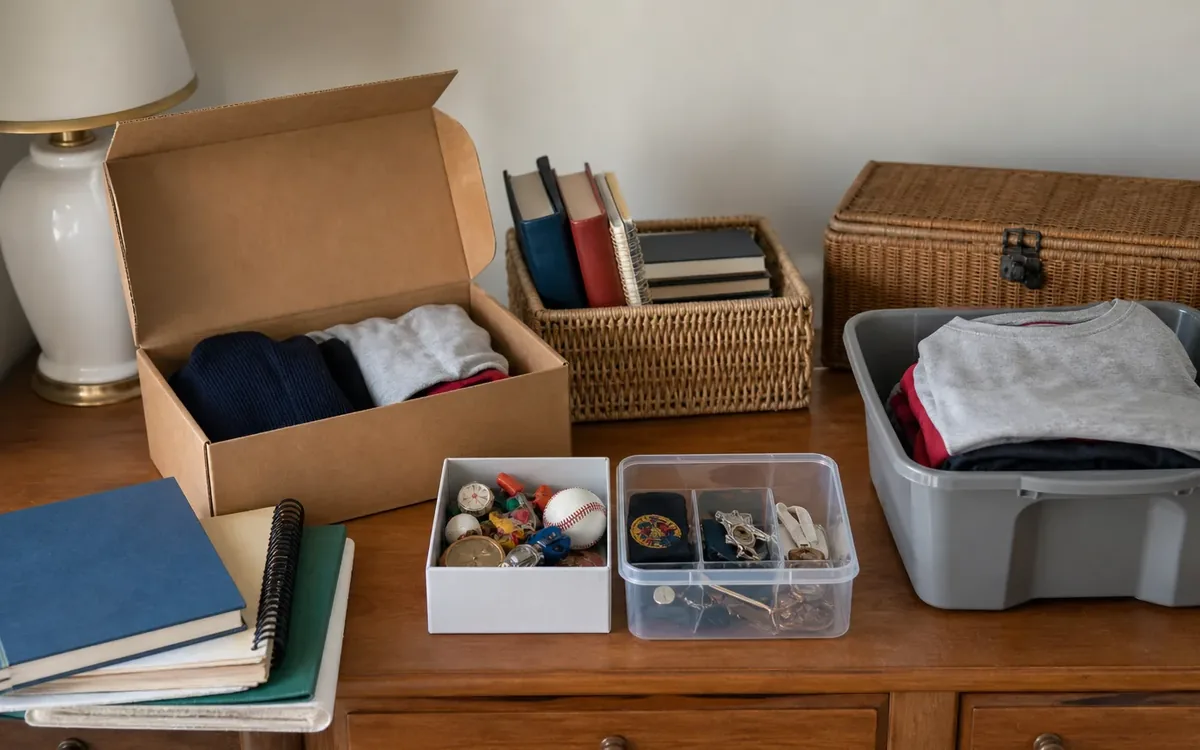
Create one staging area per child when space permits. Label containers with names and broad descriptions such as “school papers,” “sports awards,” or “bedroom décor.” Avoid combining siblings’ belongings simply because they came from the same closet.
Build a simple inventory containing:
- The number and general type of containers
- Oversized objects that cannot fit in a standard box
- Fragile belongings needing special handling
- Furniture dimensions, if relevant
- A few clear photographs of representative contents
- Items that may contain personal information
- Anything whose ownership is uncertain
Do not describe an object as worthless merely because it has no obvious use in the new home. Likewise, do not promise that an old toy, collectible, or signed item is valuable. A qualified appraiser should provide valuation guidance when value could affect a sale, insurance decision, estate matter, or family distribution.
Keep passports, birth certificates, financial records, medical records, and similar documents out of general donation or disposal piles. The document owner, an attorney, an accountant, or the relevant issuing authority can advise on retention, replacement, and secure destruction as appropriate.
For a broader look at separating property and preparing a home, the guide on how estate cleanouts work explains the roles that families and practical cleanout teams may discuss. An estate process may involve legal authority that does not apply to an ordinary downsize, so the two situations should not be treated as identical.
How do you set a pickup deadline without starting an argument?
Use one written message that is warm, specific, and operational. A vague request such as “please go through your old things sometime” leaves the parent responsible for reminders and leaves the child unsure about urgency.
A useful message has five parts:
- Explain that the home is being downsized and storage space will no longer be available.
- Describe the child’s belongings and attach the inventory or photographs.
- Offer the available choices, such as pickup, carrier shipping, independent storage, donation, or disposal.
- State separate deadlines for responding and removing the belongings.
- Explain the proposed treatment of unclaimed property, subject to ownership and legal requirements.
For example:
We are preparing to downsize and can no longer store the childhood belongings labeled for you. The attached photos show the boxes and larger items. Please tell us in writing by [response date] whether you will pick them up, arrange shipping, rent storage, or authorize donation or disposal. All items you are keeping must leave the house by [removal date]. If we do not hear from you, we plan to [state proposed action], provided we have the authority to do so.
Choose deadlines based on the household’s actual move, closing, contractor, or possession schedule. Do not create a deadline that leaves no room to resolve uncertain ownership or arrange safe access. If a real-estate contract, court instruction, lease, probate matter, or municipal requirement controls the property, the responsible attorney, real-estate professional, court representative, landlord, or authority should clarify the governing obligation.
Send the same basic information to each sibling, adjusting only the property details. Consistent terms reduce arguments about favoritism. Keep replies so that approved donations, pickups, and other choices are documented.

Give adult children a limited menu of transfer choices
An open-ended question invites delay. A defined menu moves the conversation from “Do you want this?” to “How will this leave the house?”
Personal pickup
The adult child selects a mutually acceptable access time and brings suitable transportation, lifting help, containers, and packing materials. The household can decide which rooms are accessible and whether items must be staged near an entrance.
Do not assume a parent or transition team can safely move heavy furniture, attic contents, or objects down stairs. Appropriate movers or specialty providers may be needed.
Shipping arranged by the child
The child chooses the carrier, service level, insurance options, packing standard, destination, and payment method. The household should clarify whether it is willing to box items, print labels, or wait for pickup.
Fragile artwork, antiques, instruments, collections, and unusually shaped objects may require a professional packer or specialty shipper. Those providers determine what they will accept and how it must be packed.
Independent storage
Storage is the adult child’s decision when they want the property but cannot receive it. They should select the facility, sign the agreement, understand access and insurance terms, arrange transportation, and remain responsible for ongoing charges.
Moving boxes into a unit rented by the parent often extends the same problem under a new address. If a parent voluntarily offers temporary storage, put the arrangement and its end condition in writing.
Authorized donation or disposal
Ask for clear written permission identifying which belongings may be donated or discarded. Confirm that the person giving permission owns the property or has authority to direct its disposition.
Donation recipients set their own acceptance rules. Disposal providers and local authorities determine what may enter a particular waste stream. Paint, chemicals, batteries, electronics, medical materials, and other restricted items may need separate handling under current local rules.
Possible sale or appraisal
A child who believes an item has material value can arrange a qualified appraisal or speak with an appropriate auction, estate-sale, consignment, or specialty resale provider. The provider decides whether the property fits its sale model and explains its own terms.
A practical cleanout or move team may help identify a group of items for further review, but it should not substitute for a formal appraisal or guarantee a sale result.
What if an adult child does not respond?
First, separate silence from refusal. Confirm that the message reached the correct email address or phone number. Send one concise reminder containing the inventory, choices, and deadlines rather than restarting the emotional discussion.
Next, identify property that should not be handled without further guidance. Pause action when:
- Ownership is disputed or unclear.
- A divorce, probate case, bankruptcy, court order, or other legal proceeding may affect the property.
- The belongings include firearms, regulated materials, medication, or sensitive records.
- A third party claims an interest in an item.
- The parent lacks authority to direct a sale, donation, or disposal.
- A contract or official requirement governs when the home must be emptied.
An attorney should interpret legal rights and notice requirements. Relevant authorities or qualified providers should advise on regulated materials. The household should not rely on a blog, mover, organizer, or cleanout provider for a legal determination.
When there is no dispute and the household has confirmed its authority, follow the written plan consistently. Record the final disposition with a simple list, receipt, or photograph when useful. Documentation can reduce later confusion, but it does not create legal authority where none exists.
Do not keep extending storage automatically because a child replies with “I’ll get to it.” Ask for a specific choice and removal arrangement. A deadline works only when the next step is understood.
Keep childhood memories separate from the moving schedule
Sentimental sorting can expand until it consumes the entire downsize. Prevent that by distinguishing memory decisions from logistics.
A child does not need to review every elementary school worksheet in the parent’s home. They can take the labeled container and sort it in their own space. If they do not want the full container, ask them to identify only the categories or specific objects to retain.
Useful boundaries include:
- One designated review area rather than belongings spread through the house
- No returning unwanted boxes to the parent after pickup
- No “temporary” pile without an owner and exit plan
- Digital copies only when someone has agreed to scan and organize them
- One family discussion for shared photographs or heirlooms
- Separate handling for confidential documents and potentially valuable objects
Parents can choose to keep a few memories for themselves. That should be a conscious choice based on the new home’s available space, not a way to postpone the child’s decision.
If siblings want the same item, stop treating it as ordinary clutter. The family can agree on a selection method, make copies where practical, or seek legal guidance if ownership or estate rights are involved. A transition provider may facilitate sorting logistics, but should not decide which relative receives contested property.
Coordinate the handoff with the wider downsize
Children’s belongings should have their own track within the home transition. Mixing them immediately into household furniture, donations, sale candidates, and contractor debris makes mistakes more likely.
Use four clearly marked zones:
- Awaiting decision: Inventoried property with a pending response deadline
- Leaving by pickup or carrier: Confirmed property with a named recipient
- Authorized for donation or disposal: Property with documented direction
- Hold for professional guidance: Disputed, regulated, sensitive, or potentially valuable property
A practical cleanout or move team may discuss staging, labeling, packing coordination, donation preparation, removal sequencing, and access needs. Clutter Cleaner of South Carolina provides downsizing and organizing and move-management services across South Carolina, with its physical business location in Mount Pleasant and Charleston as its primary market. The exact scope should be confirmed for the household’s project.
Other decisions remain separate. Movers establish their transport terms. Storage facilities control their contracts. Contractors determine construction scope and site requirements. Appraisers issue value opinions. Real-estate professionals advise on listing and transaction strategy within their roles. Inspectors report on property conditions. Government authorities interpret applicable compliance requirements. Attorneys advise on ownership, notice, estates, and disputes.
Before work starts, tell every involved provider which boxes are protected and which are cleared to leave. Labels should be readable from more than one side, particularly when containers will be stacked.
Common mistakes that keep the boxes in the house
One common mistake is asking emotional questions instead of logistical ones. “Don’t you care about your childhood?” is unlikely to produce a shipping label. “Which removal option are you choosing?” is answerable.
Another is offering unlimited sorting time during visits. Family gatherings can become unproductive when each object prompts a story. Set aside only the items needing shared discussion, then let each adult child take their personal boxes elsewhere.
Avoid these additional problems:
- Moving every box to the new home by default
- Paying indefinitely for storage without a written agreement
- Shipping items before the recipient confirms an address and accepts delivery
- Donating property based only on one sibling’s permission when ownership differs
- Treating family photographs as if only one person can receive copies
- Discarding documents without checking privacy and retention concerns
- Assuming collectibles are valuable without appropriate appraisal
- Letting unclaimed boxes become mixed with contractor materials or general debris
The best boundary is calm and repeatable: the parent is ending storage, the adult child chooses what to retain, and the selected property needs a defined route out of the home.
Short FAQ
Can parents simply throw away belongings an adult child left behind?
Not always. Ownership, prior agreements, court matters, and other circumstances can affect what the parent may do. Give clear written notice and seek advice from a qualified attorney when authority is uncertain or the property is disputed.
Who should pay for shipping or storage?
The family may agree on any arrangement, but the cleanest default is for the adult child who wants the property to choose and pay the carrier or storage provider. Put exceptions in writing so expectations are clear.
Should everything be appraised before a decision?
No. Consider professional appraisal when an item may have meaningful value or when value affects an estate, insurance, tax, sale, or family decision. An appraiser, not a cleanout or move team, provides the valuation opinion.
Can a downsizing team decide what gets donated?
The household or legally authorized person decides what may leave and how. A practical team may discuss sorting, staging, packing, and removal options, while donation organizations decide what they accept.
What if the child wants the items but has no room?
They can reduce what they keep, arrange shipping to another agreed recipient, or rent storage in their own name. The parent does not have to continue providing space unless the household willingly makes that arrangement.
Returning childhood belongings is a transfer of responsibility, not a judgment about family attachment. A clear inventory, limited choices, written deadlines, and separate professional guidance for legal or specialized issues allow the household to move forward without treating every trophy or yearbook as a crisis.



