
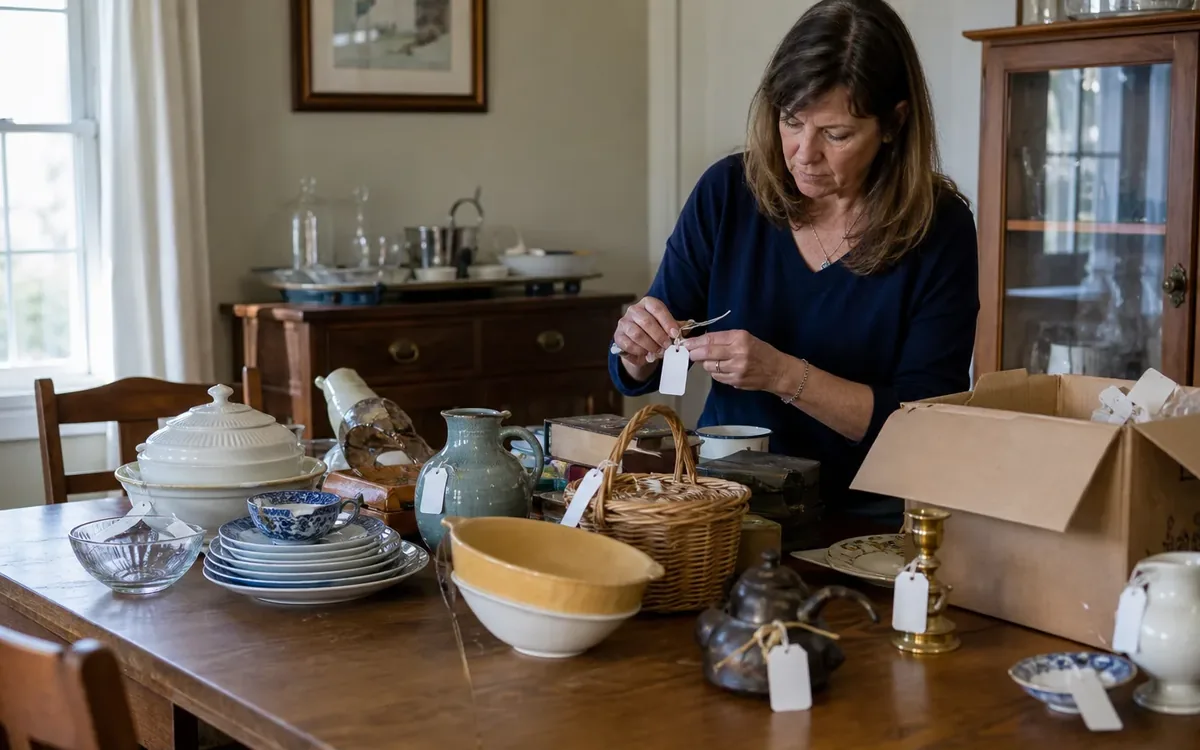
A useful estate auction lot-numbering system gives every offered item or grouped set one unique identifier, then repeats that identifier on the physical tag, inventory record, photographs, sale record, and pickup plan. For a South Carolina estate spread across a house, garage, porch, and outbuilding, location codes can help organize the work, but the permanent lot number should stay unchanged when an item moves.
Quick answer: Choose one simple numeric sequence, assign each lot only once, and maintain a master inventory that connects the number to its description, photos, current location, status, and buyer or pickup details. Use separate fields for location and status instead of repeatedly changing the lot number.
A household can decide how possessions are grouped, which rooms need labels, and who may update its working inventory. The auctioneer or sale operator should determine what numbering format works with the sale platform and transaction process. Questions about estate authority, ownership, beneficiary rights, taxes, restricted items, or required records belong with the appropriate attorney, personal representative, tax professional, auction professional, or government authority.
What should an estate auction lot number accomplish?
A lot number is a stable link between an object and every record associated with it. It is not merely a sticker used during bidding. A good identifier helps prevent confusion when similar furniture, tools, dishes, artwork, or boxed goods appear in different parts of a property.
Each number should connect to:
- The physical item or grouped set
- A concise inventory description
- Photographs of the same lot
- The room or pickup location
- The sale status
- Buyer or transaction information maintained by the sale operator
- Notes about included pieces, condition, or handling
The number should be unique within the estate. Avoid reusing a removed lot number for another object. A record marked withdrawn or not for sale is clearer than a number that suddenly points to something different.
Keep meaning out of the core number whenever possible. A number such as 0247 remains useful if a table moves from the dining room to a staging area. A code such as DIN-TABLE-1 becomes misleading after the move.
A household preparing for sale may also review Clutter Cleaner of South Carolina’s auctions and estate sales service to understand where practical preparation may fit alongside the auction professional’s work.
How should lot numbers and location codes work together?
Use a permanent lot number and a separate location code. This two-part structure lets the identifier remain stable while the location field changes as items move through sorting, photography, staging, and pickup.
A straightforward arrangement could look like this:
0001,0002, and0003as permanent lot numbersH-LRfor house, living roomH-BR2for house, second bedroomGAR-Nfor garage, north wallPORCHfor porchOB-Afor outbuilding APICKUP-1for a designated pickup zone
The household can choose labels that make sense on the property. Keep them short, readable, and distinct. If there are two sheds, name them before cataloging begins rather than using the word “shed” for both.
A master record might read:
Lot 0148 | Painted side table | H-BR2 | Photographed | Included in sale
If the table is moved, revise only the location field:
Lot 0148 | Painted side table | PICKUP-1 | Sold | Awaiting release
Do not renumber the table because its location or status changed. That breaks the connection among its tag, images, listing, and sale record.
For estates that still require broader sorting and removal planning, the guide on the best way to clean out an estate explains how to separate decisions before disposal or property preparation begins.
Build the master inventory before labeling everything
The master inventory is the controlling record. It can be a spreadsheet, database, auction platform export, or another format approved by the person operating the sale. Only designated people should edit it.
Include fields that support identification without trying to replace professional appraisal, legal, or inspection work:
- Lot number: The unique, permanent identifier
- Short title: A recognizable name for the lot
- Contents: The specific pieces included
- Original location: Where the lot was first cataloged
- Current location: Where it can be found now
- Photo reference: File names or image links
- Status: Hold, approved, listed, sold, withdrawn, or another defined term
- Pickup zone: The release location, if applicable
- Notes: Visible condition, dimensions, missing pieces, or handling concerns
- Authority note: Who approved inclusion when that needs to be documented
Use controlled status terms rather than free-form comments. For example, choose either HOLD or REVIEW, not an assortment of phrases such as “maybe,” “ask family,” and “probably keep.” Define each status at the top of the inventory.
A household may document observable details such as scratches, approximate measurements, colors, and the number of pieces. It should not present guesses about authenticity, age, value, safety, or legal ownership as established facts.
Appraisers decide valuation and attribution within their professional scope. Auction professionals determine catalog conventions, bidding groups, listing language, and sale records. Attorneys or authorized estate representatives address disputed ownership and authority to sell.
How do you match tags, photographs, and records?
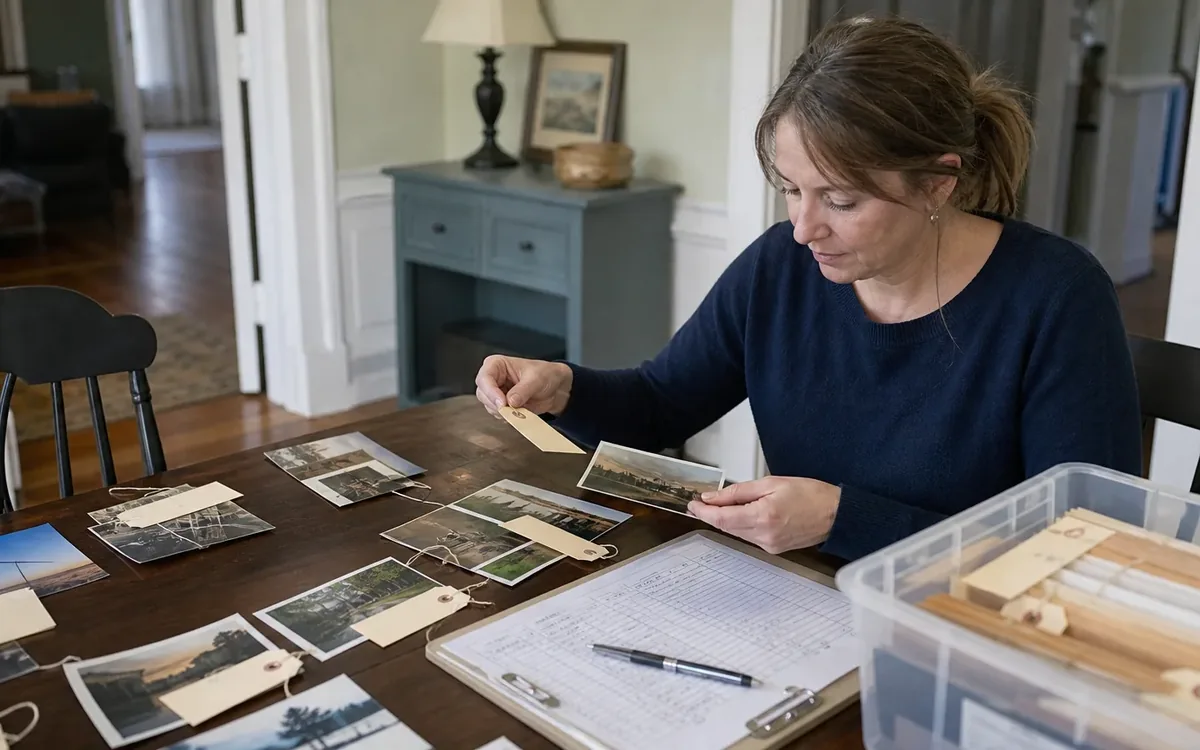
Treat the lot number as the shared label across every format. The physical tag, photo file names, inventory row, and auction listing should show the same identifier exactly.
Use this five-step process:
- Create the inventory row. Reserve the next number and enter a short description before placing a tag.
- Attach or place the tag safely. Avoid adhesive or fasteners that could damage finishes, paper, fabric, or fragile surfaces.
- Photograph the full lot. If several pieces are sold together, include an image showing the complete group.
- Photograph identifying details. Capture maker’s marks, damage, labels, signatures, model information, or included accessories when relevant.
- Review the match. Confirm that the visible tag, file name, description, and number all agree before moving on.
A practical photo naming pattern is 0148-01, 0148-02, and 0148-03. The digits after the hyphen identify individual images, not new lots.
Place a small lot card in the first photograph when practical, but do not let it cover an identifying mark or condition issue. For tiny, delicate, or valuable objects, a tag can sit beside the item rather than being attached to it.
Before publishing any image, inspect it for personal information. Remove or obscure visible bank records, medical paperwork, passwords, keys, alarm details, family photographs, and identifying documents. The responsible estate representative should decide what may be photographed or disclosed.
Decide whether objects belong in one lot or several
Lot composition is separate from numbering. First decide what is being offered together, then assign one number to that defined group.
Grouping may make sense for:
- A matching set of dining chairs
- A tool and its dedicated accessories
- A service of dishes
- A shelf of related books
- A framed pair intended to remain together
- A box of clearly described household goods
Separate lots may be clearer when objects have different owners, values, pickup requirements, or sale statuses. Do not combine items merely because they occupy the same table or box.
Write the included quantity into the record. “Four ladder-back chairs” is less ambiguous than “chairs.” If one chair is removed from the sale, revise the description and photographs under the auction professional’s process. Do not silently change the physical group.
The household or authorized representative can identify sentimental items, known family groupings, and objects that must remain on hold. The auction professional should advise how grouping affects catalog presentation and bidding. An appraiser should address value questions where a qualified opinion is needed.
Control numbering across the house and outbuildings
A multi-structure property creates two common risks: duplicate numbers and items that disappear from the record after being moved. A single sequence and a location map address both problems.
Designate one numbering source. This might be one spreadsheet controlled by a catalog lead or one numbered tag set issued from a central station. Do not let separate room teams start independent sequences unless the auction system has been intentionally designed to support prefixes.
Post a simple property location key at the work station. It could identify:
- Main house rooms
- Garage walls or bays
- Front and rear porch areas
- Named outbuildings
- Photography station
- Hold area
- Sold-item staging area
- Pickup zones
Avoid location descriptions that depend on movable landmarks. “Beside blue cabinet” stops working if the cabinet is sold or relocated. A fixed room name, wall, bay, or marked zone is more reliable.
South Carolina properties vary in layout, and porches or outbuildings may expose tags to moisture, wind, dust, heat, and fading. The household and sale operator can select suitable tag materials and sheltered placement based on actual site conditions. Tags should remain readable without damaging the objects.
Contractors make decisions about repairs and their work areas. Inspectors determine property-condition findings within their scope. Real-estate professionals guide listing and showing preparation. Keep auction inventory controls separate from contractor labels, inspection markers, and real-estate staging notes.
Track holds, withdrawals, sales, and pickup without renumbering
A lot’s number should survive every status change. Add or change a status field rather than covering the original number or assigning a replacement.
Useful status labels may include:
DRAFTfor catalog work in progressHOLDfor an unresolved decisionAPPROVEDfor authorized sale inclusionLISTEDfor a published lotWITHDRAWNfor a lot removed from saleSOLDfor a completed sale resultREADY FOR PICKUPfor an item placed in its release areaRELEASEDfor an item collected under the operator’s process
The exact terms should match the auctioneer’s platform and procedures. If a published lot must be withdrawn, retain the inventory row and reason according to the appropriate recordkeeping process.
Pickup control needs more than a buyer’s name written on masking tape. The sale operator should determine payment confirmation, buyer identification, release records, and authorization rules. The working inventory can still help by connecting each sold lot to a pickup zone and noting whether all components are together.
Large furniture may remain in its original room while smaller goods move to a release area. Record the actual location. If Lot 0321 consists of a table and six chairs, confirm that all seven pieces are accounted for before release.
Run an exception check before the catalog goes live
An exception check finds mismatches rather than rereading every description casually. Sort or filter the inventory to expose gaps.
Look for:
- Duplicate lot numbers
- Missing physical tags
- Tags that are difficult to read
- Inventory rows with no photographs
- Photograph files with no inventory row
- Grouped lots with inconsistent quantities
- Items marked both hold and listed
- Location codes not found on the property map
- Descriptions that do not identify the object clearly
- Personal information visible in images
- Empty or unexplained status fields
Then perform a physical spot check. Select lots from the house, garage, porch, and each outbuilding. Starting with only the inventory record, ask someone unfamiliar with the setup to locate the item. Then start with a tagged object and ask that person to find its record and photographs.
This tests whether the system works for someone other than its creator. Correct the underlying convention when errors repeat. For example, if OB-1 and OB-I are frequently confused, rename one location rather than relying on greater care.
Keep professional decisions in the right hands
A numbering system organizes information. It does not establish ownership, permission to sell, value, authenticity, code compliance, or property condition.
The household or authorized estate representative can generally make practical choices about room names, internal location codes, working notes, and who handles personal effects, subject to the estate’s governing authority.
A practical cleanout or move team may discuss item flow, staging areas, physical access, sorting categories, and how removals could affect pickup paths. Any role should be confirmed before work begins. Storage is a separate household decision involving a chosen storage provider, access terms, insurance questions, and ongoing responsibility.
Refer specialized decisions appropriately:
- Attorney or responsible authority: Estate powers, disputed property, required notices, title questions, and legal restrictions
- Qualified appraiser: Formal value opinions, attribution, and appraisal documentation
- Auction professional: Lot structure, catalog rules, bidding process, sale terms, payment, and release procedure
- Real-estate professional: Listing strategy, showing readiness, and market presentation
- Inspector: Property-condition findings within the inspection scope
- Contractor: Repairs, disconnection, removal requiring trade skills, and site protection for that work
- Government or compliance authority: Regulated materials, permits, local disposal rules, and code requirements
If the authority to sell an object is unclear, mark it as a hold and keep it out of the active catalog until the responsible professional or authority resolves the question.
Short FAQ
Should lot numbers include room abbreviations?
Usually, it is cleaner to keep the lot number numeric and store the room abbreviation in a separate location field. If an auction platform requires prefixes, follow the sale operator’s convention consistently.
Can a removed number be reused?
Avoid reusing it. Keep the record and mark the lot withdrawn, void, or another approved status. Reuse can connect the replacement item to old photographs or transaction records.
What if several items share one lot number?
Describe and photograph the complete group. Record the exact quantity and identify important components so the buyer and pickup team can verify what belongs together.
Who decides whether an item is valuable enough to list alone?
The auction professional can advise on sale presentation, while a qualified appraiser handles formal value conclusions when needed. Family assumptions should not be entered as verified valuations.
Should unsold goods keep their numbers?
Yes, retain their existing numbers in the record and update the status. The household or authorized representative can then decide whether to keep, store, donate, transfer, or dispose of them, subject to legal authority and applicable rules.
A disciplined lot-numbering system protects the connection among the object, catalog, photographs, status, and pickup location. Keep the identifier permanent, maintain separate location and status fields, and document exceptions rather than overwriting them. That structure can remain understandable even when an estate spans multiple rooms and buildings or passes through several responsible hands.



