
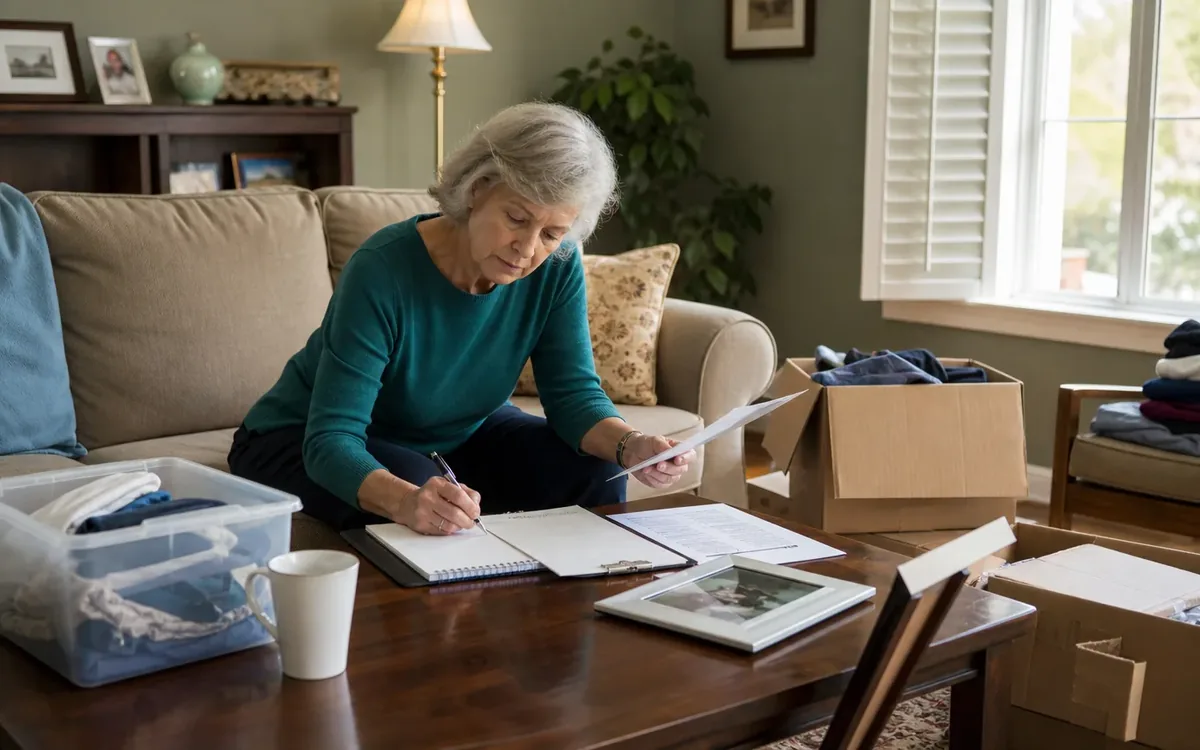
Moving to assisted living is easier to manage when the household confirms the residence’s rules first, selects only what will fit, prepares essential records, and treats the move and the former home as separate projects. The checklist below gives South Carolina families a practical sequence while keeping medical, legal, appraisal, inspection, and real-estate decisions with the appropriate professionals.
Quick answer: Start with the assisted living residence’s written move-in requirements and room measurements. Then identify daily necessities, medications, documents, and meaningful belongings. Pack and label the approved items, arrange transportation, and make a separate plan for everything remaining at home. Do not donate, sell, discard, or transfer disputed property until the person with authority approves it.
What should you confirm before sorting anything?
The residence, not the former home, should guide the first round of decisions. Ask for written information rather than relying on memory or assumptions. Rules differ among communities, room types, and levels of care.
Confirm these details with the residence:
- The room’s dimensions and storage capacity
- The provided furniture, fixtures, and appliances
- Which personal furniture may be brought in
- Prohibited items, including any restrictions involving rugs, appliances, extension cords, or furnishings
- Labeling requirements for clothing and personal property
- Move-in access, parking, elevators, loading areas, and check-in procedures
- Required medical, medication, identification, insurance, and financial records
- Laundry arrangements and recommended clothing quantities
- Policies for mobility devices, oxygen equipment, and other medical equipment
- Procedures for valuables, cash, and important documents
- Pet requirements, if applicable
A family member can record measurements and compare them with furniture dimensions. The residence should answer questions about admission, safety, medication handling, care, and permitted belongings. A physician, pharmacist, or other qualified clinician should resolve medical questions.
If coordinating the belongings and transportation is becoming difficult, review the scope of move management services in South Carolina. A practical move team may discuss sorting, organizing, packing, labeling, and move coordination. The household and residence retain control over what is admitted and where it may be placed.

Who is authorized to make the move decisions?
Clarify authority before anyone distributes property, signs agreements, or gives instructions to service providers. The person moving should direct decisions when able and legally authorized to do so. If another person is acting on their behalf, confirm the relevant authority with the appropriate attorney, court, financial institution, healthcare provider, or facility.
Keep these roles separate:
- The resident or authorized household decision-maker selects possessions, approves disposition, and sets personal priorities.
- The assisted living residence determines admission requirements, safety policies, and what may enter the room.
- Medical professionals address medications, mobility, medical devices, and care instructions.
- An attorney or court interprets powers of attorney, guardianship, ownership disputes, contracts, or estate authority.
- An appraiser or qualified specialist evaluates items when value affects a decision.
- A real-estate professional advises on listing strategy, market presentation, and transaction matters.
- Inspectors, contractors, and public authorities determine repair, permit, inspection, or compliance requirements within their respective roles.
- A move or cleanout team may discuss the physical work, access, sorting categories, packing, and removal logistics without deciding ownership or legal rights.
Create one written approval channel. Multiple relatives issuing conflicting instructions can lead to accidental removals or delays. Record who may approve packing, donation, sale, disposal, storage, and contractor access.
If the home is also part of an estate, the how far in advance should i plan a move explains how authorization, sorting, and removal can be kept orderly. An assisted living move is not automatically an estate cleanout, but the same care around ownership and records is useful.
Assisted living move checklist: a practical sequence
Use these nine stages in order. Some may overlap, but each should have a clear decision-maker.
-
Collect the residence’s requirements. Obtain the approved-item rules, room measurements, move-in instructions, document requests, and contact information for questions.
-
Build a needs-first list. Start with clothing, toiletries, prescribed mobility aids, permitted medical supplies, bedding if needed, communication devices, chargers, eyeglasses, hearing supplies, and familiar daily-use objects. Confirm medication procedures directly with the residence and relevant healthcare professionals.
-
Map the room. Mark doors, windows, outlets, closets, and clear walking areas. Compare actual furniture dimensions with the usable room, not merely the total square footage. Avoid choosing furniture based only on sentimental preference.
-
Choose comfort items. Select a small group of photographs, artwork, books, crafts, or keepsakes that will make the new room recognizable without crowding it. Ask the residence how wall items may be installed.
-
Sort everything else by destination. Use categories such as family transfer, appraisal review, possible sale, donation consideration, storage consideration, recycling, and disposal. A category is not final authorization. Keep disputed or uncertain objects in a protected hold area.
-
Prepare records and essentials separately. Place identification, residence paperwork, insurance information, contact lists, legal documents, and other sensitive records in a secure hand-carried file. Do not put irreplaceable documents, medication, keys, or valuables in general moving boxes.
-
Pack and label for arrival. Label each container with the resident’s name, contents, intended location, and priority. Follow the residence’s labeling rules for clothing and personal items. Photograph furniture and high-concern possessions before transport when a condition record would be useful.
-
Confirm move-day responsibilities. Identify who will meet the residence, who carries documents and essentials, who directs placement, and who retains keys to the former home. Confirm access arrangements with every involved provider.
-
Create a separate former-home plan. Secure the property, retrieve overlooked records, and decide whether the next step is continued occupancy, family transfer, storage, sale preparation, rental evaluation, or another lawful use. Do not let move-day pressure force irreversible decisions about the remaining contents.

What belongs in the first-day bag?
The first-day bag should remain with the resident or authorized support person. It should not be loaded among ordinary boxes. Confirm medical and admission contents with the residence because requirements may vary.
Consider packing:
- Photo identification and requested admission documents
- Insurance cards and relevant contact information
- Medications only as directed by the residence and medical professionals
- Eyeglasses, hearing aids, batteries, and cases
- Phone, charger, and a written list of important numbers
- A comfortable change of clothing and sleepwear
- Basic toiletries allowed by the residence
- Mobility equipment that has been approved and properly fitted
- A familiar photograph or small comfort object
- Keys needed after the move
- A written inventory of valuables brought into the room
Avoid combining financial papers, jewelry, cash, and general toiletries in one unattended bag. Ask the residence about secure storage and its policies before bringing valuables. The household decides whether an item should come, while the residence decides whether it is allowed and how it must be handled on site.
How should you decide what fits in the new room?
Begin with function, then add familiarity. The goal is not to reproduce the entire former home in a smaller room. It is to support safe movement, everyday routines, and personal identity within the residence’s rules.
For each proposed item, ask:
- Is it used regularly?
- Does it fit the measured space?
- Does it obstruct a walkway, door, outlet, or care area?
- Is a similar item already provided?
- Can the resident operate it comfortably?
- Does the residence permit it?
- Would a smaller alternative serve the same purpose?
- Is the item meaningful enough to justify its space?
Use painter’s tape on the floor of the former home to outline the available area if that helps visualize the layout. This is a planning technique, not a safety assessment. The residence and relevant healthcare or accessibility professionals should evaluate placement needs involving mobility, transfers, fall risk, or medical care.
Photographs can preserve memories of bulky objects that cannot move. Family members may also rotate approved seasonal or sentimental pieces later, provided the residence allows it. Avoid promising that extra possessions can remain indefinitely in a relative’s garage or paid storage unless someone has accepted responsibility for access, cost, insurance, and future disposition.
Keep, give away, sell, store, or discard?
The move usually leaves more property behind than the new room can hold. Use deliberate disposition categories rather than one vague pile labeled “deal with later.”
Keep for the residence: Limit this group to measured, approved, useful, and meaningful belongings.
Transfer to family: Name the recipient on the label and record the transfer. Do not use an informal claim system when ownership is disputed or legal authority is unclear.
Consider for sale: Separate potentially marketable property from ordinary household goods. Auctions, estate sales, consignment, direct sale, and other methods have different requirements. A qualified provider can discuss its own process, but the authorized party must approve the sales method and terms.
Consider for appraisal: Place artwork, jewelry, collections, antiques, or other uncertain items in a protected review area. A cleanout or move team can flag an item for review but should not substitute for a qualified appraisal when formal value matters.
Consider for storage: Decide who will contract for the unit, pay charges, insure the contents if desired, control access, and eventually empty it. Storage is a separate household and provider choice, not an automatic part of moving.
Donate, recycle, or discard: Confirm acceptance requirements with the selected recipient or disposal provider. Household chemicals, medications, electronics, documents, and other regulated or sensitive materials may require specific handling. The applicable facility or authority determines what it accepts.
Before clearing a property connected to a death or probate matter, consult the estate cleanout planning guide for a more focused discussion of authority and protected records.
Plan the former home as a separate project
An assisted living move ends when the resident’s approved belongings reach the new space. The house may still contain documents, furniture, food, tools, vehicles, hazardous materials, family property, or items intended for review.
Start by securing the home. The responsible party can control keys, stop unauthorized entry, collect mail appropriately, and check insurance or utility obligations with the relevant companies. Do not assume that a vacant home’s coverage, maintenance needs, or utility arrangements remain unchanged.
Next, define the property’s intended outcome. A future sale may call for cleanout and presentation decisions, but a real-estate professional should advise on listing strategy. A rental plan creates different legal, condition, and management questions. A family transfer may require legal and financial guidance.
Keep provider roles distinct:
- A cleanout team may discuss sorting, removal scope, access, and destination categories.
- A contractor evaluates and performs agreed repair work under a separate arrangement.
- An appraiser provides valuation within the appraiser’s scope.
- A real-estate professional advises on marketing and transactions.
- An inspector reports on conditions within the inspection scope.
- A code official or other authority decides official compliance questions.
- An attorney interprets legal authority, ownership, contracts, or disputes.
Clutter Cleaner of South Carolina lists estate cleanouts, downsizing and organizing, auctions and estate sales, move management, home sale preparation, and code compliance support within its statewide service territory. The exact scope for a particular project should be discussed directly. References to code compliance support do not replace rulings, permits, inspections, or directions from the responsible authority.
Prevent avoidable move-day confusion
Use a written placement plan and keep one authorized person available for questions. Color labels can distinguish the assisted living room, family destinations, storage consideration, and items that must not move.
Before loading, verify these points:
- The destination has confirmed access instructions.
- Furniture still matches the approved room plan.
- Every container has a destination label.
- The essentials bag and secure records are outside the loading area.
- Items awaiting appraisal or legal guidance are clearly isolated.
- Keys for both properties are assigned to named people.
- Someone is responsible for a final room-by-room check.
- The former home will be locked and secured after departure.
At the new residence, unpack immediate-use belongings first. Keep pathways open and avoid placing boxes where the resident or care staff need access. Ask residence staff before attaching objects to walls, rearranging provided furniture, or connecting equipment.
Short FAQ
Should every possession be sorted before the resident moves?
No. Prioritize the resident’s approved necessities, records, and comfort items. The remainder can be secured at the former home for an authorized, deliberate review. Separate anything valuable, sensitive, disputed, or potentially regulated.
Can a move team decide what should be sold or discarded?
A team may explain practical categories, flag items for review, and discuss physical removal options. The resident or other authorized decision-maker approves sale, donation, storage, recycling, or disposal. Legal and ownership questions belong with an attorney, court, or other responsible authority.
Who decides whether furniture is safe for the assisted living room?
The household can measure and propose a layout. The residence determines what it permits. Relevant healthcare, accessibility, or safety professionals should address needs involving mobility, transfers, medical equipment, and care access.
What if relatives disagree about an item?
Do not move, sell, donate, or discard it. Label it as disputed, photograph it, secure it, and obtain direction from the person with established authority. An attorney or court may be needed if authority or ownership remains contested.
Does moving to assisted living automatically mean the home should be sold?
No. Sale, rental, transfer, or retention is a separate household decision. Financial advisers, attorneys, tax professionals, real-estate professionals, insurers, and other specialists may be needed depending on the circumstances.
The next useful step
Request the residence’s written move-in rules, measure the room, and name the person authorized to approve property decisions. Those three actions establish the boundaries for every later choice.
Then create two clearly separated plans: one for the resident’s move and one for the remaining home. Families in Charleston and elsewhere in South Carolina can contact Clutter Cleaner of South Carolina at (843) 972-7020 to discuss whether its statewide move management, downsizing, cleanout, sale-related, or home-preparation scope fits the practical work required. The company’s physical business location is Mount Pleasant, South Carolina.



