

A family should consider hiring an estate cleanout service when the property must be emptied on a deadline, the volume exceeds what relatives can safely manage, decision-making has stalled, or family members live too far away to coordinate the work. Before anyone removes property, the person legally responsible for the estate should confirm who has authority, protect important records and valuables, and identify any instructions from the probate court, attorney, will, trust, insurer, or property owner.
Quick answer: Hire professional help when the cleanout has become too large, distant, physically demanding, emotionally difficult, or time-sensitive for the family to complete responsibly. First establish authority, secure important items, and clarify what may be sold, donated, recycled, moved, or discarded.
The right time is not automatically the day after a death or the moment a house becomes vacant. It is the point when the responsible person can authorize a defined scope and professional coordination will reduce risk, delay, or conflict.
What should happen before a cleanout is scheduled?
Do not begin with dumpsters, donation runs, or room-by-room disposal. Begin by confirming who may make decisions about the property.
Depending on the circumstances, authority may rest with a personal representative, executor, trustee, surviving owner, court-appointed representative, or another authorized party. A cleanout company does not determine who holds that authority. Questions about a will, trust, probate proceeding, creditor obligations, beneficiary rights, or ownership should go to the appropriate attorney, probate court, trustee, or other responsible authority.
Before requesting physical work, the household should:
- Confirm who is authorized to approve removal and disposition.
- Secure the home, vehicles, outbuildings, keys, and access codes.
- Locate wills, trusts, deeds, titles, tax records, insurance papers, and financial files.
- Remove medication, firearms, cash, jewelry, and sensitive personal data for controlled handling.
- Ask family members not to take items informally until authority and distribution are clear.
- Identify leased, borrowed, consigned, or business-owned property.
- Check whether an insurer, court, attorney, or property professional requires documentation.
If authorization is still uncertain, the practical next step is preservation, not disposal. Secure the property, prevent damage, and wait for guidance from the responsible professional or authority.

When is professional estate cleanout help justified?
Professional help becomes practical when one or more constraints make a family-led cleanout unreliable. The strongest signals concern scale, distance, safety, deadlines, and decision fatigue.
The contents exceed the family’s capacity
A lightly furnished apartment may be manageable for relatives. A home containing decades of furniture, papers, household goods, garage contents, tools, or stored collections is different.
Professional coordination may make sense when:
- Several rooms, storage areas, or structures are full.
- Heavy furniture requires safe removal planning.
- The household cannot estimate how many loads or workdays are involved.
- Sorting has repeatedly started and stopped.
- Family members lack appropriate vehicles, equipment, or physical capacity.
The decision should account for the whole property, not only the visible living areas. Closets, attics, garages, sheds, and outdoor areas often determine the true workload.
The responsible family members live elsewhere
Distance turns a physical project into a coordination problem. Repeated travel can be costly and may still leave relatives trying to supervise donation, disposal, sale preparation, and final access from afar.
A practical team may discuss access arrangements, household priorities, staged work, retained-item packing, and progress communication. The family still decides what it is authorized to keep or release. Legal authority cannot be delegated merely by providing a door code or key.
The property has a real deadline
A cleanout may be connected to a closing, lease termination, insurance requirement, contractor schedule, inspection, or court-directed milestone. When several activities depend on an empty or accessible property, delay can affect the broader transition.
Families can review the statewide estate cleanout service scope and compare it with their actual needs. For a broader explanation of the workflow, see how estate cleanouts work.
Do not assume that a cleanout company sets the deadline or decides whether a property is ready to list, close, occupy, or pass an inspection. Those decisions remain with the relevant real-estate professional, buyer, seller, inspector, insurer, contractor, attorney, court, municipality, or other authority.
Is emotional difficulty a valid reason to hire help?
Yes. Grief and family history can make ordinary objects unusually difficult to evaluate. Hiring help does not remove the family’s responsibility to make authorized decisions, but it can separate those decisions from the physical burden of carrying, loading, and clearing the property.
Watch for signs that emotion is stopping progress:
- Every object triggers a long discussion.
- Relatives repeatedly postpone entering the home.
- Family members disagree because no decision process exists.
- Useful items are deteriorating while everyone waits.
- One person is carrying most of the workload and becoming overwhelmed.
- The family spends entire days sorting but completes very little.
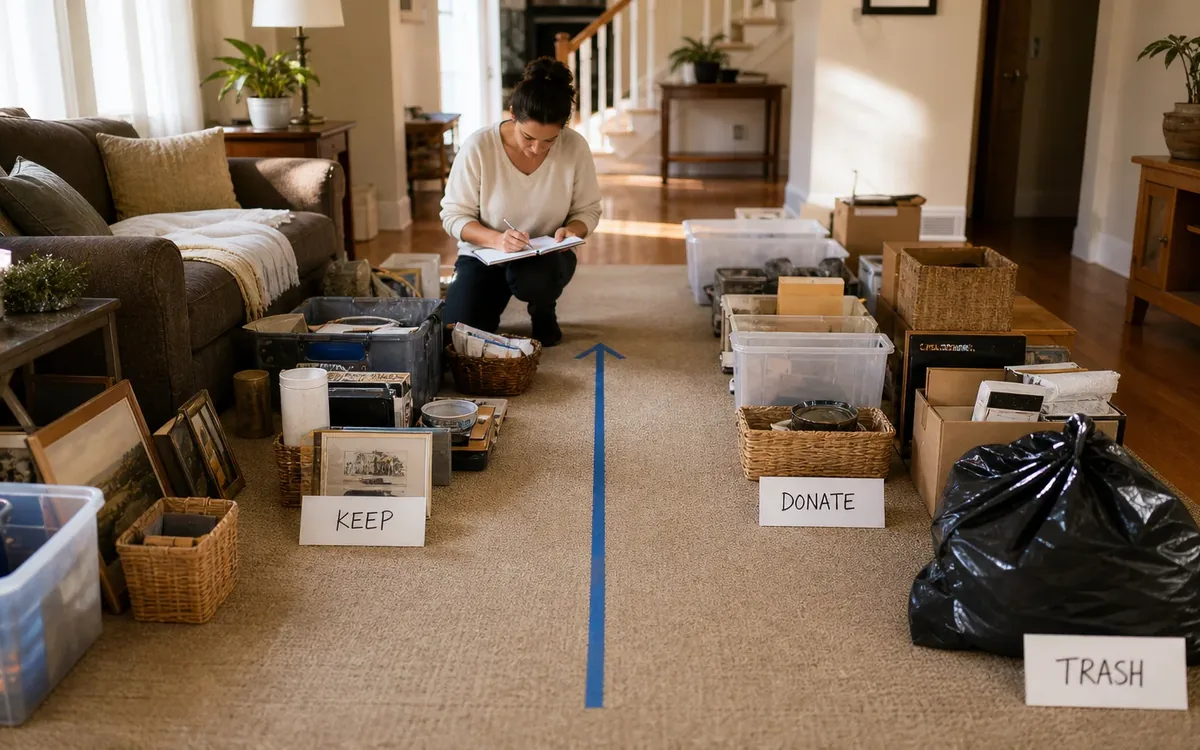
A useful approach is to create a small number of decision categories before work begins:
- Retain for the estate or authorized family members.
- Hold for professional appraisal or specialist review.
- Consider for sale through an appropriate channel.
- Donate if authorized and accepted.
- Recycle or dispose of if authorized.
- Pause because ownership or instructions are unclear.
This structure reduces repeated decisions. It also prevents a practical crew from being asked to resolve family disagreements that only the authorized parties can settle.
What can the family decide, and what requires a professional?
The household and authorized representative control many practical preferences. They can identify sentimental priorities, set aside family photographs, choose what they want moved, establish communication rules, and approve an authorized plan for ordinary household contents.
A cleanout or move team may discuss:
- The rooms and areas included in the project.
- Items clearly marked to remain.
- Packing or moving needs for retained belongings.
- A sequence for sorting and physical removal.
- Access, parking, elevators, gates, and property protection.
- Donation, recycling, sale, or disposal pathways that may be appropriate.
- Whether downsizing, move management, home sale preparation, or an estate-sale discussion fits the transition.
- Visible conditions that could affect safe access or the work plan.
Some decisions must remain outside the team’s role. The appropriate qualified professional or authority should handle:
- Legal authority and probate: An attorney, court, trustee, or authorized estate representative determines rights and obligations.
- Value and appraisal: A qualified appraiser or relevant specialist determines formal value when one is required. A resale opinion is not automatically an appraisal.
- Real-estate strategy: The owner and licensed real-estate professional decide listing timing, disclosures, marketing, and recommended preparations.
- Property condition: Inspectors and qualified trades evaluate structural, electrical, environmental, pest, or mechanical concerns.
- Code and compliance: The relevant government authority determines whether a property complies, while a support team may help carry out authorized cleanup steps.
- Tax questions: A qualified tax professional advises on reporting, basis, deductions, or estate tax issues.
- Hazardous or regulated materials: The proper authority or specialized provider determines required handling.
This division protects the family from treating convenient opinions as formal decisions.
Should the family wait for an appraisal or estate sale decision?
If the home may contain valuable art, jewelry, coins, firearms, collectibles, antiques, vehicles, machinery, or specialized collections, seek appropriate review before broad removal begins. Once mixed into donation or disposal loads, items can be difficult or impossible to recover.
That does not mean every household object requires appraisal. It means potentially significant items should follow a deliberate process.
A practical sequence is:
- Secure obvious valuables and important records.
- Identify categories that may need specialist review.
- Obtain guidance from the appropriate appraiser, auction professional, estate-sale professional, attorney, or authorized representative.
- Mark items approved for sale or continued holding.
- Define what remains for donation, transfer, recycling, or disposal.
- Begin the larger physical cleanout only after those boundaries are clear.
Clutter Cleaner of South Carolina lists auctions and estate sales among its services, so a family may ask how those options could fit into the project. Whether an item should be sold, formally appraised, retained, or reported for legal or tax purposes remains a decision for the authorized party and the relevant professional.
What timing sequence works best?
The most reliable timing is based on decision readiness rather than grief alone. Families do not need every small detail settled, but they should resolve authority, protected items, and scope before physical removal accelerates.
Stage 1: Stabilize the property
Secure access points, address urgent leaks or safety concerns through appropriate professionals, collect keys, and preserve records. Notify the responsible insurer or property manager when applicable.
Stage 2: Establish authority
Confirm who can sign agreements and approve the disposition of contents. If probate, trust administration, disputed ownership, or creditor issues are involved, obtain professional legal guidance.
Stage 3: Protect and review
Remove or secure documents, valuables, digital devices, photographs, medication, firearms, and items that may need appraisal. Record the condition of the property if the responsible party or insurer considers documentation appropriate.
Stage 4: Define the outcome
Decide what the property needs to become. It might need to be empty for sale, reduced for a surviving resident, organized for family distribution, or cleared only in selected areas for repair access.
Stage 5: Request a practical scope
Walk through the property or provide accurate information about rooms, access, retained items, stairs, outbuildings, parking, and deadlines. Ask what the team can coordinate and what must be completed by another provider or authority.
Stage 6: Complete final professional steps
After contents are addressed, the property may still require cleaning, repairs, inspections, compliance review, or real-estate preparation. The relevant professionals determine whether those steps are necessary and when they are complete.
When should a family not start a full cleanout yet?
Delay broad removal when proceeding could destroy evidence, violate instructions, intensify a dispute, or release property without authorization.
Pause if:
- No one has confirmed who controls the estate or property.
- Heirs or beneficiaries dispute ownership of contents.
- A court, attorney, trustee, insurer, or law-enforcement agency has instructed the family to preserve items or conditions.
- Valuable categories have not received needed specialist review.
- The home contains suspected hazardous or regulated materials.
- Important records remain mixed throughout the property.
- Someone occupies the property and the right to enter or remove contents is unclear.
- Rental, financed, borrowed, or consigned items may be present.
A pause does not require abandoning the transition. The family can document rooms, build an inventory of questions, identify professionals, collect contact information, and create a decision log while waiting for authority.
How should families prepare for a cleanout conversation?
A focused first conversation should describe the desired outcome and obstacles. Avoid asking only, “How fast can everything go?” Speed is useful only after the protected and retained property is clearly separated.
Prepare these details:
- Property location and type.
- Approximate number of rooms and storage areas.
- Whether the home is occupied, vacant, or under restricted access.
- Who is authorized to approve work.
- Which contents must remain untouched.
- Whether appraisal, auction, sale, or family distribution is pending.
- Any known stairs, narrow access, elevators, gates, or parking limits.
- The source and firmness of any deadline.
- Known safety concerns or materials needing specialized handling.
- Whether retained items require packing, organizing, or move management.
Clutter Cleaner of South Carolina serves households statewide from its Mount Pleasant base and primary Charleston market. Availability, project fit, access, and scope should be confirmed directly at (843) 972-7020. A conversation is also the place to clarify boundaries rather than assume every property task is part of a cleanout.
A practical hiring threshold
A family is usually ready to hire when it can answer four questions:
- Who has authority? The person approving the work is legally authorized or has received appropriate professional guidance.
- What must be protected? Records, valuables, sentimental items, disputed property, and specialist-review items are secured or clearly marked.
- What outcome is needed? The team knows whether the goal is partial clearing, downsizing, moving retained property, sale preparation, or an empty home.
- What decisions remain external? Legal, appraisal, inspection, real-estate, tax, hazardous-material, and compliance matters are assigned to the proper professionals or authorities.
If those answers are clear and the physical work is beyond the family’s practical capacity, it is reasonable to discuss hiring an estate cleanout service. If they are not clear, first resolve the missing authority or decision rather than rushing into removal.
Short FAQ
Does the entire estate need to be settled before a cleanout begins?
Not necessarily. Physical work may begin when the authorized person approves it and any legal, court, insurance, ownership, or appraisal constraints have been addressed. Ask the estate’s attorney or responsible authority when the correct timing is uncertain.
Can a cleanout team decide what is valuable?
A team may identify items worth pausing for discussion or explain possible sale pathways, but formal value decisions should come from a qualified appraiser or relevant specialist when required.
Should relatives remove keepsakes before the walkthrough?
They may secure authorized keepsakes and sensitive items, but they should not remove disputed property or distribute estate contents without proper authority. Clearly labeling items that must remain can make planning more accurate.
Can cleanout help be used when someone is downsizing rather than deceased?
Yes. The same decision threshold can apply when an older adult or another household member is moving to a smaller home. The current owner or authorized decision-maker controls what stays, moves, sells, or leaves.
Who determines whether the property is ready for sale?
The owner and appropriate real-estate professionals make that decision. Inspectors, contractors, attorneys, insurers, buyers, lenders, or local authorities may also have roles depending on the transaction and property condition.



