
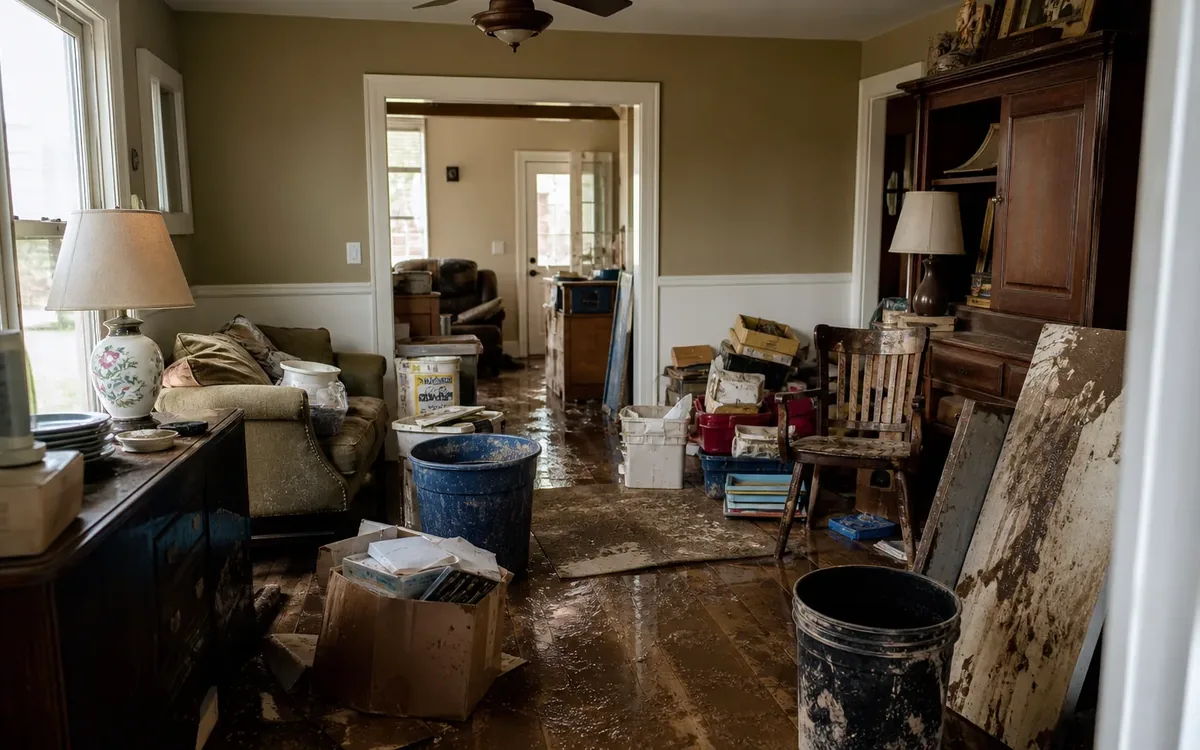
Flooding changes an estate cleanout from an ordinary sorting project into a coordinated property-recovery effort. Before removing belongings, the household should restrict access, document visible conditions, and wait for qualified professionals or public authorities to address structural, electrical, contamination, and entry concerns. Only then should contents be separated and removal coordinated in a way that preserves records, limits cross-contamination, and supports later property decisions.
Quick answer: Pause the cleanout until the property is cleared for appropriate access. Photograph conditions before moving items, identify insurance or estate requirements, divide contents by exposure and destination, and keep salvage, disposal, contractor work, valuation, and legal decisions in the hands of the household or the relevant professional.
Why does flooding change an estate cleanout?
A standard estate cleanout often begins with documents, valuables, keepsakes, donations, sale candidates, and unwanted contents. A flooded property requires a different first step: evaluating whether people can safely enter and handle what is inside.
Water may affect wiring, floors, walls, stairs, stored chemicals, appliances, and building materials. Contamination may not be obvious from appearance or odor. South Carolina’s humid conditions can also complicate moisture management, but only a qualified restoration, environmental, inspection, or building professional should determine the property’s condition and required corrective work.
The early goal is not to sort everything. It is to avoid disturbing unsafe areas, preserve useful evidence, and establish an order of operations.
Clutter Cleaner of South Carolina provides estate cleanout services across South Carolina, with a physical business location in Mount Pleasant and Charleston as its primary market. A practical cleanout discussion can address accessible contents, removal priorities, staging, and coordination. It should not replace structural assessment, contamination testing, insurance direction, or legal advice.

What should happen before anyone removes belongings?
Use the following five-stage sequence before ordinary removal begins:
-
Control access. Keep family members, beneficiaries, volunteers, buyers, and unapproved workers out of affected spaces until the appropriate authority or professional has addressed entry concerns. Do not assume that standing water is the only hazard.
-
Document visible conditions. From a location where entry is permitted, record room views, water lines, displaced contents, damaged furniture, and affected storage areas. Avoid rearranging scenes merely to improve photographs.
-
Contact the responsible parties. The estate representative or property owner may need to speak with the insurer, probate attorney, mortgage company, property manager, or relevant public authority. Those parties decide their own documentation and approval requirements.
-
Obtain specialist guidance. Electricians, restoration contractors, inspectors, environmental professionals, engineers, or other qualified providers may be needed. The appropriate provider depends on the building and the type of exposure.
-
Define the cleanout scope. Once access limits and remediation plans are understood, identify which rooms, items, and pathways a practical cleanout or move team may handle.
For a broader explanation of roles and workflow, see how estate cleanouts work. In a flood-affected home, that general process should be adjusted to follow professional safety and remediation instructions.
Who decides whether the property is safe to enter?
The family, executor, or personal representative can decide who receives permission to access the property, subject to ownership, probate, insurance, lease, or government restrictions. That permission is not the same as a technical determination that the building is safe.
Qualified professionals or authorities should address questions such as:
- Whether electrical service can remain active
- Whether floors, ceilings, stairs, or walls are stable
- Whether the water exposure creates sewage, chemical, biological, or other contamination concerns
- Whether regulated or hazardous materials may be present
- Whether protective equipment, containment, or specialist removal is required
- Whether permits, inspections, or official approvals apply
A cleanout team may discuss visible access limitations, handling concerns, staging areas, and the practical sequence for removable contents. It should not certify structural integrity, identify hidden contamination, interpret building codes, or clear a property for occupancy.
If an authority posts restrictions or a contractor establishes containment boundaries, treat those limits as part of the cleanout plan. Do not move contents across controlled areas unless the responsible professional approves the method.
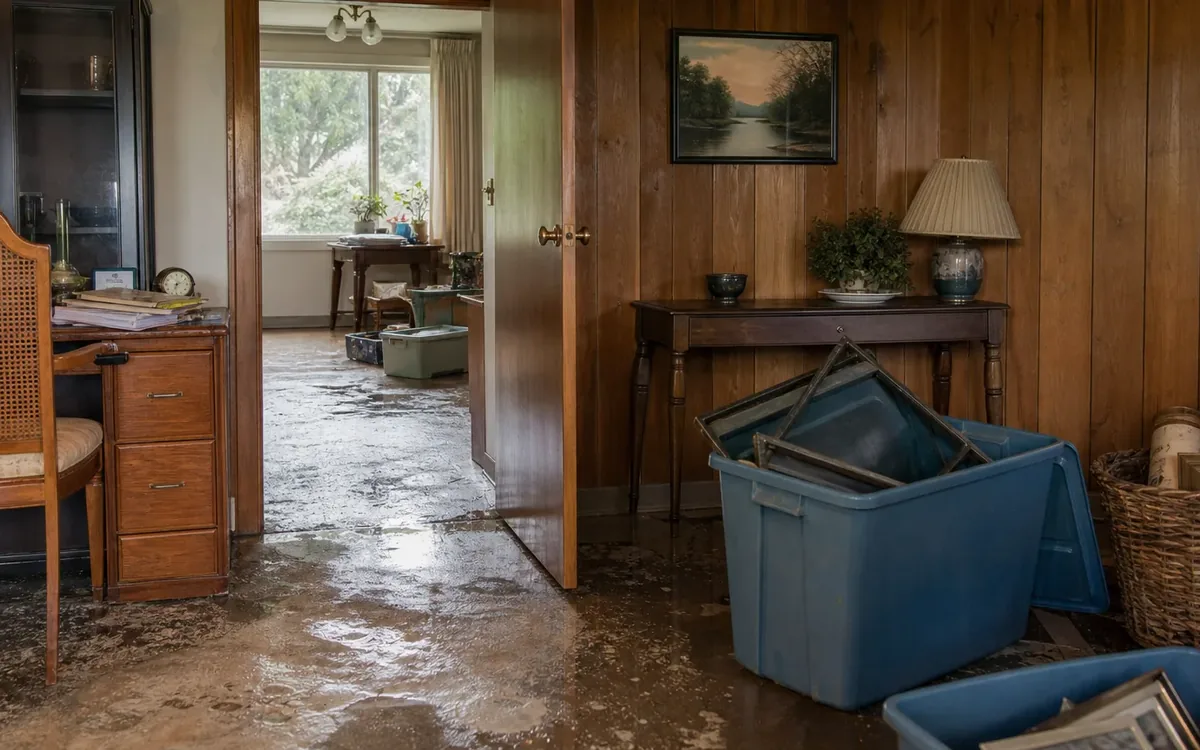
Document conditions before separating contents
Documentation protects more than a possible insurance claim. It can help family members understand what was found, support estate accounting, and reduce disagreement about why certain items were isolated or discarded.
Create a simple record that connects photographs with locations. Room names, cabinet numbers, shelf labels, or colored tags can help. Photograph identifying details only when it is appropriate to do so, and protect records containing account numbers, medical information, or other sensitive data.
Useful documentation may include:
- Wide photographs showing each affected room
- Closer images of visible water lines and damaged contents
- Labels showing the room or storage area where items were found
- A written list of high-priority records or property
- Notes about items moved under professional direction
- Disposal or transfer records supplied by the relevant provider
- Questions that require insurer, attorney, appraiser, or family review
The household should ask the insurer what must be retained, photographed, inventoried, or approved before disposal. A cleanout provider can follow an agreed labeling or staging system, but insurance coverage and claim decisions belong to the insurer and policyholder.
How should flood-affected contents be separated?
Do not begin with sentimental value alone. Begin with exposure and handling status. An item that appears valuable may still require controlled handling, while an ordinary object may hold essential estate information.
A practical separation plan can use these categories:
- Restricted or not yet assessed: Contents in areas that have not been cleared for the planned work.
- Directly affected: Items that contacted floodwater or were identified as contaminated by the responsible professional.
- Indirectly exposed: Contents from damp or high-humidity areas that did not visibly contact water but may need professional review.
- Dry and accessible: Items outside the affected zone that can enter the normal estate-sorting process.
- Records and identity items: Wills, deeds, titles, tax documents, financial records, photographs, keys, identification, and digital devices.
- Potentially valuable property: Art, jewelry, collections, antiques, vehicles, specialty equipment, or other items awaiting qualified appraisal.
- Provider-controlled materials: Chemicals, fuel, paint, medical waste, ammunition, or other items that may require a specialized outlet or authority.
Keep wet or suspect items from being carried through clean areas without an approved handling plan. Using a garage, pod, rented storage unit, or off-site warehouse is a separate household decision. Storage providers set their own acceptance rules, and moving damp contents into storage can transfer moisture or contamination rather than solve the problem.
Build zones that support the cleanup sequence
Once access and handling requirements are established, map the property into working zones. This reduces accidental mixing and helps each provider understand where its responsibility starts and stops.
Possible zones include:
- No-entry or specialist-only areas
- A route for authorized workers
- A documentation station
- A dry review area for family decisions
- A secure area for records and valuables
- A holding area for appraisal candidates
- A contractor-approved location for affected contents
- An outbound area for items cleared for removal
Choose routes that do not interfere with restoration equipment, inspections, utility work, or contractor access. The restoration contractor should decide what must remain accessible for drying, demolition, or repairs. The cleanout or move team can discuss how its staging and removal plan fits those boundaries.
Physical labels should be plain and specific. Terms such as “reviewed,” “awaiting appraisal,” “do not move,” and “cleared for removal” are less ambiguous than informal family shorthand.
Coordinate providers without blurring responsibilities
A flooded estate may involve several independent parties. Written role boundaries reduce duplicated work and prevent a cleanout decision from being mistaken for a legal, insurance, or technical determination.
The household or estate representative
The authorized decision-maker sets priorities, approves access where permitted, identifies family review needs, and chooses among available providers. That person should also confirm who has authority to approve disposal, sale, donation, or transfer.
Restoration and specialty contractors
These providers may address water extraction, drying, contamination controls, demolition, repairs, or specialty materials within their professional scope. The household chooses contractors and approves their work. A cleanout company should not guarantee or substitute for their findings.
Cleanout or move support
A practical team may discuss sorting logistics, room sequencing, staging, removal categories, packing, and coordination around approved work areas. Clutter Cleaner of South Carolina lists estate cleanouts, downsizing and organizing, auctions and estate sales, move management, home sale preparation, and code compliance support among its services. The exact fit for a flood-affected property should be discussed based on access and scope.
Appraisers and sale professionals
Qualified appraisers determine value within their field. Estate-sale or auction decisions are separate from remediation and cleanout decisions. Water exposure should be disclosed to the relevant professional so that condition can be considered.
Attorneys, insurers, agents, inspectors, and authorities
Attorneys address probate, fiduciary duties, ownership, and legal disputes. Insurers interpret policies and claims. Real-estate agents advise on listing strategy, while inspectors and other qualified professionals assess property conditions within their roles. Government authorities decide official compliance, permitting, or occupancy matters.
Code compliance support can help organize practical tasks, but only the relevant authority can issue, interpret, close, or enforce an official notice.
Protect documents, keepsakes, and valuables without guessing
Flood exposure can make families feel pressured to decide immediately. Avoid treating every damp item as either recoverable or worthless without the appropriate input.
Set aside records for controlled review when handling is allowed. Do not activate wet electronics, open damaged batteries, or experiment with household cleaning methods on documents, textiles, artwork, photographs, or collectibles. A conservator, electronics specialist, document-recovery provider, or other qualified professional may need to advise on important items.
For potentially valuable property, keep an inventory and record where each item goes. Do not clean, repair, or discard appraisal candidates solely to make the property look orderly. Condition can matter to the appraiser, insurer, estate representative, or buyer.
If ownership is disputed, isolate the item and refer the question to the authorized estate representative or attorney. A cleanout team can label and stage disputed property but should not decide who owns it.
Plan disposal only after required review
Disposal should follow assessment and authorization, not precede them. Flood-affected materials may be subject to facility rules, contractor procedures, municipal requirements, insurance instructions, or environmental restrictions.
Before releasing items, confirm:
- The area and contents have been cleared for the proposed handling
- Required photographs or inventories are complete
- The authorized estate decision-maker has approved the category
- Appraisal or family review is no longer pending
- The receiving facility or specialist accepts the material
- Personal records and identifying information are protected
- Any required disposal documentation will be retained
Donation is also a receiving-party decision. An organization may decline damp, stained, odorous, incomplete, unsafe, or otherwise unsuitable goods. Do not represent affected items as clean or undamaged.
Contractor debris, household contents, hazardous materials, and regulated waste should remain separate categories. The provider responsible for each stream should explain its acceptance and documentation rules.
Prepare for the next property decision
Cleaning out a flooded estate does not itself establish that a home is repaired, code-compliant, insurable, marketable, or ready for occupancy. Those conclusions belong to the relevant professionals and authorities.
Before a sale, transfer, or move-in decision, the estate may need separate input from restoration contractors, inspectors, engineers, appraisers, real-estate professionals, insurers, attorneys, or public agencies. The necessary combination depends on the property and circumstances.
A cleanout can support that next step by producing clear access, organized records, documented removals, and defined areas for further work. Home sale preparation may address presentation and coordination after the responsible professionals have handled condition and compliance questions.
Keep a final project file containing photographs, inventories, provider records, appraisal materials, receipts, approvals, and unresolved questions. The estate representative or attorney can determine what must be retained for estate administration.
FAQ
Can family members start by removing dry-looking boxes?
Only after access and handling boundaries are established. A dry-looking box may sit in an unsafe area or may have been exposed to humidity or contamination. Follow the direction of the responsible professional for the property.
Should affected belongings go directly into storage?
Not automatically. Storage is a separate household arrangement, and facilities have acceptance rules. Ask the appropriate restoration or environmental professional whether items can be moved safely, then confirm the storage provider will accept them.
Who decides whether an item should be appraised?
The authorized estate representative decides whether to seek an appraisal. A qualified appraiser determines value within the appraiser’s specialty. A cleanout team may isolate and inventory possible appraisal candidates but should not provide an appraisal unless separately qualified to do so.
Can a cleanout begin while contractors are working?
Possibly, if the contractors and responsible decision-maker define safe, nonconflicting work areas. Routes, containment, equipment access, utilities, and debris streams should be coordinated before contents are moved.
Who can authorize disposal from an estate?
That depends on ownership, probate status, estate documents, and applicable law. The executor, personal representative, owner, or another authorized person may need to decide. Refer uncertain authority or disputed property to the estate’s attorney.
How can a household discuss the project with Clutter Cleaner?
Prepare the property location, access status, professional restrictions, affected rooms, decision-maker information, and desired cleanout scope. Clutter Cleaner of South Carolina can be reached at (843) 972-7020 to discuss whether its services fit the accessible, approved portion of the project.



