
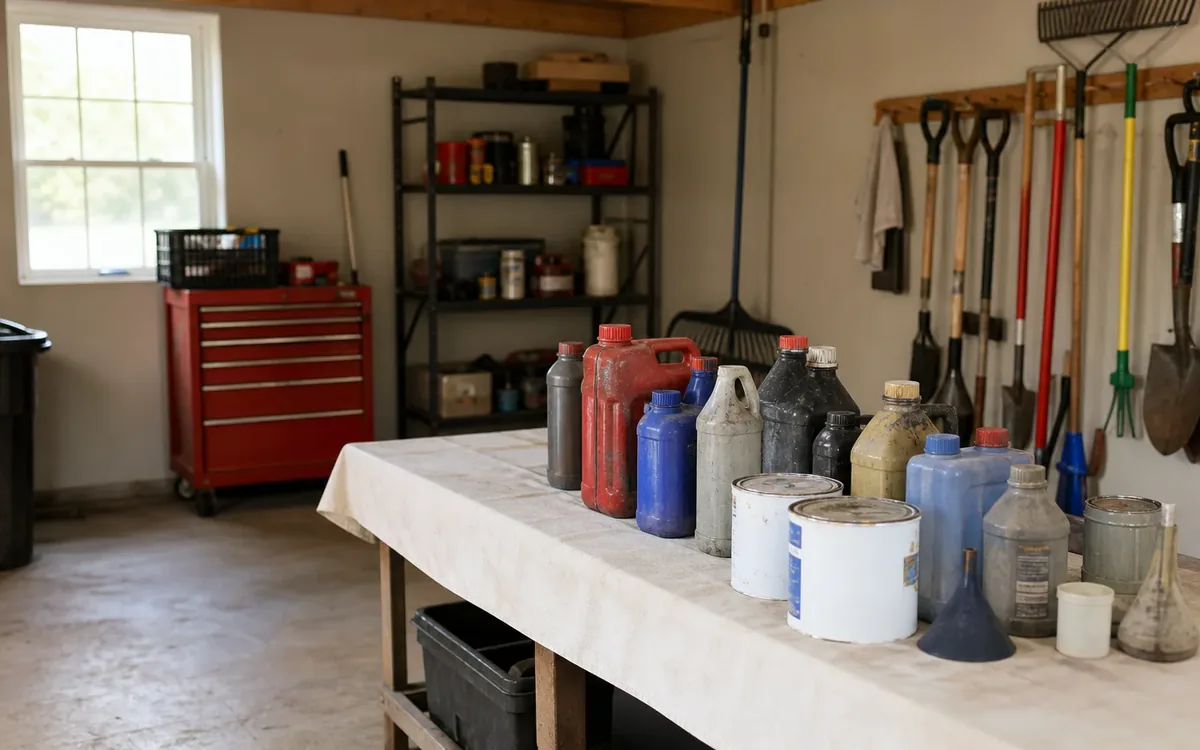
Fuel, oil, paint, and unidentified workshop liquids should be sorted by category without opening, smelling, mixing, or pouring them out. Keep each container upright, isolate leaks without repackaging the contents, and check the current guidance from the appropriate South Carolina county or municipal program before anything leaves the property. A household can identify and group containers, while disposal approval, hazardous-material handling, transport rules, and environmental compliance belong to the relevant authority or qualified provider.
Quick answer: Stop ordinary cleanout work around leaking, swollen, badly corroded, pressurized, or unidentified containers. Create separate zones for fuel, automotive fluids, coatings, and unknowns. Photograph labels, record container condition, and ask the local county or municipal program what it currently accepts and how materials must be prepared. Never assume a normal trash, recycling, donation, or cleanout route can take these materials.
Why does a garage need its own sorting plan?
An estate garage or workshop is different from a closet, kitchen, or attic. Similar-looking cans may contain products with very different handling requirements. A red liquid might be gasoline, transmission fluid, or a solvent. A reused beverage bottle might contain oil, fuel mix, or an unidentified chemical.
The goal is not to perform chemical identification. It is to create enough order for the appropriate program or professional to give useful instructions without increasing risk.
That requires separating material decisions from property decisions. The family or estate representative can decide which tools, empty cabinets, and ordinary belongings to keep. They should not decide that an unknown liquid is harmless based on color, age, odor, or where it was found.
If the garage is part of a larger property project, review the estate cleanout service overview to understand how sorting fits into broader cleanout planning. For the sequence of decisions across the rest of the home, see the guide to how estate cleanouts work.
What should happen before anyone moves a container?
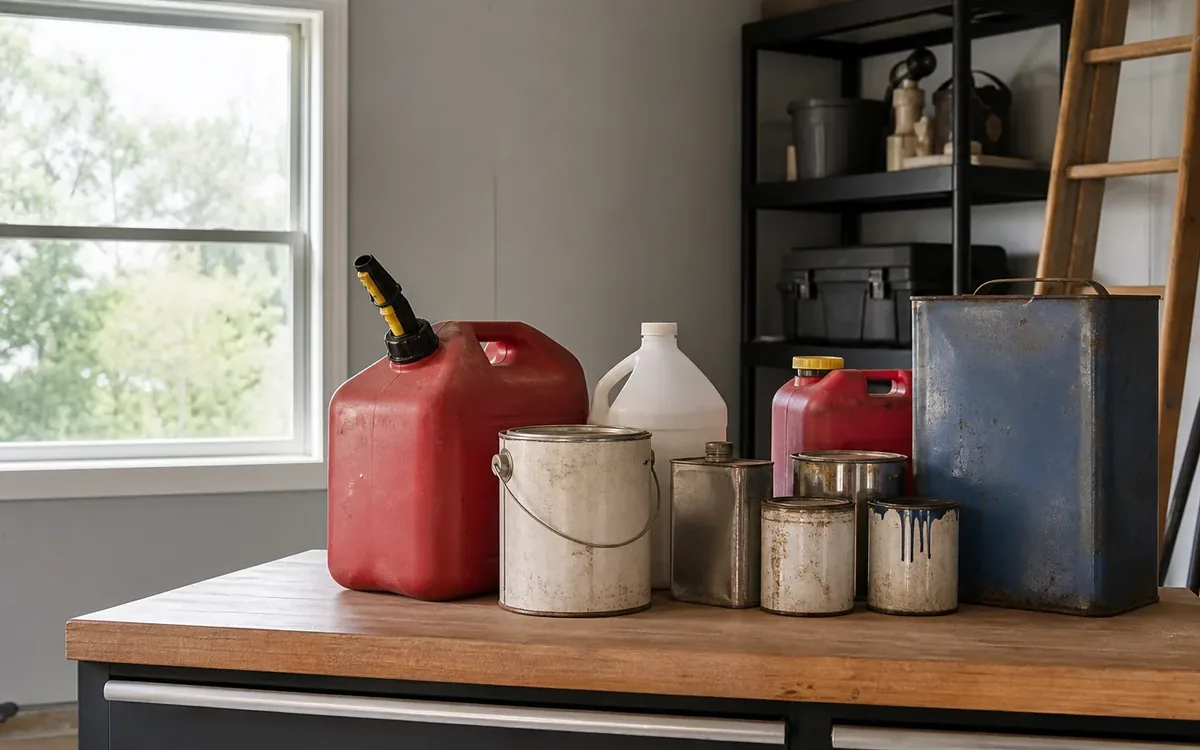
Begin with observation rather than handling. Keep children, pets, visitors, and unnecessary helpers out of the work area. Avoid smoking, flames, sparks, grinding, welding, and other ignition sources near possible fuels or solvents.
Take these initial steps:
- Look for active leaks, stained shelving, bulging cans, severe rust, fumes, or damaged caps.
- Read visible labels without turning a questionable container.
- Photograph the front label, hazard wording, and container condition from a safe position.
- Note whether the material is on a shelf, floor, vehicle, workbench, or outdoor area.
- Record containers that appear to be under pressure.
- Leave crystallized, smoking, hissing, hot, or strongly reacting material alone.
Do not test an unknown liquid by touching or smelling it. Do not open a container simply to see whether it is empty. An old-looking can may still contain liquid or vapor, and an apparently empty fuel container may present different handling concerns than an ordinary metal can.
If there is an active spill, a strong vapor problem, a fire concern, or immediate danger to people, leave the area and contact the appropriate emergency authority. A general cleanout plan is not a substitute for an emergency response decision.
How should fuel and fuel mixtures be separated?
Create a fuel category for gasoline, diesel, kerosene, two-cycle mix, fuel additives, and any container that may hold a fuel product. Keep these materials away from batteries, ignition sources, paint products, and other chemical groups.
Labels matter, but containers also matter. Fuel may have been transferred into an unmarked can or a container originally intended for another product. Treat handwritten labels as useful clues, not conclusive identification.
Use three fuel subgroups:
- Clearly labeled fuel: The original label is readable and the container is intact.
- Possible fuel: The container type, location, or handwritten note suggests fuel, but the contents are not confirmed.
- Compromised fuel container: The vessel leaks, bulges, has severe corrosion, lacks a secure closure, or is otherwise unsafe to handle casually.
Do not combine partial containers. Gasoline and diesel should not be mixed, and old two-cycle mixtures should not be consolidated with either one. Do not pour fuel into a vehicle, mower, drain, onto soil, or into household trash as a way to eliminate it.
Ask the appropriate county or municipal program whether it accepts the particular fuel, whether proof of residency or an appointment applies, and what container rules govern delivery. Requirements can differ by location and program, so current local instructions should control the next step.
Sorting motor oil and other automotive fluids
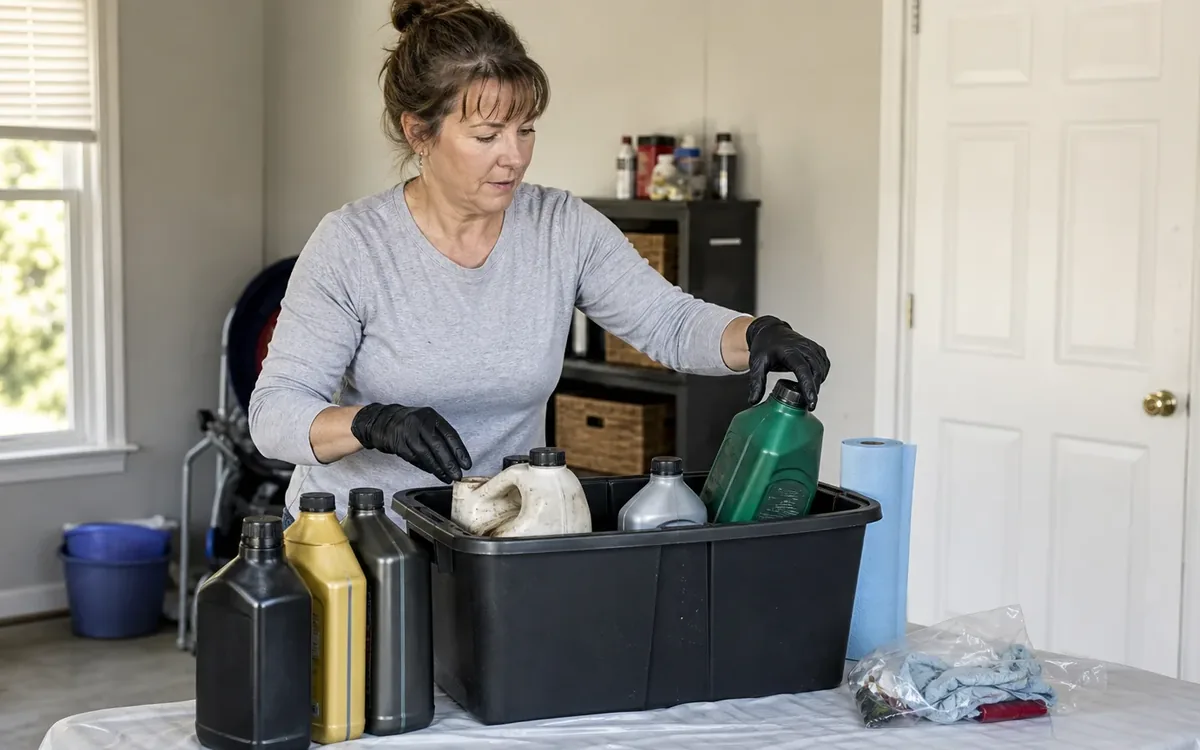
Used motor oil is only one automotive-fluid category. A workshop may also contain transmission fluid, gear oil, brake fluid, power-steering fluid, antifreeze, windshield fluid, penetrating oil, grease, and mixed drain-pan contents.
Separate these products by label whenever that can be done without opening or transferring them. A container marked “oil” should not automatically be grouped with a clearly identified used-motor-oil stream if its contents or prior use are uncertain.
Useful categories include:
- New, unopened automotive products
- Used motor oil in a sound, closed container
- Antifreeze or coolant
- Brake and transmission fluids
- Lubricants, grease, and penetrating products
- Mixed automotive liquids
- Unidentified liquids found near vehicles or machinery
- Oil filters, absorbent pads, and contaminated rags
Contamination can affect whether a collection program accepts used oil. Fuel, coolant, solvent, or water mixed into an oil container may move it into a different disposal category. Do not attempt to strain, separate, or correct a mixture at the property.
Batteries, tires, refrigerants, and vehicle parts also require their own decisions. Their presence near automotive fluids does not mean they follow the same route. Ask the relevant collection program or qualified provider about each material class separately.
How should paint, stain, and coatings be classified?
Start with the label. Separate water-based paint from oil-based paint, stain, varnish, polyurethane, shellac, lacquer, paint thinner, mineral spirits, and other solvents. Aerosol coatings should form another group because pressurized cans can have separate acceptance rules.
A practical coating sort has four categories:
- Clearly labeled water-based coatings: Often marked latex, acrylic, or water cleanup.
- Clearly labeled oil-based coatings: May reference alkyd, oil, mineral spirits, or solvent cleanup.
- Related solvents and finishes: Includes thinner, stripper, stain, varnish, lacquer, and similar products.
- Unknown or compromised coatings: Includes missing labels, unreadable labels, severe rust, leakage, or uncertain contents.
Do not assume dried residue, a skin on top, or an old date means a can qualifies for ordinary trash. Local programs may distinguish between liquid paint, fully solidified material, empty cans, aerosols, and solvent-based products. Obtain current local guidance before changing the material or placing it in any waste stream.
Keep lids closed. Do not pry open rusty cans, blend similar colors, or pour several remnants together. Do not use evaporation as a disposal strategy. If paint may be worth retaining for property touch-ups, the household can set it aside temporarily, but a real-estate professional or contractor should decide whether it is actually useful for sale preparation or repair work.
What should you do with unidentified containers?
Unknowns deserve their own category. They should never be added to the group that merely looks most similar.
Mark the outside area around the container or use a nearby written inventory rather than writing on a leaking or unstable vessel. Record visible facts such as container type, readable words, color visible through the container, location found, and apparent condition. Avoid guesses such as “probably oil” in the primary description.
Do not:
- Open the lid or loosen the cap
- Smell the opening
- Shake the container
- Pour out a sample
- Mix it with a known product
- Transfer it into a food or drink container
- Place it in donation, recycling, or ordinary trash
If an unknown container is leaking, do not improvise a transfer unless a responsible authority or qualified hazardous-material provider gives specific direction. Secondary containment may be discussed, but compatibility matters. A random tub, bag, or metal pan is not automatically suitable for every substance.
A practical cleanout or move team may flag the container, restrict work around it, photograph it, and coordinate access for the household’s selected provider. Chemical identification, emergency response, transport classification, and final disposal approval remain with the appropriate professional or public authority.
Build an inventory that local programs can use
A short, accurate inventory makes calls and online research more productive. It also reduces repeated handling.
For each container, record:
- Product name or every readable label word
- General category, such as fuel, oil, coating, or unknown
- Approximate container size without claiming the quantity inside
- Whether the original container is present
- Whether the closure appears secure
- Signs of rust, swelling, residue, or leakage
- The room or area where it was found
- A photograph reference number
Avoid precise chemical conclusions unless they appear on the manufacturer’s label. “Blue liquid in unmarked jug” is more useful and defensible than “antifreeze” when no one knows what the liquid is.
The inventory also helps prevent sentimental or saleable items from becoming contaminated. Keep documents, photographs, textiles, furniture, and boxed possessions away from chemical staging zones. If contamination may affect building materials or belongings, an environmental, restoration, or inspection professional should evaluate that issue.
Check current South Carolina disposal guidance
South Carolina households should check the current instructions from the county or municipal program responsible for the property’s location. Do this before loading a vehicle or hiring someone to haul material.
Ask specific questions:
- Does the program accept residential fuel, used oil, antifreeze, paint, solvents, or aerosols?
- Are unknown materials accepted?
- Are there container, labeling, quantity, residency, or scheduling requirements?
- Does the program exclude business, farm, landlord, or estate-generated material?
- How should leaking or damaged containers be addressed?
- Are any items directed to a separate facility or qualified contractor?
Do not assume guidance for Charleston applies everywhere in South Carolina. Charleston is Clutter Cleaner of South Carolina’s primary market, while the physical business location is Mount Pleasant, SC and the service territory is statewide. Disposal directions still depend on the authority governing the property and the material.
Website information can change, and an old flyer or saved social-media post may no longer be accurate. Confirm current instructions directly with the relevant program. The accepting authority determines whether a material can enter its facility.
Divide responsibilities before removal day
Clear responsibility prevents a cleanout crew, family member, mover, or hauler from making an unsafe assumption.
The household or authorized estate representative can decide:
- Which clearly safe, usable products to retain
- Who may access the garage
- Which provider to contact for disposal guidance
- Whether work pauses around questionable materials
- How inventories and photographs are shared
- Whether appraisal or sale advice is needed for equipment or collectibles
A practical cleanout or move team may discuss staging, access, ordinary-item sorting, sequencing, and coordination. It may identify materials that need separate instructions before removal. Any actual scope should be confirmed with the selected provider rather than assumed.
Separate specialists retain separate roles:
- A disposal authority decides what its program accepts.
- A qualified hazardous-material provider determines its handling and transport approach.
- A contractor addresses repairs or alterations within that contractor’s scope.
- An appraiser values tools, equipment, signs, containers, or other potentially collectible property.
- A real-estate professional advises on market preparation and disclosures within that professional’s role.
- An inspector evaluates property conditions within the inspection scope.
- An attorney, personal representative, court, or other responsible authority handles ownership, estate, and legal decisions.
Storage is also a household choice arranged with a separate storage provider. Do not place fuels, oils, coatings, or unknown chemicals into storage without confirming the facility’s rules and the legal suitability of doing so.
Prepare the surrounding workshop without disturbing chemicals
Once the questionable materials are isolated, ordinary sorting can continue only where conditions are safe. Keep a buffer around chemical zones and avoid creating dust, sparks, or impacts nearby.
Sort unaffected items into tools, hardware, equipment manuals, scrap, household belongings, and possible appraisal items. Check toolboxes, cabinets, and machinery compartments carefully because small fuel bottles, oil cans, and solvents may be concealed inside.
Do not sell or donate a cabinet, mower, generator, compressor, or vehicle without checking whether it contains fuel, oil, or another regulated material. The household should obtain guidance for draining or servicing equipment from an appropriate mechanic, equipment contractor, disposal program, or other qualified provider. A general cleanout team should not be presumed to perform mechanical or hazardous-material work.
For broader estate sequencing beyond the garage, the resource on the best way to clean out an estate helps separate authority, valuables, records, and removal decisions.
Short FAQ
Can old gasoline be mixed together for disposal?
Do not combine it. Keep containers separate and ask the appropriate local program or qualified provider for current preparation and acceptance instructions.
Is latex paint safe for ordinary trash?
That depends on its condition and the rules governing the property’s location. Confirm whether the local program distinguishes liquid, solidified, and empty containers before taking action.
Can a cleanout crew identify an unknown liquid?
A team may document labels and isolate the area, but chemical identification and disposal classification should remain with the appropriate authority or qualified professional.
Should leaking containers be put into plastic bags?
Not automatically. Material compatibility and vapor accumulation can matter. Keep people away and seek instructions from the responsible disposal or emergency authority.
Who decides whether vintage cans have value?
The household or estate representative decides whether to pursue a valuation. A qualified appraiser or knowledgeable specialist should assess value, especially when contents, contamination, or authenticity are uncertain.
Where does Clutter Cleaner of South Carolina fit?
The company can discuss estate-cleanout planning, downsizing and organizing, move management, home-sale preparation, auctions and estate sales, and code-compliance support within an agreed scope. Disposal acceptance, chemical handling, appraisals, legal authority, inspections, contractor work, and regulatory decisions remain with the relevant provider or authority. Call (843) 972-7020 to discuss the property’s cleanout needs after urgent hazards have been directed to the proper authority.



