
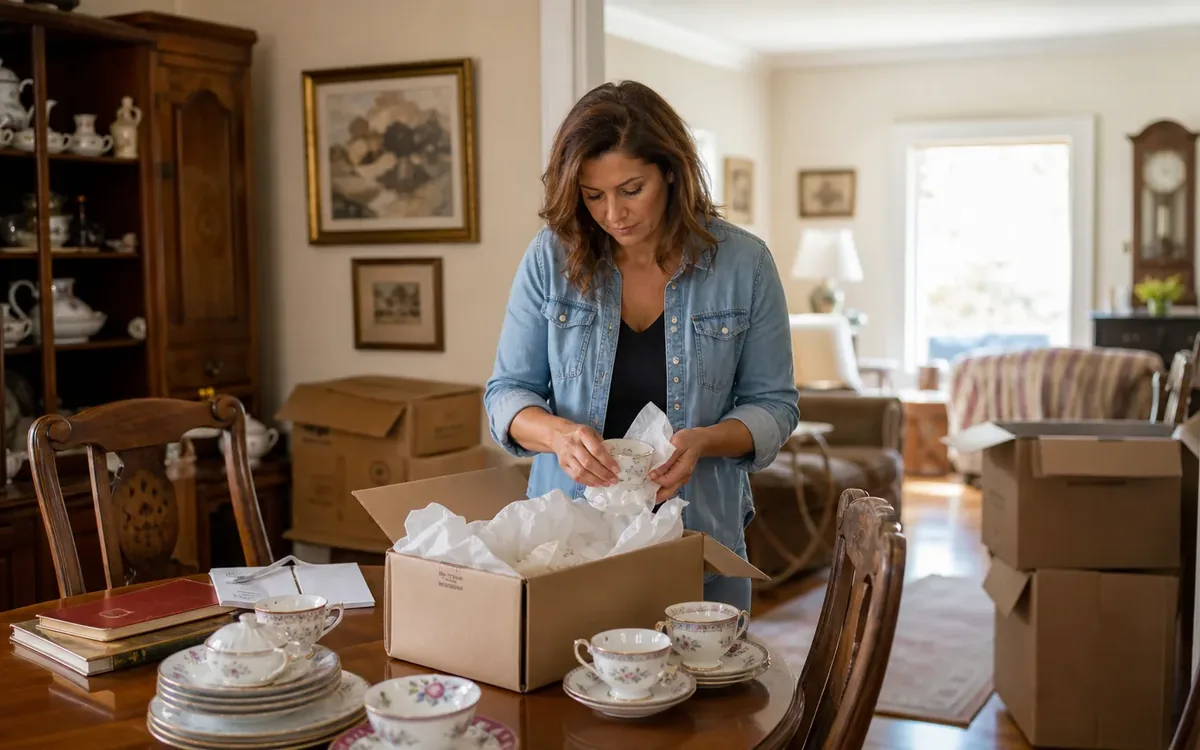
Fragile heirlooms should be identified before general sorting begins, moved to a protected staging area, documented, wrapped with material suited to each object, and placed in clearly labeled containers. The household or authorized representative decides what will be retained and who may handle it. A cleanout or move team can discuss practical packing and workflow, while appraisers, conservators, insurers, attorneys, and other qualified professionals address value, restoration, coverage, ownership, and legal authority.
Quick answer: Pause ordinary cleanout activity around fragile objects. Photograph each item, assign it an identification number, note existing damage, and move it only after preparing a clear route and padded destination. Wrap surfaces without adhesive contact, fill empty space without overpacking, label the container on multiple sides, and maintain a written handoff record.
This guide focuses narrowly on physical protection. It does not determine whether an heirloom should be kept, sold, donated, or distributed to a beneficiary.
Why should fragile heirlooms be separated before the cleanout?
An estate cleanout involves overlapping activities: opening cabinets, grouping belongings, carrying furniture, removing unwanted contents, and preparing rooms for their next use. Fragile heirlooms are vulnerable when they remain mixed into that flow.
A delicate object may look like an ordinary household item to someone who does not know its history. An unlabeled box can be moved into the wrong zone. A figurine placed temporarily on a shelf may be overlooked when the shelf is cleared. Separation reduces these risks.
Create a protected staging area before broad work begins. It should be away from doorways, active walkways, stacked furniture, food, drinks, pets, and open windows. A room with a closable door is useful when available. If no separate room is practical, mark a defined area and restrict access.
The staging area should include:
- A stable table or clean floor surface with padding
- Packing materials organized by type
- Empty containers that are clean, dry, and sturdy
- Labels, markers, inventory sheets, and resealable bags
- A place for objects that should not be packed yet
- A separate location for items needing professional review
This preparation belongs near the beginning of the broader process described in the guide to the best way to clean out an estate. If outside help is being considered, the household can also review the scope of estate cleanout services before deciding what should remain under family control.
What should be documented before anything is wrapped?
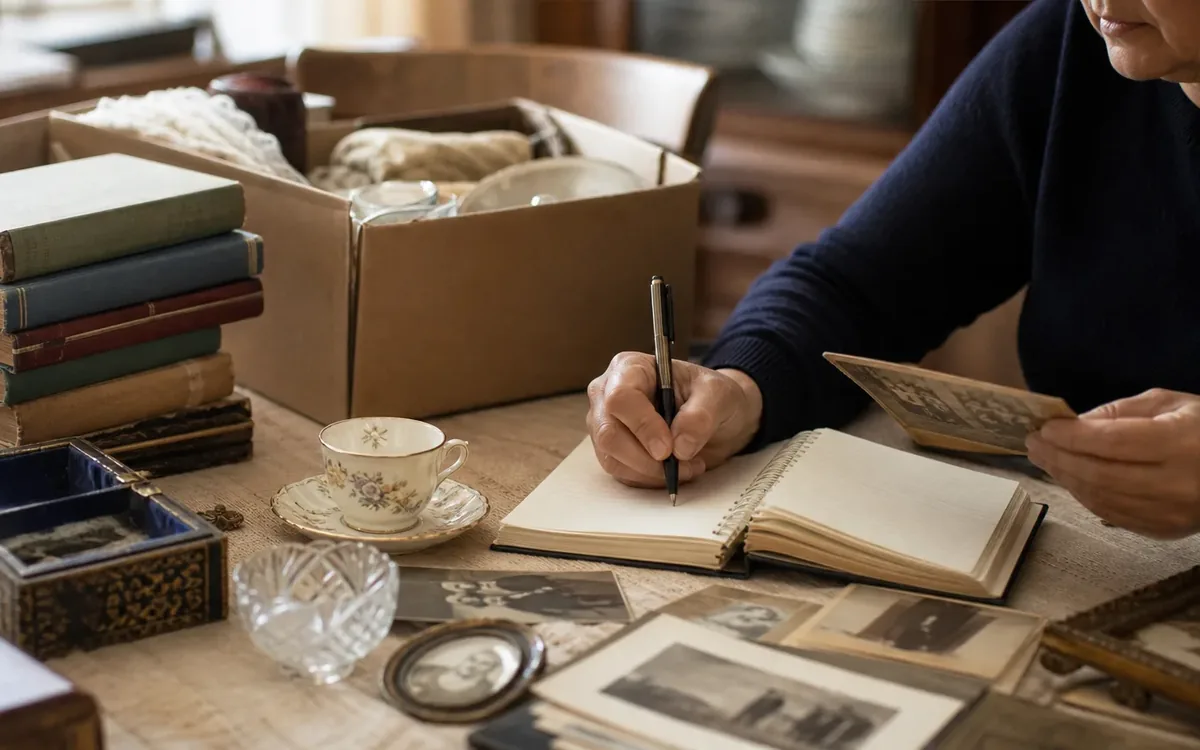
Documentation connects an object to its container, condition, destination, and authorized recipient. It is especially useful when several similar pieces exist or multiple relatives and providers are involved.
Take clear photographs of the object from several angles before moving it. Include close views of cracks, chips, loose components, stains, repairs, maker’s marks, signatures, labels, or other distinguishing details. Photograph grouped sets together and individually.
Assign a simple identification number that does not depend on memory. Put that number in the inventory and on a tag or bag associated with the object. Do not attach an adhesive label directly to an heirloom.
A practical inventory entry can record:
- Item identification number
- Plain-language description
- Room and exact location where found
- Existing condition concerns
- Separate or detachable parts
- Container number after packing
- Intended destination, if already authorized
- Person responsible for receiving it
- Date and names involved in each handoff
Descriptions should be factual. Write “hairline crack on right side” rather than “nearly perfect.” Do not record a guessed financial value as though it were an appraisal.
The household or legally authorized representative decides who can view the inventory and approve destinations. If ownership is disputed, instructions conflict, or authority is unclear, packing can pause while the executor, personal representative, attorney, probate court, or other responsible authority addresses the issue. A cleanout team should not decide who legally owns an object.
How do you choose wrapping materials for different heirlooms?
The safest material depends on the object’s surface, shape, condition, weight, and sensitivity. No single packing method fits glassware, framed art, textiles, ceramics, books, and clocks.
Use clean materials and avoid direct contact with anything that may transfer adhesive, ink, dye, moisture, or texture. As a general physical-protection approach, consider these pairings:
- Glass and ceramics: Start with clean, soft, nonabrasive material around the surface. Add cushioning outside that layer and pad the container walls.
- Framed photographs and artwork: Protect the face from abrasion, cushion corners, and keep pressure away from glass and decorative frame elements.
- Silver, brass, or finished metal: Use a clean barrier layer that will not scratch the surface. Avoid rubber bands and adhesive tape on the object.
- Textiles and clothing: Support folds with clean tissue or other suitable archival material when appropriate. Avoid crushing embroidery, beadwork, or brittle fabric.
- Books and documents: Keep them dry, supported, and protected from bending. Do not force tightly packed volumes into a container.
- Clocks and mechanical objects: Secure only components that can be safely restrained. Do not improvise disassembly when the mechanism is unfamiliar.
- Figurines and irregular objects: Support projections without using them as lifting points. Fill surrounding voids gently so the object cannot shift.
Common supplies include unprinted packing paper, suitable tissue, soft foam, bubble cushioning, corrugated dividers, sturdy boxes, corner protectors, and resealable bags for detached hardware. Material touching a valuable or sensitive surface may need approval from a conservator or specialist.
Do not let tape contact wood finishes, paper, textiles, painted surfaces, metal, leather, or glass decoration. Tape should close wrapping layers or containers, not become part of the object.
Household members can choose ordinary packing materials for routine pieces. A conservator should advise on unstable paint, flaking finishes, deteriorated textiles, water-damaged paper, corroded metal, or other sensitive materials. An appraiser evaluates value, not necessarily conservation or packing needs.
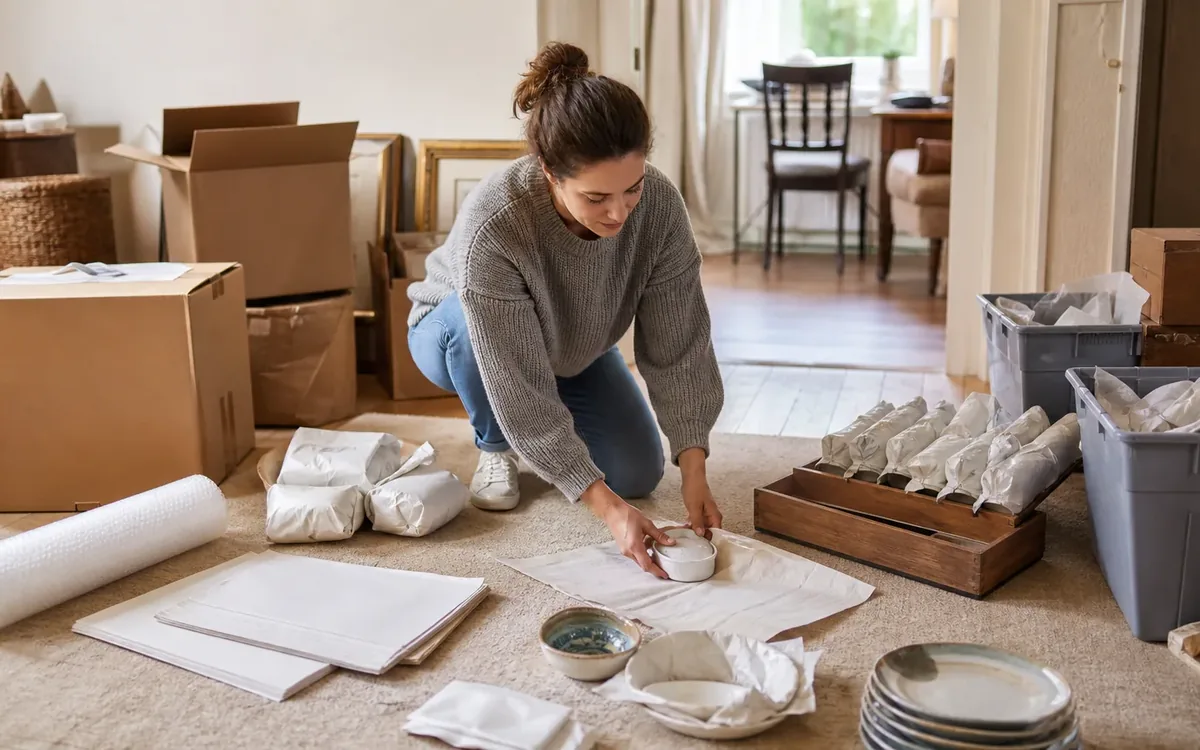
Use a controlled wrapping and packing sequence
A consistent sequence helps prevent missing parts and rushed handling. Use these seven steps for each fragile item:
- Clear the route and destination. Remove trip hazards, open doors, and prepare a padded surface before lifting the item.
- Inspect and photograph it. Record existing damage and loose parts without testing weak areas.
- Remove only safe, intended components. Place detachable hardware or accessories in a labeled bag. Do not dismantle unfamiliar objects.
- Apply the first protective layer. Use a clean, nonabrasive barrier suited to the surface, with no adhesive touching the item.
- Add cushioning. Protect corners, handles, rims, and projections without applying enough pressure to bend or crack them.
- Place and stabilize the object. Use a sound container of suitable size. Fill empty space gently and avoid packing heavy pieces above lighter ones.
- Close, label, and log the container. Update the inventory before moving to the next object.
Wrap pieces individually unless a qualified specialist recommends another method. Stacking plates, nesting glassware, or bundling figurines can transfer force from one piece to another. If items share a container, use dividers and adequate cushioning between them.
Test the packing by applying light pressure to the closed container, not by shaking it. If the container bulges, the contents may be overpacked. If movement is detectable through gentle handling, add or reposition cushioning.
What information belongs on each label?
Labels should tell handlers how to treat a container without revealing unnecessary details to everyone who sees it. Mark more than the word “fragile.”
Useful label information includes:
- Container identification number
- “Fragile” and “Do Not Stack,” when applicable
- Upright orientation arrows when orientation matters
- General contents, such as “framed family photographs”
- Destination room or approved recipient
- Special handling note, such as “lift from base”
- Inventory page or record reference
Place labels on the top and at least two sides so one remains visible in a stack. Use large, legible print. Color coding can distinguish destinations, but it should supplement written labels because color meanings are easily forgotten.
Avoid announcing high value on an exterior label. “Antique jewelry” attracts unnecessary attention, while an inventory code can preserve the connection to the record. Sensitive items may also require controlled access and a documented chain of custody chosen by the household or authorized representative.
If a box is opened, repacked, or redirected, update both the physical label and inventory. Crossing out an old destination without changing the written record creates uncertainty later.
Safe handling matters as much as packing
A well-packed heirloom can still be damaged by poor lifting, stacking, or transport. Before anyone touches it, decide who is handling the item, where it is going, and who will confirm receipt.
Use two people when an object is awkward, visibility is limited, or balance is uncertain. Lift from stable structural areas rather than handles, decorative trim, arms, lids, frames, or protrusions. Carry one manageable item at a time and maintain a clear view of the route.
During movement:
- Keep boxes upright when marked for orientation
- Do not stack other contents on a fragile container
- Keep containers away from rain, damp ground, and direct heat
- Prevent sliding by securing containers appropriately
- Separate heavy objects from delicate ones
- Confirm the receiving surface is stable before setting anything down
- Record each transfer between household members, movers, storage providers, or other recipients
South Carolina conditions can include heat, humidity, storms, and abrupt weather changes. The household should check actual conditions on the day of movement rather than rely on assumptions. Paper, photographs, textiles, wood, and some finishes can be sensitive to moisture and temperature changes. A conservator can advise about object-specific environmental limits.
A practical cleanout or move team may discuss staging order, pathways, packing coordination, loading sequence, and handoffs. The transport provider determines what it accepts and under what terms. An insurer or insurance agent addresses coverage, exclusions, documentation, and claims requirements.
Know when ordinary packing should stop
Some objects should not enter the normal wrapping flow. Pause when an item is unusually heavy, structurally unstable, contaminated, mounted to the building, or made from a material requiring specialized handling.
Professional input may be appropriate for:
- Cracked paintings or flaking decorative surfaces
- Wet, mold-affected, or insect-damaged documents and textiles
- Large mirrors, chandeliers, or architectural pieces
- Firearms, ammunition, chemicals, or regulated materials
- Objects believed to contain ivory or other restricted wildlife materials
- Items with mercury, radioactive components, or unknown substances
- Pianos, safes, large clocks, and other specialized equipment
- Collections that may need appraisal before being separated
Keep provider roles distinct. A qualified appraiser offers an opinion of value within the appraiser’s scope. A conservator evaluates preservation and treatment. A specialty mover addresses handling and transport. A storage provider sets facility conditions and contract terms. A contractor handles authorized building work. Real-estate professionals advise within their professional roles about sale preparation and property marketing.
Legal questions stay with the responsible attorney, executor, personal representative, probate court, law-enforcement agency, or regulatory authority. Compliance requirements and lawful disposal methods should be confirmed with the appropriate authority or qualified provider. A cleanout company may support an organized process, but it should not replace those decisions.
Coordinate heirloom protection with the wider cleanout
Fragile-item handling works best as a protected track within the estate cleanout, not as an improvised side task. Mark the heirloom staging zone on the work plan and keep general removal activity out of it.
The household can decide:
- Which authorized person gives handling instructions
- Who may enter the protected area
- Which items remain together as sets
- Which approved recipient or destination appears in the inventory
- Whether outside appraisal, conservation, storage, or specialty transport is requested
- When documented handoffs are required
A practical cleanout or move team may discuss:
- Room sequence and traffic flow
- Protected staging locations
- Container identification systems
- Packing supplies and physical handling needs
- Coordination with a chosen mover, recipient, or other provider
- Separation of fragile containers from general removal loads
The team should not determine beneficiary rights, authenticate an object, establish market value, approve restoration, interpret insurance coverage, or decide legal disposal requirements. Those matters belong with the person or professional responsible for them.
If contractor work or home-sale preparation will occur, remove or protect heirlooms before dust, vibration, paint, tools, or open access create additional exposure. The contractor determines the work method and site requirements. The real-estate professional and property owner decide how possessions affect listing or showing plans. Inspectors report within their inspection scope rather than deciding how an heirloom should be packed.
Short FAQ
Should every old object be treated as valuable?
Do not assume age proves financial value, but do not let uncertain value justify careless handling. Protect the object until the authorized household representative decides whether professional appraisal is needed.
Can newspaper be used for wrapping?
Printed paper may transfer ink and is not a good direct-contact layer for many surfaces. Clean, unprinted packing material is generally a more cautious choice. Sensitive objects may require archival materials selected with professional guidance.
Should boxes be labeled with the owner’s name?
Use only the personal information needed for an accurate handoff. An inventory code and destination may be enough. The household should decide how identifying information is managed.
What if damage is discovered after wrapping begins?
Stop handling the item, photograph the condition, preserve detached pieces without altering them, and update the inventory. Contact a conservator, insurer, appraiser, or other appropriate professional depending on the issue.
Who decides whether an heirloom goes into storage?
The household or legally authorized representative makes that choice. The storage provider explains access, environmental conditions, security features, insurance requirements, and contract terms. A conservator can advise whether the environment suits a sensitive object.
Where can South Carolina households discuss cleanout coordination?
Clutter Cleaner of South Carolina is based in Mount Pleasant, with Charleston as its primary market and a stated service territory covering South Carolina. Households can call (843) 972-7020 to discuss estate cleanout, organizing, move-management, or related coordination needs. Availability and the appropriate role for each item should be confirmed directly.



