
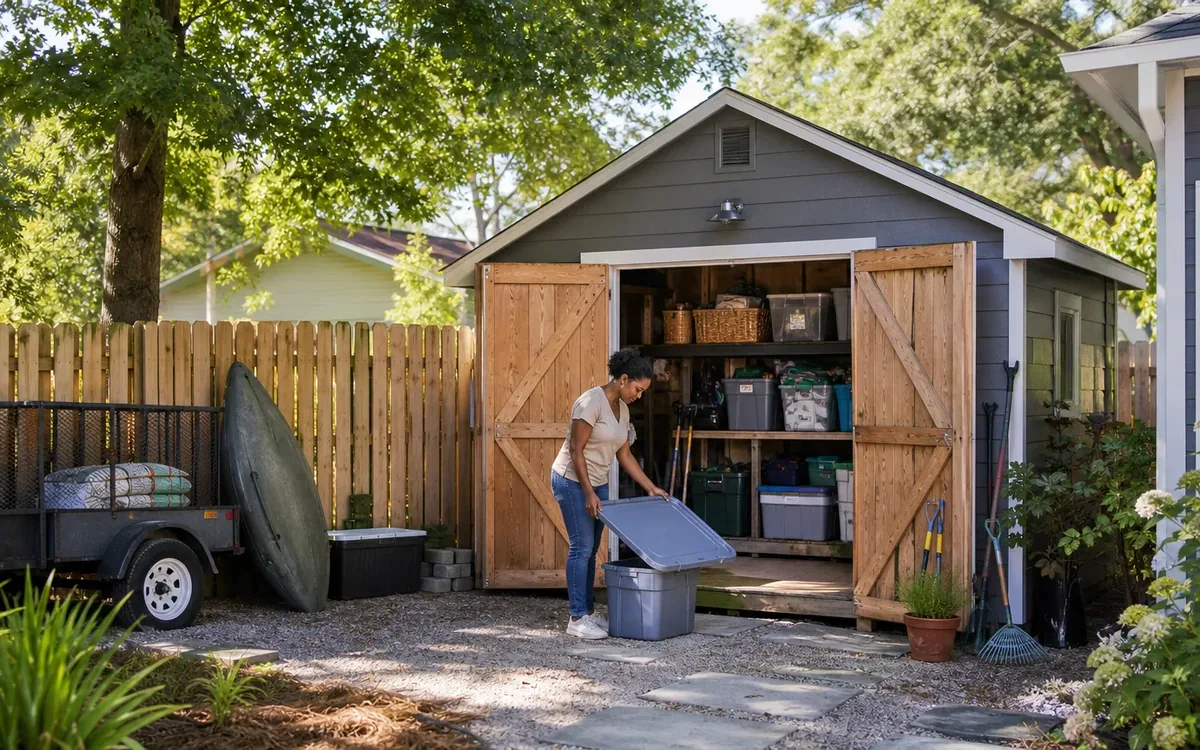
Before listing a home, empty and organize outdoor storage areas enough for buyers and their professionals to see the available space, access permanent features, and notice possible repair concerns. Keep only useful items that are clean, orderly, and appropriate to the property. Household members can decide what to keep, donate, sell, move, or discard, while real-estate, inspection, appraisal, legal, and compliance questions should go to the responsible professional or authority.
Quick answer: Work on outdoor storage before final photography and showings. Start with hazardous or access-blocking items, sort the remaining contents by destination, clear permanent features, clean the structure, and create an off-property plan for anything that should not remain. Do not hide defects behind stored belongings or assume that cleaning resolves repair, permit, boundary, or code questions.
Outdoor storage can include a detached shed, garage wall system, pool equipment enclosure, deck box, utility cabinet, carport closet, workshop, or freestanding storage building. The goal is not to make every area empty. It is to make the space understandable, accessible, and consistent with the way the property will be presented for sale.
Why should outdoor storage be addressed before listing?
Outdoor storage affects more than appearance. Crowded shelves, stacked boxes, and leaning tools can prevent buyers from understanding a space. They may also restrict access to walls, floors, electrical components, windows, doors, utility equipment, or structural connections that an inspector may need to examine.
A focused cleanout helps reveal practical questions early:
- Does the door open, close, and latch without stored items interfering?
- Can someone walk through the area without stepping over loose objects?
- Are walls, floors, corners, and built-in components visible?
- Are chemicals, fuel, batteries, or sharp tools stored appropriately?
- Will the contents move with the household, remain with the property, or leave before closing?
- Are there stains, moisture, pest evidence, deterioration, or damage that need professional review?
Preparing the area early also prevents outdoor belongings from becoming a last-minute moving problem. A household that needs broader help coordinating sorting and presentation can review home sale preparation services without assuming that every related task, such as repairs, appraisals, hauling, or regulated disposal, comes from one provider.

Start by defining what is part of the sale
Before moving everything, separate the structure from its contents. A freestanding shelf may be personal property, while an attached cabinet may be treated differently. A portable shed, mounted tool rack, security camera, generator, or pool-related item can also raise questions about what stays.
The household can make an initial inventory and identify its preferences. However, the listing agent, closing professional, attorney, or other responsible real-estate professional should clarify how specific items need to be described in listing documents or agreements. A cleanout team should not decide whether an item is legally a fixture or promise that it is included or excluded from a sale.
Create three working groups:
- Clearly moving: Personal tools, seasonal decorations, sporting goods, garden supplies, and other belongings the household plans to keep.
- Clearly leaving: Items the owner and responsible real-estate professional have confirmed will remain, such as agreed equipment or storage components.
- Needs clarification: Mounted racks, large appliances, portable buildings, specialty systems, and anything referenced in a contract or property disclosure.
Labeling the third group prevents an organizer or mover from removing something before the correct person answers the question.
What should be removed first?
Remove items that create immediate access, handling, or presentation problems before working on ordinary clutter. This makes the remaining sorting safer and exposes areas that may need attention.
Prioritize these categories:
- Loose blades, nails, hooks, glass, and sharp garden tools
- Unstable stacks or overloaded shelves
- Fuel, propane cylinders, chemicals, pesticides, paint, and automotive fluids
- Damaged batteries and unidentified containers
- Wet cardboard, mold-suspect materials, and pest-damaged belongings
- Broken equipment that has no planned use
- Items blocking doors, windows, panels, equipment, or walkways
- High-value, private, or identity-sensitive property
Do not place questionable chemicals or regulated materials into ordinary trash without checking the applicable instructions. Product labels, the waste facility, the municipality, county resources, or another responsible authority can explain accepted disposal methods. A practical cleanout or move team may discuss sorting and removal logistics, but regulated disposal decisions belong to the appropriate facility or authority.
If the outdoor area contains belongings from an estate, ownership and authorization may need to be confirmed before anything is removed. The guide on when to start preparing to sell a house explains why decision-making authority and item review should come before physical removal.

Use a destination-based sorting sequence
Sorting outdoors can become inefficient when every object is evaluated in isolation. Instead, establish destinations before handling the bulk of the contents.
Use these six destinations:
- Move to the next home: Keep items that have a known use and an appropriate destination.
- Use before moving: Retain supplies or tools needed for yard care and final property preparation, but place them together.
- Sell: Set aside suitable items for a household-arranged sale, auction provider, estate-sale company, marketplace, or other chosen selling method.
- Donate: Confirm that the intended organization accepts the item and that transportation is available.
- Dispose or recycle: Separate ordinary waste, recyclable material, yard debris, and restricted items according to local requirements.
- Professional review: Isolate belongings that may require appraisal, legal direction, specialty handling, or identification.
Avoid making the shed or garage a holding area for undecided indoor possessions. If an item still needs a decision, give it a clearly marked review zone with enough space around it to preserve access.
Selling is a separate household choice, not an automatic part of cleanout work. An auctioneer, estate-sale provider, reseller, or appraiser can discuss marketability and value within that provider’s role. A cleanout team may help organize items for review but should not present itself as the final authority on value unless separately qualified for that work.
How much should remain for listing photos and showings?
Keep only what helps the storage area look functional without concealing its size or condition. There is no universal percentage or item count. The right amount depends on the dimensions, layout, intended use, and listing strategy.
A practical target is to create:
- A clear route from the entrance to the back of the space
- Visible floor edges and wall sections
- Unblocked doors, windows, vents, outlets, and permanent equipment
- Shelves with grouped, upright items rather than tightly packed piles
- Enough open volume for a buyer to understand storage capacity
- A specific location for any supplies needed until moving day
Ask the listing agent how the storage area fits the property’s presentation plan. The agent decides which views matter for marketing and whether a particular space should be photographed. A photographer controls photographic technique. A cleanout or organizing team can help arrange belongings based on that direction, but it does not control listing representations.
Do not transfer clutter into a vehicle, attic, crawl space, utility enclosure, or hidden corner merely to clear the camera’s view. That postpones the decision and may obstruct another area that needs access.
Clean after sorting, not before
Once the volume is reduced, clean from high surfaces downward. Remove cobwebs and loose debris, wipe appropriate shelving, and sweep the floor. Use cleaning products suitable for the surface and follow label directions, especially in enclosed spaces.
Pay attention to:
- Dust and debris around door tracks or thresholds
- Soil, grass clippings, and leaves brought in by equipment
- Empty planters that retain water
- Food, seed, or pet supplies that may attract pests
- Odors from fuel, chemicals, damp materials, or waste
- Residue on shelves from leaking containers
- Dirt that makes it difficult to distinguish staining from active moisture
Cleaning is not the same as remediation. If there is suspected mold, sewage, animal waste, significant pest activity, unknown chemical residue, or another potential hazard, stop and consult an appropriate specialist. Do not cover stains, damage, or odors to create a misleading appearance.
What defects or concerns need professional attention?
Sorting may expose conditions that deserve further review, but household observations are not professional findings. Note concerns without diagnosing them.
Examples include:
- Soft, uneven, cracked, or deteriorated flooring
- Water staining, active dampness, or damaged roofing
- Rot, corrosion, or visible deterioration
- Exposed wiring, damaged receptacles, or improvised electrical work
- Doors or windows that do not operate correctly
- Pest evidence or animal entry points
- Leaning walls, movement, or apparent foundation issues
- Equipment with leaks, unusual noise, or visible damage
- A structure whose placement, permits, or boundary relationship is unclear
A qualified inspector evaluates conditions within the inspection scope. Contractors discuss repair options within their trade. Appraisers develop value opinions. Surveyors address boundary matters. Real-estate professionals guide listing strategy and transaction documents. Attorneys advise on legal questions, while government authorities decide permit, zoning, waste, and code matters.
Clutter Cleaner of South Carolina lists code compliance support among its services, but support with access, sorting, or physical preparation does not replace an official interpretation, inspection, citation resolution, permit decision, or approval from the responsible authority.
Build a plan for large and awkward items
Outdoor storage often holds the least convenient items to move. Make a separate plan for lawn equipment, workbenches, metal shelving, kayaks, grills, generators, lumber, and bulky planters.
For each large item, record:
- Its destination
- Who is authorized and equipped to move it
- Whether fuel, fluids, blades, or batteries require preparation
- Whether disassembly is appropriate
- Whether it is attached to the structure
- Whether doorways, gates, surfaces, or landscaping need protection
- Whether a buyer agreement affects its removal
Movers or move-management providers can discuss packing, sequencing, access, and transportation based on their offered scope. Equipment dealers or manufacturers may provide preparation instructions. Contractors should handle trade-specific disconnection where required. The household should not assume that a general cleanout includes disconnection, repair, crating, storage, or transportation of every specialty item.
Off-site storage is also a separate decision. Compare what needs to be stored, the access required, facility rules, insurance considerations, and the cost under the chosen provider’s terms. Moving clutter to storage without a later decision plan can preserve the problem rather than solve it.
Coordinate the outdoor area with the broader move
The storage space should support the home’s preparation rather than operate as a separate project. Keep a small, controlled set of items available for final yard care, cleaning, and minor household tasks. Pack or remove everything else according to the move plan.
A useful handoff note can identify:
- Items that must remain accessible
- Belongings awaiting a family decision
- Property approved for sale or donation
- Materials requiring special disposal guidance
- Large items assigned to another provider
- Features awaiting inspection or contractor review
- Items whose status in the transaction remains unresolved
This note is especially valuable when family members, an agent, organizers, movers, contractors, and other providers are involved. It reduces accidental removal and keeps each party within the correct role.
Before work begins, a practical cleanout or move team may discuss the amount of material, access conditions, sorting responsibility, destination categories, handling concerns, and which tasks are inside or outside the agreed scope. The household retains decisions about possessions unless legal authority rests elsewhere.
Final review before the property is shown
Walk through the storage area in the same way a visitor would encounter it. Open the door fully, follow the intended path, and look at the space from the entrance as well as inside.
Confirm that:
- Walkways and exits are clear
- Unstable items have been removed or secured appropriately
- Personal documents and valuables are no longer present
- Chemicals and tools are stored safely or removed
- Permanent features are reasonably visible and accessible
- Loose debris and obvious dirt are cleared
- Odor sources have been addressed rather than masked
- Remaining contents are grouped and orderly
- Items included in or excluded from the sale match professional guidance and transaction documents
- Unresolved defects are not hidden by belongings
Then ask the listing agent whether the presentation supports the listing plan. If an inspection, appraisal, repair, survey, or compliance review is scheduled, ask that responsible professional what access is required for their work.
Short FAQ
Should an outdoor shed be completely empty before listing?
Not necessarily. It should be clear enough to show its useful space and allow appropriate access. The listing agent can advise how an occupied or vacant storage area fits the property’s marketing plan.
Can unwanted tools be sold instead of discarded?
Yes, if the authorized owner chooses to sell them and they are suitable for a chosen sales channel. An auction provider, estate-sale company, reseller, or appraiser can address sale potential or value within that provider’s role.
Who decides whether a shed is permitted or compliant?
The responsible government authority makes permit, zoning, and code determinations. An inspector, contractor, surveyor, attorney, or real-estate professional may identify a question or help obtain information, but they do not replace the authority’s decision.
What should happen to paint, fuel, and pesticides?
Keep containers secure and follow labels and applicable local disposal guidance. Confirm acceptance rules with the relevant waste facility or public authority. Do not assume ordinary household trash is appropriate.
Can Clutter Cleaner of South Carolina help with preparation?
Clutter Cleaner of South Carolina offers home sale preparation, downsizing and organizing, move management, estate cleanouts, auctions and estate sales, and code compliance support across South Carolina. The exact scope should be discussed for the property. Legal advice, appraisal, inspection, contracting, regulated disposal, real-estate representation, and government decisions remain with the responsible professionals or authorities. The business is physically located in Mount Pleasant, with Charleston as its primary market, and can be reached at (843) 972-7020.



