
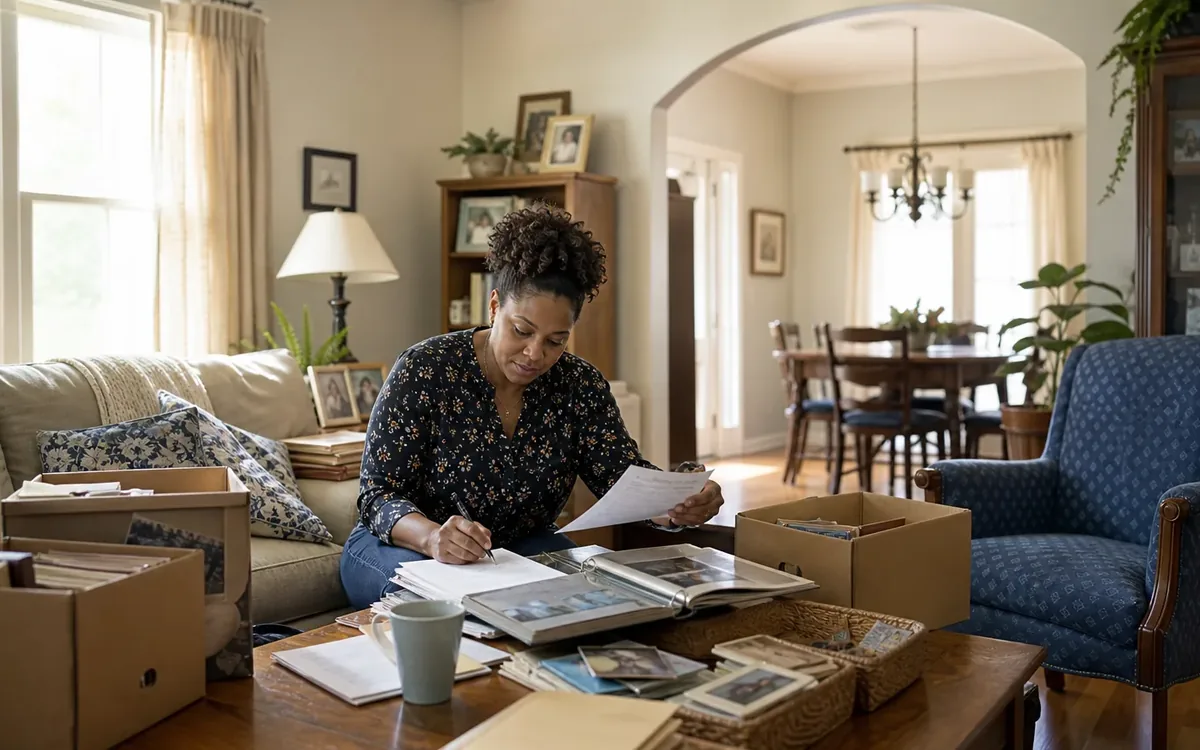
Preparing an inherited house for sale starts with confirming who has authority to act, aligning the family on goals, and protecting documents and valuables before anything is removed. After those issues are settled, the household can sort belongings, arrange a cleanout, assess the property’s condition, and work with qualified legal, tax, appraisal, inspection, and real-estate professionals as needed.
Quick answer: Do not begin by emptying every room. First identify the person authorized to make decisions, secure important records, agree on how personal property will be handled, and document the house. Then separate items to keep, distribute, sell, donate, recycle, or discard. Once the contents are under control, obtain professional guidance on value, repairs, disclosures, title, and sale strategy.
Why inherited-house preparation begins with authority
An inherited property can involve several people whose roles are not interchangeable. A family member may have keys or live nearby without having legal authority to sign a listing agreement, approve repairs, distribute possessions, or sell the property.
Before scheduling major work, identify the responsible decision-maker. Depending on the estate and its documents, that person might be a personal representative, executor, trustee, surviving owner, or heir who receives authority through the applicable process. A South Carolina probate attorney, estate attorney, or appropriate court can explain who is legally permitted to act.
The household can gather information and discuss preferences. It should not assume that family consensus replaces the authority required by an estate plan, deed, court, lender, or applicable law.
Collect available records such as:
- The will or trust documents
- The deed and recent property-tax records
- Mortgage, lien, and insurance information
- Probate or court correspondence
- Utility and maintenance records
- Keys, access codes, and vehicle titles
- Receipts for improvements or major systems
- Existing leases or occupancy agreements
- Written instructions concerning particular possessions
Keep originals in a secure place rather than leaving them mixed with household papers. A cleanout or move team may discuss access, sorting, packing, removal priorities, and the practical sequence of work. It does not determine ownership, interpret estate documents, clear title, or decide whether probate is required.

Who should make decisions when several heirs are involved?
Establish one authorized point of contact before vendors enter the house. This reduces contradictory instructions and gives relatives a clear route for questions. The point of contact should document major decisions and obtain any approvals required by the estate’s governing documents or professional advisers.
A useful family decision process has four parts:
- Confirm authority. Ask the responsible attorney, court, trustee, or other appropriate professional who may approve work and sign agreements.
- Define the sale goal. Decide whether the priority is preserving particular possessions, preparing for an as-is sale, improving presentation, or evaluating options before choosing a strategy.
- Set a belongings policy. Agree on how requests will be submitted, how disputed items will be held, and when unclaimed items may move to another category.
- Record approvals. Keep a simple written log of decisions, including who authorized removals, donations, sales, repairs, and access.
Avoid informal systems in which relatives take items whenever they visit. Even when intentions are good, undocumented removal can create conflict. Photograph requested items, label them with the recipient’s name, and place them in a designated holding area until distribution is approved.
If heirs disagree over ownership, value, or distribution, pause that item’s removal. Those disputes belong with the estate’s authorized representative and, when needed, legal counsel. A cleanout company should not decide which heir has the stronger claim.
For a closer look at sequencing the contents phase, read what is the best way to clean out an estate.
What should be protected before the house is cleared?
Begin with a controlled review rather than broad disposal. Important papers and small valuables are often stored in ordinary-looking envelopes, drawers, boxes, books, coat pockets, or kitchen containers.
Set aside these categories before removal begins:
- Estate, identity, banking, and insurance documents
- Deeds, titles, contracts, and tax records
- Cash, coins, jewelry, watches, and precious metals
- Family photographs, letters, albums, and genealogy records
- Keys, combinations, passwords, and digital devices
- Medication and sensitive personal information
- Firearms, ammunition, and regulated materials
- Items specifically mentioned in a will or trust
- Objects that may require professional valuation
Take room-by-room overview photographs before sorting. Add closer images of collections, furniture, artwork, tools, equipment, and visible property damage. An inventory does not establish legal ownership or appraised value, but it creates a practical reference for relatives and advisers.
Use a secure holding zone for records and valuables. Limit access and maintain a basic sign-out note when something leaves that area. If a family member is shipping or transporting an item, record the recipient, date, and method.
A practical team may help establish sorting zones, pack approved belongings, coordinate movement, or remove designated contents. Clutter Cleaner of South Carolina provides home sale preparation services statewide, with its physical business location in Mount Pleasant and Charleston as its primary market. Scope should be discussed for the particular property rather than assumed.

How should belongings be sorted without losing control?
Use categories tied to decisions, not vague labels such as “miscellaneous.” Each item should have a destination or remain on hold.
A workable sorting structure includes:
- Keep with the estate: Records, disputed objects, and items awaiting a decision
- Distribute: Possessions approved for named heirs or beneficiaries
- Appraise: Art, jewelry, collections, antiques, specialty equipment, or other potentially significant property
- Sell: Items authorized for an auction, estate sale, consignment, dealer, or another sales channel
- Donate: Usable goods approved for a chosen organization
- Recycle: Materials accepted by an appropriate facility
- Dispose: Damaged or unusable contents authorized for removal
- Hazard or specialty handling: Chemicals, fuels, medications, firearms, documents requiring secure destruction, and materials subject to disposal rules
Do not use a general removal pile for anything awaiting appraisal or family review. A qualified appraiser determines value for the intended purpose. An auctioneer, estate-sale company, dealer, or consignment business may discuss likely marketability, but that discussion is not automatically an independent appraisal.
The household chooses whether storage fits its goals and budget. Before renting a unit or moving items elsewhere, decide who will pay, who may access it, how contents will be inventoried, and what event will trigger final distribution or disposal. Storage merely relocates unresolved decisions if no exit plan exists.
Estate sales and auctions are separate choices. The responsible representative should compare providers, sale methods, fees, contracts, security arrangements, and treatment of unsold goods. No sale outcome or item value should be presumed.
Separate personal-property work from real-estate decisions
Clearing belongings and deciding how to sell the house are related, but they require different expertise. Keeping the roles separate helps the estate avoid treating opinions as professional determinations.
The household may decide:
- Which sentimental items to preserve
- Whether approved belongings go to heirs or storage
- What level of cleaning and presentation fits its goals
- Which professionals to interview
- Whether to consider repairs after receiving advice and estimates
- How family communication and access will be managed
A cleanout or move team may discuss:
- Room-by-room sorting logistics
- Packing and labeling plans
- Removal priorities authorized by the client
- Donation, recycling, or disposal destinations that are available for the material
- Coordination issues among movers, sale providers, and other vendors
- Practical preparation tasks within the agreed service scope
Other professionals retain their respective decisions:
- Attorney or court: Authority, probate, title questions, beneficiary disputes, contracts, and legal interpretation
- Tax professional: Estate, inheritance, capital-gains, basis, deduction, and filing questions
- Qualified appraiser: Value for estate, tax, insurance, equitable-distribution, or sale-planning purposes
- Real-estate professional: Listing strategy, buyer expectations, comparative market information, and transaction coordination within professional scope
- Licensed inspector: Observed property conditions within the inspection agreement
- Contractor or relevant trade: Repair methods, permits, feasibility, estimates, and work execution
- Government authority or other responsible entity: Code, zoning, permit, environmental, sanitation, and disposal requirements
Home-sale preparation should support an authorized strategy, not create one by default.
What condition work makes sense before listing?
Do not choose repairs solely because a room looks dated. First ask a real-estate professional how the property’s condition may affect the intended market approach. An inspection may identify concerns, while contractors can evaluate possible work. The responsible representative then chooses what to authorize, subject to estate authority and available funds.
Organize condition work into three levels:
- Access and visibility: Remove approved clutter that blocks floors, doors, panels, appliances, windows, crawl-space entries, attics, or major systems.
- Cleaning and presentation: Address approved cleaning, odor sources, excess furniture, personal effects, and visual distractions based on the sale plan.
- Repairs and improvements: Seek appropriate professional input before authorizing electrical, plumbing, roofing, structural, environmental, or other specialized work.
Contractor work is a separate household or estate choice. Obtain written scopes and clarify who is responsible for permits, materials, access, debris, and completion review. A cleanout provider may coordinate around contractors if agreed, but should not replace trade qualifications, inspection, or code approval.
Be cautious with suspected mold, asbestos-containing material, lead hazards, pests, chemicals, fuel containers, or unknown substances. Stop disturbing questionable material and consult an appropriately qualified provider or authority. Disposal rules can vary by item and location within South Carolina.
Code compliance support can involve organizing access, removing authorized contents, or coordinating practical tasks. The applicable government authority determines whether a condition violates a rule and whether compliance has been achieved.
Build a sale-preparation sequence that protects decisions
A good sequence prevents cleaning crews, buyers, contractors, or relatives from entering before sensitive property has been secured. It also reduces the chance that an appraiser needs to evaluate something after it has been donated or discarded.
Use this seven-stage order:
- Verify authority and access. Confirm who can approve work and who should hold keys or codes.
- Secure records and valuables. Remove sensitive materials to a controlled location.
- Document the contents and condition. Photograph rooms and list items needing family or professional review.
- Resolve distribution and valuation questions. Hold disputed or potentially valuable items until authorized decisions are made.
- Complete approved sorting and removal. Pack distributions and route sale, donation, recycling, disposal, and specialty materials appropriately.
- Evaluate cleaning and condition work. Consult real-estate, inspection, appraisal, trade, or compliance professionals according to the question.
- Prepare for the chosen sale strategy. Adjust furniture, presentation, access, and final cleaning to support the authorized plan.
The order may change if an attorney, insurer, court, lender, inspector, or government authority requires another step. Keep the plan flexible, but record why a major change was made.
For more detail on provider roles and workflow, see how estate cleanouts work.
Keep records that will outlast the cleanout
Create one central project file, digital or physical. It should be available to the authorized representative and backed up appropriately.
Include:
- Authority and contact information
- Photographs and inventories
- Family requests and distribution records
- Appraisal reports and sale records
- Donation acknowledgments where provided
- Removal or disposal documentation where relevant
- Vendor agreements, estimates, invoices, and receipts
- Inspection reports and repair records
- Utility, insurance, lender, and property correspondence
- Notes about keys, codes, and access changes
Do not rely on text-message threads as the only record. A short decision log can state the issue, options considered, decision-maker, approval date, and next action.
Ask a tax professional which records should be retained and whether any expense has tax relevance. A donation acknowledgment does not by itself establish a deductible value, and a cleanout provider should not provide tax advice.
Questions to ask before hiring practical help
A focused conversation can reveal whether a provider understands inherited-property boundaries. Ask questions connected to the actual house rather than seeking broad assurances.
Useful questions include:
- Can the scope separate protected, disputed, appraised, and removable contents?
- How will written authorization and changes be handled?
- Can items be labeled for several recipients or destinations?
- What happens when an unexpected document or valuable is found?
- Which materials require a specialty provider or cannot enter ordinary disposal streams?
- How will access be coordinated with family members and other vendors?
- What documentation will the household receive for completed work?
- Which tasks are outside the provider’s role?
The authorized representative should review the written agreement, confirm the property address and access plan, and ensure that the scope matches family decisions. Questions about contractual rights or estate authority should go to legal counsel.
Short FAQ
Can heirs remove belongings before probate is complete?
That depends on ownership, estate documents, and the applicable legal process. Possession of a key is not proof of authority. Ask the estate’s attorney, personal representative, trustee, or appropriate court before distributing or selling property.
Should everything be removed before an appraisal?
Not necessarily. Personal-property appraisers need access to items being valued, while a real-property appraiser evaluates the house for a defined assignment. Ask the relevant appraiser what access, records, and property condition are needed before removal.
Is an estate sale always the best option?
No. The right channel depends on the contents, authority, goals, costs, and provider terms. Compare an estate sale, auction, consignment, dealer purchase, direct distribution, donation, and other appropriate options before committing.
Who decides whether repairs are required?
The estate’s responsible representative authorizes work, subject to legal and financial constraints. Inspectors identify observed conditions, contractors assess work, real-estate professionals discuss market strategy, and government authorities determine applicable compliance requirements.
Can a cleanout team decide what is valuable?
A team may flag an item for review, but it should not substitute for a qualified appraisal or the estate’s decision-making process. Set aside uncertain objects until the appropriate person evaluates them.
What is the best first call?
If authority or title is uncertain, begin with the estate’s attorney or another appropriate legal professional. If authority is clear and contents are ready for planning, the authorized representative can discuss practical preparation with Clutter Cleaner of South Carolina at (843) 972-7020.



