

Preparing a South Carolina house for sale while living in another state requires one written plan for access, belongings, property work, and approvals. Start by choosing a local point person, documenting the home’s condition, and deciding who may enter, obtain estimates, move items, or approve work. Keep legal, appraisal, inspection, compliance, and real-estate decisions with the professionals responsible for them.
Quick answer: Create a property file, restrict access through written permissions, inventory important belongings, separate cleanout from repair decisions, and require photos or video before approving changes. A practical cleanout or move team may discuss sorting, removal, packing, donation or disposal options, and work sequencing. Your attorney, real-estate professional, appraiser, inspector, contractor, insurer, lender, homeowners association, or government authority should address matters within their respective roles.
Why is remote sale preparation different?
Distance changes how decisions are made. When you cannot walk through the house whenever a question arises, vague instructions can lead to discarded keepsakes, duplicated contractor visits, unsecured keys, or work that does not match the sale strategy.
The central issue is not simply that the home may be unoccupied. It is delegation. Every person involved needs to know:
- What they may access
- What they may photograph
- Which items they may move
- Which decisions require owner approval
- How unexpected conditions should be reported
- Who can authorize spending or sign documents
- Where keys, codes, and records are controlled
If the property needs physical preparation, review the scope of home sale preparation services before assigning tasks. If the house contains an estate or a large volume of belongings, the guide to when to start preparing to sell a house explains how to begin without treating every item as debris.

Build one remote property file
A shared property file keeps decisions from disappearing across texts, voicemail, and separate email threads. It can be a secure digital folder, a project-management tool, or another system the owner controls.
Include these records when available and appropriate:
- Property address and owner contact information
- Names and roles of authorized participants
- Entry instructions and alarm procedures
- Utility and insurance contact details
- Existing repair records, warranties, and manuals
- Relevant homeowners association information
- Room-by-room photos or video
- A list of items that must remain, leave, or receive review
- Estimates, invoices, receipts, and completion photos
- A decision log showing who approved each action
Limit access to sensitive documents. Deeds, estate papers, financial records, identification, medical information, and account credentials should not be placed in a broadly shared folder. Ask the appropriate attorney, fiduciary, insurer, lender, or other responsible professional how records should be handled when authority or privacy is uncertain.
Name files consistently. A label such as Kitchen-sink-leak-before is more useful than an automatic phone filename. Date-stamped photos also help distinguish the initial condition from later work, but they do not replace a licensed inspection or formal disclosure advice.
Who should have access to the house?
Use role-based access rather than giving one permanent code to everyone. The owner can decide who may enter for ordinary preparation, subject to ownership rights, court orders, leases, insurance conditions, contracts, and other applicable restrictions.
A practical access plan has four parts:
- Authority: Identify who has the right to grant access. If ownership, probate, trust authority, tenancy, or power of attorney is unclear, obtain legal guidance before distributing keys.
- Purpose: State why each person may enter, such as evaluating contents, preparing an estimate, inspecting a system, or photographing a completed task.
- Limits: Specify rooms, cabinets, outbuildings, vehicles, papers, firearms, medication, valuables, and personal data that are off-limits or require special handling.
- Recordkeeping: Track who entered, when access occurred, what was done, and whether the property was secured afterward.
Consider a lockbox or electronic access method that permits codes to be changed. Ask the real-estate professional, insurer, homeowners association, or other relevant party whether they impose access rules. Do not publish entry details in group messages with unnecessary recipients.
The local point person does not have to make every decision. That person can verify arrival, answer practical questions, relay photographs, and report concerns while the owner retains approval authority.
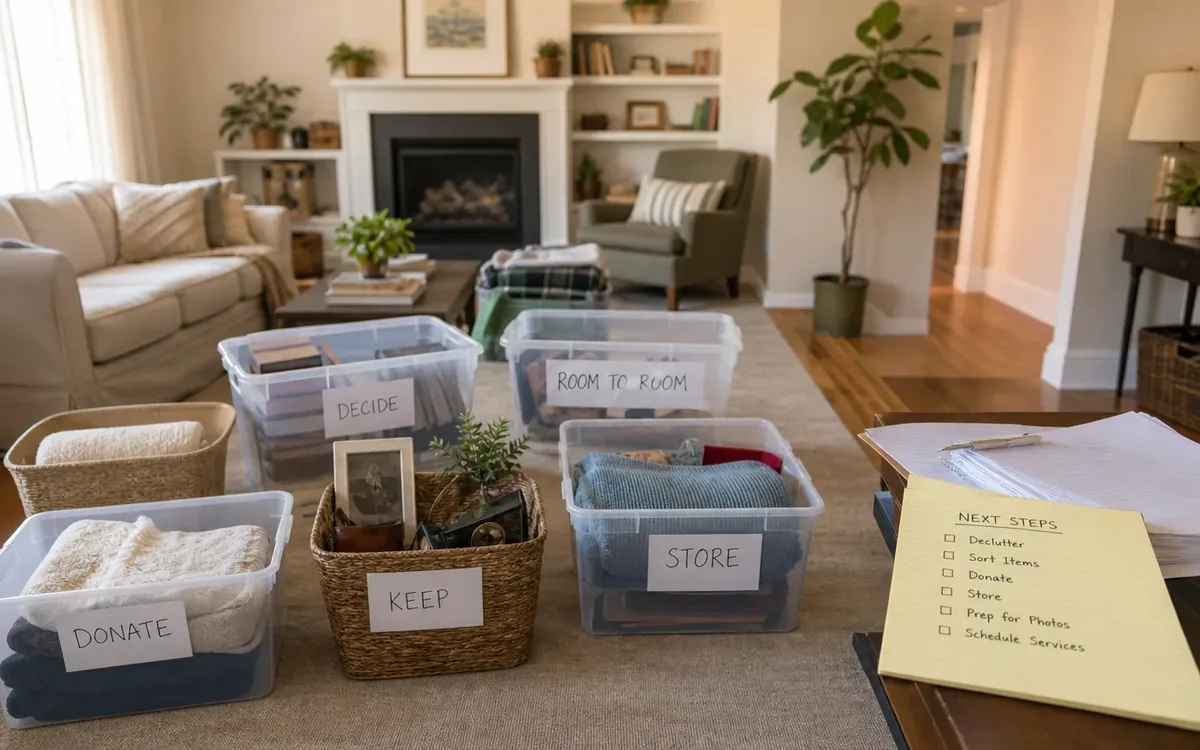
Decide what happens to belongings before work begins
Remote owners often lose time when sorting rules are based on broad labels such as “keep anything valuable.” Monetary value, sentimental importance, and usefulness are different judgments. A family photograph may matter greatly while having little market value. An item that appears ordinary may require appraisal.
Use clear categories:
- Keep in the house: Items intentionally included in staging or a negotiated sale, subject to guidance from the real-estate professional and sale documents
- Ship to owner or family: Labeled items with a confirmed recipient and destination
- Store: Belongings placed with a separately selected storage provider under the household’s agreement
- Appraise or research: Art, jewelry, collections, antiques, vehicles, documents, or other items requiring qualified review
- Offer for sale: Items the owner has authority to sell through a separately chosen method
- Donate: Accepted items directed to a selected organization, subject to that organization’s policies
- Dispose or recycle: Material approved for lawful removal through an appropriate outlet
- Hold for decision: Anything disputed, undocumented, sensitive, or unclear
Storage is not an automatic answer. The household should select the facility, account holder, access rules, insurance arrangements, payment method, and release permissions. A move or cleanout team may discuss packing and transport logistics, but it should not decide whether indefinite storage is financially or personally appropriate.
For an inherited home, confirm who owns the contents and who may direct their disposition. Executors, personal representatives, trustees, heirs, beneficiaries, or co-owners may have different rights. Those are legal questions for the responsible attorney or court, not for a cleanout team.
What can a cleanout or move team coordinate remotely?
A practical team may discuss physical tasks and the information needed to complete them. Depending on the agreed scope, that conversation may address:
- Room-by-room sorting instructions
- Packing and labeling plans
- Removal sequencing
- Donation, recycling, or disposal destinations
- Items to hold for family review
- Access coordination for approved participants
- Photo updates at agreed checkpoints
- Preparation needed before movers, contractors, or real-estate professionals enter
- Basic documentation of visible conditions discovered during work
Clutter Cleaner of South Carolina offers estate cleanouts, downsizing and organizing, auctions and estate sales, move management, home sale preparation, and code compliance support statewide. The exact work appropriate for a property should be discussed and documented rather than assumed.
A cleanout or move team should not determine title, probate authority, disclosure obligations, market value, code compliance, environmental safety, structural condition, or whether a repair is legally required. It may flag an observable issue, stop work when a condition appears unsafe, and ask the owner to contact the appropriate professional.
Auction or estate-sale decisions also require owner authorization and an agreed process. If value is uncertain, the owner can seek an independent qualified appraiser before authorizing sale, donation, or disposal.
Separate cleanout decisions from property-condition decisions
Removing belongings and evaluating the building are related, but they are not the same service. Treating them as one task can cause confusion about responsibility.
A cleanout decision answers questions such as:
- Should this sofa be moved, donated, sold, stored, or discarded?
- Which papers need secure review or destruction?
- What must remain accessible for family pickup?
- Which rooms need to be cleared before another provider arrives?
A property-condition decision answers different questions:
- Is the roof, wiring, plumbing, foundation, or HVAC system defective?
- Does work need a permit?
- Is a stain evidence of moisture, mold, or another condition?
- Does a handrail, deck, addition, or converted room comply with applicable requirements?
- What must be disclosed to a buyer?
Inspectors, contractors, engineers, environmental professionals, real-estate professionals, attorneys, insurers, homeowners associations, and government authorities address those matters according to their roles. An owner can decide whether to seek estimates and whether to approve optional work, but should not ask a cleanout crew to diagnose a building system.
For code-related concerns, support can include helping expose an area, remove authorized clutter, or coordinate access. The responsible government authority determines compliance. A qualified contractor determines the work they recommend and can perform, while permit requirements and approvals remain with the authority having jurisdiction.
How should repairs be approved from a distance?
Create a written approval threshold and require a defined scope before work starts. Avoid instructions such as “fix whatever you find,” which can blur authority and budget control.
Request that a contractor’s proposal identify:
- The observed issue
- Proposed labor and materials
- Areas affected
- Whether permits or specialist evaluation may be needed
- What is excluded
- How changes will be presented for approval
- What completion records will be provided
The owner chooses contractors unless another authorized party has that responsibility. A home-preparation coordinator may help arrange access, collect estimates, or sequence approved work, but contractor selection, technical conclusions, warranties, permits, and acceptance of work remain separate decisions.
Before approving cosmetic changes, ask the listing real-estate professional whether they fit the intended market strategy. The agent or broker can discuss positioning and presentation, while the owner decides whether to proceed. An appraiser, not a cleanout team or organizer, provides an appraisal when one is required.
Use before-and-after photographs as project records, not as proof that hidden conditions were corrected. For significant work, ask the relevant contractor, inspector, authority, or other qualified professional what documentation is appropriate.
Create checkpoints instead of constant messages
Remote oversight works better when updates arrive at agreed decision points. Too many disconnected photos can hide the one image that actually needs approval.
Useful checkpoints include:
- Initial condition documentation
- Completion of owner or family-item identification
- Review of uncertain, sensitive, or potentially valuable items
- Approval before disposal or donation
- Empty-room confirmation before contractor work
- Documentation after approved work
- Final access and security check
At each checkpoint, request a concise summary: work completed, decisions required, conditions discovered, and the next planned step. Keep disputed items in a designated hold area until the authorized person responds.
If multiple family members are involved, name one decision-maker or define which decisions require group agreement. A practical team can follow the communication structure supplied by the household, but it should not resolve family conflicts or determine legal authority.
Prepare for the listing handoff
The final handoff should tell the real-estate professional what has been done and what remains unresolved. It should not suggest that a property has passed an inspection or complies with every requirement unless the responsible professional or authority has actually made that determination.
Provide, as applicable:
- Current access instructions
- A list of completed removal and preparation tasks
- Contractor invoices, warranties, or permit records received
- Known appointments that may affect access
- Items intended to remain with the property
- Stored items and the person authorized to retrieve them
- Unresolved condition questions
- Utility, alarm, or association contacts that the owner is permitted to share
The listing professional should guide listing strategy, showing procedures, offer terms, and real-estate paperwork. Attorneys should address title, probate, contracts, powers of attorney, and other legal questions. Inspectors and appraisers make their own independent findings. Government bodies and associations decide matters within their authority.
Before the first showing, confirm that keys and codes no longer work for people whose tasks are finished. Remove personal records and medications, verify that approved belongings are out of the property, and ask the appropriate professional how any known issue should be handled or disclosed.
Short FAQ
Can I authorize a relative to manage everything?
You may be able to delegate practical tasks, but the proper authority depends on ownership, contracts, estate status, and other circumstances. A South Carolina attorney can advise whether a power of attorney, probate appointment, trust authority, or another document is needed. Give any authorized person written limits and keep financial and property records.
Should all furniture be removed before contacting an agent?
Not necessarily. Ask the real-estate professional whether selected furniture supports the planned presentation. The household can then decide what to keep, move, store, sell, donate, or discard. Do not dispose of estate or jointly owned property until authority is clear.
Who decides whether a South Carolina property meets code?
The government authority with jurisdiction makes compliance determinations. Contractors, design professionals, inspectors, or engineers may provide evaluations within their fields. Code compliance support can help with practical access or authorized clutter removal, but it does not replace an official decision.
Can photographs replace an inspection?
No. Photographs are useful for documenting visible conditions and completed tasks, but they are not a professional inspection, appraisal, environmental assessment, or certification.
How can I begin with Clutter Cleaner of South Carolina?
Call (843) 972-7020 to discuss the property, your location, access, contents, and the practical work under consideration. The business is physically located in Mount Pleasant, South Carolina, serves Charleston as its primary market, and has a statewide South Carolina service territory. Scope, permissions, and responsibilities should be confirmed for the individual property.



