
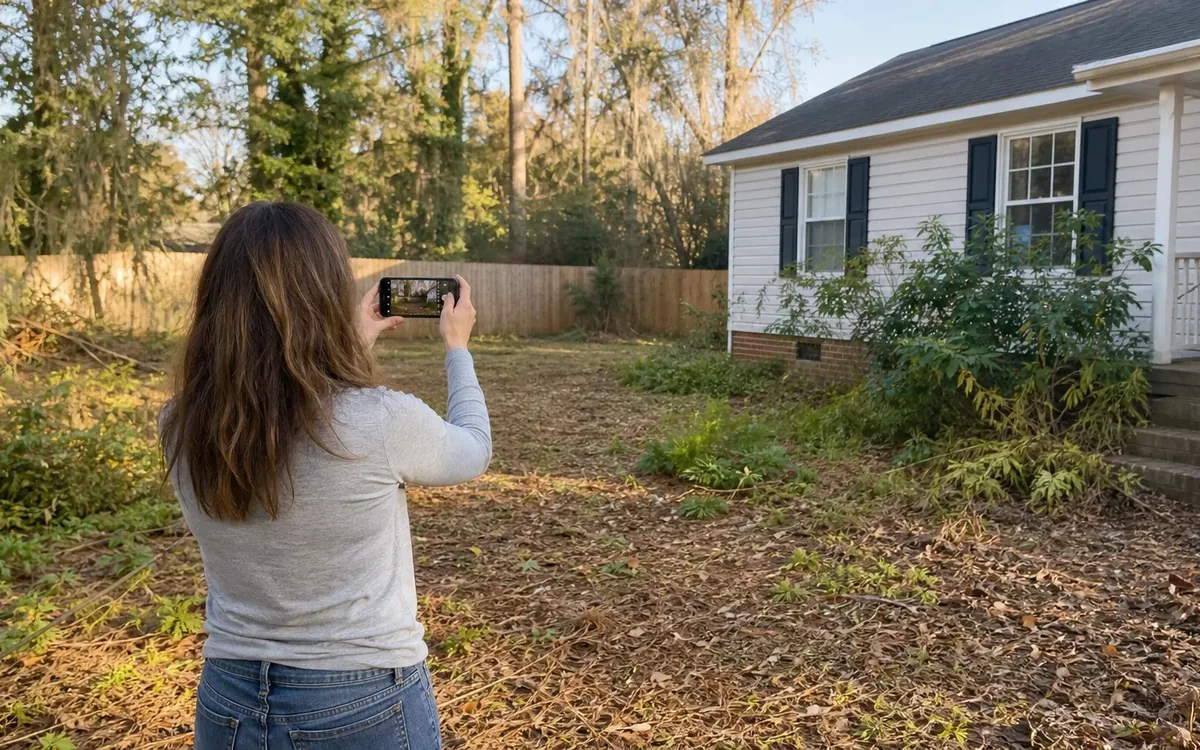
Photograph the yard before anyone moves debris, cuts vegetation, relocates vehicles, repairs structures, or removes outdoor items. Begin with wide views from public-facing and property-level vantage points, then capture each concern at medium range and close up. Preserve the original files, record basic context, and keep the photos organized. This creates a practical record of what was present before cleanup, but it does not determine code compliance, property boundaries, value, liability, or legal responsibility.
Quick answer: Take an orderly set of dated photos showing the entire property and each condition from wide, medium, and close perspectives. Include identifying context without exposing private information. Save unedited originals, make a simple photo log, and ask the responsible authority what documentation it requires before work begins.
Why photograph a yard before cleanup?
Pre-cleanup photographs establish a visual starting point. They can help a household explain the scope to a cleanup team, compare conditions before and after work, and discuss the property with an owner, personal representative, real-estate professional, insurer, attorney, contractor, or government official.
Photos are particularly useful when a yard contains several kinds of material. Vegetation, household belongings, construction debris, outdoor equipment, damaged fencing, and vehicles may need different decisions. A visual record helps keep those categories distinct.
Documentation can also reduce confusion among family members or other decision-makers who cannot visit the property. It shows what was visible on the day of the walkthrough without relying entirely on memory.
A photograph is evidence of appearance, not a ruling. It cannot confirm that a condition violates an ordinance, establish who owns an object, settle a boundary, identify hazardous material, or prove that a repair meets a required standard. Those conclusions belong to the appropriate authority or qualified professional.
Households seeking practical help with the physical project can review code compliance support services. The service conversation may cover sorting, access, removal priorities, and documentation needs, while official compliance decisions remain with the agency that has jurisdiction.

What should you do before taking the first photo?
Do not alter the scene merely to make it easier to photograph. If it is safe to do so, walk the property first and note the visible areas that need documentation. Stay within areas you are authorized to enter.
Before starting, complete these five preparation steps:
- Confirm authority and access. Determine who owns or controls the property and who may authorize cleanup. An occupant, heir, tenant, personal representative, property manager, or buyer may not have the same rights.
- Check camera settings. Use the phone or camera’s highest practical resolution. Verify that the date, time, and time zone are correct. Avoid filters, portrait effects, and automatic enhancements that materially change details.
- Preserve any official notice. Photograph or scan all pages of a notice separately, including the issuing office, reference number, listed conditions, and contact information. Keep personal details out of broadly shared files.
- Create a route. Plan to move around the exterior in one direction so that no side is skipped. Include front, sides, rear, gates, accessory structures, and visible edges of the lot.
- Address immediate safety concerns. Do not climb unstable piles, enter unsafe structures, approach aggressive animals, touch unknown liquids, or disturb suspected hazardous material merely to get a picture.
If an official notice provides photography instructions, use those instructions rather than assuming a general method will be accepted. The issuing authority decides whether photographs are required, what they must show, and whether an inspection is still necessary.
How should you photograph the overall property?
Start with wide views that establish location and orientation. The objective is to show how visible conditions relate to the house, driveway, yard, street-facing area, and other fixed features.
A useful sequence begins at the front and continues around the property. Take overlapping images so another person can understand how one view connects to the next. Where it is lawful and safe, photograph from the normal pedestrian approach and from inside the property boundaries.
Capture these establishing views:
- The front elevation and visible front yard
- Each side yard from both ends when accessible
- The rear yard and rear elevation
- Driveways, walkways, gates, and primary access routes
- Fences, sheds, detached structures, and exterior storage areas
- Areas obscured by vegetation or accumulated belongings
- The relationship between a concern and a fixed landmark
Avoid relying on digital zoom. Walk closer only when access is permitted and conditions are safe. Zooming can reduce clarity and remove context.
Be careful when photographing neighboring property. Include only what is reasonably needed to establish location or context. Do not enter another parcel, photograph through private windows, or move markers and fences. Questions about boundaries, easements, or ownership should go to a surveyor, attorney, title professional, or other qualified party, not a cleanup team.
For related planning when exterior work is part of a larger property transition, how to prepare a compliance checklist explains the decisions that can arise before removal begins.
Which close-up details matter most?
After capturing the overall yard, photograph each concern in three stages: wide, medium, and close. The wide image establishes location, the medium image shows the complete condition, and the close image records relevant detail.
For example, a single close-up of a discarded appliance may not show whether it sits beside the house, near a property line, or within an access route. A wide-only photograph may not reveal damaged components, labels, leakage, or the number of surrounding objects. The three-stage approach preserves both context and detail.
Useful subjects may include:
- Accumulated household items or bagged material
- Construction remnants or loose building materials
- Appliances, furniture, tires, or outdoor equipment
- Vegetation blocking a path, entrance, sign, or visible structure
- Damaged gates, fencing, steps, or handrails
- Open containers, pooled liquid, or visible staining
- Exterior openings or visibly damaged building components
- Vehicles, trailers, boats, or equipment stored outdoors
- Items that appear to cross a boundary or obstruct shared access
Photograph identifying labels only when they are relevant and safe to approach. Do not open containers or handle a suspected hazardous substance to expose a label. Identification and handling may require an environmental contractor, waste facility, fire department, or other appropriate authority.
Use a ruler or common measuring reference only if an authority requests scale and doing so is safe. Perspective can distort size, so a photograph should not be treated as a professional measurement. Setback, height, boundary, and structural measurements may require an inspector, surveyor, engineer, or other qualified professional.
How can you keep the photographs organized and reliable?
A useful record is easy to follow and preserves the source files. Keep originals intact, then make copies if you need to crop, annotate, or reduce file size for sharing.
Create folders using the property identifier and photography date. Within the folder, use simple descriptive filenames such as front-yard-wide, east-side-gate-medium, or rear-shed-debris-close. If the camera assigns sequential file numbers, retain a list connecting those numbers to your descriptions.
A short photo log can contain:
- File number or filename
- Date and approximate capture time
- Photographer’s name
- General location on the property
- Direction the camera faced
- Brief factual description
- Relevant notice item, if one exists
- Notes about blocked or unsafe access
Keep descriptions neutral. Write “three bags beside the rear gate,” not “illegal dumping by tenant.” The first describes a visible condition. The second alleges a violation and identifies responsibility, which the image may not establish.
Do not delete inconvenient images from the original sequence if the record may be used in an official, insurance, estate, or legal matter. Back up the originals in a second secure location. When privacy matters, share only the necessary files with authorized recipients.
Automatic metadata can be useful, but it is not infallible. Device clocks may be wrong, location data may be disabled, and files sent through messaging applications may lose metadata. A written log provides additional context. Ask the recipient whether it requires a particular file format, portal, naming method, or certification.
What should the household decide before cleanup begins?
The household or legally authorized decision-maker controls practical choices within its authority. Those choices should be settled before a crew begins moving material whenever possible.
The household can generally decide:
- Who has permission to enter the property
- Which accessible items must be retained or reviewed
- Who may approve disposal, donation, sale, or relocation
- Whether personal information needs to be removed from view
- Where uncertain items should be staged for later decisions
- Which photographs may be shared and with whom
- Who will communicate with officials and providers
Ownership questions should be resolved rather than guessed. Items may belong to a tenant, heir, business, neighbor, lienholder, or other party. A cleanup provider should not be expected to decide disputed ownership or legal rights.
Storage is also a separate household choice. If belongings must be stored, the responsible person selects the facility or storage arrangement, signs any agreement, and determines insurance needs. A practical team may discuss sorting and staging, but storage availability, security, valuation, and contract terms belong to the selected provider and customer.
If valuables, antiques, vehicles, collectibles, or estate assets may be present, an appraiser, auction professional, personal representative, or other appropriate specialist should determine value and sale strategy. A yard photograph alone is not an appraisal.
What can a practical cleanout or move team discuss?
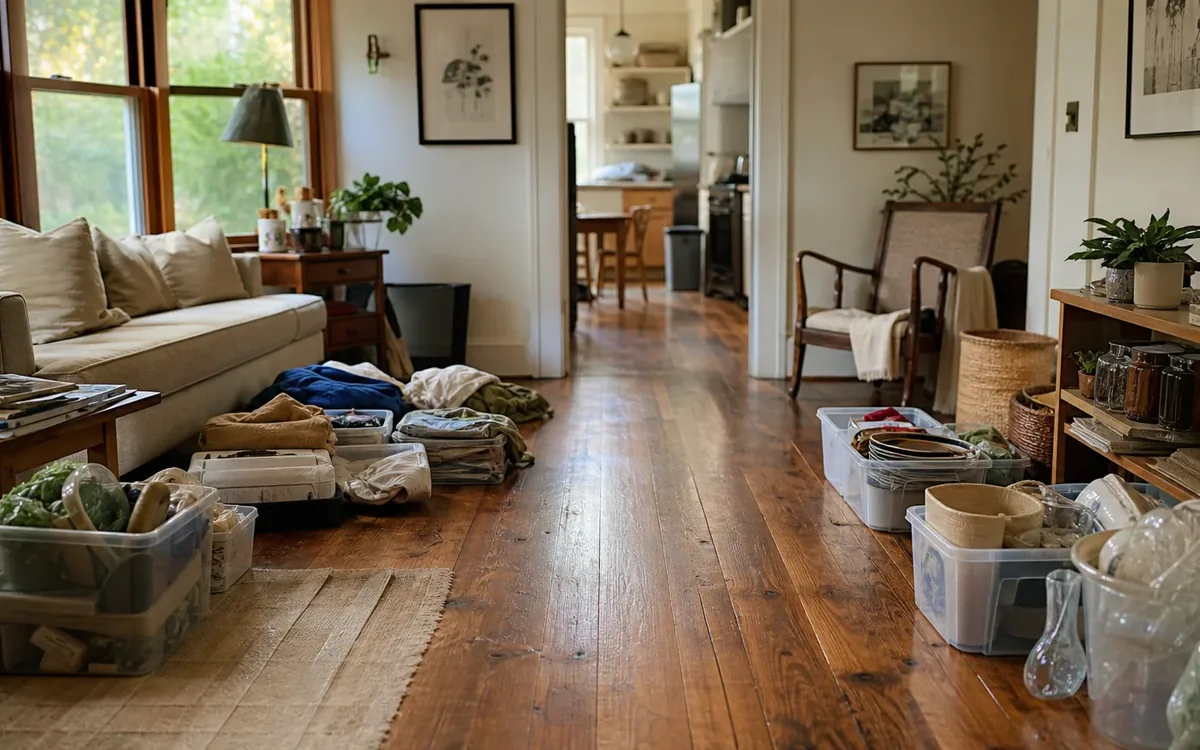
A cleanout or move team may use the photographs to understand access, volume, item categories, and the order of physical work. The discussion can identify areas that need owner review and conditions that may require another provider.
Practical topics may include:
- Safe entry points and staging areas
- Items clearly designated to remain
- Material that needs separate handling decisions
- Access limitations for people or equipment
- Areas that should not be disturbed
- A sensible sequence for sorting and removal
- Before-and-after documentation requested by the customer
- Coordination considerations involving a contractor or inspector
The team should be told about unstable structures, animals, sharp objects, suspected chemicals, septic components, wells, utility hazards, and other known risks. A photograph may help explain a concern, but it does not make the area safe.
Contractor work remains separate. Tree removal, grading, demolition, electrical repairs, plumbing, structural repairs, pest treatment, environmental remediation, and similar work may require specialized contractors or approvals. The property decision-maker selects those providers and confirms their scope.
Disposal decisions are also material-specific. A receiving facility or government program determines what it accepts and under what conditions. Unknown chemicals, fuel, paint, batteries, refrigerant-containing equipment, tires, electronics, and regulated materials should not be assumed to belong in ordinary waste.
Which decisions must stay with officials or qualified professionals?
Code compliance support can help organize the physical response, but it does not transfer the authority of an inspector or government office. The responsible authority interprets its notice, identifies acceptable corrective action, and decides whether the property complies.
Keep these roles separate:
- Code or zoning officials: Interpret applicable requirements, notices, deadlines, inspections, and closure of a case.
- Attorneys: Advise on ownership, estates, tenancy, disputes, liability, appeals, and legal rights.
- Surveyors: Locate property lines, easements, and surveyed features.
- Appraisers: Develop qualified opinions of value.
- Real-estate professionals: Advise on listing strategy, disclosures within their role, and market preparation.
- Home or specialty inspectors: Evaluate property systems within the scope of their inspection.
- Licensed design or trade professionals: Determine required repairs, permits, methods, and technical adequacy within their fields.
- Environmental or waste authorities: Address regulated substances and approved handling or disposal routes.
South Carolina properties may fall under municipal, county, state, association, lease, or deed requirements, sometimes in combination. Do not assume that a neighboring jurisdiction uses the same procedure. Contact the office named on the notice or the authority responsible for that specific property.
What should happen after the initial photo set?
Review the images before cleanup begins. Check that every listed concern has an establishing view and enough detail to recognize it. Retake blurry, dark, or obstructed images while conditions remain unchanged and access is safe.
Then create a working copy for the project. Mark the relevant areas on copies rather than altering original files. A simple map or numbered list can connect each concern to its photos and planned next step.
Separate the next steps into distinct lanes:
- Household decisions about belongings and access
- Cleanup tasks involving sorting, staging, or removal
- Contractor estimates or specialized work
- Official questions about the notice and required proof
- Professional advice about legal rights, boundaries, value, or sale preparation
After authorized work is complete, photograph the same views again from approximately the same positions. Matching angles make comparison easier. Do not represent the after-images as proof of official approval. Submit them only through the method requested, and retain confirmation when available.
Short FAQ
Should date stamps appear directly on every photo?
Not necessarily. An on-image date can be useful, but it may cover details and does not guarantee accuracy. Correct device settings, preserved original metadata, and a written log provide context. Follow any instructions from the receiving authority.
Can photographs replace an inspection?
Only the responsible authority can decide whether photographs are acceptable and whether an inspection is required. Photos document visible conditions but cannot establish compliance on their own.
Should people, license plates, or personal papers appear in the images?
Avoid unnecessary personal information. Capture identifying details only when relevant to the authorized purpose, and limit distribution. Keep unredacted originals secure if they may be needed, while using properly redacted copies for broader sharing.
What if an area is unsafe or inaccessible?
Do not enter it just to complete the photo set. Photograph the obstruction or hazard from a safe location and note the limitation in the log. Ask the appropriate contractor, inspector, emergency service, or authority how to proceed.
Who should receive the photographs?
Share them only with people who need them, such as the authorized property decision-maker, selected providers, insurer, attorney, real-estate professional, or responsible government office. Confirm the preferred delivery method before sending sensitive files.
A careful photo record gives everyone a clearer starting point. Keep the images factual, preserve the originals, separate physical cleanup from professional judgments, and obtain official direction before assuming the yard has met any compliance requirement.



